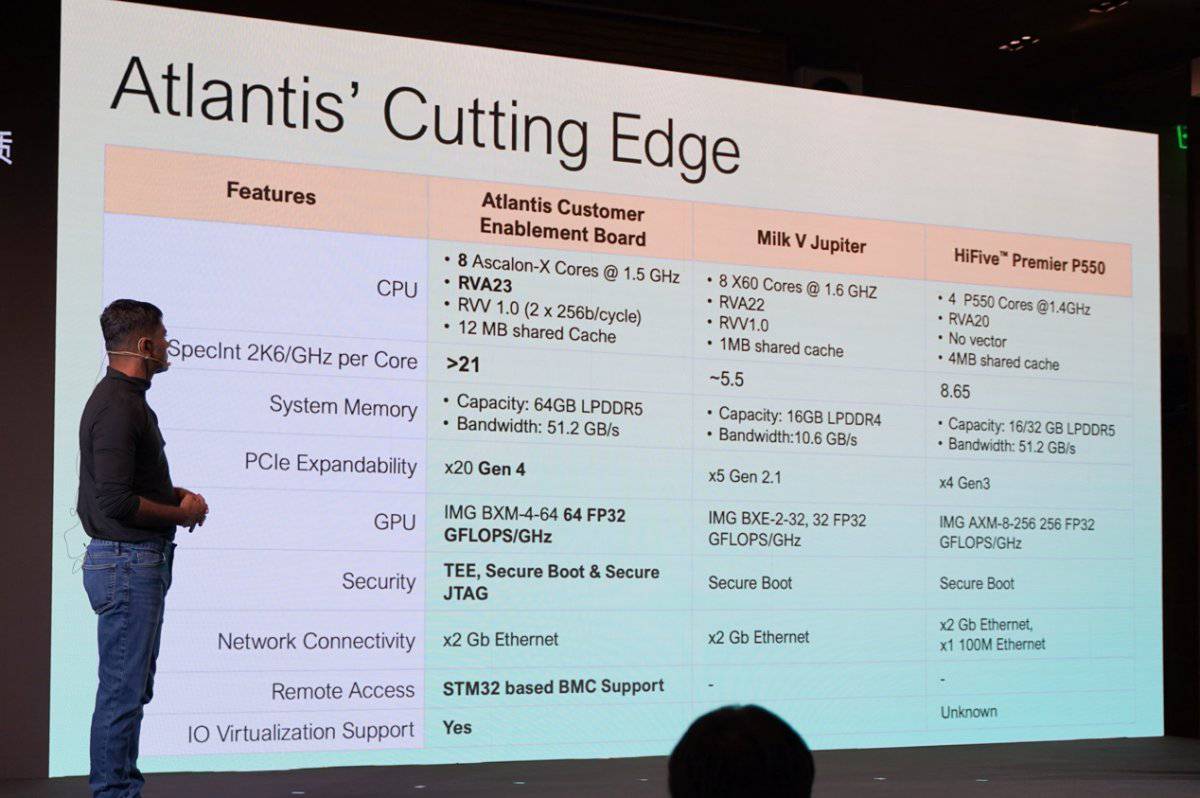
So Ascalon should have M1 IPC, at half the frequency.
A 1.5 GHz Ascalon is still going to be ... I don't know ... Skylake level? More than enough for a usable modern desktop machine and a huge leap over even machines we'll start to have delivered 3 or 4 months from now.
Hopefully it will be affordable. As in Megrez or Titan prices, not Pioneer.
Single core performance is about what you say. But multi-core performance is much better. The K3 scores higher than a 2017 Macbook Air for multi-core on Geekbench 6.
And the K3 can take 32 GB of DDR5 and run a decent-sized LLM, which is not something you are doing on an a 5-10 year old laptop. In addition to the vector instructions, the built-in video codec acceleration and hypervisor stuff make for quite a modern feature-set.
The K3 is still too slow to be a desktop system for most people but there are some of us who would already be ok with it.
As for pricing, it is hard to find info. But it seems like around $200 may be possible for the Jupiter2.
The Framework 13 K3 mainboard will be more:
https://deepcomputing.io/dc-roma-risc-v-mainboard-iii-unveil...
    14m25.56s  SpacemiT K3, 8 X100 cores + 8 A100 cores
    16m55.637s SpacemiT K3, 8 X100 cores @2.4 GHz
    19m12.787s i9-13900HX, 24C/32T @5.4 GHz, riscv64/ubuntu docker
    39m23.187s SpacemiT K3, 8 A100 cores @2.0 GHz
    42m12.414s Milk-V Megrez, 4 P550 cores @1.8 GHz
    67m35.189s VisionFive 2, 4 U74 cores @1.5 GHz
    70m57.001s LicheePi 3A, 8 X60 cores @1.6 GHz
Note that the all-cores K3 result is running a distccd on each cluster, which adds quite a bit of overhead compared to a simple `make` on local cores. All the same it shaves 2.5 minutes off. In theory, doing Amdahl calculation on the X100 and A100 times, it might be possible to get close to 11m50s with a more efficient means of using heterogenous cores, but distcc was easy to do.
RISC-V SBC single-core performance has been better than x86+QEMU since the VisionFive 2 (or HiFive Unmatched) but we didn't have enough cores unless you spent $2500 for a Pioneer.
Is that among the few known to work with open pvr drivers?