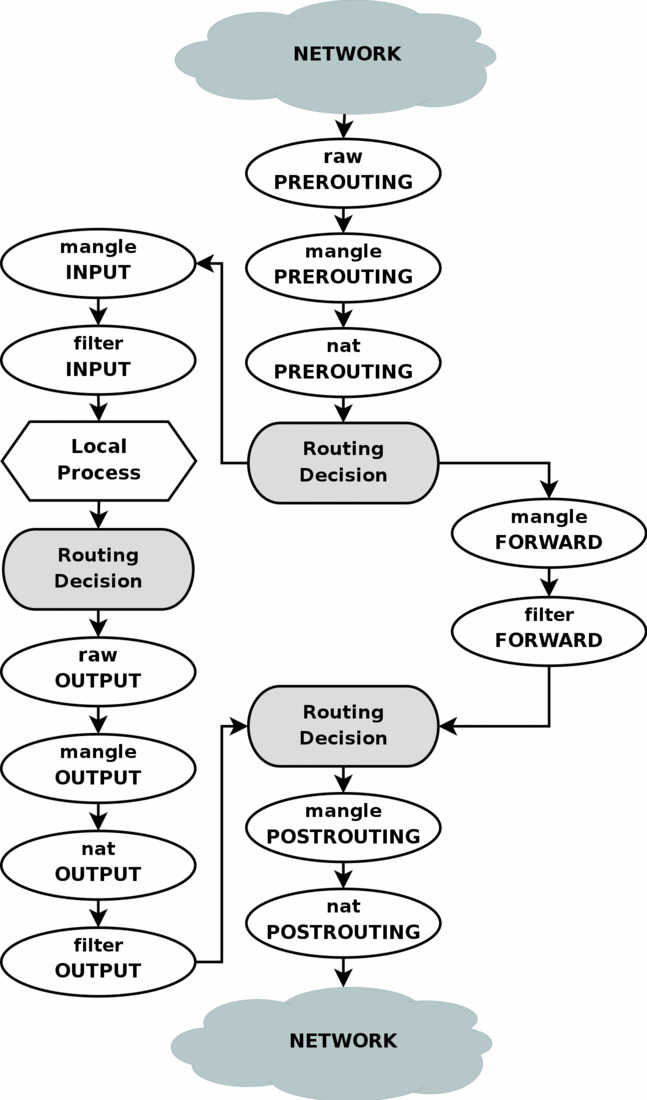
I failed to use IP tables for years. I bought books. I copied recipes from blog posts. Nothing made sense, everything I did was brittle. Until I finally found a schematic showing the flowchart of a packet through the kernel, which gives the exact order that each rule chain is applied, and where some of the sysctl values are enforced. All of a sudden, I could write rules that did exactly what I wanted, or intelligently choose between rules that have equivalent behaviors in isolation but which could have different performance implications.
After studying the schematic, every would just work on the first try. A good schematic makes a world of difference!
And the answer is it doesn't do NAT. The code is already preparing to do NAT, and that code merely consults the table to find out what kind of NAT it should do. The diagram makes it look like you can just move a NAT rule to a filter or mangle rule because the kernel just applies these tables in sequence anyway, but you can't because they are consulted by different blocks of code for different purposes.
Me too, then I discovered FreeBSD and pf tables. I _feel_ like an expert network engineer now. It took time and effort of course, but the learning process "clicked" for me all along the way and I was able to build on my understandings. Give it a try!
https://docs.freebsd.org/en/books/handbook/firewalls/
There was a recent book published on the tool, The Book of PF, 4th Edition
https://www.frozentux.net/iptables-tutorial/images/tables_tr...
I couldn’t find one that annotated where sysctl configurable were shown. But this is a useful annotation, even if it’s an exercise for the reader.
And at http://www.easyfwgen.morizot.net/ there's an old, but still useful generator for an iptables setup. That should help to understand iptables.
Shout out to the brilliant and generous work of the author!
The same thing could sometimes fall into different categories as well - like going for a microservices architecture when you need to serve about 10'000 clients in total vs at some point actually needing to serve a lot of concurrent requests at any given time.
If someone could program a visualization tool that would generate such diagrams automatically, that would be even cooler (but likely a mission impossible).
It's been a few years for me tho, so perhaps it's covered with the VM section.
Lovely diagram, thanks for sharing it!
Doesn't even go into iptables/nftables
His book "Operativni sustavi i računalne mreže - Linux u primjeni" [0] (Operating systems and computer networks - Linux in use) may well make learning Croatian worth it! Congrats on publishing, and thanks for such an invaluable contribution!