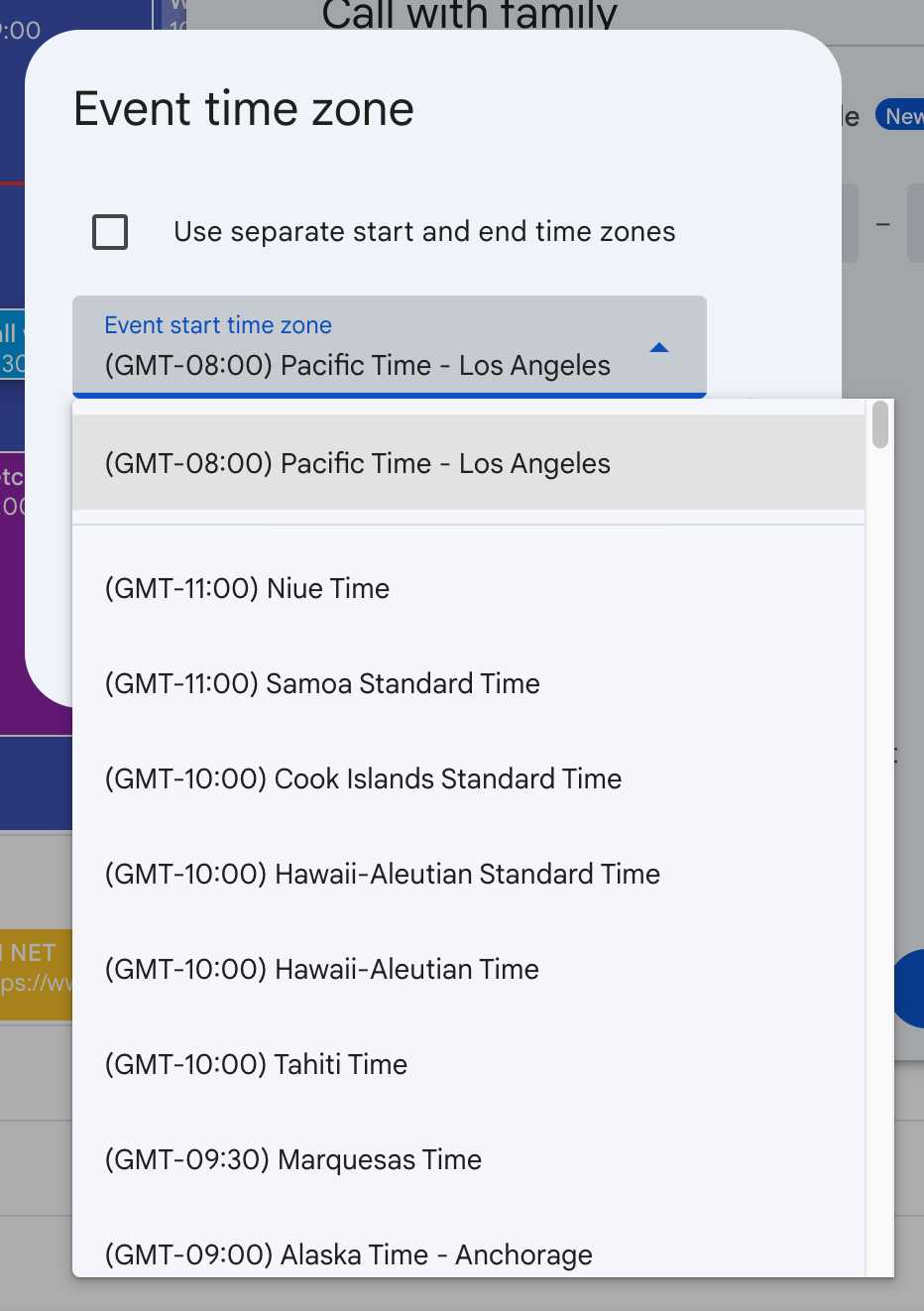
Anyway, poor UX. But of course TZ names could also be argued as poor UX. What if you just did PST/PDT as Los Angeles, CA; Oregon, OR, and Seattle, WA all on separate line items? Sure, it's duplicate data but a backend system (Postgres config files, say) should only store the value of the TZ, i.e. -7 / -8. At least a user could recognize 'oh, I drive to xyz major city occasionally, that's the choice I want'.
To keep ranting, I checked macOS 15 TZ selector for PDT/PST. The selector itself is labeled "Closest city". It has numerous locations in California, a few in Nevada, and a couple in Mexico. No cities in Oregon, Washington, or Idaho (and Hyder, AK... neat [1]).
Closest is a stretch, like I said, over 1K miles from LA. But why several California cities, including minor ones like Oceanside (~175K people), but nothing in Oregon (Eugene, also 175K), Portland (652K), or Washington - Tacoma (220K), Seattle (740K). Note I did not look for the smallest city in the macOS CA list.
It's weird to me. Maybe it's because Oregon == Intel and Washington == Microsoft. ;-)
[0] https://rachelbythebay.com/w/2025/09/11/debtz/
[1] https://en.wikipedia.org/wiki/Pacific_Time_Zone#United_State...
Because that doesn't tell you when the timezone changes. Two locales can share timezones but start or end daylight savings time at different times.
For instance, Cuba and Florida are both -4 / -5, but Cuba starts and ends daylight savings time 2 hours and 1 hour, respectively, before Florida.
Then there's the fact that locales, once in a while, will change what timezone they're in (like Samoa in 2011) or stop/start observing daylight savings time. Having the timezone set to a place largely solves this problem.
Ideally though, just get rid of DST.
Whether daylight savings time is being used at a given location at a given time of year is a matter of government policy. The city-based timezone selectors should handle that automatically based on the jurisdiction you choose.
> Sure, it's duplicate data but a backend system (Postgres config files, say) should only store the value of the TZ, i.e. -7 / -8.
Then the time may be wrong for half the year depending on where you are.
There's no America/Salt_Lake_City you're recommended to use America/Boise instead. The people in Salt Lake City are about as far away from Boise as you can get and Salt Lake City is more easily recognized as a landmark then Boise. The process of choosing which cities should be landmark cities comes across as faulty and uninformed.
And that's just the US, there's almost 200 other countries each with their own laws.
There are guarantees that there will be changes in the future! There are changes regularly, some expected, some not. In some countries the suspension of DST due to Ramadan is decided on the first night of Ramadan itself when a group of elders look at the moon and decide whether Ramadan starts tonight, or tomorrow.
https://www.cnn.com/2025/02/27/travel/ramadan-start-crescent...
Timezones are such a headache. Obviously even UTC for a location varies depending on the time of year.
Even the International Space Station shifted timezones from Houston time to UTC+0.
Curiosity and Perseverance's clocks are UTC but operations run on LMST (local mean solar time) Gale Crater and LMST Jezero Crater- their landing locations. That point is moot until humans start spinning up VMs on Mars which they will one day.
The offset from UTC for a location varies depending on time of year but UTC definitionally has a zero offset throughout the year.
If you’re in the Europe/London time zone your time is equal to GMT/UTC (offset zero) for half the year and BST (offset +1) for the other half.
In other words we have two different types here: Timezones based on location where the UTC offset varies, and the UTC offset itself (like +0100/BST or +0000/GMT/Z.)
And of course, saying 'EST' doesn't actually tell me what fucking time something is happening. Telling me what UTC offset EST is, does.
It's very unlikely, but tomorrow some state or major city in PST could decide to add 15 minutes to all their wall clocks. Should your computer's clock change? That depends on what you're using it for...
If your application can access the current location you don't need to expose a TZ selector to the user. You can figure out what time zone database sector you're in automatically.
https://en.wikipedia.org/wiki/List_of_tz_database_time_zones...
> Sure, it's duplicate data but a backend system (Postgres config files, say) should only store the value of the TZ, i.e. -7 / -8.
Your backend needs to store location because places can switch time zones. The reason for the seemingly arbitrary list of cities is they each define a region where clocks have been synchronized since 1970.
IP geolocation is often wrong and inaccurate. I’ve had a VPS whose IP was geolocated 360 km away, in another country and time zone. But even with residential IPs, they might be pointing to a different time zone in countries with multiple zones.
For the event, your backend only needs to store the timestamp in a timestamptz field and make sure that clients set the correct time zone on session start (this you might want the backend to store in the database too, but probably in the users table).
The problem is both the US and Australia have “EST/EDT” - the Australian version sometimes has an A stuck on the front to disambiguate it from the US timezone, but that isn’t always done (especially given some systems insist timezone abbreviations can be max 3 characters). And the problem with disambiguating on the basis of UTC offsets is you’d be surprised by how many people have no clue what any of them are. But “Americas” vs “Australia”, they’ll get that right
Choosing a large city you know shares your time zone does make things a bit more “human“.
You can choose that. Set your timezone to Etc/GMT-8. Then, at the exact time your political jurisdiction mandates switching over to PST, go to all your computers and switch them all to Etc/GMT-7. Then do the same thing next year for switching back.
What? That's bad UX as well? Well then, you have to name the correct political jurisdiction that mandates the timezone rules where you live. And that's hard, because so many little tinkerers at state and municipal level decide to change the rules just for their little fiefdom. And they keep changing their minds.
The tz database is looking for the longest-lived identifier that accurately describes that geographic region to which the rules apply. Every time one region diverges from the norm, they need to accommodate the split. They chose continent and city names, because the historical perspective is that city names have remained in use longer than country names.
For your case, however, they have aliases. "US/Pacific" is an alias to America/Los_Angeles", as is "PST8PDT". Set and forget.
Except when you can't forget, as in the original case for this blog post in the first place.
In the Debian installer yes, but the stupid Ubuntu installer forces you to pick from a map.
You can look at the tz data files to see what that looks like.
If you want to create an event in a different time zone from your default the select picker it gives you is utterly incomprehensible.
I can't even find the time zone for New York/US eastern in it!
Screenshot here: https://static.simonwillison.net/static/2024/google-calendar...
one can play with timezones all they want, but in the end it's a presentation issue.
Whoah there, no, that's a huge pitfall of sharpened spikes as soon as you deal with events in the future.
If someone proposes an after-work party for "5:30 PM" at the Latverian office in Latverian time, that's not a fixed offset of seconds from now, it's actually a set of triggering conditions.
We can make a decent guess about when those conditions will be satisfied, but don't actually know until it finally happens. At any moment, the administration of Dr. Doom could arbitrarily change the country's clocks. They might skip over that entire hour, or the hour might repeat on that day, or the entire country might cease to exist.
Making a prediction in UTC and storing just that is a very bad idea, because you lost all the original context you need to recalculate a better prediction as things change. Storing the "5PM in Latverian" is how we keep that context.
P.S. I do distictly remember how a reply on HN to one of her earlier posts on RSS clients mentioned that her laments kinda miguided since her own feed doesn't set one very well-documented and basic cache-controlling HTTP header that most readers actually do respect; but some time later in her later post she described that header as matter-of-fact knowlewdge, no "I've learned about this one recently" remark or anything, and by that time, her RSS feed had started setting it.
(I should note that in my crowd, references to this movie are always super-negative. "The One" gets damned to hell to eternally fight, but never win his battle.)
If someone wants to get indignant and broadcast how terrible it is that a project (Debian in this case) is so terrible that they dare have a UX issue that is probably just an oversight, then they're entitled to do that but can also expect pushback where they aren't perfect either.
That's why "US" wins over "America".
This practice is very bug prone, and has lead to high profile failures like goto fail
That particular git repository has history imported from 1996 onward, but Postgres was a very established project by then: https://git.postgresql.org/gitweb/?p=postgresql.git;a=commit...
These days people might not blink an eye at gofmt/rustfmt rewriting the AST to clean it up, but those toolchains were built that way largley because automating anything about large C codebases is so hard.
Presumably the last if statement in the diff.
That's what the authority that defines the zone calls it. Using any other name is adding a useless layer of abstraction.
Debian 13, Postgres, and the US time zones - https://news.ycombinator.com/item?id=45218111 - Sept 2025 (142 comments)
I also like that she’s able to reproduce it but I feel like this should have been a test check in the distro to ln the US zones as to not mess up older codebases.
In the end, standardizing is the right way to go. If you’re a maintainer, think about adding tests and checks for files that if moved might break things that depend on it. Maybe a service that watches for fd access to those and gives a warning, I don’t know what the best approach would be but it would be nice to have something at the user land level that said “Ahh ahh ahhh, you didn’t say the magic word”