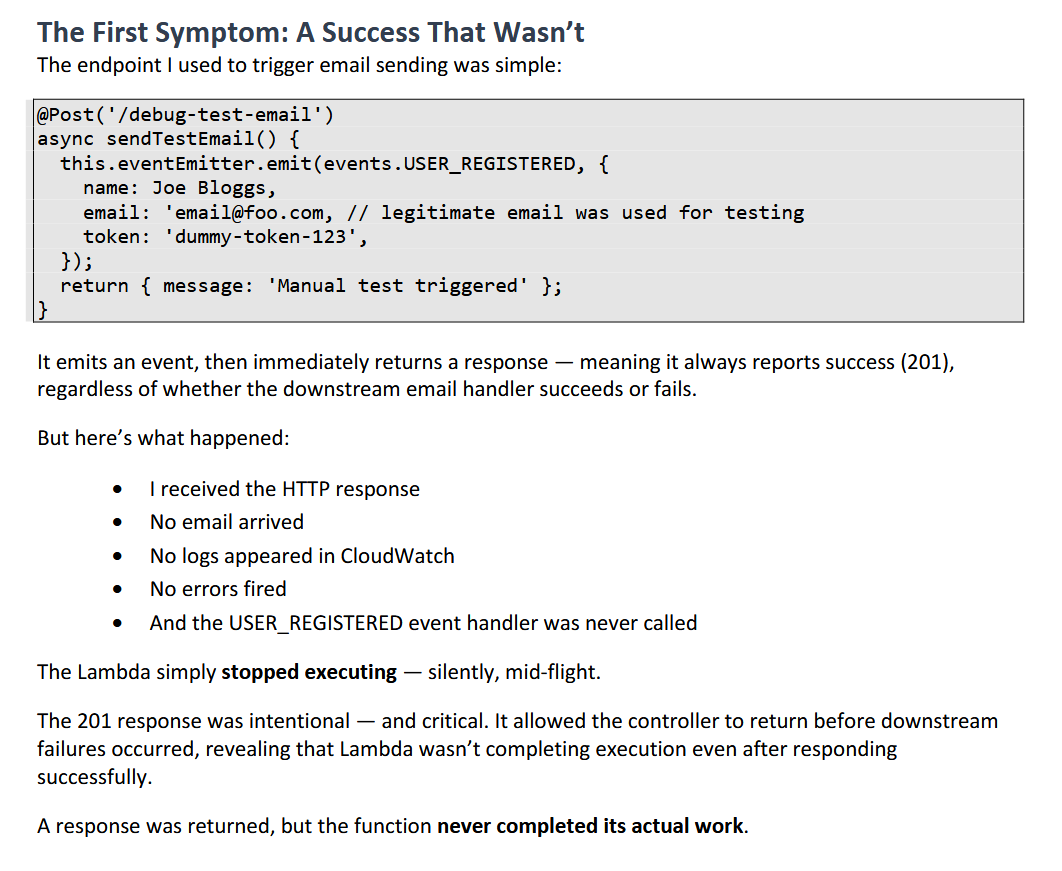
> It emits an event, then immediately returns a response — meaning it always reports success (201), regardless of whether the downstream email handler succeeds or fails.
It should be understood that after Lambda returns a response the MicroVM is suspending, interrupting your background HTTP request. There is zero guarantee that the request would succeed.
1: https://docs.aws.amazon.com/lambda/latest/dg/lambda-runtime-...
As an aside I find it strange that the author spent all this time writing this document but would not provide the actual code that demonstrates the issue. They say they wrote "minimal plain NodeJS functions" to reproduce it. What would be the reason to not show proof of concept code? Instead they only show code written by an AWS engineer, with multiple caveats that their code is different in subtle ways.
The author intends for this to be some big exposé of AWS Support dropping the ball but I think it's the opposite. They entertained him through many phone calls and many emails, and after all that work they still offered him a $4000 account credit. For comparison, it's implied that the Lambda usage they were billed for is less than $700 as that figure also includes their monthly AWS Support cost. In other words they offered him a credit for over 5x the financial cost to him for a misunderstanding that was his fault. On the other hand, he sounds like a nightmare customer. He used AWS's offer of a credit as an admission of fault ("If the platform functioned correctly, then why offer credits?") then got angry when AWS reasonably took back the offer.
That’s the whole point and it’s not the behavior your comments describe.
This is not the right way to accomplish this. If you want a Lambda function to trigger background processing, you invoke another lambda function before returning. Using Node.js events for background processing doesn't work, since the Lambda runtime shuts down the event loop as quickly as possible.
This response seemed illuminating:
https://www.reddit.com/r/aws/comments/1lxfblk/comment/n2qww9...
> Looking at (this section)[https://will-o.co/gf4St6hrhY.png], it seems like you're trying to queue up an asyncronous task and then return a response. But when a Lambda handler returns a response, that's the end of execution. You can't return an HTTP response and then do more work after that in the same execution; it's just not a capability of the platform. This is documented behavior: "Your function runs until the handler returns a response, exits, or times out". After you return the object with the message, execution will immediately stop even if other tasks had been queued up.
OP seems to be fixated on wanting MicroVM logs from AWS to help them correlate their "crash", but there likely no logs support can share with them. The microVM is suspended in a way you can't really replicate or test locally. "Just don't assume you can do background processing". Also to be clear, AWS used to allow the microVM to run for a bit after the response is completed to make sure anything small like that has been done.
It's an nondeterministic part of the platform. You usually don't run into it until some library start misbehaving for one reason or another. To be clear, it does break applications and it's a common support topic. The main support response is to "move to EC2 or fargate" if it doesn't work for you. Trying to debug and diagnose the lambda code with the customer is out of support scope.
This person should not be trusted to accurately recount a story, I would be sceptical of any claim in the doc.
The document is long, and the examples seem contrived, so anyone is free to correct me but as I understand it the lambda didn't crash, after you returned 201, your lambda instance was put to sleep. You aren't guaranteed that any code will remain running after your lambda "ends". I am not sure why AWS Support was unable to communicate this OP.
If you are using Lambda with a function URL, you aren't guaranteed that anything after you return your http response remains running. I believe Lambda has some callbacks/signals you can listen to, to ensure your function properly cleans up before the Lambda is frozen, but if you want the lambda to return as fast as possible it seems you are better off having your service publish to an SQS queue instead.
Maybe we should be asking why the OP was not able to hear what AWS was telling them. I think there is a fairly troublesome cognitive bias that gets flipped on when people are telling you that you're wrong — especially when all your personal branding and identity seems to be about you being right.
I sympathize with OP because debugging this was painful, but I'm sorry to say this is sort of just a "you're holding it wrong" situation.
AWS Support is generally ineffective unless you're stuck on something very simple at a higher level of the platform (e.g. misunderstanding an SDK API).
Even with their higher tier support - where you can summon a subject matter expert via Chime almost instantly - they're often clueless, and will confidently pass you misleading or incorrect information just to get you off the line. I've successfully used them as a very expensive rubber ducky, but that's about it.
"Failure" != "Bug"
But one thing bothers me…wouldn’t the author have encountered the exact same behavior in Azure? I guess I really will have to read this paper to find out.
It was typical Azure strategy of rushing out a product to show they have all the same features as AWS. It may have improved since I last touched it in 2018.
Well... they can![1]
It's definitely a thing in traditional always-running web server processes, which is all people know these days.
Many developers have never written a code for a short-lived process outside of maybe school exercises. Things like CLI tools, background jobs, etc...
[1] I get "Later!" printed out... most of the time: https://dotnetfiddle.net/ng93d4
However, it is still funny when you think that in regular servers you still finish when you respond to the request.
My dog keeps getting angry at the door. It won’t open automatically.
I guess it's possible someone did explain it to him, and David hasn't mentioned that in his diatribe.
There was a few days of back and forth which should have been resolved by saying "please read the how lambda works" section of the documentation.
That job was a glorified call center; I didn't last very long.
Not just possible. Quite likely. It seems very clear the answer was "yes, that's how it works on Lambda, and it is not going to change" and this person said "but I want it to work the other way on Lambda".
Sounds like he needs a holiday at the least.
The mere idea that reddit has a special Amazon protection team that is the cause of his account suspension is ludicrous.
Hopefully this exposure will help him out.
looks lile he took down his site after some other commentators in this discussion noticed some discrepencies in his resume. specifically his claims of having a PhD and a JD. Con men never learn, they just play the next fool.
While the author is probably correct in this being a platform level bug (I have not ran the code to confirm myself though), they should stop being so angry at a corporation doing what corporations do which is run a big bureaucracy and require extraordinary amounts of extra communication. One of job requirements of a principle engineer, often making hundreds of thousands if not millions of dollars a year, is to communicate across levels because it is so hard to do this effectively without being angry or losing your cool.
`As a solo engineer, I outpaced AWS’s own diagnostics, rebuilt our deployment stack from scratch, eliminated every confounding factor, and forced AWS to inadvertently reproduce a failure they still refused to acknowledge.`,
I do not think that a solo engineer would have the economic clout to get AWS to pay attention to the bug you found. Finding a bug in a system does not imply any ability to fix a bug in a bureaucracy.
Plus, given the tone of the article, I have a funny feeling that the author may have rubbed people in AWS the wrong way, preventing more progress from being made on their bug.
But, a wise fellow once said, "all progress in this world depends upon the unreasonable man".
They seem to want a fast response with background processing of a potentially slow task. The answer on Lambda (and honestly, elsewhere) is having this function send the payload to a queue, and processing the queue with another function.
However if it is worth anything I did work at AWS for 3.5 years (AWS ProServe). I knew almost immediately what the issue was as soon as I read the article and knew it was documented and expected behavior.
This also shows the best and worst of AWS: things are documented, but not always when/where/how you need them. You will still need to learn a few things the hard way when getting your toes wet (so use those "innovation tokens" sparingly).
> Exposed and published a confirmed AWS Lambda runtime failure (Node.js in VPC) — silently crashing workloads post-request. Outdiagnosed L5 AWS engineers using Docker-based rebuilds, AL2023 parity, and deep forensic isolation. Case study cited on Dev.to, Hashnode, and HackerNews.
He must also be completely oblivious to external feedback, given his "Case study cited on HackerNews" is all about his methodology and attitude being torn into pieces.
https://will-o.co/gf4St6hrhY.png (not my screenshot)
The fact that support didn’t engage us seems odd as we have gotten engaged for far more silly stuff.
However, in this case you should have awaited for the response from event emitter.
The lambda execution model clearly does not allow you to run things past the response as execution is frozen by the sandbox / virtualization software. From there, you’ve most likely caused a timeout when issuing the request.
If the designer expects a reliable system that guarantees processing of the request after the return of the status, they cannot rely on a server to not crash the moment the response was sent to the wire. Serverless enforces this well, yet people try to force their view of infinitely reliable infrastructure, which is not based in reality.
Given the AWS Active mention, the author may be living off free AWS credits and has a modest spend afterwards.
Not sure if a seven-week investigation is the best use of engineering resources at early startups. Once you hit the limits of PaaS platforms, going EC2/Fargate/Kubernetes seems like a more pragmatic option. AWS Lambda is not for async jobs; once you return HTTP, it's done. Not convinced this is a bug.
However, he did manage to get to the front page of Hacker News, and the write-up is quite decent (minus the AWS blame part).
I would suggest taking this down and hope it silently goes away. If you're a fractional CTO for a startup that spent a week on this, then spent god knows how long to rearchitect for Azure based on this... The startup might find this actionable.
---
EDIT:
After looking into this more, it seems the `context` passed to the Lambda entrypoint has a `callbackWaitsForEmptyEventLoop` parameter, which defaults to True. https://docs.aws.amazon.com/lambda/latest/dg/nodejs-context.....
Did you set this to False somewhere?
Bro needs a dose of mechanical sympathy and intellectual vulnerability.
I get that some big businesses are using JavaScript on the backend, but I’ll bet almost every single one would be better off switching to a type-safe, compiled language.