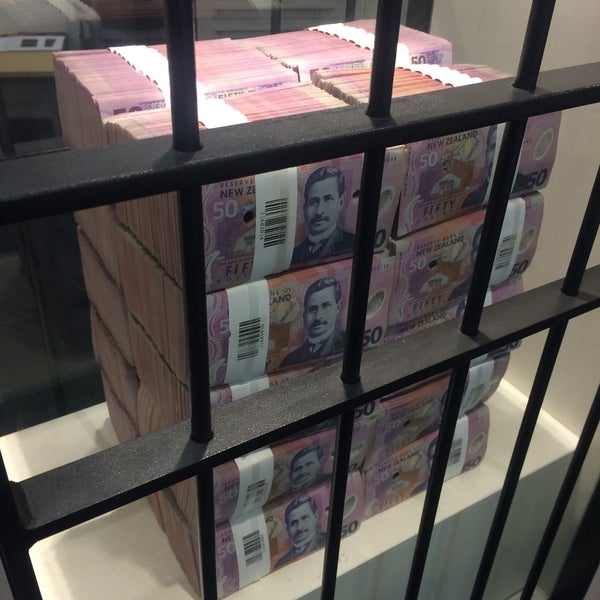
I think this is the answer. I suspect the exhibit designers had a cool idea for a display, did a rough estimate of the area needed and then commissioned the exhibit builders to make the big metal-framed cube. Either they made an error in their calculation or the innate variability in the size of stacks of used bills threw it off. It's also possible the exhibit designer simply decided a bigger cube which filled the floor to ceiling space would be a better visual. Which would be unfortunate because, personally, the exhibit concept I'm more interested in is "$1M dollars in $100 bills fits in this area" not "Here's $1M in bills." The first concept is mildly interesting while the second is just a stunt.
Regardless of the reason it's off, I think it's most likely there's only $1M of bills in the cube. The folks responsible for collecting and destroying used bills tend to be exacting in their auditing for obvious reasons. So when the exhibit designers got $1M in used bills approved and released, that's exactly how much they got. It also stands to reason that they'd design the cube a little bigger than their calculated area requirement to ensure at least $1M would fit (along with some method of padding the interior) - although >50% seems excessive for a variability margin, so I still think it was an aesthetic choice or calculation error. Of course, one could do a practical replication to verify the area required with $10,000 in $1 bills.
Regardless, it's an interesting observation and a cool counting program to help verify.
Still, it does seem like it would be cheaper to rebuild the case than to add $500k to it. Maybe it's easy for the Fed to acquire more cash as long as it's guaranteed not to be spent.
The Fed doesn't acquire cash, it creates it. USD banknotes are liabilities of the Fed, but that concept only makes sense when somebody other than itself owns them.
It could be even cheaper if these were old bills than needed to be pulled out of circulation. In that case they'ed be paying money to dispose of them anyways.
Based on Fed policy since 2007, they may be happy to hand out cash especially if it's going to be spent.
"Money printer go brrr" and all that...
Here's $1,000,000 in $50 notes at the Reserve Bank of New Zealand Museum: https://fastly.4sqi.net/img/general/600x600/2817090_qnRbbX_q...
* AUD 20c was an identical size and same embossed image of the Queen, but a platypus on the reverse.
~ Vincent LaGuardia Gambini
Simplest way to double check is if top and bottom corners have the same bill density.
But who says that they didn't actually request $1.5M in used bills after doing the math of what it would take to make a cube. Or fill it up with $1M in used bills, and come back and make another request for $500k that also got approved...
I have a friend who works at a firm which specializes in engineering and constructing exhibits for museums and all kinds of public spaces. There's a whole industry ecosystem around doing this. They get brought in on contracts by design firms which specialize in permanent installation exhibits who get hired by the person responsible for exhibits at a museum or exhibit space. It's no different than most niche specialty industries. Even though it's comparatively small, there are still thousands of sites and hundreds of firms. People who do this specialize in it, develop long-term careers and have resumes they care about. Jobs for firms and people come by reputation and word of mouth. Delivering on time, on spec and on budget is crucial for survival. The facilities manager for this Fed building hired an exhibit space manager who developed a budget for this public tour project and then put it out to exhibit design firms for bids. The project was approved on a fixed budget and time frame. The overall budget the exhibit space manager submitted to the facilities manager certainly included the cost of the cash in the cube.
But the bigger reason no one was cavalier about just filling it up with $100 bills is that this exhibit is different because the exhibited artifact is of uniquely high-value (and unlike a Rembrandt, immediately spendable), so it probably had to have a security assessment and is very likely insured against loss (not just theft but fire/water damage etc). The cost of insuring and securing the exhibit was calculated before the budget was ever approved. Adding another 50% in cash would increase the insurance premium.
If it's 50% too big, that's a serious mistake! They should, like, take down the exhibit until it's fixed. You can't just make one of the bars on a graph taller because it looks more impressive, or your pen slipped, or whatever else. This thing is inaccurate and they should fix it.
Let's say the cube gets damaged and needs to go for a repair or rebuild - real money would require emptying it under supervision and counting the bills, where as fake money can just be sent as-is to the contractor, and any visible shortfall can be made up with more fake money upon return if needed).
(In line with some other commenters, I'm more inclined to believe it's bills they've taken out of circulation than "almost finished" ones -- security features are built in throughout the process, not just an extra step at the end.)
They have that maybe 50 feet away. It fits in a briefcase. Also, $1 million in $20s.
Calvin Liang: "Ackshually ..."
I think it’s better served to use this as an analogy of how the federal government handles money.
Non-snark: Because it's fun to theorize.
> This is actually not a million dollars in singles. It is over $1,000,000. The box was created with the wrong dimensions by the contractor, but they still decided to fill it, display it, and claim it is $1,000,000. > > Source: Tour Guide at the Chicago Fed
[0] https://old.reddit.com/r/pics/comments/2f9sp7/one_million_do...
Conclusion: Low, unless you're willing to take only a fraction of the face value.
Thinking through it though - you might be able to get away with spending the cash overseas, where it will take some time indeed for the money to be under scrutiny by banks to see if the serial numbers are out of circulation. There's then problem of getting the money there without anyone noticing, then there's the problem of what kind of characters you're going to be defrauding overseas.
All told - probably a better idea is to use all that cleverness to make a 1.5 million dollars the good old fashioned way: Spending a few years saying, "Nothing from my end" on Zoom calls.
Outside the US is probably the last place you'd want to pass those bills off. Besides the logistical problem of physically getting an enormous stack of $1 bills past customs... there's so much counterfeit US currency out there that the level of caution is extremely high. Just spent a couple weeks in Costa Rica, and USD is not accepted anywhere if it is even slightly torn, worn, or out of date by more than a few years. Maybe you could tip with it, but that's about it.
Cash cannot be invalidated like this. It would ruin the value of all cash since you could no longer trust cash from anyone. Only damaged notes are taken out and replaced by the government.
They can. But if the delivered box meets the ordered specifications they will ask for extra compensation to redo it.
That plus cost of shipping back and forth.
That plus any possible time pressure around opening of the exhibit.
That plus the fact that the Fed can obtain bank notes for less than their face value. (If they are for example voided bank notes. But they can also just order prop money beyond the first layer if they want to keep their museum work and their official business separate. Which very well might be easier for organisational, accounting and security reasons.)
Plus nobody wants to admit that they screwed up the box order.
All these factors would point towards just stuffing the box with more “banknotes” and pretending that all is well.
And I'm glad you didn't find it because that lead to a great post.
As we say in my family: "close enough for government work!"
This sort of implies that it was cheaper to just go with he extra cash needed than to do a cube with the right dimensions?
But then again it's the Fed, so they probably just printed more money. (Which also costs money, though?)
(b) Whovever hypothetically got that money would have 37% stolen by the government so they'd be left with about a million anyways. It's effectively a million.
The Fed is extremely rigorous in tracking these things. It isn’t a couple guys in a room playing casually with millions of dollars. Even the retired bills are thoroughly monitored and tracked through their destruction.
He then named it “take the money and run” and showcased what amounted to an empty frame.
The conclusion that something is off is still right in that case.
Otherwise, if the bills really are where they appear, then there would have to be some partial (cut) bills along the edges for everything to line up properly.
People from a "working class" background tend to see a massive pile of money, more middle class, a smaller pile, upper class maybe a cheque or a small stack of $100 bills or a bank transfer.
It's maybe one of the weirdest parts of the JBR ransom note (getting really off-topic now), "$118,000 dollars be placed into an "adequately sized attaché" consisting of $100,000 in $100 dollar bills and $18,000 in $20 dollar bills."
That would take up a really small amount of space, but if you're never seen that amount of money you might not know that (especially in 1996, pre-internet)
https://en.wikipedia.org/w/index.php?title=Killing_of_JonBen...
Why, OP, why? How much self-awareness does it really take to realize JBR is a non-standard acronym people won't recognize? It almost feels like a superpower that I take an extra half-second to think about what jargon the average person needs to have defined.
It would've been much worse if it was under though.
What??
TLDR if you don't have a half-hour: puzzles are usually cut with the pieces on grids, and not all aspect ratios are conducive to that with all piece counts. Like, you might want a 2:3 shaped puzzle with 500 pieces, and 18x28=504 is close enough.
So many reasons this might be exactly $1,000,000 but not sum up on the outside.
That said, this is also something I would have spent way too much time overthinking, so I thoroughly enjoyed reading the blog post.
> What if it’s hollow? You can only see the outer stacks. For all we know, the middle is just air and crumpled-up old newspaper. A money shell. A decorative cube. A fiscal illusion. The world’s most expensive piñata (but don’t hit it, security is watching).
[1] https://www.youtube.com/watch?v=BhFNiPsVRoM
[2] https://fiji.sc/
"Sentences that flashbang people not in biology"
> There are some clunky old Windows programs, niche scientific tools, and image analysis software that assumes you’re trying to count cells under a microscope...
This would probably be a hard case for it! But would be cool to see how well it works.
But I wonder about an app that can count things automatically, plus maybe also work out counts of 3D shapes by counting visible things and making estimates about packing ratios. A sort of "how many M&Ms are in the jar calculator" app. That'd be neat (and would ruin a fun game).
sums, averages, population, budgets, spending, rates.
Counting things is time consuming and error prone. Ask a casino. You can have 3 people count something and come to a different figure off by a few percent.
Seriously if someone says there's $1m in there, who is going to second guess? Thankfully this guy did.
That seems a wildly unlikely idea: Despite having three people checking sums, their daily profits have a few percent unknown variability in them.
Banks of old would famously make their tellers stay late to track down rather trivial discrepencies, probably as a deterrent to carelessness.
Cite?
Pick any industry which revolves around something, I assure you there is a child-industry dedicated to providing the technology and infrastructure to count the things.
Heck, accounting, as a general purpose, applies to every profession, profession, is at its core, focused on counting things.
Hopefully this doesn't come across as argumentative. Your comment caused me to reflect on how you're right, we trust so much when it comes to numbers people tell us. But at the same time, we don't as evidenced by the vast amount of industry we dedicate to counting all that we do, whatever it is.
How did he guess so well? He was there very early on and he noticed a stack of cardboard trays stacked up in the corner of the venue. He counted the number of trays, multiplied by 24, and submitted that number. :-)
EDIT: I forgot to mention he was a functional alcoholic who drank beer constantly. It is appropriate he won it, but I'm not sure if was good for him.
I created a 3D model of the vase in Blender, used some Python to get the interior area, and then found a figure for the average volume of M&Ms to get a count.
my guess was off by about half, but was very close to many of the other engineers' numbers, to the point where we asked them to recount. the recount revealed I was closest and it turns out they had used a method other than counting for the original number (they weighed them or something... it was way off).
The cube is almost certainly hollow, to cut weight and cost.
It's the idea of what a cube of $1m would look like. It should at least fulfill that requirement faithfully.
> You’d think this would already exist, a browser based tool for counting things.
Just want to point out that these apps do exist, perhaps not browser based. For example:
Bluebeam Revu can also do visual counts for specific symbols/images provided the drawings aren’t too busy, that is one use of AI I would like to see (automated takeoffs) so I don’t have to click thousands of light fixture symbols every year. One problem is that construction drawing are 2D and height information isn’t always present so measuring distance and accounting for rise and drop is difficult to automate, I use google maps street view frequently to gather height info (calibration is based off a standard commercial door at 80” x 36” or a CMU at 8” tall) if I don’t visit a site. Due to this and other factors, I think accurate construction estimating will be difficult to automate completely with LLMs, but the process will definitely be sped up by them.
43x43 piles of 541 coins each make 1000309 coins with a pile height of 541*2mm = 1.082m, while the width would be somewhat less than 43*26.5mm = 1.1395m with a hexagonal packing.
So just over 1m cubed, a little smaller than the bill version. But at 8100 kg, tons heavier.
Anyway, the weight would be 8.1 metric tons.
https://www.usmint.gov/learn/coins-and-medals/circulating-co...
(A party put them in front of the parliament to launch a campaign for universal basic income)
I discovered this when I had to test accuracy in a pose estimation model for a computer vision project involving crowds being counted by CCTV. Turns out in low-res imaging (even the best CCTV is a bit rubbish at long range due to wide angle lenses and so on), pose estimation models beat almost everything else for counting. Except... they're still not accurate.
I would spend hours going through hundreds of frames, counting people by hand, and then I'd compare with different pose models, and found they were always out, but they were out by the same amount.
Some models got confused by reflective surfaces, so would double count. Others would be out by ~20% every time for various environmental factors. The good thing about this is you could then easily show calibration. "OK, in that space, whatever the model says, half it, that's a better count", or "OK, in this image from this camera whatever the number the model says, increase/decrease it by 20%, and that'll be more accurate".
We ended up through human calibration being able to provide much more accurate "models" per camera than the models themselves.
It did mean counting hundreds of people per frame for hundreds of frames for dozens of cameras though... I had to abandon the trackpad for a mouse and just got settled in for a few days with DotDotGoose. Colleagues were surprised I had the patience for it. :-)
https://biodiversityinformatics.amnh.org/open_source/dotdotg...
Notice in this photo how the side of the cub right/side - the bills are not oriented in the same direction as on the other sides.
...well?
Hilarious and well written exercise, regardless. Kudos!
us dollar size: Width: 6.14 inches (155.956 mm) Height: 2.61 inches (66.294 mm) Thick x100: 0.43 inches (10.922 mm)
How close over a million dollars can you make this cube?
The exhibit picked a cube ~50 inches. 8 wide = 49.1 inch 19 tall = 49.6 inch.
But this assumes that having a perfect "cube" of bills was the artistic vision.
Though having an app handy might make sense sometimes.
Of course the tracking of this information down to that level would be pretty pointless. The moment someone breaks a 20 the connection to the recorded transaction is lost, and there's no one who can prove you didn't break a 20.
https://play.google.com/store/apps/details?id=xz.camera.obje...
I realize the fed is not technically a government agency.
Jack Binion's sister, Becky Behnen, famously sold million-dollar display of one hundred $10,000 bills in '99 for (a rumored) $4 million to the currency dealer Jay Parrino.
(Supposedly) one of those $10,000 bills was posted on eBay for $160,000.
I find it funny they still advertise having a display of a million dollars, but in boring modern notes. Didn't even bother to look for it even though I walked past the place like 15 times on a Vegas trip, and literally went into the building for a cheap breakfast.
The Bureau of Engraving and Printing had a similar glass box filled with uncut sheets of $10 notes when I visited in 2016.
4o: that's $25.7 million
Is the idea of the exhibit that the cube is empty other than the outside edges?
Mr beast routinely has a million dollars as a prop and it's significantly smaller than this, and cubed values go up FAST
Who gets anything out of giving people the wrong idea about what $1m would look like?
If you are commissioning the thing to be built, why might you want it to either contain more than $1m, or be hollow and larger than what $1m really is? What purpose does an incorrect display serve? A correct display already serves almost no purpose in the first place, now make it incorrect.
None of the reasons I can think of would seem to apply here:
Disinformation.
Advertizement.
Art, where the artists point was to make it wrong and never tell anyone.
Simple goof up? This one is at least plausible. Someone estimated wrong, got a local shop to build an expensive cube(1), well we got the cube we got, fill it and get the display up.
(1) That will have to be quite thick polycarbonate or glass, not cheap. In fact, that right there might expose that there is at least some kind of fakery inside, if the glass is not at least as thick as the aluminum frame, then it's not strong enough, neither is the frame for that matter if it's what it looks like. So if the glass and frame are as thin as they look, then there is some kind of internal skeleton.)
Maybe there is some other significance we've lost since it was built. Maybe the $1m was never the interesting point originally. Maybe instead the dimensions or maybe weight of the cube were the interrsting thing, and this is really something like "1000 gallons of $1 bills" and that just hsppens to come out to 1.55m.
Ah, that'll be the allowance for inflation/devaluation.
> "I'm afraid we don't, boss."
> "Let's inflate it!"
> "The dollar?"
> "Not the dollar, idiot, the cube! With air.
> "On second thought..."
1: we want a big cube
2: has to have a million dollars
3: should be stacked neatly.
Given the bills are so evenly arranged on the lower surface there's only so many squares you can produce with the bills like that. 8x19 or 6x17 . 6x17 is noted as close to 1 mill but they only remove 2 stacks from the 100 side. so now it's not a cube, you'd come under if you trimmed it down to a cube.
so stacked flat seems 8x19 is the smallest square you can make for one side for a cube of cash that fits mil. so they did that and just filled it up.
It might be hollow, there's certainly a void. There's some comments about the border but you can clearly see that the bills don't go behind the border so the corners are squared in, which means there's probably a weird void of some sort because it's not really a normal cube.
The cube did not cost $1.5M+. These are decommissioned dollars diverted from the normal process. The Federal Reserve is responsible for destroying currency. These bills are worthless. The only expense here is building the walls of the cube.
https://en.wikipedia.org/wiki/K_Foundation_Burn_a_Million_Qu...
https://www.youtube.com/watch?v=L9SzDFGbsFI&pp=0gcJCdgAo7VqN...
Also Calvin: can't make a basic functioning webpage that doesn't crash
The absolute state.
Edit: it seems to be that video embed
>It’s stupidly simple: upload an image, click to drop a dot, and it tells you how many you’ve placed. That’s it. But somehow, nothing like it existed.
A small related story.
I once was an intern on a bioscience laboratory that was working with maize. My very intern-y job was to count the number of white spots on the leaves of like ... thousands of plants.
Improvement # 1 (not by me but a colleage), we scanned the plants, on a regular flatbed scanner, they were small enough to fit in.
Improvement # 2 (this one was me), the plan was to automatically count all the spots with CV but it wasn't really working that well; it was back in 2012 and the algos were not that good, they still missed some and we needed to be as accurate as possible. I ended up doing a web app very similar to the one in the article, you just loaded an image and start tagging stuff and at the end it gave you a count for each type of spot you tagged ...
... then we spent weeks scanning and tagging plants full-time :'(.
https://www.cbsnews.com/news/jens-haaning-take-the-money-and...
Like if I had a box with an apple and pear in it, I could put up a little plaque saying “There is an apple in this box” and it would be a completely accurate statement
I bring this up because the article and many of the comments here act like this "cost" the Fed $1.5 million to make the cube.
Thank you
Edit: Actually I reckon they deliberately oversized the container a bit so it's easier to pack the cash in. You don't want to build it too small! (Relative budget notwithstanding). Another design constraint it has to be a cube, and has to fit nicely to the dimensions of the banknotes on the front face (aspect ratio and size) without having a big gap on one side.
Well, no, it's kind of like ordering two burgers and getting three.
But I DO know, the most of HN is probably autistic and mostly agree on an explanation that completely defies Occams Razor.
The truth imo...
Its mostly a million, fake, stuck to the sides, padding in the middle, with a few bills missing from the top for mementos from the last installer in the room. Every now and again some more bills are thrown in if people start asking too many questions.
Which ironically represents the FED accurately.
lol
[1] https://www.tagesanzeiger.ch/wert-nutzung-gewicht-6-fakten-z...
It should be between 0.002-0.004 in. thick, so each band per bundle is about 0.004 to 0.008 thick. Might take off a little bit of your overage.
Last week I was watching that episode of Better Call Saul where he carries $7M throughout the desert for 36 hours, and realized his bags were supposed to get ripped 4 minutes into the process.
--
Calculation by Claude:
Here's the calculation:
A single US banknote weighs about 1 gram regardless of denomination.
So 70,000 bills × 1 gram = 70,000 grams = 70 kilograms = 154 pounds.
That's quite heavy - equivalent to carrying around a large person!
Those 70,000 bills would also represent $7 million in cash
* edit corrected the pounds calculation