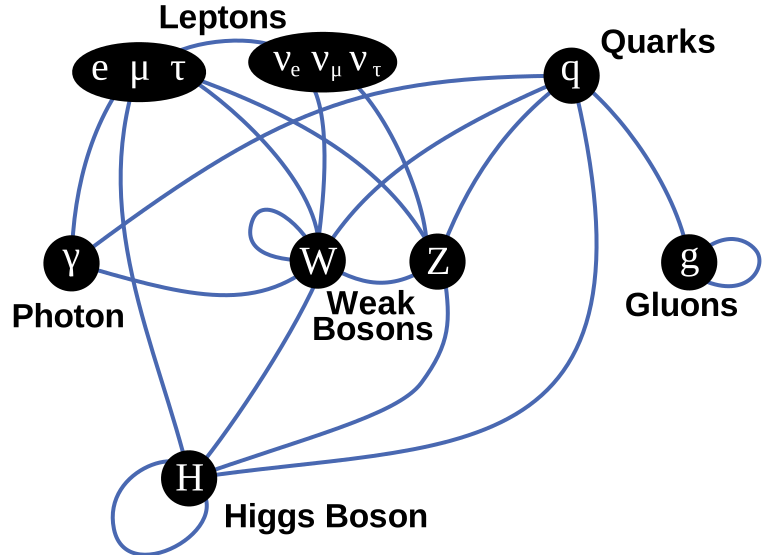
If you'll notice though, there's one interaction between ALL of the particles that is missing: gravity. Gravity affects anything with energy. Photons, leptons, quarks -- they are all attracted to each other because they possess energy (negligible, unmeasurable attractions, but still extant).
Wouldn't it be interesting if the only way that dark matter interacted with the other particles was through the gravitational force? Maybe from some alien's perspective it would constitute the matter of everyday life, but because it didn't interact with any of our particles except through gravity we would be missing out on a large aspect of our universe!
Furthermore, is it that far-fetched to think there might exist particles that do not interact at all with the ones we have discovered? Gluons, for example, only interact with themselves and with quarks. Some other particle may interact with nothing we are familiar with -- and thus we could never study it. Is it even "real" then?
(Any particle physicists on here, please feel free to educate me further!)
At the moment, the most popular dark matter theory comes from supersymmetry. In this case, there's only one dark matter particle, and all of the rest of the particles interact with normal matter, in pretty much the normal way, since all of the underlying structure of the model is almost identical.
Philosophically, this is equivalent to the question of whether other universes, which do not interact with ours and therefore we cannot study, exist or are "real". It is not a question that Science can answer.
That question really has far reaching implications. Because if we say Science is what we observe and describe as per our interpretations of logic(And the language of logic - 'Math') then our science is really broken. Because what we can observe doesn't often turn out to be true and what is true is not often observed.
Because look at it this way. We are now saying Dark Matter doesn't interact anyway with light nor something else. Hence observing, detecting or modeling them out through conjectures manufactured through thin air is nothing more than what religion was some centuries ago.
Anything unexplainable was attributed to some form of divinity in times before.
We know it exists, but we can't show you, can't explain you what it is, how it looks is the text book definition of god throughout centuries.
It is, though: Science suggests that they don't exist because science favors simpler models to more complex ones, as long as the simpler model still accounts for all the evidence and makes correct predictions.
I'm not going to explain what any of that means because A. I've only recently woken up, B. you're perfectly capable of googling for yourself, and C. I'd probably get it wrong anyway. Suffice to say it's all brain-meltingly interesting.
The excellent sean carroll has done a lecture on this: http://online.kitp.ucsb.edu/online/lens06/carroll/
He has also written several long-ass blogposts:
http://blogs.discovermagazine.com/cosmicvariance/2011/02/26/...
http://blogs.discovermagazine.com/cosmicvariance/2012/05/09/...
EDIT: you may also want to look up the Bullet Cluster. Or just read those blogs, it's all in there.
We can tell how much dark matter is out there because we can "weigh" it through indirect measures. And then we can take different theories of dark matter (such as, say, the theory that it's all just a bunch of interstellar orphaned planets and "black dwarfs" and what-have-you made up of ordinary matter) and figure out what sorts of implications that would have, make predictions on observable effects of those different models and then test those predictions. And that is precisely what happened about 20-30 years ago. A lot of work was done to pin down what type of dark matter makes up the majority of it out there.
For example, you can point a telescope at a set of neighboring galaxies and look for brightening effects due to gravitational micro-lensing from a chance alignment of a "macho" (e.g. orphaned gas giant planet) along the line of sight. Surveys were set up and indeed found that there were orphaned "macho" objects in our galaxy, but the statistics showed that they were orders of magnitude too rare to make up the bulk of dark matter we know about from other studies. Another line of evidence involves studying the large-scale structure of the Universe (e.g. the layout of galaxies, galaxy clusters, etc.) and comparing it with various computer simulations of models with different assumptions on the composition of the mass of the Universe (e.g. 100% "ordinary" baryonic matter, various percentages of "special" dark matter such as cold and hot dark matter, WIMPs, etc.)
From this and many other lines of evidence we came up with very strong evidence that the vast majority of the mass budget of the Universe is in the form of so-called "cold dark matter" which is composed of weekly interacting massive particles other than neutrinos (neutrinos are dark matter, but we've been able to place an upper limit on how much they contribute to the dark matter budget of the Universe, because they are detectable to a degree, and it's only a fraction).
So that's it, just a simple matter of comparing the predictions of different theories with observations and eliminating the theories that do not predict what we actually see out there in the Universe.
I've read that supermassive black hole accretion is the most energy-effective process of mass to energy conversion in the Universe (50% efficiency or so).
I'm just curious: Where does all that energy go? Extremely powerful jets of radiation are emitted into the intergalaxy space and then what? Does it just disappear? Isn't this energy responsible for Universe expansion? It must push galaxies away from each other, right?
NASA has a brief page on dark matter and something else we know little about, dark energy:
http://science.nasa.gov/astrophysics/focus-areas/what-is-dar...
Critical response: http://www.scilogs.eu/en/blog/the-dark-matter-crisis/2012-07...
Source: http://www.nature.com/nature/journal/v487/n7406/full/nature1...
˟˟ http://physicsworld.com/cws/article/news/2006/aug/25/gravity...
It makes me wonder why we can't observe dark matter (which seems to emit only pure gravitation, and no light nor electromagnetic radiation). Could it be because there's no actual matter (i.e pure gravitational waves, like the magnet+iron+paper experiment)? Or are they massive clouds overloaded with Higgs bosons?
You can check out something like this on your computer
http://http.developer.nvidia.com/GPUGems3/gpugems3_ch31.html
To see what pure 1/r^2 interactions look like. You can download the simulations from here:
If you take a bunch of marbles and put them in a big bowl they will roll around for a while but eventually end up in the bottom of the bowl because they keep running into each other. But if you put in special marbles that just pass through each other and don't experience friction then you'll end up with marbles rolling around the bowl everywhere for ever, which is the way dark matter works.
consider a magnet(refer here as object) - something which has the property to attract(gravity like) and repel(field like): Now if you were to have 2 magnets(moving objects) come close enough such that they repel(or attract); but due to forces(and/or fields) of other moving objects in their vicinity(or far enough[1]); they get locked or entangled such that their movement(and other properties) is now dependent on the strongest forces or fields of nearby objects. Over time; these other objects also get entangled and tend to form clusters and keep moving(exhibiting other properties like radiation etc). But now their movement(and other properties) seem to be the resultant effect of forces (and/or fields) of all the objects now entangled - giving an illusion of some matter that exists - now known as Dark matter.
I have used magnets as just as an example - one could think of matter having both these properties to attract and repel - such that the area affected by them could vary depending on various properties of the objects(matter).
[1](far enough) - such that their observation is neglected; but these objects tend to have forces(and/or fields) that they affect a particular system under observation.