Among many other uses: https://m.youtube.com/watch?v=h6QYjNjivDE
(And amazing production of the actual video as well)
Pretty sure you can see some kind of masking for satellites in some of the frames of the asteroid videos.
Doing some extremely rough math along these lines to double check myself:
* Gemini says that a dinosaur-extincting asteroid hits Earth about once every 100 million years. So in any given year that's 0.000001%.
* Economists say a human life is worth about 10 million dollars. There are about 8 billion people on Earth. So the total value of all human life is $80,000,000,000,000,000 (or 8e+16).
* So in any given year, the present value of asteroid protection is $800,000,000 (likelihood of an impact that year times value of the human life it would wipe out).
* The Guardian says the Vera Rubin telescope cost about $2,000,000,000 (2 billion).
By that measure, assuming the Rubin telescope prevents any dinosaur-extinction-level asteroid impacts, it will pay for itself in three years.
Tracking large near earth objects is wise for several global and domestic security reasons.
Have a great day =3
What's amazing to me is just how long it took to get to first photo- I was working on the design of the LSST scope well over 10 years ago, and the project had been underway for some time before that. It's hard to keep attention on projects for that long when a company can IPO and make billions in just a few years.
Both modes of observation - surveys and targeted observations of individual objects - are necessary for astronomical research. Often, large surveys are used to scan the sky, and then targeted observations are used to follow up on the most interesting objects.
0. https://en.wikipedia.org/wiki/Sloan_Digital_Sky_Survey
Note that "seeing" means something very specific in astronomy: https://en.wikipedia.org/wiki/Astronomical_seeing.
It is surreal to see LSST/Rubin finally get first light.
Even more interesting to see who is still working on LSST, and who is not.
The image of the woman holding the model of the sensor is nice because it includes a moon for scale.
Question I was curious about is whether or not the focal plane was flat (it is).
This is an interesting tidbit:
> Once images are taken, they are processed according to three different timescales, prompt (within 60 seconds), daily, and annually.
> The prompt products are alerts, issued within 60 seconds of observation, about objects that have changed brightness or position relative to archived images of that sky position. Transferring, processing, and differencing such large images within 60 seconds (previous methods took hours, on smaller images) is a significant software engineering problem by itself. This stage of processing will be performed at a classified government facility so events that would reveal secret assets can be edited out.
They are estimating 10 million alerts per night, which will be released publicly after the previously mentioned assessment takes place.
>This stage of processing will be performed at a classified government facility so events that would reveal secret assets can be edited out.
Interesting, I'm guessing secret spy satellites?
The thing that really saddens me is that the military gets to filter the data first and scientists only get to see the already manipulated data instead of a raw feed from their own instrument.
Both because they can't be made invisible, and because you need to avoid collisions.
(For those who haven't noticed, you can just simply paste 186.66721+8.89072 or whichever target you're curious about in an astronomy database like Aladin[0], and there right-click on "What is this?")
[0] https://aladin.cds.unistra.fr/AladinLite/?target=12%2026%204...
https://skyviewer.app/embed?target=186.66721+8.89072&fov=0.2...
https://skyviewer.app/embed?target=185.46019+4.48014&fov=0.6...
https://skyviewer.app/embed?target=188.49629+8.40493&fov=1.3...
https://skyviewer.app/explorer?target=187.69717+12.33897&fov...
They look like they're roughly in the same plane. Is it safe to assume they're roughly in the same plane, or could they be really distant along the line of sight? The similarity in size makes me think they are, but I don't have any reason to be confident in that judgment.
https://noirlab.edu/public/images/iotw2421b/ ("thought to be right next to each other — both at a distance of about 50 million light-years")
There was a livestream presentation and press conference up on YouTube
https://www.youtube.com/live/Zv22_Amsreo?si=zQLeGfJokZoCPkji
At time 1:38:19 - one hour 38 minutes 19 seconds - into the livestream presentation, there's a slide that shows RGB streaks of fast-moving objects that were removed for the final image.
Those streaks are apparently asteroids.
Perhaps it is indeed a glitch or cosmic ray event.
(Is there a better URL for the slide deck?)
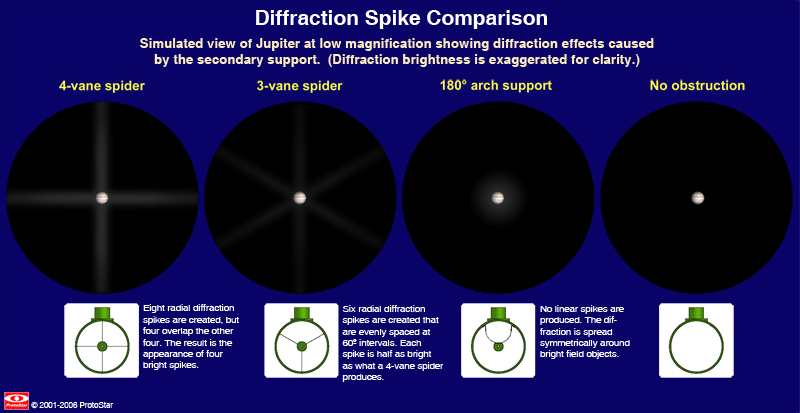
This one's extra-special! The pattern is multiple + shapes, rotated and superimposed on top of each other. And they're different colors! That's this telescope's signature scanning algorithm—I don't know what that is, but, it's evident it takes multiple exposures, in different color filters, with the image plane rotated differently relative to the CCD plane in each exposure. I assume there's some kind of signal processing rationale behind that choice.
edit: Here's one of the bright stars, I think it's HD 107428:
https://i.ibb.co/HTmP0rqn/diffraction.webp
This one has asteroid streaks surrounding it (it's a toggle in one of the hidden menus), which gives a strong clue about the timing of the multiple exposures. The asteroids are going in a straight line at a constant speed—the spacing and colors of the dots shows what the exposure sequence was.
I think this quote explains the reason they want to rotate the camera:
> "The ranking criteria also ensure that the visits to each field are widely distributed in position angle on the sky and rotation angle of the camera in order to minimize systematic effects in galaxy shape determination."
https://arxiv.org/abs/0805.2366 ("LSST [Vera Rubin]: from Science Drivers to Reference Design and Anticipated Data Products")
However, the brightness of the diffraction effects is much lower than the light of the focused image itself. Where the image is itself dim, the diffraction effects might not add up to anything noticeable. Where the image supersaturates the detector (as can happen with a 1-pixel-wide star), the "much lower" fraction of that intensity can still be annoyingly visible.
My favourite fact about these in relation to astronomy is that you can actually get rid of the diffraction spikes if your support vanes are curved, which ends up smearing out the diffraction pattern over a larger area [2]. However this is often not what you want in professional astronomy, because the smeared light can obscure faint objects you might want to see, like moons orbiting planets, planets orbiting stars, or lensed objects behind galaxies in deep space. So you often want sharp, crisp diffraction spikes so you can resolve these faint objects next to or behind the bright object that's up front.
[1] https://www.celestron.com/blogs/knowledgebase/what-is-a-diff...
All the dim fuzzy objects are galaxies much further away.
The interesting thing about the spikes in our images is that they stay fixed in image plane coordinates, not sky coordinates. So as the night sky moves (earth rotates) the spikes rotate relative to the sky leading to a star burst pattern over multiple exposures.
For observatories like Rubin, is there a plan for keeping them open after the funding ends? Is it feasible for Chile to take over the project and keep it going?
On a practical note, what happens to a facility like this if one day it's just locked up? Will it degrade without routine maintenance, or will it still be operational in the event someone can put together funding?
Arecibo was about 60 years old for comparison when it collapsed, but there are lots of faculties that are effectively ships of Theseus, with new instruments coming in over time which refresh the faculty (and when that stops happening, then you get concerned).
However, what we strive for is being accurate to "if your eyes COULD see like this, it would look like this". To the best our our ability of course. We did a lot of research into human perception to create this and tired to map the information of color and intensity in a similar way to how your brain constructs that information into an image.
Let me tell you, I did not appreciate how deep a topic this was before starting, and how limited our file formats and electronic reproduction capabilities are for this. The data has such a range of information (in color and intensity) it is hard to encode into existing formats that most people are able to display. I really want to spend some time to do this in modern HDR (true HDR, not tone-mapping) where the brightness can actually be encoded separately than just RGB values. The documentation on these (several competing) formats is a bit all over the place though.
Edit: I wanted to edit to add, if anyone reading this is an expert in HDR formats and or processing, I'd live to pick your brain a bit!
[0] https://aladin.cds.unistra.fr/AladinLite/?target=12%2026%205...
[1] https://rubinobservatory.org/gallery/collections/first-look-...
https://aladin.cds.unistra.fr/AladinLite/?baseImageLayer=CDS...
Incredible.
https://docushare.lsstcorp.org/docushare/dsweb/Get/LSE-163/L...
Congrats!
Second this, but other areas are of great interest too. Kuiper Belt discoveries and surveys FTW!
* https://petapixel.com/2025/06/23/hands-on-at-the-vera-c-rubi...
Not super technical, but a little higher level (with decent analogies to photography, for their traditional audience).
I'll see myself out.
(via https://news.ycombinator.com/item?id=44352455, but no comments there)
TL;DR: VCRO is capable of imaging spy- and other classified US satellites. An automated filtering system (involves routing through some government processing facility) is in place to remove them from the freshly captured raw data used for the public transient phenomena alert service. 3 days later, unredacted data is made available (by then the elusive, variable-orbit assets are long gone.)
[1] https://www.theatlantic.com/science/archive/2024/12/vera-rub...
What's that faint illuminated tendril extending from M61 (the large spiral galaxy at the bottom center of the image) upwards towards that red giant? It seems too straight and off-center to be an extension of the spiral arm.
EDIT: The supposed "Tidal tail" on M61 was evidently known from deep astrophotography, but only rarely detected & commented upon.