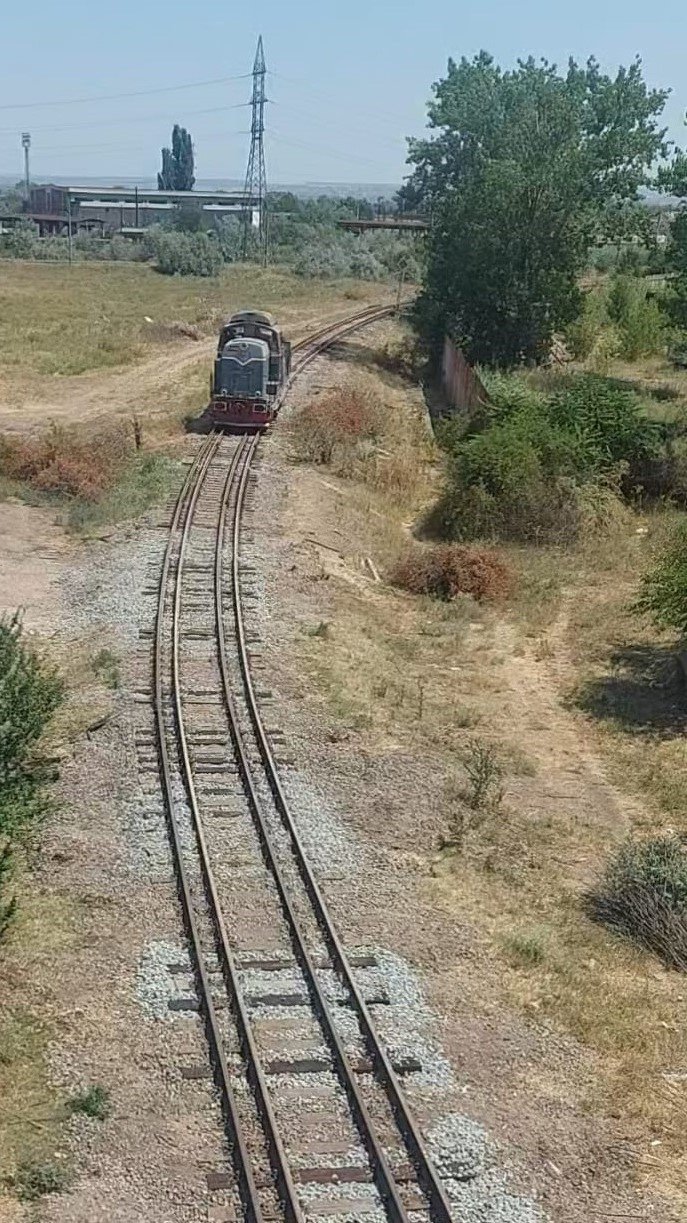
How is a change like this going to be implemented? E.g. are they going to mainly update some tracks everywhere (and have two systems running in parallel), or all tracks in selected areas (and have passengers change), or something else?
Was there a comparable large scale rail infrastructure change in some other country?
It's a slow and quite annoying process. For example, to reach my region, trains from Madrid have to change gauge because my region still has the old one. Apart from spending around 10 minutes doing this, this has caused a lot of problems because it essentially means there is a single model of 300 km/h train that can make it here (others don't support gauge change) and to top it, said model turned out to be highly unreliable. This created a lot of political tension because of course we wanted 300 km/h trains like other regions, but now we're stuck with these lemons and our regional politicians push for gauge change, but the national government doesn't want to do it yet as it affects freight trains.
I hope at some point we get the change done in the whole national network, although generally it moves at a glacial pace. It makes sense to have seamless connection with France and the rest of Europe, and to be able to use the same trains everyone else does.
Meanwhile here in Australia our “fast rail” trains go 160km/h. Unless it’s over 32 degrees, then they slow down. And if it hits 36 degrees they slow down even more (90km/h)
And it gets that hot here a lot…
[1] https://yle.fi/a/74-20161793
[2] https://en.wikipedia.org/wiki/Helsinki%E2%80%93Tallinn_Tunne...
The subtext is not economic: it's "in the event of being invaded by Russia, can we minimize the delays in moving NATO materiel by rail to the front while denying Russia equally easy access to the rails".
It would also enable high-speed services from Finland to Central Europe - Rail Baltica to Tallinn is currently being built, so Helsinki-Warsaw could be a plausible connection, doable in less than 8 hours. (More than ideal, but trains that run for 8 hours from one end of their journey to another are commonplace in Central Europe.)
> Was there a comparable large scale rail infrastructure change in some other country?
http://southern.railfan.net/ties/1966/66-8/gauge.html
Obviously doing this today would be a much more complicated affair, considering the much higher speeds and weights of contemporary trains.
German soldiers re-gauged Soviet railways on a very short notice too when Barbarossa started.
As the Finns will presumably not permit Russia to do prep work on the rails in advance of their invasion, they'll have to do all that prep work after the invasion. The article doesn't say how long that two years of prep would actually take if needed ASAP, but if it would take a month then the Finns would have a huge boon.
There were a number of gauge changes, but they were usually quite early on, when the infra was less critical and you could get away with closing lines for months. I'm not sure that there's a real 20th century example, beyond standard gauge high speed alongside non-standard normal-speed (for instance see Spain, and likely soon Ireland).
It was also a time when railways used wooden sleepers, so you could simply drill new holes at the new track gauge for moving the rail fasteners, thereby minimising the work required for changing the gauge, at least on the plain line, switches and crossings excepted.
Plus it was a time when a lot more manpower for that kind of massive manual work was available, plus railways were the dominant transport mode and could actually commandeer that kind of manpower.
That article has a short paragraph mentioning it:
Here's a helpful overview from wikipedia: https://de.m.wikipedia.org/wiki/Datei:Finnish_railroad_netwo...
I'm not sure how complete & up to date that is. But up north where the borders with Sweden and Norway are there isn't a whole lot of rail it seems. Norway's rail network doesn't extend that far. But Sweden gets pretty close to the Finnish border. I'm guessing a priority would be first connecting to their rail networks and then providing progressively more access to industrial hubs and eventually regional hubs.
This might also help with freight to the rest of Europe. Currently the only way into the country for freight is by ship (ferries, containers) or by road via northern Sweden. Sweden has decent north south rail connections and a bridge to Denmark. So extending coastal rail to Oulu would allow access to the rest of Finland for freight trains.
Just some thoughts.
Adjustable-gauge rolling stock has also been ruled out as incompatible with the Finnish climate.
The most (only?) feasible way to do it is to “simply” build entirely new standard-gauge track next to existing track (and then possibly start upgrading the latter too at some point in the future).
Check back in in a few years and all your questions will be answered.
Baltic states attempted this (project Rail Baltica). Lots of EU money were spent with no visible result. I guess, several people in Baltic states became super rich, but in terms of rail infrastructure nothing was done.
Let's keep in mind that it's not just standard gauge track. It's a high-speed rail project (200-250 km/h) and, for any country, it takes time to build such a huge infrastructure.
I thought this is a project for a new railway, not reguaging existing track ?
My comments:
The important thing to note that at this point it's just a political posturing and an announcement of intent. They haven't shown any concrete technical plan how this would actually be executed.
> "Of course, we are very pragmatic and realistic, we cannot do this in five years. Planning will continue until the end of the decade, and maybe in 2032 we can start construction."
Once they have the cost estimates and effects on existing rail traffic studied, I bet construction will never start.
"Unification to standard gauge on May 31 – June 1, 1886 [United States]
In 1886, the southern railroads agreed to coordinate changing gauge on all their tracks. After considerable debate and planning, most of the southern rail network was converted from 5 ft (1,524 mm) gauge to 4 ft 9 in (1,448 mm) gauge, then the standard of the Pennsylvania Railroad, over two days beginning on Monday, May 31, 1886. Over a period of 36 hours, tens of thousands of workers pulled the spikes from the west rail of all the broad gauge lines in the South, moved them 3 in (76 mm) east and spiked them back in place.[6] The new gauge was close enough that standard gauge equipment could run on it without problem. By June 1886, all major railroads in North America, an estimated 11,500 miles (18,500 km), were using approximately the same gauge. To facilitate the change, the inside spikes had been hammered into place at the new gauge in advance of the change. Rolling stock was altered to fit the new gauge at shops and rendezvous points throughout the South. The final conversion to true standard gauge took place gradually as part of routine track maintenance.[6] Now, the only broad-gauge rail tracks in the United States are on some city transit systems."
https://en.wikipedia.org/wiki/Track_gauge_in_the_United_Stat...
The tolerances are just a bit tighter, the risks and liabilities are higher, and the workforce just isn't "there" - this is from a time when rail was a huge money earner and could afford to employ a huge number of people. Today? Not so much, pretty much anywhere in the World.
The Days They Changed the Gauge (1966) - https://news.ycombinator.com/item?id=8371773 (2014, 15 comments)
And a related discussion:
Why BART uses a nonstandard broad gauge - https://news.ycombinator.com/item?id=32031131 (2022, 253 comments)
The BART discussion was where I first learned about the North American 2-day gauge change. A truly inspiring feat for so many engineers to come together across such a large amount of land area to Make It Happen.
I wonder if one can do anything like this with the current concrete sleepers and thermite welded tracks.
One such oddball is the TTC subway/streetcar gauge of 1495 mm in Toronto, Canada. https://en.wikipedia.org/wiki/Toronto-gauge_railways
[0]: https://valtioneuvosto.fi/en/-/1410829/report-shows-that-cha...
[1]: https://api.hankeikkuna.fi/asiakirjat/697c1f25-332b-40ed-9d6...
I'm sure EU taxpayers will be presented with a solid business case demonstrating value for money before our €billions are spent on a project such as this.
Oh, wait, this is the EU.
Most likely a deal would be thrashed out between key players via Whatsapp but that "due to their ephemeral nature"[0] we aren't entitled to read any of their messages.
[0] see https://www.politico.eu/article/pfizergate-ursula-von-der-le...
It is not that hard. Countries like Spain have already two different gauges and have the necessary technology in the trains to change between different systems.
Fear is why Finland allied with the Nazis.
Fear is why the Soviet Union also signed a pact with the Nazis and invaded Ukraine.
It's easy to justify anything with fear.
https://www.openrailwaymap.org/?style=gauge&lat=62.774837258...
It makes more sense for islands such as Ireland to retain their old gauge.
Ireland's was kind of an accident; it wasn't even a case of retaining an old gauge as such; it's just that a different gauge won, and, being an island, this didn't matter. The first railway in Ireland was built in 1831 and was what's now called standard gauge. There were a bunch of competing companies, using standard gauge, 1600mm, and various other things. It happens that the two that won both used 1600mm rail, and while that first line from 1831 still largely exists, it was ripped up and replaced with 1600mm over a century ago.
Britain was exactly the same, except that it happened that standard gauge eventually won and all the other stuff (with the exception of one or two narrow gauge lines, I think) was ultimately replaced or retired.
Of course, both being islands, in a way the gauge didn't _really_ matter. It matters more in continental Europe, because you have cross-border lines.
The same happens with the electricity grid, even though it is connected to France, it has very small capacity.
Given that France invaded Spain in 1807, the military made it necessary to have a different gauge from France. Not only that, the train by the coast was also forbidden in some places as a naval bombardment could disrupt communications in case of war.
Spain has lots of mountains with a large plateau over 700 meters high and the coast is usually way lower so it makes sense to transport things by the coast.
Ideally you would want to do this all over Europe.
Those are not nice things. Double decker trains take longer to load/unload than regular trains for only a small increase in capacity. Single deck trains can make more stops in the same amount of time thus serving more people, or they can take less time in the stops thus getting people where they want to be faster. Time is important to humans, anyone who says slow down to others has no idea how they live or where their needs are. If you want to slow down and smell roses that is fine: go to a park and do so - meanwhile a lot of people need less time on transit so they get more time at home with their kids (or whatever else they do in life)
Larger loading gauges are a good things for a lot of reasons, but the ability to run double decker trains is not one of them.
It sure is standardized; the problem is that there are so many standards to choose from!
See https://en.wikipedia.org/wiki/Loading_gauge for an overview.
Britain is a bit special, in that as the first country to have extensive rail infrastructure, it also has the smallest loading gauges around. Later built railway networks tend to have bigger loading gauges.
I think bridge heights are the bigger problem here
So little actual difference.
Not just for military purposes either, economically it makes sense. Trains can just keep going to the edges instead of having to stop and their cargo moved to a different gauge. I've heard they're planning on doing the same in the Baltic states.
If taking over Finland would help Russia, why didn't it do so in 1945 when it was there for the taking, to little protest from the UK and US? Russian had no use for it then, or now, other than the Karelian isthmus, which is part of Russia. Russia didn't raise much protest of Finland joining NATO. These notions of Russia having designs on Finland are loony.
They tried, but weren't able to defeat them completely; a deal / armistice was made in the end.
> Finland lost 12% of its land area, 20% of its industrial capacity, its second largest city, Vyborg, and the ice-free port of Liinakhamari
In Spain, we already deal with both Iberian and standard gauges—trains like the Talgo models can change gauges with minimal delay. It's not seamless, but it works reasonably well. Spain also has the world's second largest high speed train network.
What the EU could really benefit from is greater support for small companies and independent freelancers who are driving innovation. Unfortunately, governments (Spain included) often treat them as revenue sources, with high taxes and complex regulations, while large corporations can navigate around much of that with ease.
There's no defensive reason for this other than in the cabinet talks.
We did such things in the US in month long long ago.
Which they are, as even a quick search would have shown.
https://greatnews.ro/wp-content/uploads/2022/07/linia-ferata...
Maybe they would choose to downgrade a single track where there's two, and half of each station's lines, but that would make it very difficult to schedule trains in both directions on a single track. So, they're probably not going to do that either.
The 1520mm was some Soviet effort to "metrify" their railways while keeping compatibility with existing rolling stock.
https://en.wikipedia.org/wiki/VR_Class_Sm6
https://en.wikipedia.org/wiki/5_ft_and_1520_mm_gauge_railway...
If you are not doing all of this at once, this likely isn't worth it.
The idea is simple. Ensuring everything is smooth and safe = cost multiplier.
If they build new lines next to existing ones, they need to touch all that stuff anyway. No point in replicating old systems.
Ballast cleaners* are a thing and they are already pretty amazing at what they do, namely taking apart track and then putting it back, in place, from a machine that runs on those very tracks itself. I could imagine a giant version that not only cleans the ballast but also unties then reties the track back together at the new gauge.
While the details are unknown, this project will almost certainly mean new tracks alongside the old tracks at least for the main lines. Which means that the existing corridors in many places would not have enough space. Additionally there is probably desire to improve the geometry to allow higher speed trains, so that makes the existing corridors less useful
There is no such thing as "blown up for good" for a railway line. And similar for "not feasible for Russia to rebuild". Destroying enemy-held (or soon-to-be-captured) rail lines was a thing, at scale, in WWII. On the Russian Front. Similar for rebuilding captured rail lines to convert them from "enemy gauge" to "our gauge". At best, using a different gauge and rail destruction are delaying & resource-draining tactics.
Why do you say that?
Both the heaviest cargo trains and the fastest passenger trains (ignoring monorails, maglevs etc., just normal style trains running on two steel rails) on the planet run on standard gauge.
That's of course completely impossible but one can dream.
Imagine the cost if it was the other way around... Nevertheless, a valiant effort by the Finnish.
I guess we eventually have to do Ukraine (and Iberia?) too, so hopefully the lessons learned can be applied there.
While a downshift if usually much esier since a smaller gauge simply fits inside the larger one so all bridges and tunnels are wide enough by definition.
Freight-wise, better load capacity can also be solved by ballastless track, using additional axles, or running longer trains. Passenger-wise, better stability can also be solved with canting - and wider tracks means significantly larger curves.
In return you get to buy significantly more expensive one-off trains and are unable to connect to your neighbors. Not exactly a great deal, is it?
Why are wider inter-track requiring larger curves? It should be the same, but with better lateral stability.
https://transport.ec.europa.eu/transport-themes/infrastructu...
I don't think russians like to acknowledge how hated their country actually is, universally, across all countries that ever dealt with them on their soil long term, including former soviet republics and ie Warsaw pact. Not russian civilian population just to be clear but country as a whole definitely, just a consistently safe harbor for biggest scum mankind can produce.
It's a tradeoff and worthy of deliberation.
You can't announce migration if you haven't decided you plan to migrate...
In the poorer countries like my home country these look like this: https://dmitriid.com/media/1/3/7/1/f50f-720b-4f59-873a-75c51... (article: https://dmitriid.com/romania-2023-chisinau-bucharest)
What coupler are they going to use? Switching from Russian automatic couplers to European buffer and chain freight couplers is a step backwards. (It's amazing that the EU hasn't modernized freight couplers. There was something called "Eurocoupler" proposed in the 1970s, but it was never implemented. A "Digital Automatic Coupler" with data passthrough is being proposed now.)
lol, I guess that this is only half of the equation, the other being to fairly obviously reduce military mobility for another class of vehicles.
But 89mm is probably too small a margin for that to work.
Intesting times.
> The government is expected to make the final decision by July 2027, with construction starting around 2032.