The article spots well the dark side of the moomins, but in my opinion goes too deep into it. My disagreements boil down to this: "One of the oddest aspects of the Moomin phenomenon is how these complex tales of apocalypse, breakdown and disfunction have been consistently misread as cutesy celebrations of domestic life." Yes, all these things exist, but the point to me has always been that they are cutesy despite that! The stories paint a very typical family dynamic (at least of the time, at least in a Finnish swedish speaking family like Tove's), throws it into weirdest situations, and they all survive together thanks to, and despite, their dysfunctions. And Moominmamma is the most wholesome character ever, period.
> "One of the oddest aspects of the Moomin phenomenon is how these complex tales of apocalypse, breakdown and disfunction have been consistently misread as cutesy celebrations of domestic life."
It's actually really simple. Here in Poland, myself and my entire generation grew up watching the children cartoon adaptation of the Moomins. It was cute, it was happy, it had nice art and music, it was suitable for small children but engaging even to older ones, and it was aired when all kids would be watching[0]. This was our generation's intro to the Moomins, and it colored how we read the books.
I imagine the case is similar all across Europe. A whole generation primed to read these stories as positive and light-hearted, because of a TV adaptation.
--
[0] - https://en.wikipedia.org/wiki/Wieczorynka - public TV (TVP1), every day at 19:00, just before the evening news slot. In times I grew up, watching this was pretty much a national tradition for any family with children.
I'm in my mid-30's and still remember nightmares those stupid series gave me when I was in kindergarten. It was X-Files-tier scary ("The X Files" being other show aired by polish TV around same time), masquarading behind cute animations. How can anyone in their right mind call the episode where the Moomintroll swaps bodies with Stinky lighthearted and positive? What about the collection of monsters like Groke or Hattifnats? On some occasion I remember my parents would call me to get out from my room to watch the "wieczorynka" and I would pretend I can't hear and come out only as I hear the outro song starting, just to avoid whatever insane plot the Moomins would bring on me that time. I hate Moomins so much and wish could erase it from existence. Calling it "cute and happy" is like saying candybar with razorblade inside is delicious; technically true but not exactly an accurate description.
Many episodes had darker undertones as well, especially those with the Groke[1] or hattifatteners. Tvtropes has a list[2].
> The Groke was so horrifying in fact, that in Poland it caused a nation-wide fear in almost all children, some of which were even left traumatised for years, leading to some parents forbidding their children from watching Moomins, and some using the Groke as a Bogeyman to scare their children into good behavior. Any 90s or 2000s Polish kid will know how it felt.
[1]: https://en.m.wikipedia.org/wiki/The_Groke
[2]: https://tvtropes.org/pmwiki/pmwiki.php/NightmareFuel/TheMoom...
The books are strange tales. They have dark undertones. And sometimes the adults take actions that only someone with life experience would really understand (e.g. Moominpappa wanting to suddenly upend everything in the families life and move to an isolated island). But, my kids mostly pick up on the adventure and the friendships.
I feel that the Moomins are like most media that is enjoyable by both children and parents in this way (e.g. Bluey, Pixar films, etc.).
Moominland Midwinter is interesting character study too, with sporty "artistic" coded Hemulen proving too much for most of the cast to handle, the forgetful grandpa. Perhaps the message was it is okay to not be friends with everyone as it is a bother.
Compare it to "Finn Family Moomintroll" which is just a constantly stacking ridiculous lighthearted escapade with a few more mature jokes mixed in.
But that's exactly what makes domestic life worth celebrating - at best it sustains you through disaster and hardship. What better way to celebrate it than to show it's strength?
To be fair, Jansson never claimed she wrote for kids in the first place.
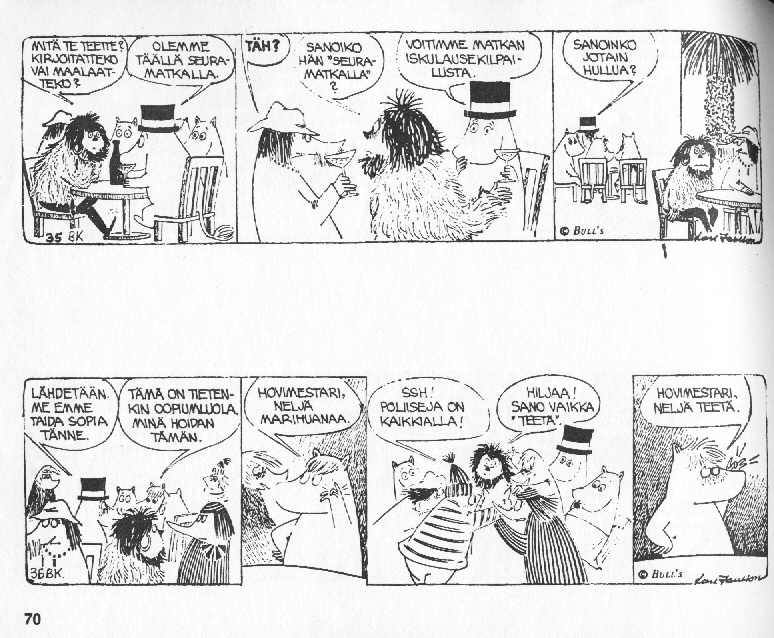
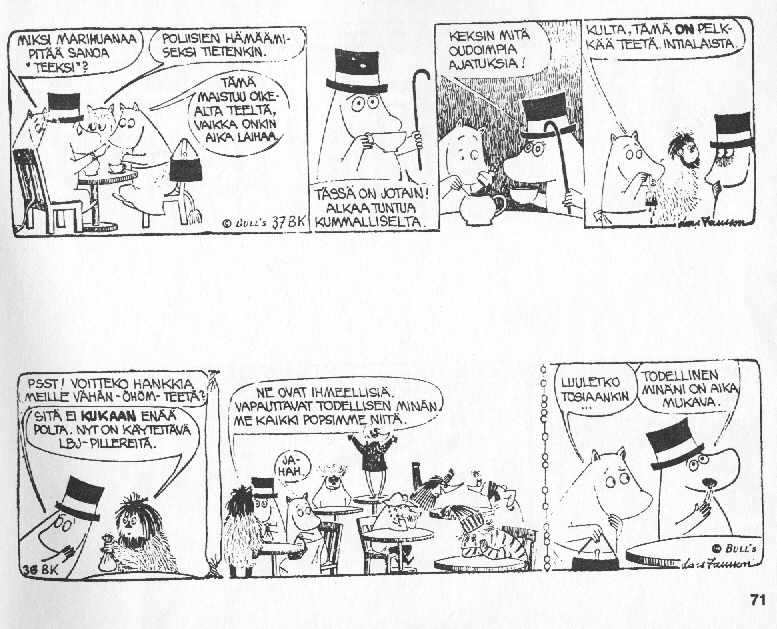
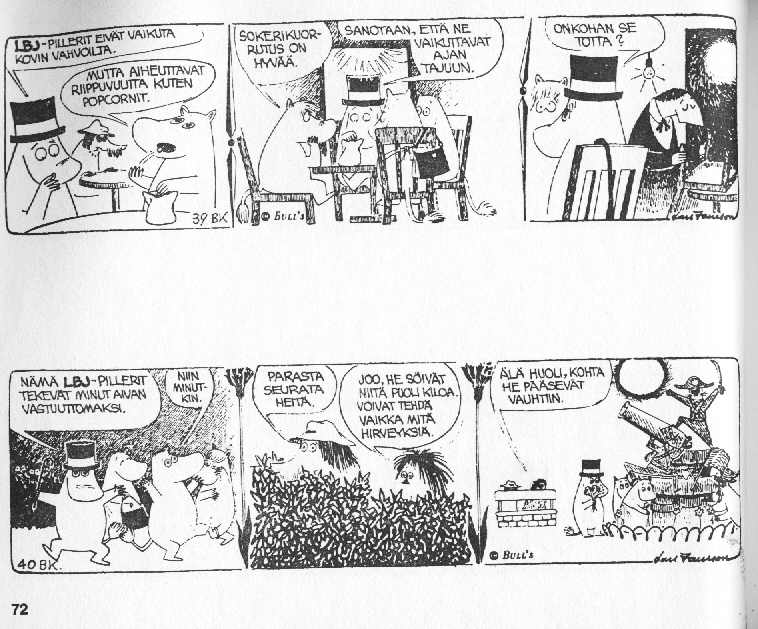
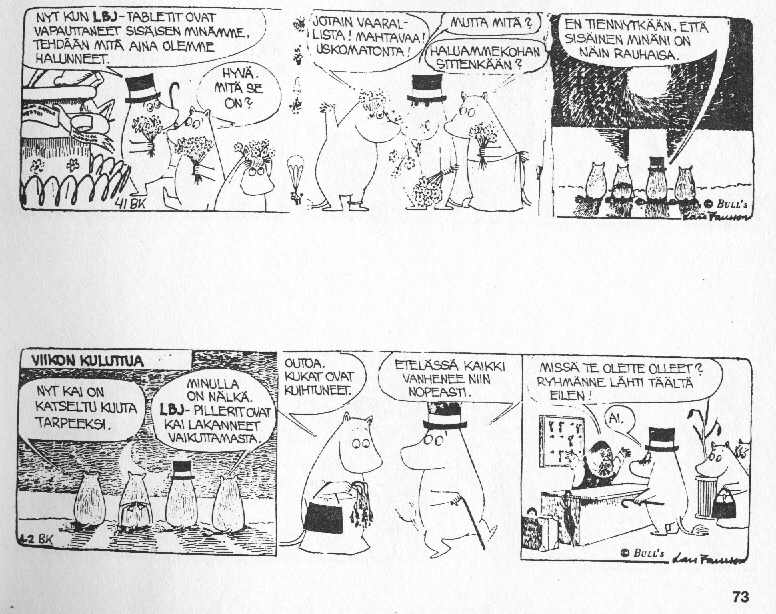
Relevant pages:
https://www.oocities.org/ghb17/muumi/18.jpg
https://www.oocities.org/ghb17/muumi/19.jpg
https://www.oocities.org/ghb17/muumi/20.jpg
https://www.oocities.org/ghb17/muumi/21.jpg
"Waiter, four marijuanas" - they end up scoring LBJ pills instead as marijuana was so last season.
Note that the comic is by Lars Jansson, Tove's brother.
https://tovejansson.com/sv/story/illustrator-barnboksforfatt...
On topic: interesting read. I'd never think these stories had so much dark side to them.
I got all 9 stories in 3 books at the age of 11 and read most of them, and was very happy with the stories, never noticing any of the dread the article speaks about.
Especially the Midwinter story was fascinating - we lived not that North, but in cold winter mid-continent, and the story was like looking out watching for the first signs of the spring, that eventually always comes, but you shouldn't celebrate any of those too early -- when day temperature comes above 0 in March, you know it's going to be freezing in the evening. (Later I was stunned with foreigners in our city complain of this March weather, call it "winter" and be depressed!)
A few years ago someone on social networks posted her impressions from reading them out loud to children -- that indeed it's depressive.
So I guess, the conclusion is that people make opposite meanings and moods of the same events.
Findus is more of experimenter. He comes up with an idea about something, and ends up following that idea so that it gets tested. He isn't a systematic, scientific experimenter though, since he's a cat.
I also liked all the little animals. To contrast that with the Moomin stories, I only saw it on TV, but it was immediately obvious that they were very austere and very Finnish, even though of course, the author is a Finland-Swede. It's good stuff, but can be, not scary, but something adjacent, to watch as a child. It might be worth it since it allows you to understand these characters in this very austere, isolated environment.
As for the Moomins, I don't know what you all are on about in the comments. I'm with OP on this one. Lasting child Moomin impressions:
- Original comic: Dark, heavy, existential, anxious, depressed, sarcastic, "this is probably not for kids". Still loved them and still find them underrated and wish more people read them.
- Mainstream TV cartoon: Fun fantastical times. And Groke (aka Mårran) was indeed nightmare material
- Newspaper comic: Couldn't keep track
- TV live action: Now this was the true nightmare material. I think it was supposed to be lighthearted but my brother at 37 still talks of how it traumatized him.
(FTA)
The Moomin stories were born, Jansson wrote to her friend Eva, “when I was feeling sad and scared of bombs and wanted to get away from gloomy thoughts… I would creep into an unbelievable world where everything was natural and friendly – and possible.”
1959: https://en.wikipedia.org/wiki/Die_Muminfamilie
1969: https://en.wikipedia.org/wiki/Moomin_(1969_TV_series)
1972: https://en.wikipedia.org/wiki/New_Moomin
1977: https://en.wikipedia.org/wiki/The_Moomins_(TV_series)
1990: https://en.wikipedia.org/wiki/Moomin_(1990_TV_series)
2019: https://en.wikipedia.org/wiki/Moominvalley_(TV_series)
The comics and the books are different in genre, even if they use the same characters and storylines. The comics are darkly satirial of modern life while the illustrated books feels more poetic and timeless.
Fun fact: Jansson illustrated The Hobbit and drew Gollum as a giant. Tolkien realized he never described the size of Gollum and made adjustments to later editions.
For those curious like me, here are some low-res images:
https://zepe.de/tjillu/hobbit/index.html
And here an article about the illustrations (haven't read) with a a few images in higher resolution (including Gollum):
https://en.wikipedia.org/wiki/The_Moomins_(TV_series) :
> It is, in contrast to the 1990s series, widely believed to be the most faithful TV adaptation of Tove Jansson's stories, and much closer to her vision. Tove herself had a great deal of involvement during the series' production and was very happy with it (as revealed in an interview with Anne Wood in Simon Sheridan's 2007 book The A to Z of Classic Children's Television). The scripts for each episode were translated from Polish into Swedish and sent to Tove and Lars Jansson, who, if they felt that anything needed to be changed, corrected the script, expanding or rewriting it; afterwards, the scripts were sent back and only then did production of the particular episode begin.
https://en.wikipedia.org/wiki/Moomin_(1990_TV_series) :
> Tove and Lars Jansson were also involved with the screenplay by doing certain changes in scripts.
Everything the Grimms brothers collected and Disney sanitised still hides warnings.
I have read all my children “The Tiger who came to Tea” as well as taken them to theatre performances- and the author ran from Germany hours before the Gestapo came knocking and it affected much of her life and writing (“Hitler Stole Pink Rabbit” is the autobiography I think)
So yeah. It’s got layers onion boy, layers.
Still have fond memories of my kid hugging a six foot moomin in Covent Garden.
"On a summer day, she was discussing literary philosophy with her brother Per Olov Jansson next to the outhouse at their summer cottage in the archipelago. Tove quoted Immanuel Kant, who Per Olov immediately downplayed. To get back at her brother, Tove drew the ugliest creature she could imagine on the outhouse wall. That drawing, out of chance, is the first glimpse of a Moomin-like figure, although Tove called it a Snork."
Another thing is that for long-running franchises, it's really interesting to watch the progression of character design. Both visually and characteristically. The first Moomins look really weird, but fun, compared to the later iterations. Because, of course, the context also changed a lot around them - in real life, not in-universe.
I'm watching them now with our son, and I guess I was just born with a strong appreciation for melancholia.
I changed my mind, when I was a kid I thought they were good, now I think they are great!
In many ways, what makes moomin dark is that it shows us what we already know, the world _just_is_ and in the big picture, does not care about you, you might die, someone you care about might go away, and everyone is, fundamentally, alone, and what makes a person who they are, is partly how they deal with, if at all, being alone in this world of loners.
Moomin is very real and very direct in its dealings with the pain of the meaninglessness of life.
Snufkin, as a child, I took him for a cynic and disliked him, but he taught me something about the world, I think he is a stoic and a nihilist, and I very much like him now, he simply _IS_ in the world, and he accepts, and so appreciates that which also simply is, and which he cannot control.
Yeah, Moomin is dark, but life is dark, life is pleasure and pain, and we will all die, everyone we ever loved will suffer and die, but they will also experience pleasure and life, one could chose only suffering and death, one cannot chose only pleasure and life, and must come to terms with the fact that the underpinnings of pleasure and life is indeed suffering and pain. That's it, the world just is, and we're just in it.
I feel like a lot of the cartoons and tv shows of my childhood was like this, life.. it kinda has bad parts.. and back then, they showed them to kids, and what do I know.. maybe it prepared us to take it on ?
https://www.moomin.com/en/blog/who-will-comfort-toffle-backs...
> But when he tries to write about how lonely he has been, About his house and Hemulen, the smooth white shell he’s seen,
> The Groke, the night he sailed the sea, he finds no words will come. He is too shy to write his tale. Poor Toffle is struck dumb.
> So Who Will Comfort Toffle now? Will someone lend a hand And help him write to Miffle so that she can understand?
Mozzarella is moomin meat.
It used to be even more but someone from Japan found a few.
And the creator refuses to talk about some of the lost episodes.