LLMs are still waiting for their autocomplete moment: when they become an extension of the keyboard and complete our thoughts so fast, that i could write this article in 2 minutes. That will feel magical.
The speed is currently missing
Just today I generate U-Net code for a certain scenario. I had to tweak some parameters, at the end I got it working in <1hr.
This is my biggest fear with everyone adopting LLMs without considering the consequences.
In the past, I used "Do I have to write a lot of boilerplate here?" as a sort of litmus test for figuring out when to refactor. If I spend the entire day just writing boilerplate, I'm 99% sure I'm doing the wrong thing, at least most of the time.
But now, junior developers won't even get the intuition that if they're spending the entire day just typing boilerplate something is wrong, instead they'll just get the LLM to do it and there is no careful thoughts/reflections about the design and architecture.
Of course, reflection is still possible, but I'm afraid it won't be as natural and "in your face" which kind of forces you to learn it, instead it'll only be a thing for people who consider it in the first place.
Yes AI makes mistakes, so do humans very often.
I remember.... I turned it off immediately.
Hope the Next Big Thing (TM) is the Electric Monk.
I feel like the opposite/something else is missing. I can write lots of text quickly, if I just write down my unfiltered stream of thoughts, both together with and without an LLM, but what's the point?
What takes really long time, is making a large text contain just the important parts. Saying less takes longer time, at least for me, but hopefully saves the time and effort for people reading it. At least that's the idea.
The quote "If I had more time, I would have written a shorter letter" comes to mind.
At that point any other human being will likely also have one to scan incoming text.
I’m OK waiting 10 minutes with o1-pro, but I want a deep insight into the issue I’m brainstorming. Hopefully GPT-5 will deliver.
so people will do it, people will be annoyed by it, people will prioritize to more efficient communicators
or
“That,” replied Hardin, “is the interesting thing. The analysis was the most difficult of the three by all odds. When Houk, after two days of steady work, succeeded in eliminating meaningless statements, vague gibberish, useless qualifications—in short all the goo and dribble—he found he had nothing left. Everything canceled out. Lord Dorwin, gentlemen, in five days of discussion didn't say one damned thing, and said it so that you never noticed.
It's lossy expansion. The worst of both worlds!
maybe we end up back at hieroglyphs.
Totally agreed. I'd like to cut to the point with a bit of pleasantry at the beginning just because I have to.
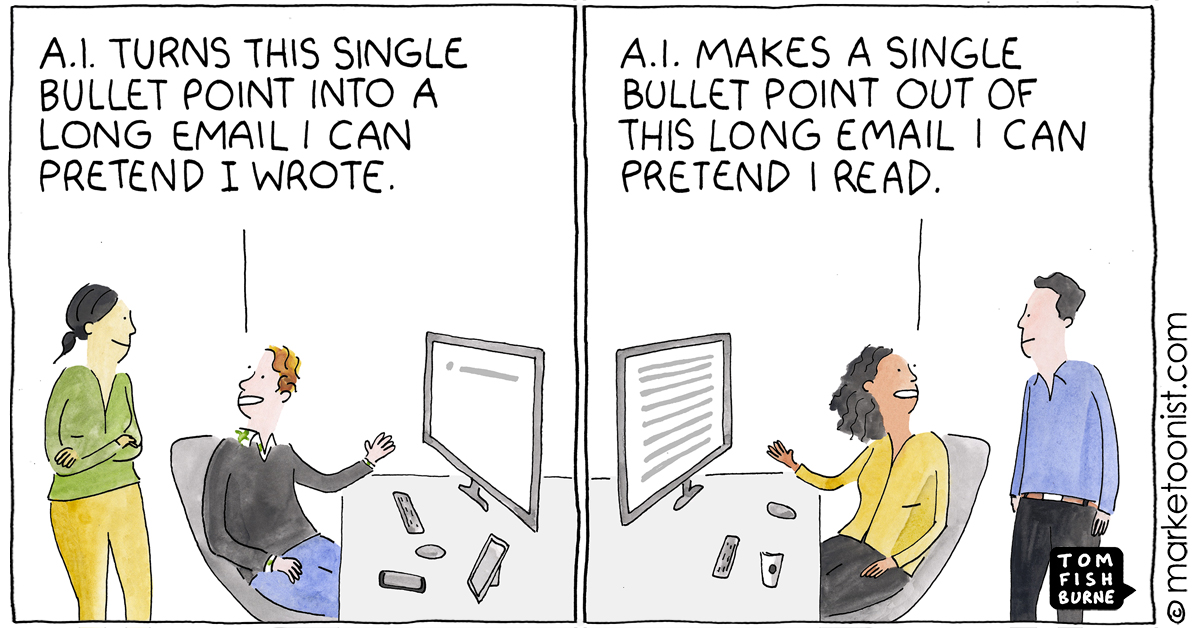
at least everyone can also let it be summarized for us then
The way in which we create and consume information has a direct effect on our experience of the world, and I think there is a deeper point to be made here about how the way we use communication technology. The endless firehose of information is drowning our brains to the point that we are compelled to find a way to cope. But I would argue that the way to do that is to rate limit receipt of messages so that only the quality stuff gets through, rather than letting everything through and destroy every human aspect of them in the process. It’s Twitter’s 140 character limit argument from last decade all over again; the medium becomes the message, so we must be careful what mediums we use.
That was the case prior to the availability of LLMs. However, the practice of sending over LLM-expanded content from the sender to the recipient and the use of LLM-aided summarization on the recipient's side is only about to become prevalent. Once it reaches some sort of saturation point, people would either forego LLMs entirely, or move to other forms of communication that you speak of where this sort of social convention won't be needed entirely.
In my case, I predict that this is going to make people interact a lot more in meatspace and supersede Internet communication in the same way email has been relegated for many people over channels such as Discord, WhatsApp, etc.
Why not just adopt a more direct style of communication? Why fret so much over emails? You wouldn't leave an actually important e-mail to an LLM, I would hope not. And, if it's more casual (even in a work setting), just write as you usually do, the other person most likely knows you and doesn't give a shit.
or have I just had bad luck
You are correct of course, The fluff is the "delivery vehicle" but that also introduces errors.
the problem is, this kind of extra information is hard to do effectively, and its not really taught formally. Worse still its very hard to do if there are cultural or neurological differences(ie being on the spectrum, or a Dutch person talking to someone English)
I actually do the reverse of the example the author gave (bullet points - fluff). I give train of thought to an LLM about what I want to communicate and instruct it to use no BS and make it tight and it gives me a well structure short message with clear action items logically structured. It adds the minimal amount of fluff (e.g. "Thanks for taking the time to speak with me today") but it makes it a lot easier for the other person to comprehend, without using an LLM.
The "fluff" is a careful orchestration driven by our desire to maintain social standing. 5,000 years ago rejection by the tribe meant death, and that fear is subconsciously influencing all our communications and actions. That is why a bullet point email of what is wrong with a coworker is not acceptable, it lacks all the nuance that allows you to read into the other persons past perceptions and future intents.
As far as I can tell, he dropped this thread, and there wasn't, "more on that in a moment."
But I'm kinda surprised why he "hasn't a clue" that the answer to that question is a clear "yes." The whole point of school is to teach kids to use their brains, and reading something complicated, understanding it, and being able to synthesize something about it is a pretty important brain-use.
> Here we can think of the long email with meaningless fluffy padding as being the business speak protocol that office employees communicate with today. And we can think of the bullet points as how we actually think.
You've got to be careful to not overgeneralize this kind of observation, a problem that software engineers are especially prone to. Sometimes the "fluff" is meaningless, and "bullet points" are all that's really there. Other times the "fluff" is important stuff that the person making the judgement just doesn't understand or has trouble comprehending.
Software engineer types are often pretty ignorant, without really realizing it, and often assume their superiority because "intelligence" or some dumb shit like that.
Yes, LLM expansion of bullet points is fluff that wastes everyone's time, but that doesn't mean all or even most true thought can be compressed into concise bullet points. Furthermore, even when it can, there's are often good reasons why the most concise and compact form is not the most desirable presentation.
It’s clearly on display here. He made me skeptical when he pooh-poohed the importance of reading books and writing about them in school, and lost me when he casually claimed that all people think in bullet points. These things are incredibly egocentric and stereotypically engineer.
First part of the problem is we need to stop cookie cutter course lists. Forcing people to take a course they don't care about is a futile ability. Back in the day it was easy to do it, but now it has gotten harder due to LLMs and reliance on exams as a compliance tool. Yes, this will make it harder to say someone has a degree in X. Instead you will have to handle a bit more nuance and discuss what specific topics they studied.
Second part is we need to dial down the credentialism. Treating third party exam grades as an indicator of ability is no longer feasible in the LLM world. The only viable way is to have a extremely controlled exam environment, but that greatly restricts what sort of things you can examine. A lot of knowledge is relevant on a timescale of days or longer, not a few hours, and you can't detain people for days just for an exam grade.
Both of this are challenging for sure but I don't think it's impossible. The programming industry has dealt with this for decades. When someone has a degree in CS or related area, it doesn't mean all that much in practice, and the GPA in that degree is also a weak indicator. Instead, the industry found other ways to directly evaluate ability. Sure, they're not perfect, but not exactly hopeless I would say.
As a student I was forced to take classes I would have never willingly chosen to take, and yet I still learned from them. I worked for an A and didn't consider cheating an option. I'm not really sure why, I can answer why I wouldn't today, but I can't particularly say why my yesteryear self was so against it, yet it remains as a key point in me gaining a very useful education.
>Forcing people to take a course they don't care about is a futile ability.
While I think sometimes we include too many unrelated courses, I also don't agree with the idea of only giving someone courses they are interested in. I would have been weaker for it. I think the issue is the culture that encourages cheating as a valid response, but where does that come from and how to fight it are massive problems.
>The only viable way is to have a extremely controlled exam environment, but that greatly restricts what sort of things you can examine.
I think oral exams are great at testing knowledge, but they suffer other problems. They don't scale at all, and they leave more room for bias than other forms of exams. I'm sure there are other problems, but those two are enough to start with. If only there was some option that had the benefits of an oral exam with an expert without the issues (this sounds like I'm hinting there is such a solution, but I promise I'm not, it is just wistful thinking).
I also believe that there's something to be said about being able to sit and focus on something like reading a book for a long period of time. Patience and focus seem to be diminished these days.
Some level of long focus and deeper awareness of written material is necessary to create anything substantially new and massage it into what you actually desire.
I understand where you're coming from when it comes to technical stuff - I would agree that I haven't gotten very much of my engineering knowledge from books, but rather from shorter-form stuff.
But there are so very many things I've read over the years that have stuck with me, that have informed the way I think about the world, that have provided comfort or food for thought or new lenses through which to view things. My life would be so much poorer without the books I've read, they all mix around in my brain and come to me at random times, and give me a lot of use, even if it's the kind of "value" that is hard to quantify and pin down.
The problem with this post is that, despite mentioning programming languages in the title, the examples are about writing emails. The author forgets to address programming at all, which is very much a use case and will remain one as processors only run compiled machine code and not bullet points.
AI diplomats talking to each other, while humans stick to communicating via bullet points.
I'd be okay with that! Verbosity has become too pervasive as of late.
I'm not convinced myself AI will have much impact on the developers landscape, beyond better autocompletion and doc generation.
All these fancy AI developers are cute, but we have had the cheaper vs lower quality trade-off available for quite some time now with outsourcing to emerging countries. When I was in my studies, we heard all the predictions of the destruction of software engineers because of outsourcing, the need to become an architect instead of a developer or you'll be replaced, etc.
I've seen none of that happen over the years, except for very low skilled automation / CRUD jobs.
I’ve been a developer for 20 years. Using an LLM to generate context-specific prototypes has completely changed my productivity. It has allowed me to start and finish projects that were previously relegated to “maybe someday” (read: never).
It’s not clear what the net result will be in the long run, but it’s already changing what and how I build things, and I’m not nearly as bearish as I was before a few successful projects.
I don’t think AI is going to replace good engineers. It’s going to make good engineers better engineers. This alone will lead to some interesting outcomes I think.
A lot of low level stuff has been outsourced to India over the last decades, and more if you count second or even third level support (won't even include first level support that's not required to be on-site).
C-levels only see the expenses savings, but how their employees feel about internal support being utter dogshit can't be quantified in a language that beancounters speak...
I do agree with the fact, that this is an annoying phenomenon. It took me a while to understand that there are people who are not just using LLM to write these style of emails, but those people are the source of the training data for LLMs.
The solution is "simple", to move aways from such people and stick to genuine communicators.
Though I suspect many of my emails go unread, and people have confessed that they ran my personal messages to them through an LLM to generate something for them to report up in some spreadsheet etc tool.
Or in the case of some managers for whom the critical technical detail goes over their head, they just re-ask their questions in a call and try to get to “is it done yet” and “how many engineers can I add to make it go faster”.
I think I might be on the chopping block if a move was made to get rid of overly-thorough verbose communicators, genuine or not
I'll celebrate the day this happens and gets widespread. Conversing with Americans is painful compared to Germans, because Americans insist on being coddled all the time and the very second you don't they'll complain behind your back to your boss.
Fun fact - that cultural difference was also a huge part why Wal-Mart failed to gain traction here in Germany. German consumers really didn't like staff welcoming them with a forced smile, that and bad press from crossed labor laws was their downfall.
Walmarts notorious "people greeters" are there to prevent theft, and as far as I can tell, the people greeter reason seems to be purely speculative, and less explanatory than more solid political reasons (established competitors conspired, just like Walmart does to incumbents in the US).
How is some old pensioner sitting (or worse: standing) at the entrance going to deter theft? Thieves don't care unless there are actual security guards on patrol.
A very distressing experience that prompted me to change how I approach take home assignments.
At least one or more of the following MUST be true:
- Take home takes 2 hours or less
- Take home has a posterior instance that will take place with a human being in order to allow me to defend/discuss/expand the take home. Of course this assumes I eliver something that is not just the word "farts" in a txt.
- Take home is monetarily compensated.
These are heuristics that do not imply I am an impressive IC or something like that. It's just self defense.
Excel '98 probably covers 90% of what the average excel user needs, yet here we are with a grossly bloated SaaS excel app in 2025. Constant SaaS feature-pack enshitification that people are either pushed or tricked into.
I think software is in a for a big disruption when people realize they can prompt an LLM "Make me a simple app for tracking employee payroll for my small business. Just like lotus 1-2-3 was more than capable of doing 40 years ago."
Although LLMs have a tendency of using — in place of - - which is the one I use.
Which is, to keep using LLMs as reviewers, rather than as writers.
In fact, if the author feels confident in this theory, I suggest they replace the blog post with this AI-generated bullet-point summary I just made...
The short prompt leaves a lot of room for interpretation. The code itself leaves zero room for interpretation (assuming the behavior of the coding language is well understood). I don't agree that AI will allow us to start relying on code that isn't fully defined just because it might allow our emails to remove fluff that didn't contribute to the meaning at all.
Do the rest of you really do this? I can’t recall receiving any slack or emails with this sort of thing over the 25+ years I’ve been working in a business environment, even though all of them have been in American English. I certainly don’t use that sort of “boilerplate”. I just jump straight into what the topic is.
Not only hasn't the person thought about it or invested in it, but now they're jamming my ability to read into exactly what that one person said, and how they said it.
Many people have made the observation/joke that meaning->LLM->LLM->meaning is silly, but I don't recall anyone pointing out that information that a skilled reader/listener can discern from direct expression is lost.
I'm not sure about you all, but as a non-manager at [big tech company] I can count on one hand the number of actual emails I've sent in the past year.
Everything is IM chats. Its actually pretty nice
In the overall software development process, lots of people contribute different things to create the product.
The job of the software developer is to bring the amount of ambiguity in the specification to zero, because computers can only run a program with zero ambiguity.
There have been lots of high level programming languages that abstract away certain things or give the programmer control over those things. The real thing that you want to do is pick a programming language that allows you control over the things you care about. Do you care about when memory is allocated and deallocated? Do you care about how hardware is used (especially GPUs and ML accelerators) or do you want the hardware completely abstracted away? Do you care more about runtime or dev iteration time? Does your program need to exist in a certain tech context?
There's no programming language that will let people who care about different things deal with them or not deal with them.
Yes, AI is going to change the world, not as anyone seems to be discussing. We've created interactive logical assistance for everything and anything intellectual anyone does. The ramifications of this are ambitions requiring intellectual difficulty are going to skyrocket. This is thanks to the magical thinking that is already rampant is all aspects of society. Net result will be significantly higher demands on anyone with a knowledge based career, after all "you have AI assistance now, why are you not 10X?"
We will all be forced to become adept using AI, and not just casually. We will be required to operate on our intellectual edge, or we will find ourselves unemployable.
Thats the way it'll change the world, think manufacturing job losses in Europe/america. in the late 90s/00
It's fine to see Thomas catching up with the times, but two pages of writing seems a bit overkill, imo.
Edit: Found it, https://marketoonist.com/2023/03/ai-written-ai-read.html ... and yeah two years ago to the date, always right :).
The reason it won't matter "long term" is that e-mail clients are solving/will solve[0] the "give me 'the point' of this e-mail." If my couple of decades of experience across multiple employers is any indication[1], the vast majority of people in software development fall into one of two camps: (a) They don't have the basics of written communication down. It's not a matter of misspellings or improper semi-colon, or emdash. It's all lower case[2] with no punctuation, or with "..." (no spaces between, either) in place of every other form of punctuation. Or (b) they are generally grumpy people who write in a manner that fits their personality.
Conveying tone, correctly, via written text is hard unless the tone you're trying to convey is "frustration/anger/impatience". And, of course, the same folks who can't figure out punctuation tend to respond tersely. Between co-workers who work closely together, that's preferred. When my boss has to tell me something minor about my performance and sends it in a five-word e-mail, it comes off like I need to start looking for new work. Prior to AI, "good managers who were writing-challenged" would find templates online and replace words. It never sounded genuine. AI brings us a lot closer to that, while not requiring an enormous amount of effort on the part of the writer. It'll be a matter of time before a lot of that process happens within the client (if it doesn't, already). I know tone detection is a common feature on communications tools I use[3].
[0] Not entirely sure; I use e-mail so infrequently, but thinking about the chat app we use at work, it provides AI summaries of the day's chats in each channel.
[1] Anecdata, I know, but it's all I've got
[2] Including the first letter of every meeting invite and subject; if I have OCD, that triggers it.
[3] Divorce communications ...
AI will change the world, but not in the way the OP (Thomas Hunter) thinks.
--
The first statement, AI will change the world, is low surprise and clearly true already.
The second statement, not in the way X thinks, is also low surprise, because most technologies have very unpredictable impacts, especially if it is "close to singularity" or the singularity.
I hate titles that attempt to address the reader directly and personally when they can't possibly do so.
You can express the same idea without using this tactic. Just say "... but not in the way most might think"
"This HTTP call has no message body and therefore no content, and can thus be ignored" he said confidently, not noticing the status code. The verbiage is where you find out useful information, like whether the speaker is on your side and whether they understand the problem the same way as you and whether they're dumb. It's not as if the reason we didn't adopt bullet-points-only ten years ago is that it required better AI.
More generally, I submit that when faced with a long email thread, skim reading is superior to LLM summaries in all cases (except maybe the one where the reader is too inexperienced to do it well). It's faster, captures more detail, and (probably most important) avoids the problem of the people on the thread coming away with subtly different understandings of the conversation.
Taking wagers he only knows English