1. Supply chains and key raw materials mostly controlled by China
  2. Japan's demographic collapse
  3. Japanese Gen Z fed up with an unwinnable rat race where they live to just pay rent and groceries
[1] https://carnewschina.com/2025/01/13/byd-surpass-toyota-in-ja...
Sales of EVs in Japan fell 33% y/y to 59,736 cars in 2024, the first decline in 4 years.
EV's share of all vehicle sales fell below 2% in Japan
The current crop of Chinese electric car makers are all trying to fake it until one of them makes it and the money spigot keeping them afloat will eventually get turned off at some point.[0] Good luck keeping that flashy EV running when the company goes bust.
[0]https://www.businessinsider.com/chinese-evs-losses-widen-des...
Premium cars that aren't so premium as to be disposable (i.e. not a luxury car you're gonna trade in every 3-5yr like clockwork) always last really well because people who can afford nice things can generally afford to maintain them.
This is pretty clearly borne out when you compare same cars across brand e.g. Ford Lincoln Mercury panther platform cars) or look at the exceptions like all those objectively terrible northstar caddilacs and v12 Jags and whatnot that are in impeccable shape because they got used and maintained nicely for a decade before being "retired" to the garage of the owner's vacation property on Cape Cod or perhaps the Hamptons or compare airport people moving vans that were retired to church group service to work vans that got sold down the river to even harder service.
It's really easy to "well we really should sell a water pump while we're in here for your 100k timing service" on a Subaru owned by someone who can afford a Subaru vs selling a preventative transmission fluid change to the guy who could barely scrape together the down payment on a Sentra.
I'm being a little sloppy and leaving some loose ends and room for nitpicking jerks to wedge in but I think the point here is pretty clear.
Tesla/Nio are a bad examples - many EVs were built to be sold and essentially ignored by the manufacturer.
Compare these:
(germany) https://population.un.org/wpp/graphs?loc=276&type=Probabilis...
(alternatively, Europe as a whole) https://population.un.org/wpp/graphs?loc=908&type=Probabilis...
(Japan) https://population.un.org/wpp/graphs?loc=392&type=Probabilis...
(China) https://population.un.org/wpp/graphs?loc=156&type=Probabilis...
to this one
(US) https://population.un.org/wpp/graphs?loc=840&type=Probabilis...
A key aggravating factor is most countries in the first group have stagnating productivity and the country in the second group has raising productivity on top. This creates a compound advantage for the country in the second group.
It seems likely to me that there is almost no degree of anti-national behavior the government of that country would need to exhibit or no amount of country-eroding policies that could forfeit this fundamental advantage. They'd need to get their country literally nuked or something similarly catastrophic.
Europe has largely converged on American growth, the East in particular continues to grow fast. But more important is that this is obviously an intentionally selective group of countries. Add Taiwan or South Korea to this story and it becomes a lot more complicated, because the latter is about to/has overtaken Japan on a per capita basis while having some of the worst demographics on the planet.
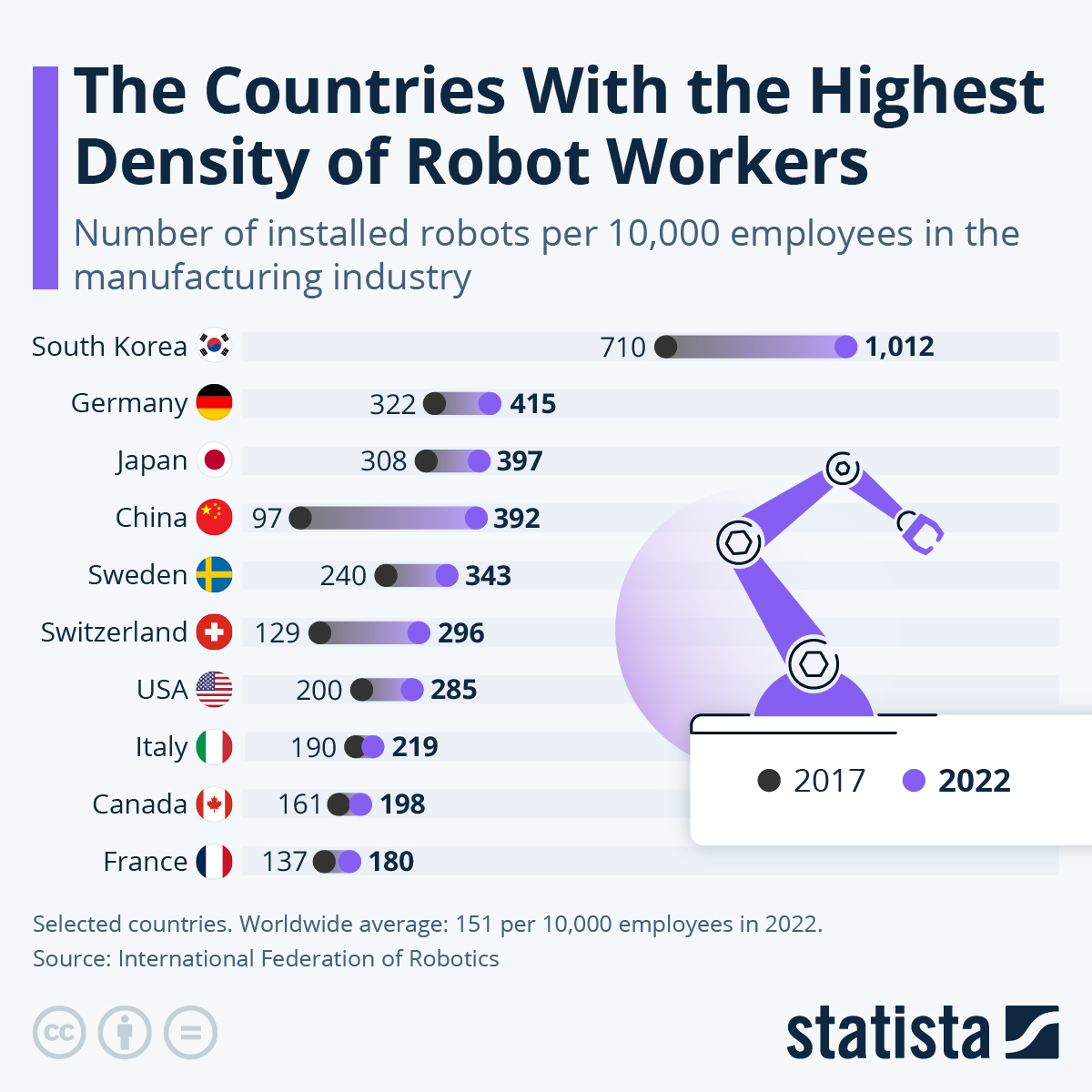
There's research by Keyu Jin that actually shows the opposite, globally growth after the year 2000 has been faster in aging countries for the simple reason that it increases returns on labor saving technology, i.e. automation (telling image:https://cdn.statcdn.com/Infographic/images/normal/13645.jpeg) and that is, even if you are conservative on technological developments in the next few decades, likely to accelerate quickly.
  1. median IQ
  2. skills
  3. future unfunded liabilities (welfare, pensions, public health, etc)
I hope China learns this lesson an makes some changes. At least they have a bit more runway to do so.
* https://population.un.org/wpp/graphs?loc=124&type=Probabilis...
When shit hits the fan, there will be drastic changes, just like how Japan is accepting more and more immigrants every year. That tap will be cut of in a decade or two, because every country will be fighting for them unless we have some magical economical overhaul. I have zero clues what predictions can be made for 2050 in terms of demographics.
As for point 3 it also feels odd. When we check stats in the 3 Asian Tigers, the rat race (and young population sentiment around it) seems like Japan < South Korea <<< China. And usually my friends from those countries usually feel the same way. Lie down movement, all the frustration in SK showed to the world through their entertainment kinda shows this too.
It's quite possible to win a market with 30-50% of people liking you. Any if right wing customers buy Teslas for political reasons rather than utility they could reduce quality and increase pricing do even better financially.
They are widely cited as unreliable, poorly built vehicles. My neighbour bought a used model S and the first time he saw us after buying it he came over to justify his purchase ("Got a killer price, etc").
I don't know if that's true, but I find it all pretty funny regardless.
Five or more years ago, people hated Tesla drivers, either because they represented wealth or that they were seen as progressive 'tree huggers'.
Today people seem to hate Tesla drivers because the brand is for right wing nazis.
I think both takes are misguided, and I don't know how popular those takes are, but I can't help but finding the 180 humorous.
For context, I'm not taking a side and don't have a strong opinion either way. I don't own and wouldn't own one, but for reasons with nothing to do with politics or quality.
Now that other companies are making EVs that compete directly with Tesla, they aren't reliably best-in-class or best-in-price-point anymore. Compare the Rivian R1T to the Cybertruck, or the Equinox EV to the Model Y, or the Ioniq 6 to the Model 3. The top of the line Model S still doesn't really have any viable competitor.
Tesla has phenomenal battery and motor tech, but their actual car design leaves a lot to be desired, and that's starting to hurt them now that they aren't the only game in town.
And the fact that their CEO throws Nazi salutes at political rallies does not help their market share. In Europe at least that's directly impacting their sales.
Come now, even the Anti-Defamation League, hardly a habitual supporter of Musk, disagrees with this take. Your opinions are your own and you're free to believe he did Nazi salutes, but it does make you sound like you have an axe to grind.
And maybe your response to all of the above is that Tesla will not be allowed to fail as part of an industrial strategy on the part of America, in which case the question is why would the other domestic manufacturers like Ford and GM be allowed to fall by the wayside? And further, why would Japan not also embark on a similar strategy and prop up their domestic manufacturers?
Any way you look at it, a prediction that China wins out everywhere except for plucky old Tesla moving into the "Apple" position seems like some sort of bizarre partisanship/home team support that doesn't stand up to a moment of scrutiny.
It works for Apple. When you're premium you can charge 2x as much, because your market isn't as price-conscious.
> why wouldn't current halo manufacturers like BMW and Mercedes and Lexus also try for that market, and why are they sure to fail while Tesla succeeds?
They will. They're not. But Tesla has a fighting chance, in a way that companies trying to compete with China in the commodity EV market don't.
Tesla doesn’t make a car as nice as the Air Sapphire… I don’t think they could if they wanted to. So they’re forced to stay in the less expensive / less quality market segment
TBH if I were on Tesla's board I'd be pushing for a stock-funded takeover of a company that has an actual plan and ability to deliver it. Merge with (say) Stellantis and they'd have a survival plan.
Carlos Ghosn was able to "turn Nissan around", but it was at the expense of future product capabilities (in my opinion) [Disclosure I work for GM, this is solely my own opinion]
Also, I must say that it is not clear to me that anyone could know what a long term winning play looked like 10-15 years ago when the damage was done (in my opinion). It takes a lot of effort and money to make a mediocre automobile, it takes a lot more to make a high quality automobile.
Technical competence is generally very hard to judge and often even harder replace. It's not surprising that the same management types are salivating at the thought of replacing people with AI.
By all estimations he's a genius with as good of chops as anyone could ask for his responsibilities, with a unique set of citizenship, connections, and multilingualism to go with it. Even his escape from Japan was just stunningly executed and the perfect selection of professionals with technical competence to pull it off.
They missed the electric wave sure, but as with any innovations the more competent you are in the previous wave of technology the harder it is to switch to the new one. But it's a different kind of problem.
At an end-user level it always was easy to judge that Honda was at the top for technical competence. The same it true for judging the bottom rung. You can judge by favoring high quality products, or by disfavoring businesses that try to sell you on sizzle and "fun". It's all the same.
I was under the impression it mostly failed because of how bad it was at software, and the strategy tax hitting them heavily as their ecosystem was penalized by that weakness, so I'd be glad to hear a different take.
The company comes into being to make widget x, and never cares / is able to make another product again.
I mean, that's kind of how it all happens anyway. The people who stick through things and make the thing go away anyway. the ip is then acquired.
It depends. If you see a lot of insider buying after a bottom it can be a good sign that there's strong internal faith in the companies future. I've used it as a buy signal myself before when a market cap is high enough. It has paid off.
> it is not clear to me that anyone could know what a long term winning play looked like 10-15 years ago
Well it probably _wasn't_ partnering with a Chinese state company to try to expand the brand there. That was a poison pill.
The issue is that power got to his head and truly believe he was the second coming of Jesus or something, and stopped improving his companies to rub shoulders with the Nepo CEO/aristocrat crowd. Had he continued the push toward affordable EV, Nissan could have been BYD, but R&D stopped, for no visible reason.
My personal theory is that the fallout from his divorce estranged him from his early friends and his closest advisor (his wife) and idiotic sycophants made him believe he was above the law and deserved even more. I've heard a lot of good things about pre-2008 Goshn, from people who aren't usually glazing billionaires, so maybe I'm biased.
Yes, I've noticed that people having nasty public fights with family members can lead to extremely negative effects on decision making.
There was an interesting interview with him where he commented on the, then, still active negotiations about a possible merge of Nissan and Honda.
Very interesting to listen to. He identified that there was essentially no synergy between the two and that a merger doesn't really make sense for either company. They don't really complement each other. After the merger, you'd merely have two of each in a gigantic company that isn't performing great. Similar cars, going after similar buyer segments, competing EV strategies and related investments, etc. Except Honda is a bit better than Nissan. So, they'd be ending up inheriting a lot of problems whereas Nissan wouldn't really gain anything they don't already have.
The core issue is that Nissan in particular needs to adjust course and is not willing to do that. That's also the reason this deal is collapsing: Honda doesn't want to make Nissan their problem and Nissan is rejecting the notion that they need to change.
Ghosn's analysis was pretty sharp: https://www.youtube.com/watch?v=ljewn28Korw
Well in all fairness he is above the law. He walked out of Japan and is free in his country.
Nissan is clearly an anchor, and acquiring it would have just dragged Honda down .
I have a friend who worked for Honda as an engineer in the past decade and he concurred. He said the goal was seemingly to make everything as "mid" as possible.
Their utter snoozing on the hybrid/EV game is baffling. I am not sure how much of that was a failure to see the future, and how much of that was (perhaps?) due to Toyota snapping up a bunch of patents on basic concepts.
My extremely loose understanding is that you can't realistically build a hybrid without licensing a bunch of Toyota's patents, but, I could be wrong. (I mention it in the hopes that somebody with actual understanding can confirm or correct)
https://www.msn.com/en-xl/news/other/honda-s-ceo-struggles-t...
The merger/buyout collapsed because Nissan is too proud to admit that they have failed and aren't in any position to be making demands.
Also, this is a tangent but with the US Steel buyout/investment from Nippon Steel being a common subject matter these days, remember what Japan did to protect Nissan every time they bitch about the US protecting US Steel. What goes around comes around.
Not in Asia, the worlds biggest car market, and where the worlds biggest car making country is. More than anything, low end electric cars are MASSIVELY popular in China.
Companies are so much more than the consumer experience.
When Ghosn got arrested, the Alliance Renault-Nissan was shredded to pieces. Many in Europe (including myself) were betting on a Nissan survival and a quick death of Renault.
Renault that was the sick dog of the French automotive industry for decades. Mainly due to bad business decisions and a lot of debt dating from before the arrival of Carlos Ghosn. With Ghosn in exile and no clear successor: there were very little optimism in Europe about the survival of Renault.
But ironically: that could not be farther from the Truth.
Renault get away with a pretty well executed electrification. It is now hyped and healthy.
Several models have been acclaimed by critics [1] and are even qualified as 'sexy' by the younger generation. It also sells well: The Megan EV sells well, so does the R5 and the Scenic. Renault even outsells Stellantis in Europe[2]: Something that did not happen for decades.
And near to that Nissan, the big one in the story, seems to go from bad to worst.
Nissan's stocks are going straight to the ground and with pretty worrying financial status. Nissan seems stucked with a conservative Japanese high level management unable to understand nor execute the changes the brand need. They completely miss the electrification: The leaf is outdated, the Ariya arrived late and full of problems[3]. And the rest of the product ranges do not sell well at all outside of Japan.
Nissan need urgently help, and pretty much nobody want to work with them in Japan.
This is again one of this twist of fate that only the automotive world is able to provide.
[1]: https://www.topgear.com/car-reviews/renault/megane-e-tech-el...
[2] https://www.reuters.com/business/autos-transportation/europe...
[3]: https://www.ariyaforums.com/threads/so-many-issues-with-less...
Yes. This is also quite a twist of fate because 10-15y ago it was exactly the opposite.
Renault had the reputation of poor reliability with a lot of problems regarding electronics while the old TUs engines from PSA (now Stellantis) where rocks solid monsters you could bring to 300k km without a swet. Many of them are still alive and way over 1M km in northern Africa.
This applies to all Japanese car companies now. They've basically told China, "Please, take the loyal market we've built up these past 40 years. We don't need or want it. We want to die."
It makes no sense.
They're betting on ICE vehicles losing no demand and on "clean" hydrogen completely displacing all demand for electric vehicles entirely.
And a quick rundown on how clean hydrogen energy works in Japan: they burn coal or petroleum to make liquid hydrogen that will replace petroleum-burning vehicles. So instead of using fuel directly, they burn stable fuel that can be used in most cars to make unstable fuel that can't be used in any cars. Smart.
It is more complicated than that.
The Chinese government in the last decade made the life of foreign automotive brand un-manageable. Most of them (outside of the luxury market) are now getting out.
They enforces rules that are clearly designed for IP leaks and takeover. For instance: For every vehicule sold in China by Toyota and others, the source of the software need to be sent to the Chinese authorities.
This is not a market that the Japanese want to stay in: They know they are playing against someone that cheats with the rules.
I'm assuming you live in the US: how many US consumer companies could you cite that make product that are almost useless in the US ?
For instance, would you see Tesla make mainly cars that extremely well adapted to small and tortuous old european cities ? Or would you image Apple's next iPhone line to be fully revamped to only work with Felica NFC payments, dropping credit card and Apple Pay support ?
That is kind of how electric cars are positioned in Japan, and Toyota is a Japanese company. The market exists, but is marginal and not where the country is putting its weight on (I think you'll understand why nuclear energy in Japan much more controversial than in the US)
As stated in the article - "the merger talks unravelled in a little more than a month due to Nissan's pride and insufficient alarm about its predicament"
More critically, Japanese automakers have always tried to diversify away from Japan as part of the "Flying Geese" paradigm.
For example, Toyota and Honda truly became "American", Mitsubishi truly became "Southeast Asian" (Indonesia, Philippines, Thailand, Vietnam), Isuzu became "Thai", and Suzuki became "Indian".
Nissan on the other hand tried a foreign expansion with the Datsun in the 1960s-80s, but that crashed and burned horribly, and reduced their appetite to expand abroad.
Post-Datsun, most of their international expansion tied their future to Brazil, China, and India as part of the Renault-Nissan partnership under Carlos Ghosn, but that itself came very late (early 2000s) and other players (domestic, international, and Japanese) were well established in those markets already.
Furthermore, Nissan Group's prestige division Nissan Shatai is too entwined politically to Kyushu, which scuttled the merger as Honda would have shut down Nissan's Kyushu factories which represent much of Nissan's capex.
Fundamentally, Nissan's leadership has a low appetite of taking risks abroad after the failure of Datsun, and this would have been toxic for an internationally minded Japanese firm like Honda who has stronger PMF abroad compared to domestically in Japan.
Japanese companies like Nissan and Honda are a bit on that losing side. Quite literally; both are struggling with rapidly reducing demand for their now clearly obsolete vehicles and the ramp up of the production of competitive EV replacements for those.
Nissan basically dialed back investments after they got rid of Ghosn and the collaboration with Renault. Which was actually producing some early successes. Like the Nissan Leaf. They could have doubled down on that but they didn't.
Now years later they are basically facing a lot of issues with with an outdated product portfolio that can't keep up with new EVs from others grabbing lots of their market share in most of their key markets.
The reason the Nissan-Honda merger was on the table at all is that it really has gotten that bad for both of them. And of course merging two poorly performing companies doesn't result in a situation where the sum of the parts is larger than the value of the parts.
The reason this deal bounced (and was probably a bad idea to begin with) is that Nissan is in denial about their existential need to adapt to the changing market. EVs are at the center of that.
I cant stand Teslas, and tesla look alikes, they feel like sitting inside of an iPad. I think GWM has the right of it. Just pump out hybrids and EV's that feel as much the same as an ICE vehicle as possible. Let the customer decide.
Mazda is also minority-owned by Mitsubishi Group and Toyota Group and co-owns plenty of plants with Toyota, so it's a different story from Nissan Group which retains independence.
At this point, Mazda is an OEM for Toyota Group, and previously they were an OEM for Ford.
Mazda is a huge outlier in manfacturing because they are small, but have motorsports calibre/history (meaning they have a history of homologating sports cars.)
Mazda sells an order of magnitude less cars than even newer companies like BYD. Even less than isuzu. Because of this, they can more tightly control investor expectations, profit/loss. The stock value rarely changes, nevermind grows, so investors are confident in stability and dividends.
AKA, if you work at mazda, you aren't gonna be seen as a mega rich engineer. If you invest in mazda, you know you're gonna be able to sell at any point without much worry.
That said, I see no future for mazda beyond acqusition by chinese firm. It Manufactures in far too high COL countries, sells for too cheap, Self cannabalizing (9 different SUV models), too tight of a CUV market, lack of brand identity.....and the biggest issue, they cannot afford to r and d another miata gen, another RX-7,8 gen.
mazda desperetely needs a cash infusion, or joining into a much wider network with more selling power. Until then, I fear they will coast down the same road as Mitsubishi in the us.
TIL that Nissan has an EV strategy, other than "build the world's first mass-market EV (Leaf), then ignore it for a decade".
What I don't get is how Nissan exited so many segments it did well in... Look at off-road SUVs: Jeep is making a killing selling Wranglers, Ford can't keep Broncos in stock, Toyota is now selling 4Runners AND Land Cruisers in the US, where's the new Xterra?
Compact to midsize trucks are all the rage too, Nissan basically ignored that segment not updating the Frontier for what, 15 years? Then coming out with a new Frontier that is already 10 years behind on arrival...
They squandered their first mover advantage in EVs...
They literally gave up on everything that isn't a cheap shitbox, all they seem to sell is bland, cheap small SUVs and cars. Meanwhile a bunch of segments they used to care about are exploding.
Honda meanwhile doesn't really have any hits other than the Civic and maybe CR-V... Their SUVs are boring, their cars are boring, they have no off roader, never seen one of their EVs (according to their website it exists). Hyundai/Kia are doing everything Honda is doing but better. Honda has racing pedigree and probably could be doing something interesting but they just aren't.
An actual merger with a new name and some new energy could have revitalized them both and allowed them to escape the past if neither of them want to play to their historical strengths anyway... Honda making Nissan a subsidiary though is also old thinking, and just ain't it.
But somewhere you need synergies. Common rail, for chassis, gearboxes, engines. Diverge on fit out, but share parts.
Nobody in Oz buys Honda Utes. Loads of Nissan tradie vehicles.
It collapsed because they didn't want to change.
Whoever was pushing it for whatever reason, basically none of involved parties were interested in it, other than that everyone agreed that hypothetically combining Nissan and Honda would create some accumulated capitals.
You can see this in car price explosion and tanking profits.
The result will be consolidation and further automotive inflation.