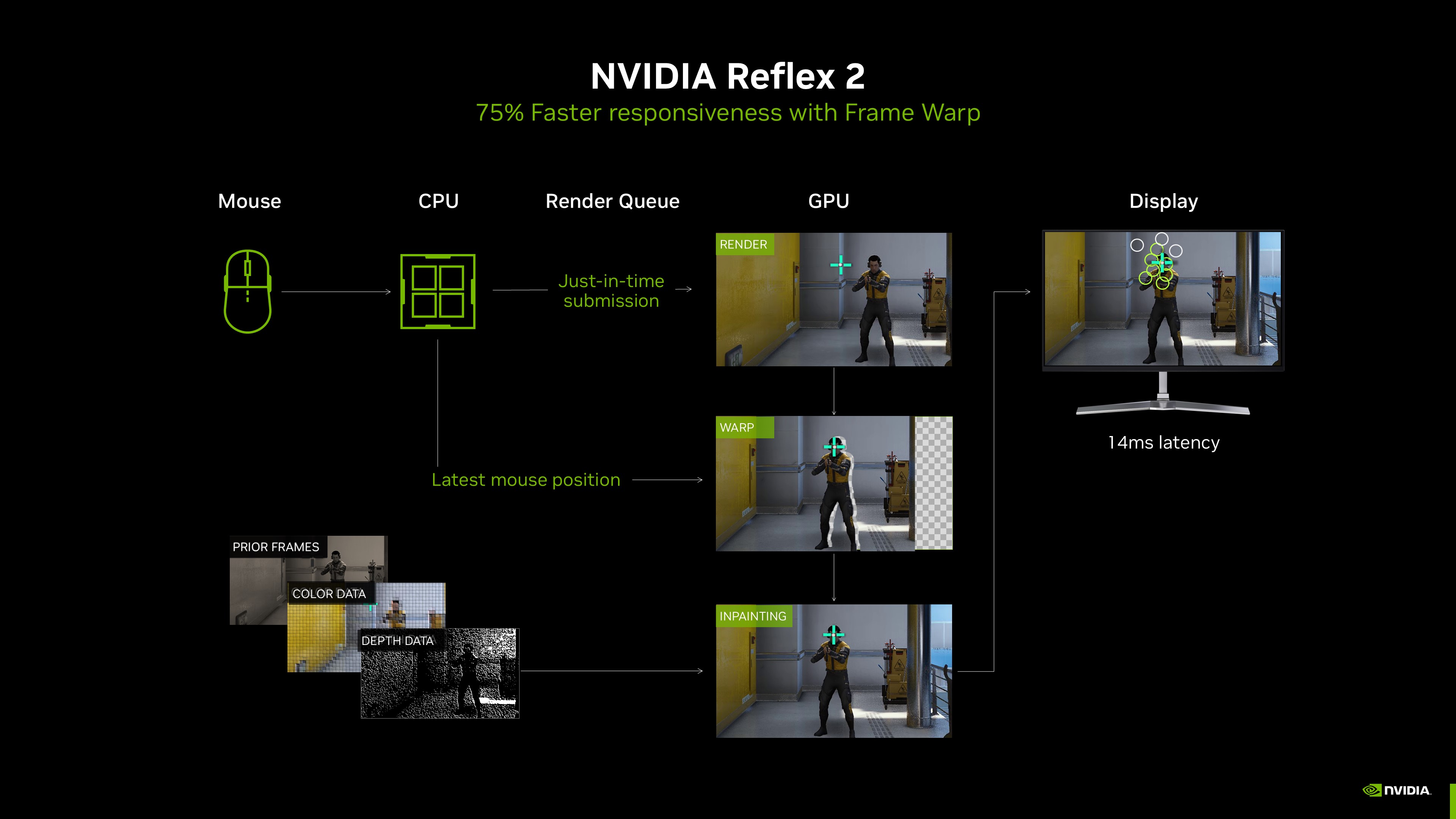
There’s also the new reflex 2 which uses reprojection based on mouse motion to generate frames that should also help, but likely has the same drawback.
Do you have a source for this? Doesn't sound like a very good idea. Nor do I think there's additional latency mind you, but not because it's not interpolation.
Extrapolation means you have frame 1, and sometime in the future you'll get a frame 2. But until then, take the training data and the current frame and "guess" what the next few frames will be.
Interpolation requires you to have the final state between the added frames, extrapolation means you don't yet know what the final state will be but you'll keep drawing until you get there.
You shouldn't get additional latency from generating, assuming it's not slowing down the traditional render generation pipeline.
To me this sounds not quite right, because while yes, you'll technically be more frames behind, those frames are also presented for a that much shorter period. There's no further detail available on this it seems however, so people have pivoted to the human equivalent of LLM hallucinations (non-sequiturs and making shit up then not being able to support it, but also being 100% convinced they are able to and are doing so).
Digital Foundry has actual measurements, so whether or not that matches your intuition is irrelevant. But I think the part you forgot is that generating the frames still takes time in and of itself, and you then need to still present those at a consistent rate for motion smoothness.
The Digital Foundry initial impressions are promising, but for me with a 144hz monitor that prefers V-Sync with an an FPS cap slightly below, I'm not sure using 3x or 4x mode will be desirable with such a setup, since that would seemingly make your input lag comparable to 30fps. It seems like these modes are best used when you have extremely high refresh rate monitors (pushing 240hz+).
I'm guessing users will self tune to use 2x/3x/4x based on their v-sync preference then.
So Nvidia's example of taking cyberpunk from 28fps to 200+ or whatever doesn't actually work. It'll still feel like 20fps sluggish watery responses even though it'll look smooth
it's certainly not reduced lag relative to native rendering. It might be reduced relative to dlss3 frame gen though.