I remember hearing about virtual economies where money can be injected at any time through gold mining, etc, and that they were inherently unstable. Once you got the gold farming schemes that sold gold on e-bay, it created massive hyperinflation.
And it totally made sense that hyperinflation would occur since the creation of virtual gold was limitless and effortless, so the gold farmers didn't care how much gold they sold it for as long as they got real money. That rendered the price of gold worthless, and it drove up the prices of virtual goods across the board.
I would love to see how these problems are tackled in the virtual world.
(Big simplification for TF2 players follows) Also, in TeamFortress 2 (Valve's biggest virtual economy), it's difficult to farm gold. Logged in players receive 1 gold/hr, capped at a max of 10 gold/week. It's possible to create new accounts, and run all of them concurrently, but the expected gain is fairly low, and you have to pay Valve real money for the privilege of having extra accounts.
The exchange rates are also totally asymmetric. The exchange rate for money into gold is approximately $1 => 81 gold. The exchange rate for gold back into real money is ambiguous. There isn't a liquid market here. It involves finding rare in-game hats that aren't sold in the valve store, and selling them on e-bay for $100-$400.
The hypothetical gun might cost $2 on the valve store, but 1 gold in game (i.e less than 1% of the store price). This strongly incentivizes players to trade in-game.
It's possible to make a profit by trading with humans, but that's labor intensive (because you have to find the player and haggle), and probably seen as a positive for Valve, because the traders are providing liquidity.
One such "glitch" is known as a "vintage scrap metal" which only a few exist in the game. They popped up when a user would delete their metal and ask valve to put it back, when they did, it showed up as "vintage scrap metal" with blue text. Such metal has sold for over $1,000.
I feel much of the TF2 economy (these items that can't be bought in a store) is simply players holding onto the weapons and working together to sky-rocket the price. Now, people refer to a "spreadsheet" which is set by a group of individuals. Everyone follows this spreadsheet religiously.
For small items, I think the TF2 economy is very neat. But for rare items? A mess.
Complete conjecture, but I suspect this is related to things like the increased price to craft gems in Diablo II (bigger gems are more expensive) which was a stark contract to Diablo 2's simple method of "3 small gems make a big gem".
Diablo 2 felt like it had an economy that happened almost by accident whereas DiabloIII feels like they put a lot of effort into the economy and trying to have enough ways to remove gold from the economy.
WoW I think had some of the most visible impacts in terms of gold sinks (some I am sure were pioneered by other games and MMOs)
They brought about the concepts of vanity items, which were absurdly expensive and went from there.
Whats even more interesting is seeing the progression and evolution of these economies.
Wow 1.0 auction houses and others barely had the concepts of gold sinks, nor any of the finer tuned economic catches that blizzard introduced by the time it reached its 3rd expansion - Wrath of the Lich King.
That would make the items too expensive for normal players - only the gold farmers and their customers would be able to afford it. Tricky business.
Diablo 3 has crazy gold hyperinflation due to bots and the real money auction is causing further havoc. It is pretty obvious that this was not well thought out prior to release.
That would be one fun thing to test - and better yet, contrast with real world examples.
The creation of the US dollar is also limitless and effortless.
If every U.S. citizen could create dollars, we would indeed have hyperinflation.
If any of you folks are interested in reading about a truly fascinating, active digital economy, you have to read the EVE economic reports and other investigations of EVE. It's like reading about mining, manufacturing and stock markets - against a background of eternal war between corporations - in far-future space.
EVE Quarterly Economic News, by CCP's economist Eyjólfur Guðmundsson (link courtesy of xb95): http://cdn1.eveonline.com/community/QEN/QEN_Q3-2010.pdf
edit: links to additional content ----- http://pc.gamespy.com/pc/eve-online/855380p1.html
>>> EVE Online was developed to have a very dynamic economy from the very beginning. It was decided that "time" would be treated as a valuable player resource: for that reason, raw materials were spread all over the galaxy map, which takes hours to traverse. This created regional pricing. Interestingly, there were no trade hubs built into the core game design -- players gradually settled into certain areas and made their own pockets of population where trade thrived.
>>> Gudmundsson had some fun examples of how intelligent virtual economies can be. He showed a graph displaying the prices of a mineral in the game known as Zydrine. Zydrine is hard to find in the EVE universe, but players had discovered that killing a certain class of drone often leaves behind Zydrine in the wreckage. This hole in the market led to lots of drone-farming, and subsequently the price started to drop. Drastically.
The developers decided to tweak the drop rate and this change rolled out onto the test server, unannounced, and mixed in with all sorts of other tweaks. Still, clever players noticed the change. Word got out. And suddenly, even though nothing had yet been done on the live server, prices for Zydrine spiked dramatically. Markets make for great predictors of future events!
----
http://blogs.wsj.com/economics/2010/06/21/real-economist-tak....
>>> One of his team’s first big findings is somewhat sensitive. Confirming decades of gender research by economists, sociologists and anthropologists, Mr. Turpeinen’s group found that the same biases that have historically favored men in the real world exist in a virtual economy. Their research demonstrates that both women subscribers and female avatar characters operated by male subscribers in EVE are biased toward a slightly lower chance of success in competition with their male counterparts.
I wasn't intending to mention this, but I might as well since people are looking at EVE:
http://ps3.ign.com/articles/122/1221463p1.html
CCP has built a PS3 MMOFPS game called Dust 514. Players play mercenaries battling on planets. The utterly amazing thing is, this game is actually integrated into the EVE universe. Dust players are actually mercenaries being hired and fighting in real time on the planets in the EVE galaxy. EVE players will be able to put up contracts for Dust mercenaries to assault other corporations' facilities, and Dust mercs will be paid by the EVE pilots for their services. What's more, Dust mercs can request live orbital strikes from EVE pilots who are above the planet -- this was demonstrated in March this year and blew the crowd's minds. And surface artillery can hit EVE pilots.
There's even economic integration. The weapons, tanks, equipment used by Dust mercs will be bought from markets supplied by EVE players' production facilities. It's not fixed prices and unlimited item spawning here: mostly everything can be manufactured. And the facilities Dust mercs fight over may include actual factories and labs -- meaning that they will indirectly influence the prices of things and the fates of corporations in the game. Heck, I'm expecting cross-game corporations to form - elite mercs partnering elite pilots to dominate swathes of star systems.
It's literally two games with completely different playstyles built in the same universe, and I haven't heard of anyone pulling this off before. I'm terribly excited to see what the future holds for EVE, Dust, and multiplayer gaming.
----Further reading----
http://massively.joystiq.com/2012/03/24/dust-514-presented-a...
>>> During the DUST 514 keynote speech, developers demonstrated orbital bombardment of a DUST match by EVE players in realtime. We saw the orbital command center and surface command centers that enable communication between the two games; we also saw the orbital artillery that let DUST players retaliate against players in orbit.
>>> In addition to PvP matches organised by NPC corporations, there will be co-op PvE survival missions in which players fight off hordes of rogue drones -- living machines with a collective consciousness. The PvE mode will be released in 2012, and there are some exciting plans for expansions scheduled for the year after.
>>> 2013 will bring in e-sports and competitive gaming, with gladiator arenas in which players compete in capture the flag, deathmatch and custom game modes. The matches will be a true spectator sport, with live viewing from both the EVE and DUST game client and even betting on matches. Battles on hostile worlds are also due for release in 2013, with tactically different terrain that may require vehicles to get around. CCP confirmed that the highly requested MTACs (mechs) will also be introduced in 2013.
[Spectator bloodsports, with betting? Crazy!]
An interesting quote from the EVE Economic News report jumped out at me:
----
>>> The most interesting high-end mineral this quarter was Nocxium. It was the only mineral that rose in price in June, despite the insurance changes, and continued to rise in July and August. The most drastic increase came in September, though, when Nocxium prices jumped by 52%. The changes made to drone compounds in June reduced the supply of Nocxium, which naturally raised its price.
>>> Realizing that a long-term price increase was taking place, one which would likely create a short term shortage of Nocxium, some enterprising traders played a clever market manipulation. By buying up large parts of the Nocxium available they ensured that a serious shortage of Nocxium was created – or, rather, that the foreseeable shortage was greatly amplified. This took much of the market by surprise, with many a lamentation heard from manufacturers of Tech I goods. This is market PvP at its finest. (emphasis added)
----
While I wouldn't necessarily agree the move was especially clever or unexpected, I think it's interesting that EVE is probably the only game where the term "market PvP" has come to exist. PvP is "player-versus-player", as opposed to PvE ("player-versus-environment"), and normally refers to players engaging each other in combat (duels, raids, etc.). In EVE the concept has been extended to players exploiting arbitrage opportunities in the marketplace and depriving other players of profit.
I think markets have generally been are too large for any group of producers to collude to push up prices, but the domination of certain regions of mineral-rich space has recently resulted in an attempt to game the market and form a cartel: the Organization of Technetium Exporting Corporations, or OTEC. [ the following quote is from http://www.tentonhammer.com/node/230860/page/2 ]
>>> "Technetium, the fabled conflict diamond of the North ... only comes from the northwest regions of the galaxy, and the brutal defenestration of Raidendot from Tenal and Vale finally has brought about something that savvy market-watchers have dreaded since the Technetium bottleneck was first created - a cartel. This OTEC - the Organization of Technetium Exporting Corporations - comprises representatives from the CFC, NCdot, Ev0ke, and PL, the four nullsec entities that control 90% of the Technetium moons in the galaxy. Rather than trying to restrict supply, OTEC has coordinated price-fixing, jacking the price of Tech past 200k per unit - and in doing so driving up the price of every T2 ship and module on the market. ... the nexus of incentives from Escalation, Hulkageddon, and OTEC, macroeconomic extortion of Empire for profit will rapidly transform from a gleam in a nullsec financier’s eye to a brutal fact of economic life in New Eden."
This isn't your typical micro-market-PvP, but an outright exploitation of a privileged position by entrenched corporations. One could argue this is game PvP extended to a new arena (the market) on a macroeconomic level, or one could view it simply as the natural dynamics of an unfettered market economy that is real in all aspects except the virtual nature of its commodities.
We have production facilities -- several of them. We have distribution facilities. Transportation units (local and long-haul). We have combat pilots to protect the transportation. And we have the final delivery points where we actually sell goods -- both retail (on the market) and bulk (contracts to buyers).
To manage all of this, we have built an ERP system. It tracks our inputs, outputs, and processes. It makes procurement decisions (build vs. buy) and submits orders to the various groups of people who actually make things happen -- the producers, researchers, haulers, marketers, etc. The game is very manual on that front, but we use an automated system to actually submit very small, easy to understand orders that people can do in a few minutes usually. In aggregate, it powers a rather complicated machine.
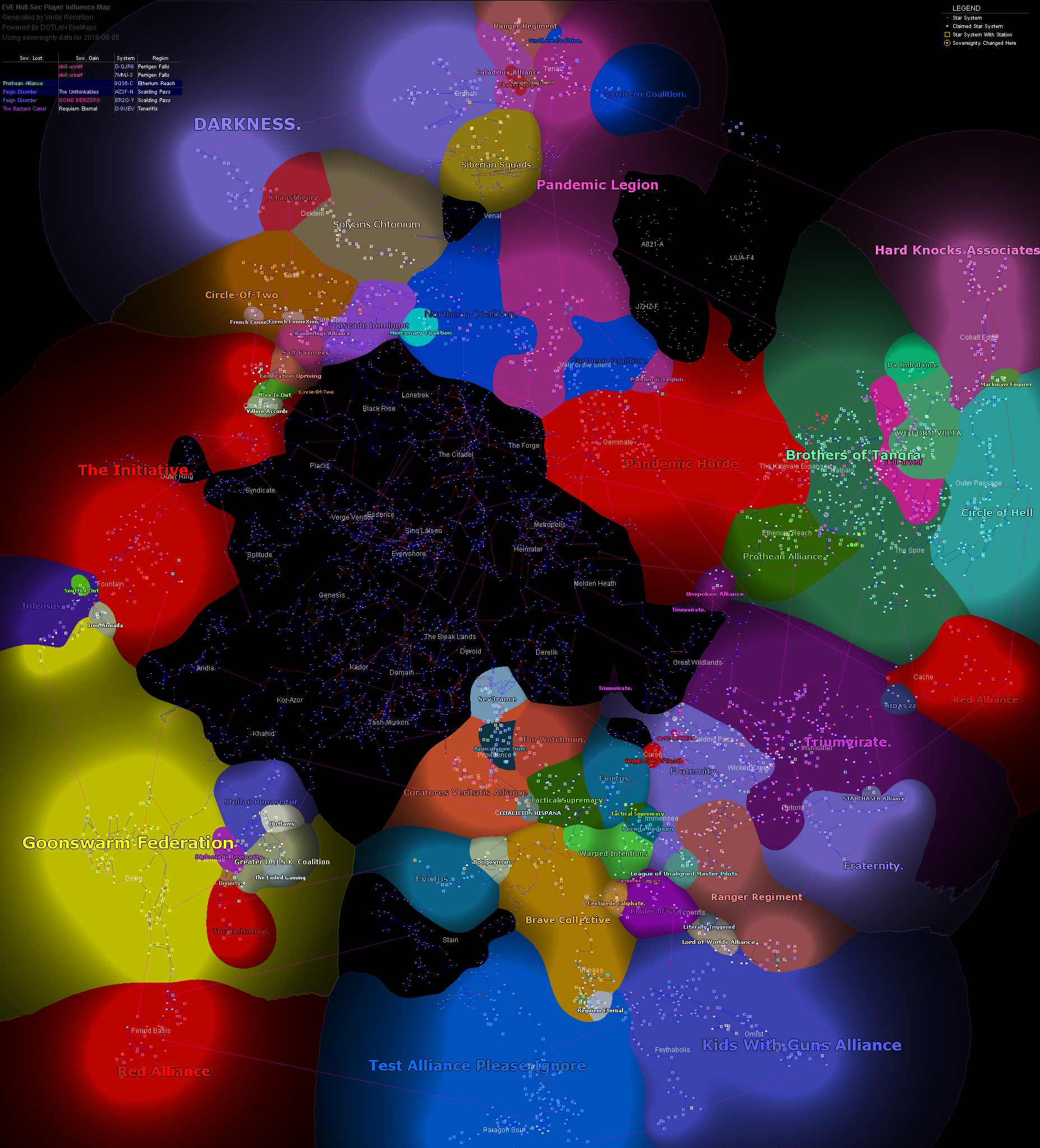
As an example... let's say somebody places an order for 10 Widgets out in the edge of space. We live out near the edge -- actually, look at this map:
http://go-dl1.eve-files.com/media/corp/Verite/influence.png
That's the sovereignty map. It's updated daily. My alliance is Intrepid Crossing in the top right in green. That's 0.0 space (null-security aka no police and lawless -- players own and control everything). Now, let's go through that example of a user ordering 10 widgets.
* Delivery order is submitted if we have it in stock. If so, someone will deliver it via contract. Done. * If not in stock, start the decision tree for this item. * Do we have this in stock in production/stock facilities? If so, submit a transportation order. When it gets transported, the system detects this and submits a delivery order. * If we don't have it in stock, check the market prices for the goods required to build this item as well as the cost to purchase it from a reseller. * If it's cheaper to buy, we submit an order to our procurement team. (Automatic, still.) Once they procure it, the order goes to transportation and then finally delivery. * If it needs building, we do another process of seeing if we have what we need -- or if we have to buy minerals, blueprints, etc. * If we had to buy things, those orders are submitted to procurement and transportation. * If we have it (or the minerals arrive), the production order is submitted. * When we finally have the good, then transportation and delivery happen.
The entire thing is mostly automatic. We carry out the whims of this machine and we supply (rather efficiently) a pretty large alliance. It's a really impressive system.
Yeah, it's a video game. Sort of.
I love it.
And I haven't even touched on the politics, wars, and everything else. It's a beautiful, wonderful, maddening thing.
The game is definitely full of time-sink complexity: Resources used for construction in EVE only come from a few sources, all of which are directly or indirectly player-driven - if you want to get raw materials to manufacture things, you have to either get them by mining asteroids (manually), killing AI-driven pirates and melting their wreckage down for scrap (manually) or by maintaining a setup of 'planetary interaction' stations that harvest resources from in-game planets.
On the other hand, the actual space combat - which is still a cornerstone of the game even if it's very abstract and strange to the casual observer - is often extremely engaging, has lots of room for high level tactics and coordination, and can actually handle groups of thousands of players all competing for control over a single star system. There's nothing else like it.
The best way to describe it is sort of like playing chess in outer space: Every action you decide on needs to try to anticipate your opponents' reactions and you need to apply that level of tactical thinking a few steps out. Likewise, in general fleets and vessels in EVE cannot move very quickly and battles can often become very drawn out, with much of the actual victories and losses occurring in a purely tactical sense (poor decisionmaking, incorrect information from your scouts, poorly chosen positions for your fleet, etc).
One of the other interesting things about EVE is that at a high level, the design team tries to make it a game full of balances and counterbalances. Even once you've 'made it' and acquired one of the biggest, most powerful vessels in the game, you have dramatic weaknesses - a pilot in a supercarrier worth $500 USD can, despite his mighty defenses and arsenal of fighters and point-defense weapons, be undone by a single opposing player in a ship that is literally worth nothing. The way it essentially works is that the smallest, weakest vessels are dramatically more agile, which (as an extension of the game's physics model) makes it impossible for huge, slow-moving, heavy-hitting vessels and weapons to cope with them. The end result is that a viable fleet for combat in EVE needs to contain a mix of cheap, disposable vessels (to confront and 'tackle' the opposing fleet's big supercarriers and other heavy-hitters) along with a mix of larger, more expensive vessels to do the work of actually dealing damage to opponents and providing logistics support (scanning, repairs, etc) to the rest of the fleet. It creates a really nice equilibrium where, when the game is working right, new players end up being just as important as veteran players.
On the other hand, arguably EVE's biggest problem is that it is 'appointment gaming' at its worst. As an active player, you will spend probably close to 95% of your in-game time waiting for something interesting to happen. There are lots of things to do to fill that time, but none of them are particularly interesting; they're all preludes to that huge, pitched space battle that (if you're lucky) might happen every few days, if you're awake and around to participate. For people with flexible schedules it ends up being a great fit, but for me, it was hard to fit into my schedule and I ended up with few opportunities to participate in the 'fun stuff', so I ended up giving my accounts and ships away to other people who would actively use them.
EVE is nothing short of amazing in terms of what CCP is doing. They are one of the few companies actually evolving gaming and technologies involved. It is one of the very few "role playing games" where you instantly and automatically take on a role and play it both in and outside of the game - you decide to be a warrior, you play, act and talk like a warrior; if you want to produce or be a freighter pilot, you can also do that at just as much depth. There are no quirky flame-wars over what is "in character" or not, like in WoW on RP servers. In EVE, anything you do is automatically in character and perfectly suitable, at least to some degree. You can actually play a freighter pilot or a producer or miner/gatherer and nothing but that and be just as successful as a fighter, if not more! EVE really offers a lot and each route offers a lot of depth especially when compared to market-leaders like WoW. WoW's economy and crafting is quite frankly kindergarten compared to EVE's economy. Even the first, lowest items you craft in EVE have a purpose and will make you money while in WoW, you are actually just crafting to make it to the top-items and anything below is by and large useless. The battles you can find yourself in can be wild, imagine flying with a few hundred or thousand people from all over the world!
There are downsides to EVE, for me: it can be too much and get too real quickly. It has a LOT of depth and a LOT of that is happening outside of the game, so you will definitely have to invest more thought and reflection on what's going on, it can take time to learn just one thing. This outside-of-the-game is an integral part of EVE and one of the reasons it can offer so much. This can also make it very frustrating as a beginner while people in good corps and alliances have mentors or require you to spend a lot of time reading online. At the same time, anything you do is "real" and has actual consequences. Yes, you can loose days or weeks of progress if you do something very stupid. Yes, players have lost what can be estimated to be four digit real-world USD values. To really get full access to what EVE is really all about, you pretty much have to play in a corp and then special rules will apply of what you are and are not allowed to do. If you are a fighter, there will be a military-style drill of some sort. On this level, your actions can easily have even more consequences on a larger scale. To sum it up: EVE is no idle pastime and you do not just log into EVE and "zerg" through a few battleground inebriated without any consequences or danger. But if you like that, it is pretty much the best game around! Don't let the strange UI scare you off at first. Another downside might be that you will be very unimportant and expendable for quite some time; unlike in e.g. WoW where you get that satisfaction of really having killed some mob or a player, in EVE battles can be frustrating and drawn out, often without a clear 100% winner and seldomly do you get that same satisfaction of really having killed that one important enemy... you will be much more of an unimportant zerg; later on you can develop into a very highly trained and knowledgeable commando or a very well geared but strictly regulated and commanded fighting force. This might not be "fun" for everybody but it definitely offers you a lot of things that no other game can offer.
On the upside, a lot of that outside-of-EVE gaming gives TONS of fantastic opportunities for little software projects! A lot of EVE players with programming skills are developing something somewhere for themselves or their corp/alliance and CCP created a few APIs and services to openly interface with some of the game's information!
I spoke with some somewhat famous startup-type people; several I met on HN. None of them seemed interested in my pitch (I was looking for a cofounder). One basically said "I've already got my FU money. This just doesn't excite me that much."
I'm looking for some cool things to happen in this space over the next decade. When I was kicking this around we had all sorts of things we wanted to try. It'll be interesting to see if any of them come to fruition. One of the key questions in this space is whether it's even possible to manage virtual economies as this guy wants to do, or it there's always some level of abstraction that's remains out of reach. My money says the thrill of being able to finally experiment will be short-lived. Odds are each economy we create with gaming rules will simply be a small subset of a much larger informal economy. Cool stuff.
Modern finance is largely computerized or computer-assisted arbitrage based on asymmetric information...the "objects" being traded are virtual. And over the past 20 years it has greatly outpaced manufacturing in job and value growth.
And this does not even consider the growth in product design and software products and services, which are also virtual.
edit: I a word.
> Everything that is tangible now will become software and intangible in the future.
When you say this what exactly do you have in mind? Virtual reality? Living substances made through bio-hacking?
> or it there's always some level of abstraction that's remains out of reach.
What sort of abstraction do you feel would be prohibitive in this environment?
> That means the virtual economy is set to eclipse the current one.
In what capacity? Like bitcoin, or like for the win[0]?
[0]: http://en.wikipedia.org/wiki/For_the_win
Thanks in advance.
And as you point out, that's not even touching bio-hacking, which is also converging to digital/created lifeforms.
Call me cynical, but this article struck me as nerd candy. It's a totally-awesome idea: we finally get to really measure and experiment with economies! But in my research several years ago I was already uncovering hundreds of millions of dollars in a virtual goods black-market. People will take a character of yours and spend all of their time leveling him up and getting lots of goodies. Then you log in and take over. You pay them through some back channel. Or you leave an item where somebody else can pick it up, etc. No matter how you design a virtual world, there are plenty of ways to make economic transactions outside the walls. The illusion that you somehow have a god-like view and can see and observe everything of important is just that, an illusion. But I'm willing to wait a few decades for the economists to figure that one out :)
The virtual economy will merge along multiple different lines. I don't think there's any one answer here. There's no reason your WoW character can't be traded for BitCoin and used as a downpayment on a VR piece of real-estate that you then later sell at a profit for options on a futures market in some rare item coming out in a game next year. Thinking in a linear fashion can really handicap the possible solution sets out there.
Exchange between virtual currencies is discussed somewhat in the 2009 documentary "Another Perfect World"
http://www.youtube.com/watch?v=NxZP_ur_Tvo#t=25m
Near the end they interview the CEO of a South Korean company called ItemBay.com who says it's his dream to setup such a market.
Well, not so much spells, since it's space oriented rather than fantasy, but it does have a complicated, realistic economy with corporations, wars, and economic exploitation.
Its player base is limited compared to most MMOs (around 1000-2000ish, last I looked), but it's a combat free game centered around economic production.
It's also a bit unusual in that it has no in game currency. The last time I played (a bit more than 5 years ago), it was largely a barter economy. However, there was a player run item exchange whose credit functioned as a defacto currency.
I have no idea what the current state of the game is, but if you're curious about a non-combat economic MMO, it's worth taking a look at.
Though, I do wish this guy could explain why real-world money Steam games in the US are often half the price of those in Australia/Europe.
Valve will have pricing analysts that have studied the demand curve and concluded the higher price point may reduce demand but is nonetheless the point where marginal revenue from that geographical segment approaches some notion of marginal cost, thus maximising returns. With such a varied range of content and the ability to vary pricing dynamically through specials and discounts and bundles, they'll have collected a wealth of data about game price elasticity in different market segments.
As anyone who's studied economics 101 would say, it's all about willingness-to-pay and how that translates into price elasticity.
In a similar vein, it is 80% more expensive to prebook an Avis rental car at Melbourne airport (MEL) if you declare US residence vs EU residence. Yes, really, 80% more, try it.
This is explained by expectation, which translates directly into willingness-to-pay: US visitors are so used to renting a car that they don't explore the alternatives. European visitors on the other hand are astounded that there is no rail link into the city, and renting a car is at the bottom of the alternatives list.
In the game distribution world, it's likely that the US has more volume, more alternatives and more domestic competition, hence greater price elasticity, hence more aggressive pricing. Steam has strong differentiation and provides global access to products not otherwise marketed outside the US, and Valve are typical of a leading oligopolist, exploiting this position in their pricing strategy.
I guess it just frustrates me because I can't get around it.
With physical goods, if I don't like the AU price, I can easily shop online on another countries website and get the goods shipped. No problems.
With digital goods, there's mostly no way to legitimately purchase them from overseas. You can use a VPN and a fake address, but that breaks the terms & conditions.
However, VAT in EU countries (don't know about Australia) is included in the price. This causes a fairly substantial discrepancy, as VAT can be rather high (in the UK, 20%). Other discrepancies can usually be put down to exchange rate fluctuations, which with the recent financial issues in Europe have been somewhat unstable.
The Australian Competition and Consumer Commission, an independant regulatory body in Australia that oversees the Trade Practices Act (among other things), is in the process of inquiring into the so-called "Australia Tax" to find out why companies like Apple and Valve charge far more for software sold in Australia than in other countries despite the low true cost difference.
Unfortunately, that means that the real reason is "Because they can".
http://blogs.valvesoftware.com/ just redirects to http://blogs.valvesoftware.com/category/abrash/ and I can't find any way to find a listing of all categories/blogs. The RSS feed only contains this entry and abrash's.
I simultaneously feel his elation and am mystified. If you have such a quantity of data that you must relate to it via statistics, how is that better than only having the statistics? Is it because you can define and calculate your own creative statistics, or...?
Basically it's a huge data laboratory where you are able to record every transaction in the world, and work from there. That's massively useful to economists, because they can now test a far wider range of hypotheses and, furthermore, eliminate them much more quickly.
[1] https://en.wikipedia.org/wiki/False_negatives#Type_I_error
[2] http://neuroanthropology.net/2010/07/10/we-agree-its-weird-b...
Its the quality of the stats that is the difference. e.g. When economists work out the GDP its a case of thumb-sucking a number based on a few factors which in turn are also educated guesses. With a digital economy you can just throw it in an Excel sheet and get a perfectly accurate answer. Thats what he means with "having the data".
Having 'all the data' sidesteps any possible need to use statistics outside of forecasting, which he doesn't seem too fond of anyways.
http://www.businessweek.com/articles/2012-05-24/greeces-brai...
> By the end of 2011, Yanis Varoufakis was a celebrity. The director of the Ph.D. program in economics at the University of Athens, Varoufakis had been arguing for two years that Greece was insolvent and the country should default while staying in the euro region ... In 2006, Varoufakis gave a talk in Athens predicting a financial crisis that would start in U.S. real estate, move through Wall Street, and on to Greece.
His work regarding european crisis [2]
[1]:http://yanisvaroufakis.eu/2010/12/17/the-modest-proposal-in-... [2]:http://yanisvaroufakis.eu/euro-crisis/
Does this man believe we should have legal regulation of game economies? Oh wow.
Assume an economy can be sized... so it's a $100m economy, or a trillion-$ economy, etc.
Connecting economies together obviously causes them to impact each other. So long as games are connected just to the US economy, and it is much, much larger than any game economy, the impact on the "real" economy is nil.
What about a much smaller real economy? Connect an economy the size of Eve or WoW to one the size of Zimbabwe. Suddenly, events in the game can have very real macro-economic effects on the "real economy". For example, uncontrolled creation of "wealth tokens" can lead to inflation, and contaminate the real world just in the same way as currency fluctuations impact the real world.
Banks can create money, and they are regulated. If virtual economies can create money on a scale large enough to disrupt the real economy, shouldn't they be regulated too?
I'm not saying the answer is obviously one way or the other, but to dismiss the question with an "Oh wow" seems very short-sighted.
I should also note that I don't see anything in the guidelines about asking for a summary.
"let’s face it: Econometrics is a travesty! While its heavy reliance on statistics often confuses us into believing that it is a form of applied statistics, in reality it resembles computerized astrology"
"the reason for this unavoidable failure? None other than our inability to run experiments on a macroeconomy"
The theories are never tested. They just get implemented. A thousand other things are happening at the same time and its impossible to get anything approaching the clarity of a double blind experiment. But the adherents act as if they've got exactly that.
What do you mean by "so much"? Because they can't accurately, regularly predict the future?
I think you'll find that, in reality, economists know their fallibility and limitations. It's the proletariat that doesn't understand the under-pinnings and assume economists should be 100% accurate when they make predictions, and are upset when they are not.
Most economists fail to offer theories that accurately describe reality. Keynesian is the current disaster.
And politicians can only pick from the available theories and tend to pick the most shortsighted of policies, as they are trying to get re-elected.
Its not that a bunch of unforeseen events have occurred. Its that theories being followed are bad. They ignore many very real things. And the consequences that most economists have been denying all along are happening.
For example, they analyze the multiplier effect government spending but ignore the effects of removing those resources from other parts of the economy. They don't analyze what happens where the resources are being taken away. But those resources are real things that people no longer have and cannot use.
Given that I was a foreigner who was working and living in Iceland, I didn't have much of an evening social life. I was also one of the relatively few employees (sadly) that were really active in the game in the advanced levels of play -- 0.0, empire wars, etc.
Eyjólfur spent a bunch of evenings sitting with me while I played internet spaceships. He asked tons of questions and really got to learn the universe, or at least my corner of it. It was really interesting to work with him and hear him talk about his thoughts as he was putting them together.
CCP used to publish the Quarterly Economic Newsletter, like this:
http://cdn1.eveonline.com/community/QEN/QEN_Q3-2010.pdf
They've since stopped doing that, but you can see from that example that it used to be a fantastic resource. If you wanted to know the nitty-gritty details about the universe of EVE Online, the QEN was hard to beat.
CCP's economist's reports are the real deal. The EVE game economy is I dare say more developed and complex than most other games' - it has many kinds of input factors and stages of production, and many of the production facilities/resources are player-controlled and their fate determines on political maneuvering, war and sabotage between player corporations (guilds). The price of most items in EVE (ships, weapons, components, structures) is determined by the state of production and speculation in the economy, so CCP has to consider the economic impact of nearly every single change they make to the game world.
If any of you folks are interested in reading about a truly fascinating, active digital economy, you have to read the EVE economic reports and other investigations of EVE. It's like reading about mining, manufacturing and stock markets - against a background of eternal war between corporations - in far-future space.
edit: links to additional content ----- http://pc.gamespy.com/pc/eve-online/855380p1.html
>>> EVE Online was developed to have a very dynamic economy from the very beginning. It was decided that "time" would be treated as a valuable player resource: for that reason, raw materials were spread all over the galaxy map, which takes hours to traverse. This created regional pricing. Interestingly, there were no trade hubs built into the core game design -- players gradually settled into certain areas and made their own pockets of population where trade thrived.
>>> Gudmundsson had some fun examples of how intelligent virtual economies can be. He showed a graph displaying the prices of a mineral in the game known as Zydrine. Zydrine is hard to find in the EVE universe, but players had discovered that killing a certain class of drone often leaves behind Zydrine in the wreckage. This hole in the market led to lots of drone-farming, and subsequently the price started to drop. Drastically.
The developers decided to tweak the drop rate and this change rolled out onto the test server, unannounced, and mixed in with all sorts of other tweaks. Still, clever players noticed the change. Word got out. And suddenly, even though nothing had yet been done on the live server, prices for Zydrine spiked dramatically. Markets make for great predictors of future events!
----
http://blogs.wsj.com/economics/2010/06/21/real-economist-tak...
>>> One of his team’s first big findings is somewhat sensitive. Confirming decades of gender research by economists, sociologists and anthropologists, Mr. Turpeinen’s group found that the same biases that have historically favored men in the real world exist in a virtual economy. Their research demonstrates that both women subscribers and female avatar characters operated by male subscribers in EVE are biased toward a slightly lower chance of success in competition with their male counterparts.
It would be absolutely useless & provide zero opportunity for intelligent dialog. If anyone from Valve is listening and wants to open discussion, they would do better to interact with 'higher quality' communities directly.
http://yanisvaroufakis.eu/2012/06/15/ponzi-austerity-intervi...
What's the connection? Max Keiser sounds exactly like the defective turrets from Portal 2. Coincidence?!