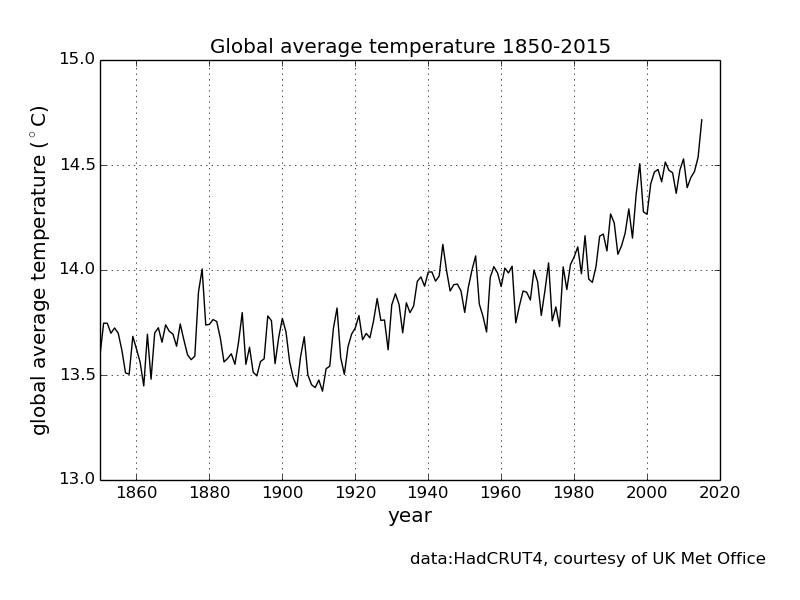
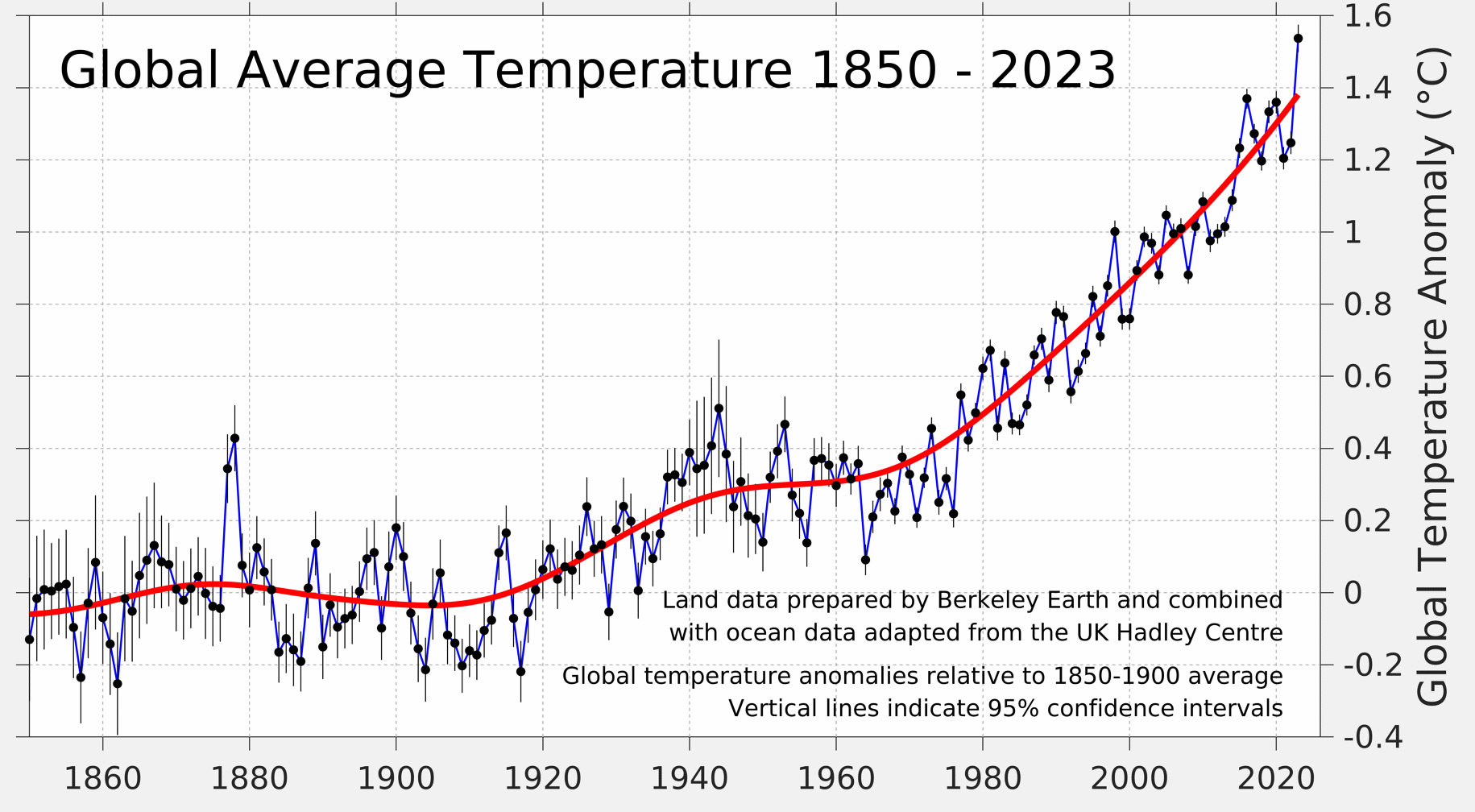
Long term temperature increase due to complex systems like AMOC could explain why we see measurable linear temperature increases starting in the 1880s, instead of the 1940s as CO2 forcing might predict, have historical evidence of extremely cold weather in classical Europe (frozen Rhine, etc.), and have evidence of warmer temperatures than today with the Holocene maximum about 8,000 years ago.
Could you cite your sources on this one? Every graph I can find shows the linear increases starting in about 1920 (plus or minus a bit, depending on how you squint your eyes), and correlating very neatly with atmospheric CO2 concentrations.
[1] https://www.metlink.org/wp-content/uploads/2020/11/200_years...
[2] https://qph.cf2.quoracdn.net/main-qimg-bbbf79f1dadb29616e78b...
[3] https://www.researchgate.net/profile/Robert-Stavins/publicat...
[4] https://berkeleyearth.org/wp-content/uploads/2024/01/AnnualP...
When you plot my lake, it's a solidly linear trend of fewer days of ice coverage ever since they began measuring it.
The neat atmospheric CO2 correlation is presumably the same thing that has caused that same correlation to exist in pre-historic times: CO2 has been a correlated trailing indicator of global temperature through the entirety of Earth's history.
If there has been a long-term global trend for Earth temperatures, like my little (not so little actually) lake seems to indicate, some of the assumptions that establish CO2 radiative forcing as a cause rather than an effect go out the window entirely.
But don't take my word for it. Read this Nature paper, and add in the postulate that global temperature since the 1860s is some linear trend similar to my lake's temperature, and watch what comes out:
What predictions would this hypothesis suggest (that aren't also shared with CO2 forcing)?
" That the Gulf Stream is responsible for Europe's mild winters is widely known and accepted, but, as I will show, it is nothing more than the earth-science equivalent of an urban legend."
https://www.americanscientist.org/article/the-source-of-euro...
I could use some expert advice...
Iceland, e.g., is warmer than Alaska, and that might change. Northern Europe in general is warmer than the PNW, despite the North Atlantic being smaller (and thus less buffering) than the North Pacific.
Seems unreasonable to expect the UK to end up like Newfoundland, or Labrador, if the AMOC shuts off, but "colder" seems in the cards.
Of course, all of this is completely armchair on my part.
The siblings spent two years refining their approach, doing more tests. Across a thousand runs, the model cranked through the temperature data and settled on a year. Sometimes the model spat out later dates. Sometimes earlier. The two scientists made a plot of the numbers and a neat cluster emerged. Yes—2057. But that’s just the middle point: In 95 percent of the model’s simulations, the AMOC tipped sometime between 2025 and 2095.