We've been working the 4-day work week far longer than we've had VC money. Our first investment came in the fall of 2011, long after we existed as a company, and we were profitable prior to raising VC.
In general I saw that developers working on "a secret sauce" (i.e., engineers in Oracle working on RDBMS, etc.) are not working more than 35 hours a week while developers working on some generic CRUD crap work all days and night.
Now the challenge is to hire developers which can work on or develop your "secret sauce"... which is point of this post.
As I understand it, Henry Ford chose a 40-hour work week because he found that it maximized the total output of his employees. Computer programming is (minute-for-minute) considerably more demanding than working an assembly line. Maybe an average programmer maximizes her total output when she works substantially less than 40 hours a week. In fact I'd be surprised if that weren't the case.
And of course you could still run the service if you guys worked four-day weeks. Just make sure somebody's working on any given day.
Hacking code may be more mentally taxing, but if you need to take break (for the bathroom or whatever) you can do it on your own schedule -- not on your lunch break like a lot of factory workers.
Look, I know little about Treehouse, but I read the blog when things appear on HN. It looks like a useful product, and seems to be run by sincere guys. But you're talking about attracting good talent when you're able to offer amazing benefits, salaries and a 4 day work week. That is only possible because you're swimming in cash, and you're only swimming in cash because this space is still riding the upswing of the business cycle. The market will sort this out, and one only has to look around to see that. It's unsustainable. How old is your business? Let's see if you're still working 4 day weeks in five years.
That said, it's probably a great place to work. Kudos for sharing the wealth with your employees.
I'd say that's pretty good proof that it's not just sustainable, it's also very smart.
The only thing is, it needs validation. I hope the company does really well in the long run, and therefore puts 4-day work week on the table for others to follow. Wouldn't that be great...
We've been doing a 4-day week since 2007, so it's been five years and thankfully we've been successful.
I think limited hours per day makes more sense. People can be laser focused for 5 or 6 hours per day if you give them a good work environment. Once you move to the usual 9 or 10 hours per day, personal life gets in the way and people goof off, achieving as much productivity as in the focused 5 hours.
You could say the same about lowering prices: "why should I lower my prices to $X, what's next, $X-1?" If it gives you a competitive advantage, and yet you are still able to profit and succeed, then the economics of it make sense.
If you want to reduce the total hours per week, doesn't it make more sense financially to work fewer hours per day but for five days and be able to pick up your kids at an earlier time each day? I would think that would be the case for most family folk. Don't your kids get off school or child care at somewhere around 3pm? Who takes care of them between 3pm and 6pm and how much does it cost you?
Finally, what a family person wants differs from what a single 20-something year old wants. 9am works great for a family man. 9am does not work fine for a 20-something year old, but in the majority of companies the family man is the boss and dictates the 9am start time.
Edit: I have to apologize. I overlooked that the names are made up, so the following statement is incorrect. Sorry Ryan!
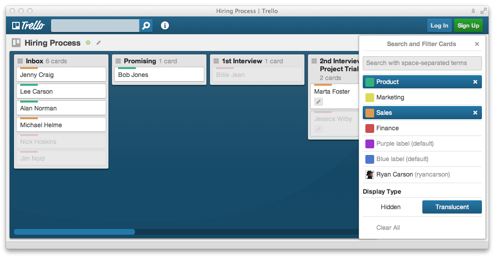
Sadly, I have to whine about some privacy issues: I don't approve of Ryan Carson's publishing the names of his applicants how it can be seen in the screenshot at [1]. I'm quite sure these are real names beloging to their applicants, and I wouldn't like to see my name published when I'm applying for a position at this company. On top of that, I would feel sad to see that my name had been greyed out but Person XY has advanced to the next stage.
Perhaps it is better to anonymize the information as I suspect it was not Ryan's intention to publish these names.
[1] https://trello.com/board/hiring-process/4fc4942316b650d22d09...
Given how young they are and that their investor list includes the likes of Kevin Rose and Reid Hoffman, I'm going to go with the latter.
I operate a small ecommerce company with about 15 employees that include everything from developers to warehouse workers. There's no way I could sustain such benefit list and I know none of my competitors could either. There's just not a high enough margin (and we're in a high margin business).
The answer might be that a company whose product is "knowledge work" might be in a different boat, but it really makes me wonder if you can sustain that kind those kinds of benefits when you're standing on your own two feet.
Now that we've raised $5m, we can increase our burn to outpace our revenue to speed up customer acquisition and product development.
    Product
    Marketing
    Sales
    Teaching
    Video
However, one thing that would still appeal to me more though as a developer would be the ability to work remotely.
It's surprising even to me that I'd rather do 20% more work for the same money if it's at home!
I also suspect this would make it easy to 'hire talented people, very quickly' as it opens up the whole world to you in terms of candidates.
What are your thoughts on this Ryan?
(and living on 50-60k in Portland is fine even if you have kids; it is poverty unless you're either long established (own a home from the 1990s, or cheap rent), or alone. This opens up a lot more potential hires for non engineering roles)
1) Paying $20k-$50k to a recruiter, per person 2) Taking good care of your team so you get tons of applications for every job opening, from very talented people
Keep in mind that there's also a huge cost to attrition. Every person that leaves your company, because the culture is so-so, costs you a huge amount in time and cash resources to replace
Those are normal benefits in corporate America. The 6% 401k match level is an IRS safe-harbor threshold most large employers try to meet each year. Even the vacation time (18 days) is modest for your European competition. I don't see where any of that is getting bubbly.
For a small company that's growing this quickly, it's probably going to take more than 12 months to know for sure if a hire is good or not. Declaring them as good does not make them so. I'd be interested to see a follow up post 12 months from now giving an update on retention rates and any hiring process updates they've subsequently made.
I have a pretty good sense, based on experience, whether someone is a good hire or not. You often know within 30 days.
My criticism was limited to your early declaration of victory on your hiring binge. The bottom line is that you can't know if someone is going to end up ROI positive until they actually get there. After 30 days you can tell if someone is a good dude and they can get stuff done, but you can't tell if some other company will come along in 2 months and poach him. Shit happens.
By building a strong culture you are taking good steps to minimize the chances of losing people, but you won't really know if you've succeeded with these hires until they are a net positive.
I am currently just starting to use treehouse to train a group of new grads for the company I work at. I'm very impressed with the site.
@Ryan : if I was in your region, I would so be applying for a job ;)
It's also a great talking point with clients. The 4DWW is gaining traction in the wider world: I was interviewed this week on dot-au national television to talk about it.