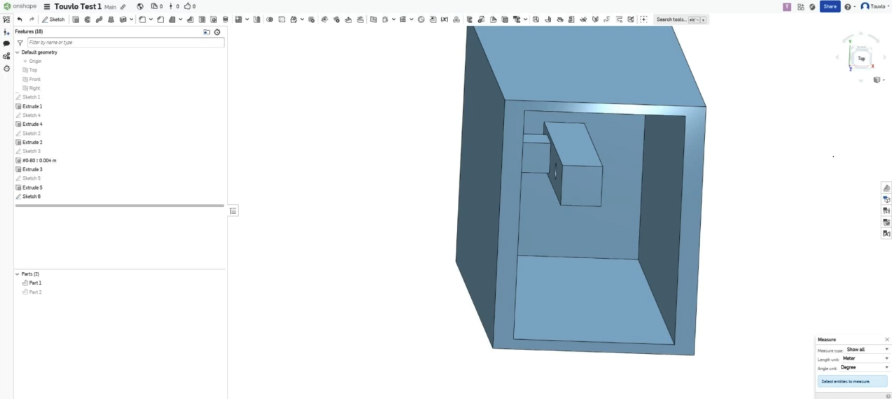
Our interviews test real-world engineering skills, largely via a collaborative CAD session through our in-browser platform. You can think of it as a pair-coding session between the interviewer and the interviewee, but for hardware. Interviews are conducted by real hardware engineers with industry experience (currently my co-founder, Danae). After each interview, you get a detailed score card, as well as full, timestamped recording of the interview.
There's no pricing page yet, but we charge 220$ per interview, with discounts for monthly packages for 10 interviews or more.
If you're a hardware/robotics startup, give us a try: we can help you hire better and save you time. Drop us an email (founders@touvlo.co), or sign up for a demo interview on https://touvlo.co. We offer a money-back guarantee and a free trial for our next few customers.
We're also applying to YC – we went from an idea to a product with users in 2 months.
We would highly appreciate any feedback.
It’s an interesting idea and I like that you’ve stood up something minimal to test your product offering quickly.
What’s your elevator pitch for your value proposition?
How do you plan to scale this business beyond you and your co founder?
Our pitch: We make recruiting easier, better and cheaper for the companies building the hardware of tomorrow, by letting them focus on their product rather than repetitive candidate skill assessments. Currently, senior engineers in small startups and scale ups spend a lot of their time interviewing, and they often don’t do it well (remote CAD sessions aren’t really a thing). We save them time and money.
We will scale this by hiring freelancer interview engineers. This has already been done in software, very successfully: karat.com. So we think it can work at least equally well in hardware.
I know recruitment firms serve some of the phone screen purpose you’re proposing, but just with basic Q/A of resumes.
I think, if I were looking to hire you, I’d be wondering how alike your working style was to that of me and my team. I’d want to know how much I could trust your judgment in a candidate’s technical approach.
I’d also offer that you can’t really outsource the job of evaluating cultural fit - which is still really important in spite of all the baggage that term carries.
Engineering questions do not have to be complex, but they are different in kind.
How are they thinking of hardware engineers? (Like an interchangeable commodity or one that can get a letter grade? Very transactional, maybe a gig?)
Will your customers do substantial additional interviewing after passing your technical interview, for qualities you don't or can't evaluate but companies should? Could your service be mainly a screening, before a company invests more significantly in interviewing with technical and other team members?
What is your answer to "Why did I spend 4 years in engineering school, and build my professional track record, yet have to keep doing these negging tests? Does this company not employ anyone who can get a sense of a fellow engineer's skill and professionalism just by talking with them? Did they read my resume? And now they're not even administering the test themselves?"
Can a particular job-seeker interview with you once, and get their report card sent to many employers over time? Who pays for each instance, and do they pay less if it's reused?
We don't want to serve non-hardware companies that are hiring their first hardware engineers. We want to serve companies of all sizes (including startups) that are building products that are so critical that they can't waste their senior engineers' time to do 10-20 technical interviews a week. These customers will care a lot about their hardware engineers.
Yes, our customers should do more interviewing for candidates that pass the Touvlo interview. We think that our service should be primarily a technical screening before the company invests more in additional interviewing, but you're free to use it for at any step of your recruiting process. There is also more to evaluate in a potential hire than technical skills (for example, cultural match).
> Why did I spend 4 years in engineering school, and build my professional track record, yet have to keep doing these negging tests? Does this company not employ anyone who can get a sense of a fellow engineer's skill and professionalism just by talking with them? Did they read my resume? And now they're not even administering the test themselves?
There's two parts to this: (1) On one hand, the interview should never feel like a negging test and the interview of a graduate should be completely different from the interview of a senior engineer with 5+ years of experience. And if you are extremely senior with an amazing professional track record, then perhaps no technical interviewing is necessary at all. (2) On the other hand, no one should feel offended for having to do a technical interview that matches their seniority and experience. It's outsourced to a third party company, because we can do it better and faster. Candidates will be happier, because they can interview outside business hours (incl. weekends) and have a positive experience. Also, the alternative in many cases is that the company won't bother interviewing the candidate at all, or worse, they might send a take-home test that takes hours to 100 candidates and then spend 0-3 minutes reviewing each.
Currently a job-seeker can not get their report card sent to multiple employers, however this is a good idea to consider after getting to a certain scale. At that point, we would essentially become the standard in hardware technical interviewing. Figuring out a fair payment model would be one of the challenges.
> Interviews can be scheduled (and rescheduled) interviews around the clock, 7 days a week.
I believe the second `interviews` should be omitted.
Who is your ideal customer? I'm imagining either a nontechnical solo founder (with a really good, high value idea that he'll explain after you sign an NDA) looking to hire a first engineer/technical cofounder to actually build it...and all the problems that come from that. Or I'm imagining a big corp with an HR department that's at odds with the engineering department, always denying their hand-picked candidates and sending them unqualified candidates, but I'm fortunate to have never experienced that kind of environment.
Maybe we're not in your target market in that we expect to need to do training, and don't expect our best long-term candidates to be able to hit the ground running at full speed. We've hired senior engineers with zero experience in our Autodesk Inventor CAD suite, as well as fresh grads with little experience whatsoever? Our "HR Department" is really just two people (our CEO and accountant), so there's no "must know how to lay out a robot cell" to validate in an assessment.
Or maybe we're not in your target market because already have an engineering department with something like a century of combined experience who are totally capable of sorting out a good candidate from someone blowing BS.
Or maybe we're not in your target market because we are just an ordinary small business, we have negligible turnover (it's been 6 years since someone moved to a different company), and only moderate growth rates (only hired 3 engineers in the past 6 years), it's just not that big of a time sink. I suppose a hardware startup with meteoric growth rates would need to spend a lot more time hiring engineers.
One question: You write "We can use any CAD software you prefer." Any? Really? Seems you need a short list here. If you're providing the license, having seats of Inventor, Solidworks, Catia, Creo, NX, Fusion, etc. on hand for occasional interviews sounds really expensive. And an experienced designer who can effectively every one of those is really rare and also expensive. I would call Altium/Cadence/Kicad "hardware design CAD packages", but those are completely different skillsets and I wouldn't expect a typical ME to know how to use them well.
Yes, we can use any CAD software (or at least, we will seriously consider it). We’re a new company and following the YC advice of doing things that don’t scale. If that means buying 5 different software licenses for our first 5 customers, then we’ll do that.