The product has come a long way since that first HN launch. The best way to think about it is as a 'multidimensional spreadsheet' — instead of writing formulas that operate on single cells, Causal formulas operate on "variables" that span lots of cells (e.g. multiple 'months', or multiple 'products', or multiple 'countries'), so you can express any kind of model with 100–1000x fewer formulas. Lot of other important functionality like live data integrations, dashboards, etc. but the multi-dimensional modelling system is really the secret sauce :)
Sounds super abstract, but the main use-case today is financial planning/reporting for early-stage companies, although some of our users have actually replaced their BI tools with Causal as well.
Anyway, thanks for the support and keen to hear feedback :)
Causal's building blocks are "variables" and "dimensions" which makes it much more powerful to work with dimensional data.
This video explains this in a more visual way: https://www.youtube.com/watch?v=WELP2A5IzF4&ab_channel=Causa...
Disclosure: I was a founding member of the Python in Excel team and am looking for new problems that Python in Excel could solve.
Excel is an amazing product and I'm sure people will still use it in 10 years. Our thesis is that for financial planning (and various other number-crunching use-cases) our building blocks make more sense.
You could solve releasing Python in Excel for MacOS.
- traffic tiering and balancing based on request's perceived amount of work
- low latency data loading during our calc loop
- implementing a selector framework to unify all the stores used by the application
- redesigning the formula editor to make human friendly yet expressive enough for the most hardcore user (fun UX challenge)
We really ought to start blogging more about these things :D.
I work in this space. I don't envy this. Been through it more than once.
Did you also have challenges with circular references?
For circularity, we found that we could keep the UX dynamic by making a deep copy of the circular part of the DAG behind the scenes, asking the user to determine which variable in that path should be "resolved", hard coding that variable in the copy, then solving that variable to zero through a newton optimization. Once optimized (in parallel to main graph), it feeds back into the main DAG just like any other dependency.
Would be a silly approach in Excel, but not so much here.
I honestly think it's one of the best I've seen for any software. It showcases the functionality, displays the actual UI, doesn't rely on narration, is visually interesting, and succinct.
Was it made internally or with an agency?
1. Slack introduces "sidebar" concept
2. Notion takes it a step further
3. Everyone starts doing sidebars, including Linear
We took inspiration from Linear's 'search button in sidebar' and 'profile pic in sidebar', which I think were maybe their unique contributions to the tradition :)
Reminds me of the vertical tab strips in FF w/ TreeStyleTabs.
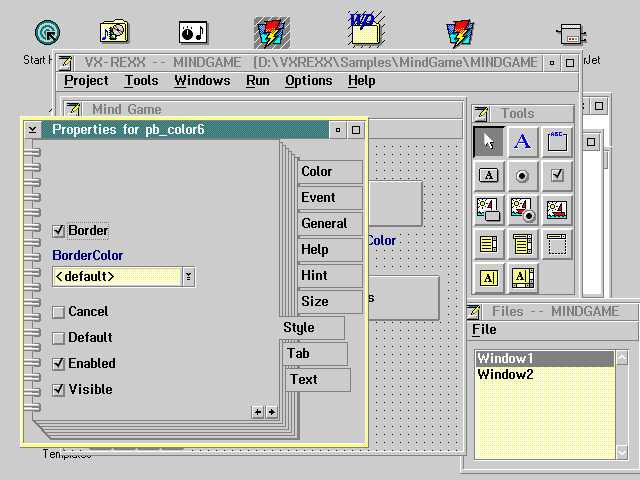
Which reminds me of OS/2, where tab strips were on the side, with some nice skeuomorphism: https://www.landley.net/history/mirror/os2/history/os221/vxr...
Docs: https://docs.causal.app/formulas/values-with-uncertainty
I cannot even login using firefox.
(granted, the experience is optimised for Chromium based browsers, but FF is not forgotten).
I would absolutely convert to paying if the jump to the next tier weren't so expensive ($250/mo), which has been really tough to digest right now.
In the meantime, we're pretty chill about offering $99 plans to early stage companies if you're under 10 people, or have raised under $500k.
You can find the form for that on our pricing page under "Startup programme": https://causal.app/pricing
Hope that helps, and thanks for the kind words and loyal support!
1. Where does the name come from?
2. I’ve seen a lot of startups with the business model of serving other startups. These remind me a lot of derivatives in the stock market in terms of the “risk” of their business model, and there have been instances of companies having to pivot when the economy goes down (i.e. Brex)… Do you have a contingency plan for this?
2. Fair question haha. While a majority of our customers are startups/tech cos, a bunch of our customers are also non-tech small businesses (e.g. small agencies/consulting firms in various niches). Interestingly, we found that after the economy went down 18 months ago there seemed to be more demand for Causal from smaller companies (startups + regular SMBs) — our guess is that staying on top of finances is important when things are tough, and less important when there's tonnes of cash flying around!
I work in enterprise planning and wonder what is keeping you from targeting larger firms. Is the startup-target temporary or do you expect to let your clients "scale out" of the product?
Because of this, we're focusing on smaller companies as a self-serve product for a while, and then gradually plan to build out that kind of enterprise stuff for bigger companies.
There's also a lot more competition in the mid-market/enterprise in this space, and 0 competition for SMBs/self-serve, so we thought it would be good to lean in there :)
Interesting stuff!
Overall, it's cool to see lots of startups creating the next generation of spreadsheets:
- Causal.app
- Rows.com
- Equals.com
- Rowzero.io
- and at least 50 others I've found
The financial model, expenses, hiring/ salary plan and basically all thin ledger financials of most SMBs/startups are highly sensitive.
If leaked or sold to third parties, it gives competitors (or maybe your own investors) insights in the technology, development expenses, and direction of the company.
How do you handle data confidentiality? How is the data security?