Some people do not enjoy my writing style. That is fine; it’s a big Internet and there are writers with many styles on it. Some people think my style is poorly considered or unnecessary. I invite them to attempt writing a few million words. It will give one a very considered view on one’s own style.
I have spent half my life working in a foreign-to-me language and so I feel for non-native speakers who try to read my writing. That said, all choices in life have trade-offs. Many publications in the U.S. target a fifth to eighth grade reading level. You likely would have little difficulty reading those publications, much like I have comparatively little difficulty reading Japanese aimed at 5th graders. However, people rarely associate those publications with dense, insightful, textured prose on complicated technical and interdisciplinary subjects. (If some HNers do, awesome; stuff you’ll love is available at the obvious places on the Internet.)
Suppose an angry reader is looking for a reason to form a mob against you. If you write in simple sentences, that makes it easy for the angry reader to process your statements and go after them. But if your sentences are more complicated, the angry reader needs to decode them logically before they can justify their anger. Angry people tend to be poor at logic. So when they run into this kind of writing, they often get bored before they have a chance to get outraged. You get your message across, and the angry reader moves on to the next tweet in their feed. Everybody wins.
This doesn't work 100% of the time. But if you do it right, it cuts down on a lot of negative virality. I'm not saying this is or isn't Patrick's intentional strategy. I have no idea. It's just one among many consequences of this communication style.
Someone else I put in this group is CGP Grey, the YouTuber, specifically his early podcast episodes. That guy's ideas changed my life in a lot of ways as a teenager in ways I think I can't fully describe today.
One of my weird qualifications is evaluating text complexity. Most of Patrick’s writing is simply highly accurate and precise erudite language. Frankly, compared to other writers at a comparable level of erudition, his writing is downright economical rather than convoluted.
His texts tend to be very information dense in a way that I’m not sure all readers appreciate or value.
>. or if he is simply careful about using the proper terminology
Yep. All that.
> and my English is just not good enough to follow him like a native speaker would.
Probably (not sure about your English proficiency level), but that’s not a knock on your English.
Note that Patrick’s writing is very high level, and I think many native speakers don’t read his texts with a high degree of fluency. Specifically, they simply don’t make it through the text, they don’t understand what he wrote, or they are not able to identify the preciseness and accuracy (and sometimes artfulness) with which he communicates his ideas.
On a personal level, I am a big fan of his writing — it’s just a delight to read material on a complex topic with a high degree of confidence that what he says is extremely accurate.
Another author who I think writes at a high level is Scott Alexander of slatestarcodex and astralcodexten (or wherever he writes these days) — very high brow style on complex topics. It’s not for everyone. Fwiw, I’ve had to read (and reread) some of Scott Alexander’s pieces in small chunks with breaks to process what I had read — sometimes it’s just oozing with intellectual goodness.
For someone who writes in finance in a more casual style, I recommend Matt Levine and his newsletter Money Stuff (free).
We've got an early leader in the clubhouse for the 2024 Accidental HN Slogan Contest.
"I have an ebullience and love for it in a way that people in our social class in the United States are aggressively socialized out of having ebullience and true love for anything. I think that the internet is the capital G, capital W, Great Work of the human race in a lot of respects, that it is magical. It is an encapsulation of the best things about our society that is also tremendously, instrumentally useful in making all the good things better and ameliorating all the problems over sufficiently long time scales.
It seems naturally to me that this is extremely important. This is extremely valuable, and it seems extremely underrated by almost everyone, including people who would consider themselves great fans of the internet but say, “Oh, I’m a great fan of the internet, but I’m a great fan of penicillin, too.
I think, in aggregate, the internet is obviously more important than penicillin by many orders of magnitude. Is it more important than medicine? I will bite that bullet. The internet is more important than medicine, the entire institution of medicine, from time immemorial to reasonable extrapolations of what we can do right now. Is it more important than writing? You couldn’t have the internet without writing, so writing was very important to get to the development of the internet. That might be one of the most important things about writing, that writing got us to the internet. That sounds like a little bit of . . . I know people will take that full quote and say, “Oh, this crazy, nonintellectual person,” but I think that there is a reasonable case for it."
Having zero medicine but the internet would be a very very different world, with people dying left and right from infections, broken bones would not be set crippling quite a few, accidents would be a lot more fatal (also because there would be no understanding of effects and causes of injuries), no wounds would ever be treated, etc etc. It would be a truly bizarre world where humans wouldn't care one bit about damage to and problems with their bodies (but would have highly optimized advertising systems).
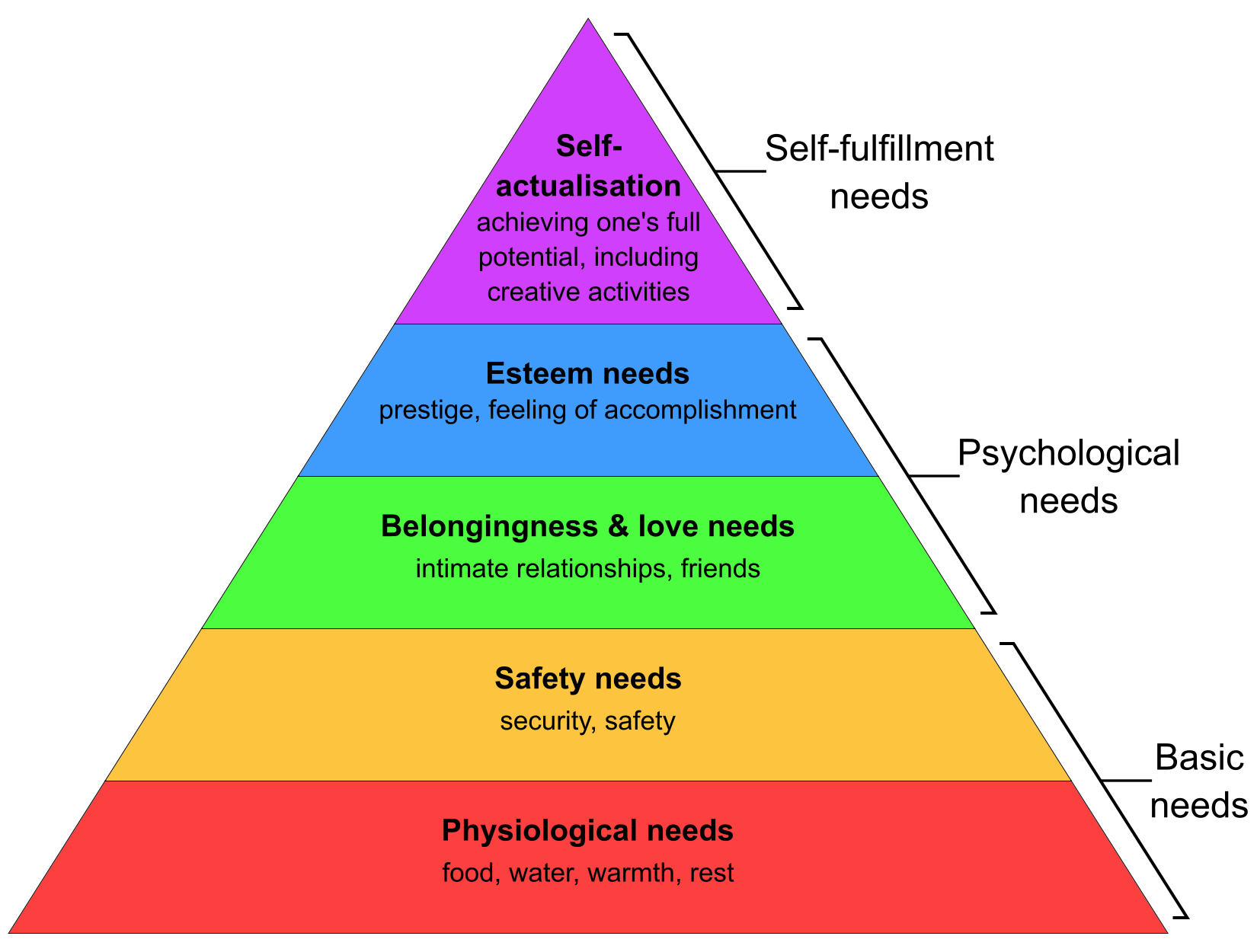
[1]: https://upload.wikimedia.org/wikipedia/commons/e/ea/Maslow%2...
Medicine is great because it helps save lives (there is “non-medicine” which also achieves some good outcomes here). The internet, the instant exchange of information, is great because it magnifies humanity’s greatest power: mass collaboration. With the Internet, medicine could emerge. At least in the form of exchange of ideas and data, and subsequently spread its positive impact faster. The world’s greatest physician scientists working together.
Also I am guessing the ads bit was hyperbolic but like, common, Google is a verb for a reason. We’ve never had access to information like this before. And this is just focusing on something abstract like “information”.
And so, I disagree.
We ran the reverse (medicine then internet) and it took a long time to get to the internet.
Medicine, on the other hand, was responsible for removing an immeasurable amount of pain and suffering from humanity, including having our loved ones (and ourselves) around for much longer. I find hard to believe people would give back antibiotics for anything we have from the post-Internet revolution.
now that I have kids, I grow increasingly conscious towards the effects this has on them.
Without the internet, I'd have vastly reduced choice in entertainment.
I'll take the medicine. By many orders of magnitude.
Now if we focus on "sufficiently long time scales" perhaps the internet is going to be the human invention that enables us to get where we need to be. But that's a guess. Perhaps I'm dim but I don't see how the internet is obviously more important than penicillin by orders of magnitude.
In the long term, people will look back and say that although medicine did develop first, it only really got serious traction when the Internet and related technologies appeared.
> Without the internet, I'd have vastly reduced choice in entertainment.
This is facetious. Do you really believe that current medical care does not benefit from the Internet at all; that it's only used for entertainment?
Many people may use a significant portion of their electricity and lights on watching... whatever. But the statistical majority of use cases does not define the medium.
Maybe a less controversial way to say it is "global communication is more important than medicine," but I still like the way patio11 said it.
Is that typical?
Cowen probably puts in more research than any other interviewer. His style is pretty unique, but the interviews never become rambly and the guests get to showcase much more range.