No, work doesn’t have to be soul crushing and you don’t have to be on a constant state of burnout.
For me, the industry I’m in and the product I’m building are the most important part of my job, boss and coworkers being second most important. If I were simply trying to sell more ads or building a product that survived on ad revenue, I would have burned out years ago.
Instead, I’m building a product that helps actually improve people’s physical being and, in turn, their lives. No, it isn’t selling a product but providing a service.
Seeing our end users live a better life makes dealing with corporate bullshit and meetings on meetings easy to deal with. I love what I do and enjoy it even if I’m frustrated from time to time.
And then you’ll turn 30 and realize that you need money to buy stuff that you want. Important stuff, not frivolous consumer goods. And you’ll wish that you had pushed through the immaturity of youth and developed a good work ethic and a network you can use to find a decent job.
If you’re going to become anti-work, at least do it after a decade or two of hard work. You’ll have firsthand experience of the topic and (hopefully) some money to plan an escape.
I’d also note that with remote jobs, it’s easier than ever to build a life around something other than work. It’s entirely possible to work 5-8 hours a day, then spend the other 8 hours skiing/reading/gardening/whatever your hobby is.
I've spent most of my spare time programming stuff for Minecraft, because I liked the game and the challenge + appreciation from others. I could programm all night long for this game. Sadly the motivation has faded.
Nowadays I am constantly scrolling hn, watching yt videos etc. in the hope to find something that finally sparks my interest again.
Not sure if I can find this in a 9 to 5 job.
That just changes the boss to clients, investors, business needs.
Plenty of company owners work harder for longer for higher risk. We get a job so we don't need to deal with most any failure case more dramatic than getting sacked (which has some obvious mitigations).
There is a selection bias - the type of person to run a business is usually highly motivated and they often sell the dream about how amazing their life is (which it often isn't).
You're going to college for a few reasons at the very minimum. Use those to guide you before you find something else later on.
I always wanted to start a company, but the motivation usually fades away when thinking how it could really be beneficial for humanity. People buy useless products, and unfortunately that's where the money is in, but not the motivation for creating it.
I had nothing to do, it was my strongest outlet for social connections. I was praised. I was paid well.
Now that I have a long-term partner that I really enjoy spending time and traveling with. It's terrible, lol. I can't imagine how I feel after a few kids.
But his observation isn't some theory or anything put-together; more of an aside while he was ranting about Alfred Lee Loomis.[0] See for yourself if it tracks.
[0] https://scottlocklin.wordpress.com/2023/10/30/some-more-book... p. 6
Stepping off the hedonic treadmill is a choice.
Not being a natural born hustler is Ok.
Though I don't disagree that "lying flat" is any better.
It seems it's just really hard to get honest discussions out of people when no one wants to be wrong and everyone wants to be the right one. I don't think people mean this in a very conscious way, it's just an emergent property of the hustle culture and capitalism.
One sees this when a person asks a sequence of seemingly simple questions which elicit responses of dismissal until the sequence ends where the question asker basically realizes no one actually knows the answer despite all the answers given.
Virtually every type of work is a way to fight high entropy and basically survive. No matter where you are or where you go, work is needed. If you live off-grid in the woods, you need to hunt and survive somehow, in which case arguably work is much harder than in the middle of civilization.
It is hard to find meaning from tasks that have no direct connection to this overall reduction in entropy. I see it as a trade-off. You get civilization at your fingertips i.e. food delivery, the entire knowledgebase of humanity with the Internet, amazing entertainment from movies to VR, etc. and in exchange you have to cope with being a tiny, insignificant part of the machine.
Even if you do the same "work", both circumstances can will feel wildly different, provide different value to society, and change the fraction of this "tiny, insignificant part of the machine" that you represent.
I'd argue that both kinds of "work" can function independently, and neither of them is a "requirement of life" provided the other option is available.
Anyone who can't see the difference between preparing a nice meal for oneself and flipping burgers has no business dissecting the sociology of work.
Many jobs are a bad experience, but comparing it to nice activities is just focusing on the fruits of this same labor done by someone else. Some people get lucky but even in a perfectly fair system, work is needed, things need to be fixed, cleaned, prepared etc.
I used to lecture about it often when consulting, and despite that it still reared its ugly head in my own life.
I used to love talking about tech. Because I loved talking about tech and was often right in what I had to say about it, I ended up getting paid a crazy amount of money to talk to senior management at very large companies about tech.
And after I left the industry because I didn't want to be a professional Cassandra for the rest of my life, I pretty much stopped talking about tech to my professional peers, because I was no longer being paid for it.
It took about a decade to realize that I'd effectively cut off my nose because I'd gotten used to profiting off my face. I missed out on what were I'm sure many conversations I'd have intrinsically enjoyed simply because I'd removed the extrinsic motivation for having them.
In an ideal world, the things we enjoy doing that create value wouldn't be extrinsically compensated because they wouldn't need to be as we'd have our needs taken care of by fair distribution of collective profit in an ever less scarcity driven world. Unfortunately it's not a perfect world and likely won't be in my lifetime, so instead I just try to be more mindful to not let extrinsic motivators too deeply into the parts of my life I care about or enjoy.
Work (doing a task for extrinsic reward) is toxic to intrinsically motivated passion.
I remember someone on HN mentioning that "extrinsic motivation kills intrinsic motivation". I think for them it was something as banal as using a an app motivating them to jog or something like that. They were able to jog on their own just fine, tried the app, and when they tried to get off the app they couldn't do it anymore.
I'm trying to learn piano using an online course and I'm actually scared to even get a real teacher because of that. I'm afraid having somebody else push me and keeping me accountable will kill my inner motivation to learn.
So there are ways to improve it.
I'm actually toying with going back into consulting for fun, in which case I've been thinking of essentially providing clients with payment details to a separately managed account and asking that they pay what they think my services are worth (or what they would have paid a competitor), and directing the management of that account to invest it for retirement.
There's value in having people pay for a thing because they then value it more than if it were free, but I don't want to know about it and my not knowing would allow me to take or reject business based on how much I think I'll enjoy the project or not.
This only works with it being a side gig for me, but luckily I'd have the freedom to keep it as that.
But yes, it's extremely hard in general to avoid the overjustification effect, and it's not very well known at all despite being quite destructive.
“A man perfects himself by working. Foul jungles are cleared away, fair seed-fields rise instead, and stately cities; and with the man himself first ceases to be a jungle, and foul unwholesome desert thereby. The man is now a man.” – Thomas Carlyle
There is also the memorial for Robert Falcon Scott: To strive, to seek, to find, and not to yield.
OTOH yea I get this. I could devour me some crap 'tec fiction and a drink by a shady tree.
Society needs to discuss this urgently.
I think 3.5 days might be the sweet spot. The issue is I very much enjoy my work but I find my productivity is the same or sometimes even better compared to when I worked a 5 day/40 hour week. I just use my hours better.
I should also say my managers have been great about massively reducing my meeting time in response to our company going 4 days a week. I went from 2-3 hours worth of meetings a day to an average of about 20 minutes (the morning standup).
Finally, one other thing I think is worth noting is that I tend to spend a portion of my extra day off studying various compsci/programming problems which have often benefited my company. I think they are essentially getting 0.5+ days worth of skunkworks research. In previous jobs where I would work upwards of 80 hours on fairly conservative work I didn't have the motivation to improve in my off hours.
>The idea of a work-life balance is a myth. It suggests that work should be as central to our lives as our passions, which is wrong.
The author of this piece is a creative, and probably has a preoccupation with what her peers are achieving and measuring herself based on that. But I've known people who are waiters or bartenders who end up just as obsessed with their job. It's inherently going to be a part of you. It's part of your life. You can't just turn that off.
Something that's really interesting to me about viewing work through this lens is how disconnected the idea of "work" has become from reality. Every day millions of people wake up and perform all sorts of labor that is absolutely essential to keep societies functioning. Growing and harvesting crops, repairing electrical outages, keeping our water supply clean, picking up trash, etc...
Without that, things would fall apart. But most of those jobs are looked down upon and there definitely isn't a sense of community built by doing them. In any way of humans organizing themselves, labor would be necessary. The author's feelings about work remind me of Karl Marx's theory of alienation: https://en.wikipedia.org/wiki/Marx's_theory_of_alienation
That's why I always say: we ourselves have made the world an impossible place to live in. We've created an unbearable society.
When I was a kid, on my summer vacations, my parents would send me to my grandparents in the rural countryside. I loved it there, there would be all kind of enjoyable activities to do: fishing, swimming, playing football, reading (practically no TV since there was nothing on it but two hours per day of communist propaganda).
But inescapable among leisure there was also work. Farm work.
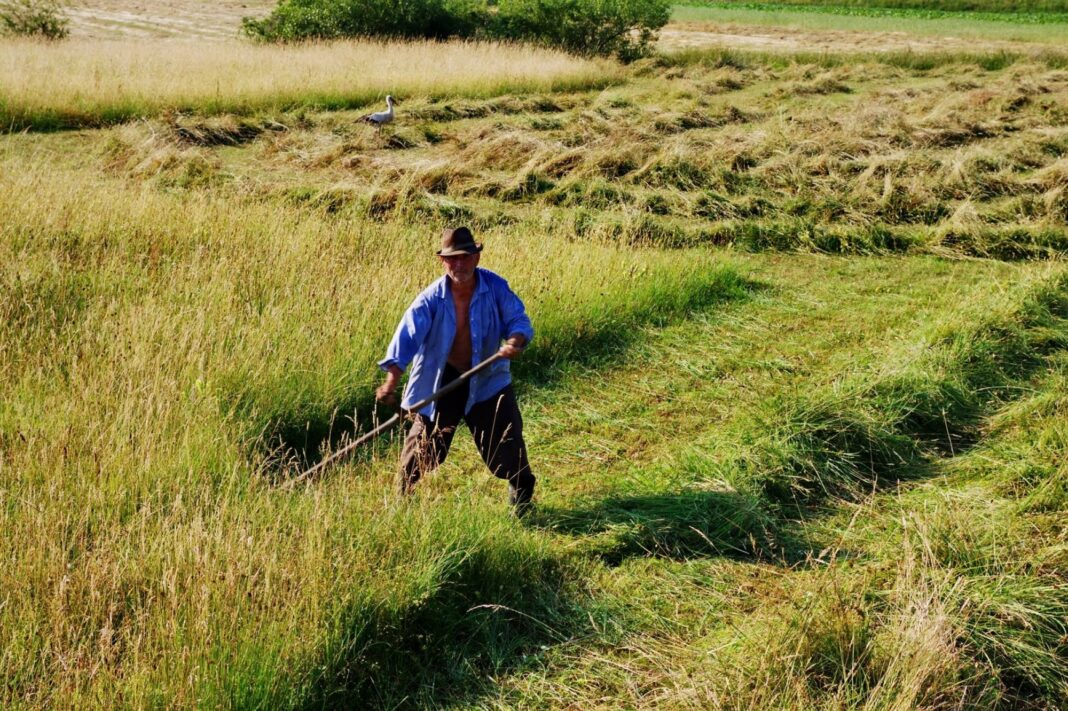
Scything is really hard and on top of that I'd be awaken at 5 AM in the morning, force fed and sent to the fields (with my grandpa and my cousin). It's cold in the morning and the grass is wet from the dew but I guess it beats doing this in the scorching heat of the day: https://romanialibera.ro/wp-content/uploads/2021/07/747678-1...
But the thing I really really hated was weed hoeing: https://nordnews.md/wp-content/uploads/2021/06/prasit-750x43...
Never fucking ending rows of corn or potatoes in the scorching heat of the day with leaves touching my sweating skin and irritating it as if the heat and sweat and dust weren't enough and on top of that the monotony of it. I would try to think of something useful or entertaining but inevitably I'd fall into a torpor where my mind would just shut off and only my body would mechanically carry on automatically. And worst of all, there was no point either hurrying up nor was it possible to slack off. Slacking off meant getting scolded for not keeping the pace. Hurrying up was even worse, I'd get tired and find out the reward at the end of finishing a never ending row of plants and weed was ... another row.
I do not recall it but my parents remind me that at some point I let go this from my mouth and sounded like it came from the depths of my soul: "I'd rather solve 1000 problems in mathematics than hoe just another row of weeds".
So I guess hating work is all about references. All work is hate-able but not to the same degree.