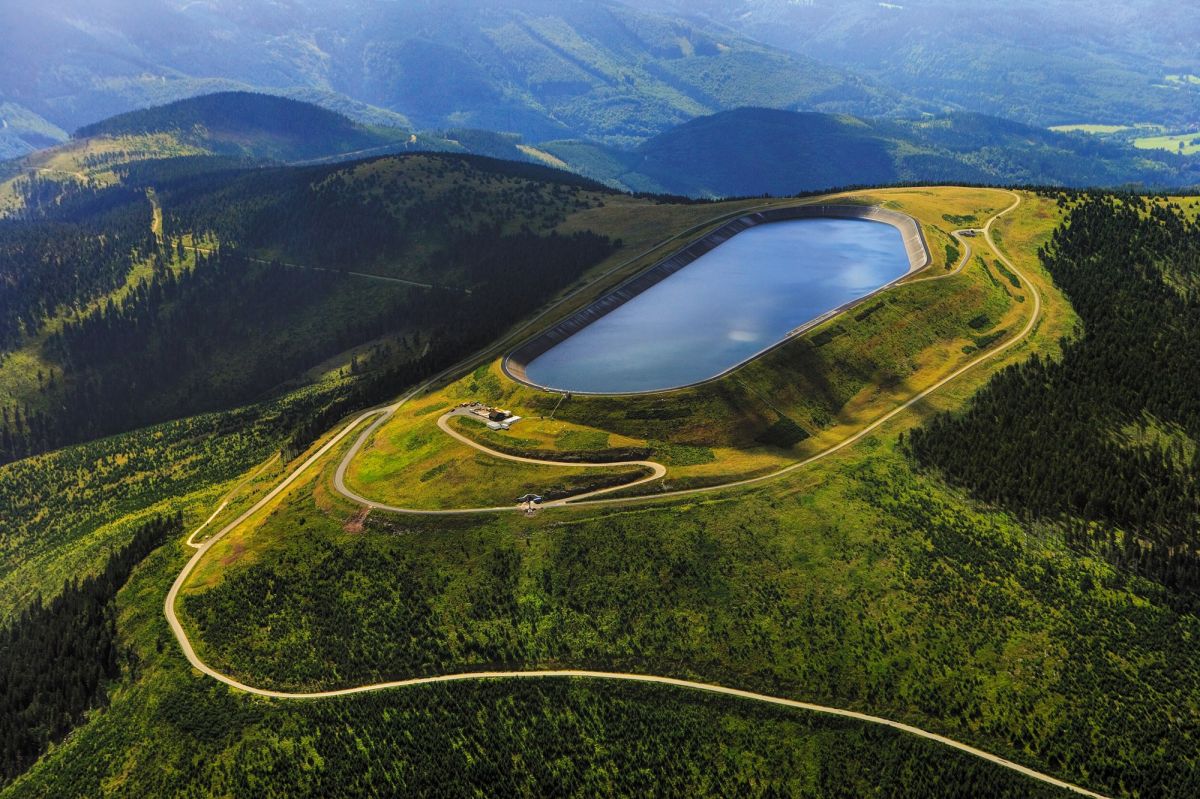
Wherever that happens, it is probably financially a good idea to build one of these.
But that geography is really rather rare, so the rest of the world will probably have to use gas peaker plants (environment-killing) or battery storage (expensive).
You only need one large lake (or a place which can be dammed to create one); the other one can be completely artificial, with no water inflow or outflow other than through the pumps/turbines. In fact, I think it might even be possible to make both reservoirs completely artificial, and fill them by pumping water from somewhere else. That makes the necessary geography a lot less rare; you only need the appropriate height difference, and the ability to create artificial reservoirs on both ends.
Pumped storage needs big lakes - a swimming pool on the top of a mountain isn't going to cut it.
Batteries can also provide grid support (frequency and voltage support when transmission or generators trip) and can be grid forming now; instead of having to follow the grid, they can drive grid health, including black start [4] when the grid is down. In South Australia, a new battery storage facility has recently come online and is in testing to enable AEMO, the grid operator, to turn down the requirement for ~70MW of constant fossil gas generation for grid services [5].
[1] https://reneweconomy.com.au/snowy-2-much-how-can-a-2-2gw-wat... ("This is the fourth time Snowy 2.0’s cost has been reset – from $2 billion in 2017, to $3.8-$4.5 billion later that year, to $5.1 billion in 2019, to $5.9 billion in 2020, to $12 billion now (2023).")
[2] https://www.energy-storage.news/global-bess-deployments-to-e... ("Global BESS deployments to exceed 400GWh annually by 2030, says Rystad Energy")
[3] https://www.teslarati.com/tesla-china-megafactory-constructi... ("Tesla’s estimated initial production capacity for the China-based Megapack factory is 10,000 units per year or about 40GWh.") [My note: This is equal to their existing capacity in Lathrop, California]
[4] https://www.nrel.gov/grid/black-start.html
[5] https://opennem.org.au/facilities/sa1/?selected=TIB&tech=bat... ("Torrens Island BESS")
There was always much better ways the money could have been spent, like investment into offshore wind, battery banks etc. but to directly invest in renewables and battery storage was and is politically untenable for that party. The Government has changed now to the party that doesn't have the same kind of direct fossil fuel investments, but unfortunatly the massive political donations from the resource industry and oil & gas to our politicians is bipartisan so they talk 'clean energy' while not that much actually changes...
The Borumba site will provide 2,000MW generation with 48GWh of storage and works are starting now.
Meanwhile Pioneer-Burdekin is currently scoped as 5,000MW with 120GWh (not a typo) of storage. Assuming it proceeds to that spec it will be the largest pumped hydro station out there.
There is water at the base of a lot of mountains, just knock the top off and build a lake.
However, Dinorwig, UK is far larger at 9.1 GWh, and is 40 years old.
They only started with a single lake and a moderate amount of elevation.
(Update: for those who are downvoting, it was a serious question.)
2. Reservoirs are very large. The lower reservoir in this article is 7 million cubic meters[1]. The Hoover dam passes 289 million cubic meters of water daily, with around 78.3 million cubic meters of that generating electricity. The largest land vehicle in the world can excavate 700k cubic meters per day[2].
[1]: https://coflein.gov.uk/en/site/423380 [2]: https://en.wikipedia.org/wiki/Overburden_Conveyor_Bridge_F60
3. We do dig them out- the reservoir in the article was substantially enlarged. But it's still rare to find places you can actually do that.
4. The upper reservoir is a totally different question. It would take over 125 years to dig out a hole the size of Lake Mead for the Hoover Dam. It would take almost a million of the bombs used the Sedan nuclear test[3] to dig that hole.
You would presumably be pumping air from one sphere to the other.
That air ends up compressing/decompressing, and therefore heating or getting cold. That dramatically lowers efficiency.
And on top of that, a football stadium sized sphere full of compressed air at the bottom of the ocean is going to need hold-down anchors at a scale the world has never seen...
https://en.wikipedia.org/wiki/List_of_pumped-storage_hydroel...
1. Carol Vorderman did a lot of the engineering calculations, before she started on Countdown (probably only relevant to the UK lot).
2. They couldn't run powerlines from the facility to the grid as it's an AONB so they had to run them underground at a cost of £1M per mile for however many miles.
Great place along with Sellafield and the wind turbines in Norfolk for a kid to visit.
If you are a Harry Potter fan, it's not far from Loch Awe to the famous viaduct at Glenfinnan as well. Details here: https://www.nts.org.uk/visit/places/glenfinnan-monument/high...
As a Scot, who’s done a lot of hillwalking in the past (and been scared witless by airforce jets suddenly appearing over the brim of a hill) it was amazing to see tie-fighters whooshing across the Scottish landscape.
> It’s a remarkably efficient process, with about 75% of the energy available for reuse.
Not an (hardware) engineer, so wondering: are turbines typically efficient running both ways? Or would a turbine in this scenario have tradeoffs compared to turbines that are designed for running in one direction only?
The best I can come up with from the comfort of my armchair is that straight gears are typically equally efficient in either rotating direction, but often gears with angled teeth are used when one rotating direction is primary.
There are also what are called ternary sets, which are the generator turbine, the torque converter (a massive clutch) and a pump. A good diagram in here: https://voith.com/corp-en/11_06_Broschuere-Pumped-storage_ei.... These are used at another Welsh pumped storage station: Ffestiniog.
Helical gears (the ones with angled teeth) are used not because one direction is better than the other, but because they have a larger contact area and allow larger forces for a given tooth size (module) and lower vibration because multiple teeth mesh at any time rather than one-by-one. The angle can go either way, and, indeed, can go both ways on one gear (a herringbone gear) to nullify the axial loading.
I can easily imagine a turbine being a good chunk of the installation BOM cost and budget constraints saying price recoup in x years that extra parts doesn't balance against. And in this scenario, then no, another turbine facing the other direction would not be an option - though it is only efficient one way.
You were clearly looking for an answer from somebody who knew something about the field, but I decided (for some reason) to come in with, like, over simplified first principles speculation. I hate it when people do what I did, haha. Sorry!
I really regret not learning Welsh while I lived in such a Welsh-speaking part of Wales.
They look like this: https://www.istockphoto.com/photos/oklahoma-wind-energy-turb...
[1] https://en.wikipedia.org/wiki/Bear_Swamp_Hydroelectric_Power...
Cheoah Dam is on the infamous Tail of the Dragon in TN, and there's a spot where you can pull over and see the whole thing below, it's such an inspiring thing.
[0]https://en.wikipedia.org/wiki/Dlouh%C3%A9_str%C3%A1n%C4%9B_H...
[1]http://turystyka.studentnews.pl/img/wo/3/58/Elektrownia-wodn...