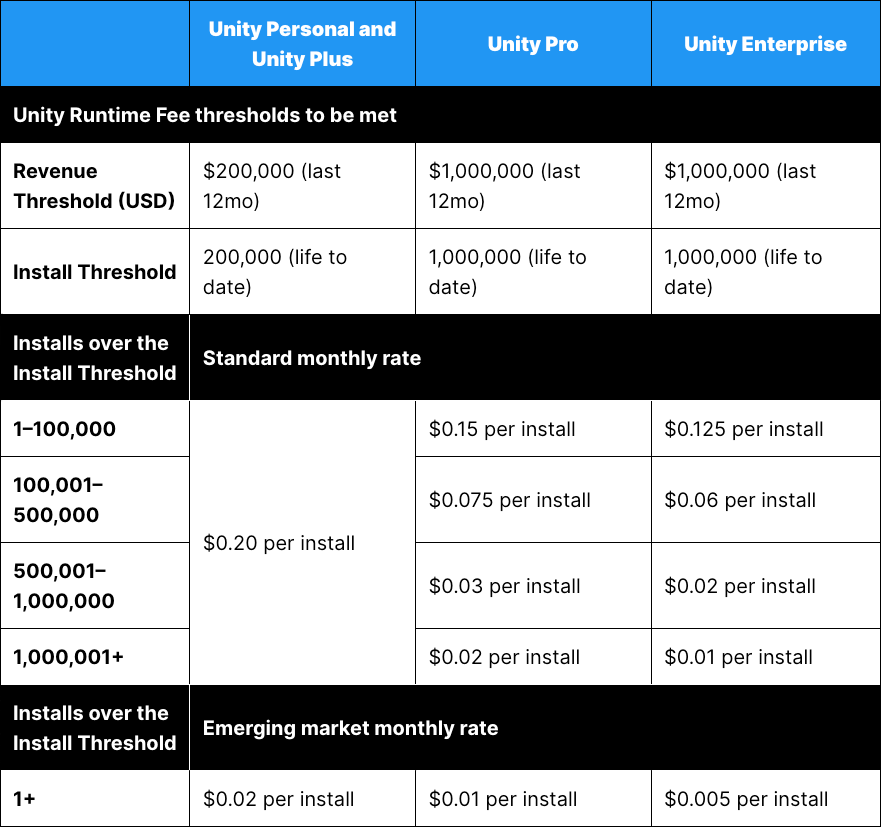
Let's look at fictional scenario for Vampire Survivors, and model 5M units sold in the first 12 months at $4.99 per sale. We'll also assume a Unity Enterprise plan.
    Units Sold:   5,000,000
    Gross Sales:  $24,950,000

    Steam Fees:
    $0-10M (30%): $3,000,000
    $10M+ (25%):  $3,737,500
    Total:        $6,737,500

    Unity Fees:
    0-100,000:    $12,500
    100-500k:     $24,000
    500k-1MM:     $10,000
    1MM-4MM:      $30,000
    Total:        $76,500

    Net Sales:    $18,136,000
So in this fictional scenario, the Unity fee is 0.3% of gross or 0.47% after Steam takes its cut.
Even if we assume the average consumer downloads the game 1.2 times, that's still only $20k more. The bigger issue is how thresholds accrue, since that could push more installs into costlier lower threshold brackets.
I'm not sure I see the outrage.
Not every project needs to seek to make money. Sometimes you want to put something out there for the sake of putting something out there without worrying that you are going to need to pay up for it.
While we are at it, I want to shill my personal favorite engine...Godot. I know its fairly well known in the HN scene, but I think that this should be a push to use more free and open-source technology in game dev, rather than relying on a bunch of corporate black boxes that can turn predatory at any minute.
There are scenarios where the $ number goes negative, for your net, for a modestly successful game .. is negative tens of thousands of dollars.
There is no provision against software piracy, or competitors/griefers artificially inflating your install account.
Is it a hobby if you're making more than $200k in a 12-month period? Most hobbyists will likely be unaffected by this, and those that are will see very small fees less than what Visa charges to process a credit card transaction.
I would like to see that same breakdown for the much smaller games that barely pass the sales threshold. That is the main Unity audience. Vampire Survivors is a huge outlier that didn't even start using Unity until after it became a massive hit.
https://www.rockpapershotgun.com/vampire-survivors-makes-its...
Charging the developer when a customer re-downloads a game they already bought sounds incredibly asinine to me, no matter how small the fee actually is. No download store charges for this privilege, and they're the ones actually footing the bill for the bandwidth and infrastructure to make that possible. Unity is adding accounting complexity and fees for something they do none of the legwork to provide.
5 million x $0.20 = $980,000 in Unity fees under 2023 pricing vs. $2040 annual pro subscription under 2022 pricing (for exceeding $100k in sales).
In other words, this is an instantaneous 480x fee increase, without any corresponding increase in the value of the services provided.
Do you understand why people are outraged now?
So you think they would have left money on the table rather than spend $4k to upgrade to Enterprise?
As an example where their new pricing scheme especially breaks down: You actively lose money (beyond just lost sales) for including your game in things like charity bundles because Unity will still ship you a bill for every install. This means if you had a modest success the incentive is to never give away your game even temporarily.
They also removed pricing levels that hobbyist developers used, which means they also have to pay more in subscription fees (up to $1k+ more) in addition to the fees above.
Going with % of profit does.
Also it is quite unfair to cheaper games, indie 5$ games pay a much bigger share than a 40$ / 70$ game
    Units Sold:   250000
    Gross Sales:  $1 247 500

    Steam Fees:
    $0-10M (30%): $374 250

    Unity Fees (personal or plus):
    250 000    :  $50 000

    Net Sales:   823 250
It's a big bite for something that's impossible to code out of the project.
Imagine if Oracle charged a dollar every time someone ran your software the first time on the JRE in that machine. installation on a new machine? pay again. Old customer reinstalls the JRE? pay again. main executable or JRE update? pay again.
Not so funny anymore.
You could also have saved $8k by upgrading to Unity Pro for $2040, though of course you run the risk of paying for that plan and not selling 250k units.
What if you get 5M installs and fail to monetize it or if the game isn't well suited to monetization?
And assume that you, beforehand, breached 200k, then monetization drops for some reason.
Then you own unity ~85k$ and you so you go in net negative.
That is the real problem here.
Start with 5 million installs, and then your new installs are another 5 million copies, which incurs a worst case ($0.20/install) $1 million fee from Unity. You would still have to have earned $200,000 (worst case you're personal user) in the last 12 months.
So with this, you would gross -$800,000. And this is before app store fees, taxes, payroll, and no accommodation for pirate installs in the new plan.
I don't see the benefit to the developer. Mark Whitten CFO of Unity, says the developers are excited about this. The 6 Plus pages of 99%- comments on the unity forum shows a lot of excitement, a lot of negative excitement from developers.
I don't see the value to many developers. It seems like a huge mistake.
Get fucked dude, you have no idea what any of our backgrounds are.
Unity's recent moves to me speak to a fear that they've more-or-less hit their market saturation point, and now they're looking to extract more from the developers who live in their slice of the pie. I fear this will make that slice shrink, which will create more fear, and then the problem spirals.
Man, you just described [enshittification](https://www.wired.com/story/tiktok-platforms-cory-doctorow/) to a tee
But most of my issues have been with engine philosophy, where Unreal has bent over backwards to expose things to their visual scripting language. It feels like every single feature has a mandate to work in a blueprint tech demo, and as a result few of them are pleasant to code against and almost none of them work together coherently. These are not issues that depend on the language used.
That being said as a non mobile guy who occasionally dabbles in engine stuff I'll be migrating to Unreal for good now. I haven't been a paying customer for a while now but I used to pay for Unity back in the super early days of AR.
Or I guess take another serious look at Godot :D
Never interfere with an enemy while he’s in the process of destroying himself.
I'm also surprised though they haven't just gone and added C# support as a first class option, it seems like such an obvious win.
Maybe ChatGPT6 can port the UE C++ codebase to C# and we can call it UE6
It's difficult to champion high end features for your engine but keep it suitable for low end smart phones. Epic made a good attempt to win mobile devs back in the Infinity Blade days, but given their recent focus (not to mention lawsuits against Apple and Google), it seems they intentionally decided to deprioritize mobile and focus on PC and console.
Edit: am I wrong (mathematically?)
Of course if you sell games at $60 a piece it is not a whole lot, and the regular seat pricing of Unity is most likely a far greater expense.
Is that insane? I'm not a game developer, but it seems like it's in the ballpark of what the app stores are charging, and with a structure that's actually enforceable at reasonable cost from Unity's perspective.
Are there any app stores that charge developers per install? It's only per-purchase/transaction, right? The principle behind that is you don't get charged except as part of a transaction where you're making money. If a user downloads your app for free or pirates it or doesn't make any transactions, you don't pay anything.
What Unity is saying that if I buy a new phone and re-download my apps, that should cost the developers money. That seems like a very different situation to me.
But now that's on top of the app store fee. So, using your example and the "standard (aka 30%)" app store fee, after that 200k cliff, the game makes $0.50 for every $1 sale. That is going to drive people away from using Unity on mobile games imo. Who cares about a $0.20 fee for a $70 (rip $60) game, but for a $1 game where 30% of your rev is already gone... it changes the dynamics.
Maybe that's what they want though? Maybe they are trying to use this to angle as Unity is a "serious" engine now?
That said, wow. Charging a monthly fee on game installs is absolutely wild. The personal fee (for first world countries) is $0.20 / month. If you charged $10 for the game, you'd be losing money after only 50 months (around 4 years).
After reading the FAQ though I’m not sure it’s a good deal.
It also seems like you 100% have to enable spyware
> What is the Unity Runtime Fee?
> (...) Creators only pay once per download.
Yup, but don't worry. You can get a discount if you use Unity's ad network![0]
This whole thing seems...short sighted.
[0]: https://unity.com/pricing-updates "Can I get a discount on the Unity Runtime Fee?"
The question has already been "Why aren't you using Unreal?" and that's just going to get harder.
Given the current VC taste for eliminating all things which count against gross margins now might be a good time to be an engine developer again.
Unreal is just another vendor with a hand in your revenues.
I do a fair amount of Godot development - for casual mobile games, limited PC games, or games where you're planning on a publisher to fund your port, I think Godot is a good choice.
But everyone will be waiting for Godot to have the first widespread hit before jumping in like that.
C++. Sure, we can talk about Verse or even Skookum, but C# is much easier. Still, if any big game engine would have something like JS it would be even better for indie or small studios.
The name of the game is iteration speed. (I always think of Paul Grahams story about beating out the competition using Lisp.)
I've been working with UE since 2014, originally started in UE4 C++ and avoided blueprints and kept everything in C++. Was great 'for performance' and code diffs but now 10 years later I'm 99% blueprint and only go down to C++ if the performance requires it for the 1% of hot paths. My iteration time in UE using blueprints makes me shutter to think of all the time I spent waiting for C++ to compile.
Lack of Web and Mobile support
I tend to think the dev iteration speed is the core Unreal weakness.
The problem Unity have created is if something can be made with Unity it will get crowded out with clones in five minutes.
> Starting in November, Unity Personal users will get a new sign-in and online user experience. Users will need to be signed into the Hub with their Unity ID and connect to the internet to use Unity. If the internet connection is lost, users can continue using Unity for up to 3 days while offline. More details to come, when this change takes effect.
Notably, Adobe Creative Cloud requires you to check in every 30 days to validate licenses. I feel like it takes some work to come up with a DRM scheme for a development tool that is more onerous than Adobe's restrictions, but what do I know?
I certainly have never left a demo laptop unplugged for a week and then set up a demo quickly without Internet access and needed to make a quick change in my engine. That never happens to indie developers, so locking down the editor until they reestablish an Internet connection totally won't be a problem for them. /s
It's optional (Godot is free), but if any developers who are considering switching from Unity want to see Godot development accelerated, consider kicking the project a few dollars a month: https://godotengine.org/article/godot-developer-fund/
https://twitter.com/JohnDraisey/status/1701620078419251255
> They eliminated Unity Plus subscriptions as of today, Plus members are being switched to Pro automatically. Be careful not to have auto-renew on your account if you can't afford the price. And this is with just 2 people on my team with project access.
I mean... Jesus.
> Finally, Unity Plus is being retired for new subscribers effective today, September 12, 2023, to simplify the number of plans we offer. Existing subscribers do not need to take immediate action and will receive an email mid-October with an offer to upgrade to Unity Pro, for one year, at the current Unity Plus price.
Right. I had a demo laptop turned off for most of a year, and when I turned it back on, it took half an hour while Windows updated. All laptops are now on Linux.
JetBrains license server is 48 or 72 hours and won’t even let you open the app in any way if you have no connection.
With that being said, I have never had the desire to use it (or any other engine). Perhaps I'm a minority here, but I dislike engines and I dislike the idea of "building my own engine."
I think you should set out to make the game. You begin by creating a window. Then you draw some pixels or render a texture. You add events and controls. You make the game logic and states. Then you have a game. It can take as little as a hundred lines of code to have a basic game up and running.
From there, you make the thing you want to create. No more, no less.
Yes, but without an engine, how do you make this all cross-platform?
Using something like Unity, you can theoretically write your program once and it runs on damn near anything. Android, iOS, Linux, Windows, PlayStation 4/5, Switch, and more.
Did I forget about reflection probes? How about a terrain editor? Maybe you need to bake lighting to make your game look good.
I think this comment might wildly underestimate just how much modern game engines like Unity, Godot, and Unreal bring to the table. They may very well be the most complex pieces of software in the world today
Just pray that you're never employed to be the #2 developer to someone who built their own game without an engine. "Why would there be documentation? Just follow my inner voice."
This reads as something insane. If a player replays a game on steam, redownloads it, the developer still pays for the installation? I know people who redownload games all the time, like tens of times over the span of several years. I hope it's imprecise language and only the initial install/download is counted.
I hope these changes (whatever they actually are) won't push game developers towards developing games that milk users more, with loot boxes, in-game currency, cosmetics etc, and away from stand alone you-pay-once games, single player or multiplayer, only to be able to pay for the ongoing engine fees.
- What about pirated copies?
- What about maliciously installed copies? (4chan: "alright frens, time to install-bomb <gamewehate.exe>! Remember to click the IP address rotation button each time!"
There is a real risk of this happening.
Eufloria is a good example (for me), as I've played that one on several different machines over a few years. Probably played and deleted it more then 20 or 30 times overall. And will likely keep on doing more too.
Unity is assuming that there is "success" due to an installation. That's a inconsistent assertion. And so, there are flaws with this billing approach.
They are also seemingly making Unity games online-only for the DRM/accounting purposes.
So if you made $200k off of 1M installs, you’ll now pay $200k and your total profit will be zero.
I guess the assumption is that each install will earn you >>$0.20, but that’s a very generous assumption. What about a F2P game that has millions of installs but only a fraction support the game with microtransactions?
There’s definitely going to be some cases where studios will owe more money to Unity than their game makes.
You’re right, some studios are going to be forced to switch to the Pro plan to save on per install pricing. That just seems like a really frustrating forced upgrade.
Then you shouldn't be in the business of selling games with a model that bad. Who is charging 20 cents for their games?
The Unity Page does not mention free games with micro transactions, but especially there the user turnover is way higher. A lot of people will install it, play it for a few minutes (or days) and remove it again. Will the developer pay those install fees too?
This entire thing seems not really thought out.
I am also wondering what about trolls, who spoof HWID (or whatever the unique install id is based of) and spam-install it
We're kinda busy right now so we're paying the fee, but buying a mac mini for builds is definitely on our TODO list now, and once there's some slack in our schedule that will be done.
We've also wasted weeks of time debugging bugs in their cloud system in the past, some of which were mysteriously fixed and they had no clue why. So I'm not even sure we've saved much time over just having our own in house build server.
This will absolutely kill any incentive for the remaining indie devs to use Unity with such a low floor and flat cost. Whereas your game going temporarily viral would have been huge , now it’ll be a huge burden. Meanwhile Unreal is 5% after 1M.
A progressive fee would have at least made some sense.
As it is, Unity lags severely behind Unreal for both features and sentiment. The big markets for Unity were indie and enterprise. They’d ceded everything in the middle to Unreal.
Epic provide megagrant funding to Godot, in what I imagine is a play to eat Unity from the bottom up. Unity will just accelerate that.
And enterprise is fickle. They’ll switch to something else as soon as any project lead feels like it.
Imho this is one more step down the road to the death of Unity. They have brilliant engineers led by very incompetent leadership.
Which is still more than Unity as long as you game costs more than $5-20?
Of course this pretty much makes making any actually free (not filled with ads free) games impossible.
Edit: If I understand correctly the install fee only kicks in after $200k revenue? If so these pricing changes actually seem pretty reasonable..
Big company selling big games will see this as a rounding error in their revenue. Indies / small company will probably need to shutdown some games because this won't be profitable...
The issue is that, Unity are in a very odd place of the market. They completely ceded high end gaming to Unreal. They have reasonable alternatives like Godot on the other end. So their main markets are:
1. Enterprise - which is fickle
2. Indie devs aspiring for success - who are going for cheap
3. Mobile (which might include 2)
4. A very few AAA games
I think this move will alienate a lot of their indie clients in the hopes of getting more money from their higher end clients. For those indie clients, hitting 200K of revenue is a much closer dream than 1M of revenue, and they'll see that Unreal gives them more "high end graphics".
So I understand Unity's position, I just think they're alienating one of their biggest bases. Even if they don't make money directly off of them, those are the people who often advocate for use of Unity in other areas like Enterprise.
This pricing change pressurizes modestly successful long tail profits. And so I think yes competitor game engines that are more progressive will be more popular for those segments.
Per install fixed cost is a good way to avoid the race to the bottom and then the F2P nightmare that still plague the mobile gaming market.
Before Apple invented the $.99 pricing tier, most mobile games were sold for $7-$20 and it was, IMO, a much better market.
Like I kind of get where you're going... Increasing expectations so products must be high quality and guaranteed to be profitable. Although that's still a little wishful. And so it might not be realistic.
I personally think this will actually suffocate certain segments of the software market. It's like the insurance donut hole here in the United States where if you're between certain ages you don't qualify for Medicare and you still are paying for it and so you risk going into extremely high insurance cost zone, just because your age happens to be like 58 years old.
Nowadays, of course, the $40 game is $70+Battle Pass+Digital Deluxe Upgrade+Day 1 DLC and the $1 game is free but contains a hypnotoad that will mind control you into spending $400 a month gambling for jpegs.
Dirt cheap games appeared "thanks" to Apple.
Completely abolishes the incentive of pushing free updates too. You don't want to make new great features that would push people to re-download your game.
It seems they will just bill monthly on the net gain in installs.
They still avoid the topic of defining how a install is tracked (do reinstalls count?) and so far on their forum have not replied to it.
Still bonkers for a cheap mobile game.
The writing was on the wall then. These “pricing upgrades” today are designed to drive more adoption of Unity’s ad network. Popular free games will have to start showing ads via Unity to pay for the new runtime distribution fee.
This has made +10 years of high-quality, unforgettable, GOTY games made in Unity to not have the logo, while all the humble, low-quality, full of free-asset-store assets, practice projects of newbies, show the Unity logo first and foremost.
Literally attaching your brand recognition to the projects exactly opposite of the ones you want your brand to be recognized with.
That's a change from the past, and the FAQ doesn't provide a reason why. My guess would be analytics over licensing, but who knows really.
Ugh, this whole thing is so frustrating. I’d love to cancel our unity projects and port to godot or unreal, but that’s just not possible in the near term.
Unity is doing everything they can to push devs away.
Is that really such a problem? It looks like it'll work offline for up to 3 days.
Will there many people doing game dev that can't go online once every 3 days in 2024?
I'm sorry but maybe I'm missing something obvious.. Why are they making this seem preferable to developers? Also what does the runtime being installed have anything to do with the cost to Unity? This is mind blowing, i have to missing something.
I don't disagree that Unity need to make money, but they should go the Unreal route with % of profit or something.
Tons of games don't even make back 0.20$ per user (mobile or f2p), what's going to happens to those? Force to close because they cannot pay the rent?
"How will Unity track installs?"
> We leverage our own proprietary data model, so you can appreciate that we won't go into a lot of detail, but we believe it gives an accurate determination of the number of times the runtime is distributed for a given project.[1]
> Q: If a user reinstalls/redownloads a game / changes their hardware, will that count as multiple installs?
> A: Yes. The creator will need to pay for all future installs. The reason is that Unity doesn’t receive end-player information, just aggregate data.
https://forum.unity.com/threads/unity-plan-pricing-and-packa...
Also what is an install? Why not go with "user", someone installing the game 5 times is gonna cost 1$?
Terrible communication all around form Unity.
Unsurprisingly, the FAQ does not answer much.
My app is totally free, done as a charity/side project for disadvantaged kids.
I've been paying for their Plus plan - $35 a month. Now it will have to be $185 a month, or my app would have to have Unity splash screen...
Very sad.
Would have to figure out another engine to move to, preferably that has good native Web support as well. Any recommendations?
- I strongly dislike the name and logo
- It feels very foreign at first, but easy to pick up
- It appears to me that it is production ready
- Migrating an existing unity project would be an absolute nightmare
- Publishing to consoles looks tricky, but I haven't been far down that path yet
I am going to be spending more time with it now, because I have been growing less and less happy with unity over the last 2+ years. The proverbial straw has now found it's seat upon the camel's back
I assume you haven't made "$200,000 USD or more in the last 12 months" from it, so you can relax.
I’m fully expecting enshittification of the Unity Editor next.
After taking some time to mourn I plan on looking into Godot. I expect to take a big productivity hit but at least I won’t be continuing to invest my time into working on a platform that is so anti-dev.
>An install is defined as the installation and initialization of a project on an end user’s device.
Lmao, so if someone pirates your game the developer has to pay for it?
And if a user installs your demo you have to pay the fee anyway.
I wonder if this entire fee will be passed directly to the customer
Also this seems to be targeting the mobile market more than other markets because of how large install bases are on that platform. 100M+ users for each popular mobile game * 0.01-0.02 = a lot of money for Unity.
- the per-install fee doesn't kick in until you've passed BOTH the annual game revenue and install thresholds (i.e. >$200k annual revenue on the game and >200k lifetime unique downloads)
- the fee isn't monthly, it's per unique download (poor wording in Unity's chart)
- you only pay the fee on the number of downloads over the threshold
This new pricing will actually decrease the price of using Unity for many developers. Before, if your company's total annual revenue was >$100k, you had to buy a paid Unity license no matter what. Now those company's can use Unity totally free until their game reaches $200k annual revenue and 200k lifetime downloads.
This licensing scheme is actually very similar to licensing the AVC/H.264 video codec from Via LA (for example, if you want to ship a build of Chromium with MP4 enabled). In their case, licensees self report the number of units they've distributed per year and pay a small fee on the number of units over 100k. If you ship under 100k units, there is no fee.
Probably true since it doesn't appear like they're a game engine company any more. The enshittification machine is rumbling to life.
A developer decides to make their game that was a hit almost a year ago free? Now they might have to pay Unity more than the $200k they made on the game earlier!
Or if they throw it in a charity bundle, they get punished for their attempt to help people in need!
Ripe for fraud.
If unity is malicious they could actually set up farms artificially inflating installation counts and generating a little extra profit.
And what about the install fees? Let's say my studio fails but people keep installing because of piracy or any arbitrary reason, am I going to get charged for the remaining of my life? It's just a shocking move
"I got some clarifications from Unity regarding their plan to charge developers per game install (after clearing thresholds)
- If a player deletes a game and re-installs it, that's 2 installs, 2 charges
- Same if they install on 2 devices
- Charity games/bundles exempted from fees"
This is genuinely insane — I’m not familiar with any other software in the world that charges a customer for deleting and reinstalling it to the same user/same machine.
In my case, this would be the final straw after years of baffling tech reorgs and broken promises, but I have such a massive sunk cost investment in Unity store assets that I am effectively locked in.
All of that said, I would put serious money on this getting at least partially rolled back in the next few days. The blowback is going to be big enough that the investors might tell the MBAs to stop sacrificing their long-term profits for short-term gains.
* Do WebGL plays count?
* This could bankrupt indies if too many people click the WebGL games
* What Unity Version is this effective from?
* Will games made on prior versions of the editor be affected?
According to https://unity.com/runtime-fee "distribution via streaming or web browser is considered an install."
> Will games made on prior versions of the editor be affected?
From the FAQ https://unity.com/pricing-updates , "Will this fee apply to games using Unity Runtime that are already on the market on January 1, 2024?
Yes, the fee applies to eligible games currently in market that continue to distribute the runtime".
So while it doesn't apply to any past downloads, it will apply to any future downloads of previously released games.
You are likely already paying a recurring cost to Unity, as per https://unity.com/pricing: Excluding the free Student & Personal tiers, the starting list price is $2,040 per year per user (for Unity Pro), going up to $4,950 per year per user for the top tier (Unity Industry).
So, this is a new charge, which becomes active when the following conditions are met for a particular game:
• # of installs, over the life of the game, passes 200k (Personal) or 1MM (Pro/Enterprise). • Revenue, over the last 12 months, passes $200k (Personal) or 1MM (Pro/Enterprise).
Once both of those thresholds have been met, then you get charged a flat fee per install over the threshold. So, if you meet the Revenue amount, and you've had 200k/1MM installs, your next install requires you to pay a fee to Unity.
This is all covered in the table at https://unity.com/sites/default/files/2023-09/NewFeeTable.pn...
For games that are not being distributed through a channel (Steam, GoG, console/app store, etc.), this is going to be really annoying to track and report on. This is also going to be annoying for games that are distributed through multiple channels. Unity's probably going to get into the auditing game at some point; à la Microsoft, Oracle, etc.
I imagine they could expand on their existing analytics platform, which I believe is already forced into any release from Unity Personal?
https://docs.unity3d.com/Manual/com.unity.services.analytics...
https://unity.com/products/unity-pro
So I see $2040 per year per seat for Unity Pro. That doesn't quite explain why the per-install costs decline with volume for Pro/Enterprise licensees, but I suspect that's just that the Pro/Enterprise are more sophisticated and have better negotiating power.
So your game is dependent on their servers, and they can kill your game?
- cross your fingers for a deal with a major (Xbox game pass, Epic exclusivity) - cross your fingers for a deal with one of the smaller ones that will do proper guidance and marketing (devolver, deck13, new blood, Annapurna, team17, etc) - cross your fingers for big streamers to dedicate at least a few hours to your game - make an extremely niche, moated game that will for sure attract a specific fanbase that buys everything on that niche. And cross your fingers that a competitor doesn't launch around the same date. - make an addictive gachapon filled casual mobile game, and burn money in ads
Only one of these doesn't have you crossing your fingers. (I'm half joking please don't take this too seriously)
EDIT: The more I read the FAQ, the more I think this is a bad deal
I don't know what to do. I have a huge sunk-cost fallacy here.
I guess I'm going to ship it and pray, and then never use Unity again.
Jesus christ, what were they thinking?
Fuck Unity.
Funnily enough the changes have also made me look back into Unreal, I hear they have a proper Linux editor now and that their flavour of C++ is a bit nicer than I expected. I doubt I'll switch from Godot anytime soon, but worth a look.
EDIT: I see the point being made a lot that this won't affect many smaller devs as they'll never make enough money to meet the threshold, however it seems to me that if your choice of engine makes you hope your project isn't successful, then it might be time to choose a different engine. Unreal engine devs hope their game will make enough to qualify for the revenue share, not because the revenue share is a good thing for them, but because it means if they're making that kind of money it won't be a problem.
Unity did have some great and useful libraries for doing things like animation rigging and editor customization. RIP
Imagine Sony suddenly trying to impose a per-playback fee on all existing and future factory-produced Blu Ray discs.
Imagine Lockheed spending 5-10 years developing a jet fighter, then a year before it's finished, TI tells them that there will be a monthly usage fee for every TI chip used in the aircraft.
Imagine a retailer spending hundreds of millions of dollars to roll out a new Fujitsu point-of-sale platform, then a year later Fujitsu says they're updating the license terms to require a flat fee for every customer transaction. Or worse, imagine that the Fujitsu platform runs on Windows, and Microsoft tells the retailer that the Windows licensing terms have been updated to require a per-transaction fee for every Windows device that has point-of-sale software installed.
Maybe I'm missing something, but I'm completely failing to see why any business would continue to use a product that requires a long-term commitment when the vendor has acted this way.
Is it a last-ditch cash grab to appease Unity investors? i.e. do they know that it will kill their platform, but they're hoping the tail end of Unity-based games[1] will generate enough licensing fees to recoup some of the investment money?
[1] i.e. games already released, but still for sale, as well as games still in development but too far along to switch to another engine.
This was not clear to me at first based on their table which currently shows 1-1000 installs as falling into the $0.20, but it's in fact actually the installs AFTER passing the threshold I believe. So assuming it was installs, it would be install 200,001 - 201,000 that would be charged $0.20?
We had over X million downloads of Void Bastards.
I wonder how many people are scrambling to pull the game out of Gamepass right now :)
Update: I updated my comment to hide the install numbers in case there was some rule that prevents developers sharing those numbers.
Watch your games get auto removed after the developer goes out of business or doesn’t pay RENT
I think it's a play to force f2p games to use their ad mediator as the install fee will effectively raise the cost-per-install for anyone using competing ad networks.
Vampire squids doing vampire squid things. I'd expect them to get sued, and at least in the EU it seems likely to be difficult to defend.
These days I'm doing WebGL and ThreeJS is not fun either with upgrades, depreciated functions.
The whole ecosystem is a mess these days. I need to shave my beard.
I suspect this will significantly impact the Xbox GamePass lineup soon once it takes effect.
Also, imagine that pirated copies or even multiple installs by the same users counts into hitting that threshold. I could see a malicious competitor pushing a lot of installs to hit someone else bottom-line and sink them financially with a minimum of risk for them.
That new policy need to go back to the drawing board ASAP.
Innovation requires talent, efforts and pain - and that's a scarcity, especially in the aging company which prefers an illusionary comfort to the true freedom.
There's MonoGame, but man, it's really a mess, they're still using Microsoft.XNA.Game;
And I always have a hell of a time getting it hooked into Visual Studio.
Recently started a C# project that renders using DirectX onto Windows SDK window.
Hopefully I can continue along with that.
Mobile games are already a risky business with success hard to come by. Marketing costs for games has already gone up due to due to ATT.
They are doing the classic chase current revenue while destroying future revenue thing
Last time I checked their storage limit was around 40GB, that's too little unless you are making 2D casual games. I'm making a 3D shooter that takes 300GB+.
"We are introducing a Unity Runtime Fee that is based upon each time a qualifying game is downloaded by an end user."
"Only games that meet the following thresholds qualify for the Unity Runtime Fee:
Unity Personal and Unity Plus: Those that have made $200,000 USD or more in the last 12 months AND have at least 200,000 lifetime game installs. Unity Pro and Unity Enterprise: Those that have made $1,000,000 USD or more in the last 12 months AND have at least 1,000,000 lifetime game installs."
If you're an indie studio making small 2d or basic 3d games, you will use Godot If you're a big studio looking for AAA graphics capability you will use Unreal.
There is no other reason to use Unity other than legacy asset store purchases and existing project maintainence.
In 2-3 years those legacy projects will wrap up and Unity will be dead in the water as a company, mark my words.
To many low quality unity games out there.
Also, this continues my pet peeve of disguising bad news with neutral headlines. If they had made anything cheaper they would have put it in the headline. "Updates" means "price increases".
Unity right now is only massively used by 1) Indies 2) Mobile game studios
They just made sure that all of those will switch tech.
Unreal Engine has a much better license because it says that "it's not retroactively changable": so if you eg stay at Unreal 5.2 forever no new epic changes to the license will apply to you since the 5.2 license applies to you forever.
RIP unity.
Even if unity reverts this (which IMO they will due to backlash) all new mobile studio game devs will move to some other engine.