https://www.sliderulemuseum.com/SR_Class/OS-ISRM_SlideRuleSe...
IMO, what the slide rule does is replace the memorization of squares and roots, or of logarithms of digits. I've never used a slide rule professionally, but I've noodled around with a few (I inherited a fancy one from my grandfather), and it really forces you to think about scaling and precision in a way that's different from both calculator and pencil-and-paper arithmetic, and the idea of knowing how to do the mantissa, and then using logical rules to infer the order of magnitude, is central. I think that's the through-line of the article, too, or at least it seemed so to me.
Log 2 is a matter of dividing by two (and adding 1 to the log2 value) until X is in the range [1,2)... (or multiplying by 2 and subtracting 1). The to handle the fraction, square the number, if it's above 2, divide by two and add a 1 to the binary fraction, if not, add a 0.... and continue.
Log 10 is similar... divide by 10, then once you're in the [1,10) range... take X to the 10th power (square, square, *X, then square)... count the number of times to get the number back to the [1,10) range, and add that digit after the decimal, and repeat.
    2: 0.0809
    6: 0.0495
    12: 0.0355
    20: 0.0277
    30: 0.0227
    42: 0.0192
Logarize?
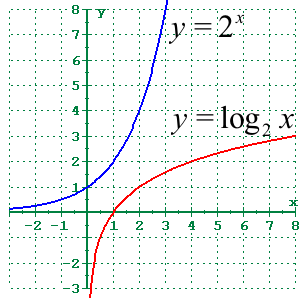
https://people.richland.edu/james/lecture/m116/logs/log2.gif
Graphical visions of functions are more intuitive especially if your're thinking continuously.
It thus follows that power functions becomes "linear displacements" when log-log-transformed.
Logarithm should really be called "scale-metric displacement-ifier" or "linearizer-for-quantities-that-have-an-absolute-zero" or something along those lines
The difference between a O(1) and O(log n) algorithm is usually not that big!
There's a book called Calculus Reordered by Bressoud that describes Napier logs/natural ln(x) too
[0] - https://betterexplained.com/articles/demystifying-the-natura...
Then I learned that he'd been out of school for quite a few years and is a programmer now. That makes me pretty sad. Is it really such a novel insight to learn about the relationship between exponentiation, roots and logarithms that you need to write a blog post? Isn't this basic school math anymore that everybody doing anything even remotely related to math should know by heart? (Programming definitely counts into that..) How do you even do things like basic finance, interest rates, inflation, without groking this?
It makes me worried not just about the future of society in general, but about our industry in particular. I'd feel uncomfortable working at a place where any of my coworkers would feel compelled to write a blog post about the relationship between exponentiation and logarithm that explains that exponentiation is not commutative.
levels(n, 10) is approximately num_digits(n).
knowing that levels(10, 2) is approximately 3.32, I know that to represent 1000 (3 digits) needs 3 *3.32 approximately 10 bits. 1 million (6 digits) needs 20 bits. 1 billion needs 30 digits. bits are just binary digits.
Another important case when logarithm shows up, that multiplication on (0,inf) and addition on (-inf,inf) have the same structure, and logarithm creates an isomorphisms between them. Usually it makes multiplication easier/more familiar. Vi Hart has an entertaining video about it [0] where she explains how she likes to smell numbers, and visualizes the exponential function on a line written values over it, instead of a 2d graph.
There are a lot of other cases where logarithm may show up. I usually treat them separately. For example if a logarithm shows up as the integral of 1/x, then chances are that I better think of it as the integral of 1/x, and I don't gain anything if I think of it as the number of digits. That doesn't happen often.
Assuming 1 manager oversees 10 people (then -1 to subtract lowest level of engineers).
Google 190,000 => ~4 levels of managers (5 - 1 = 4)
Apple 164,000 => ~4
etc.