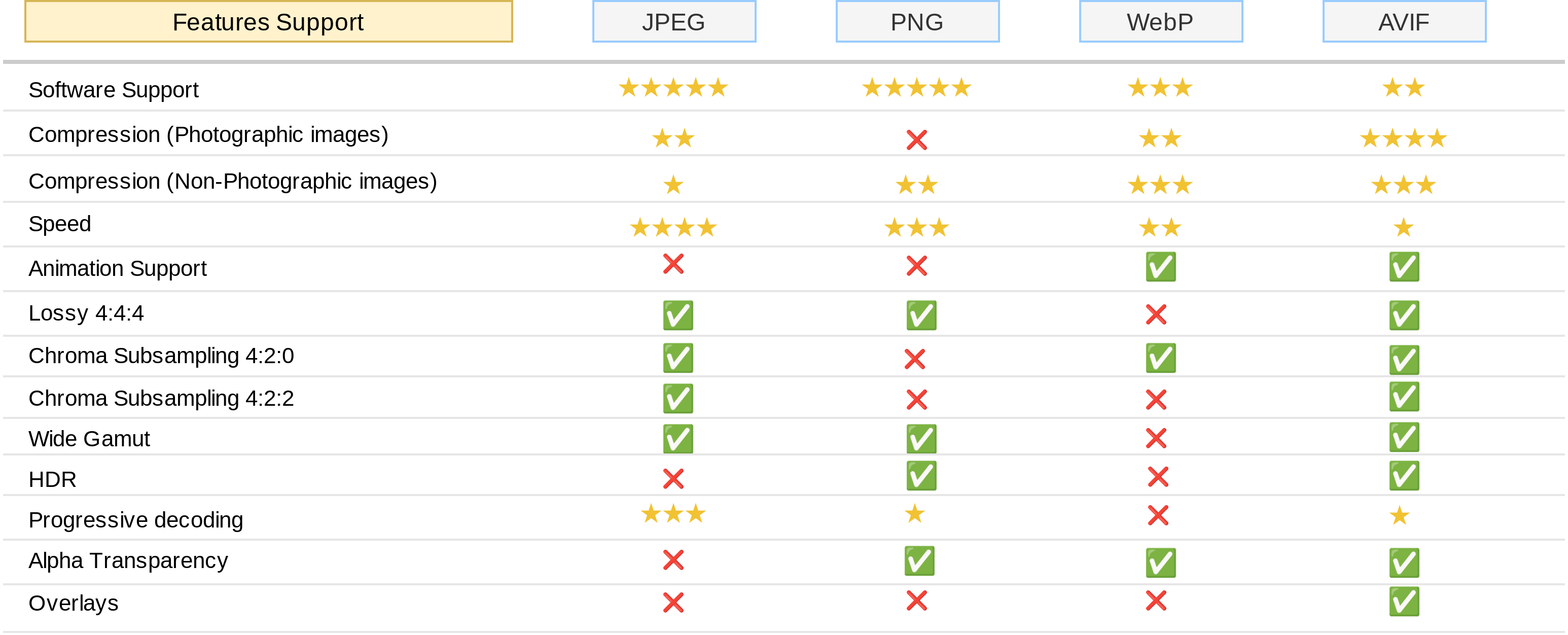
WebP is obsolete. It's still based on VP8 codec, which in video has been replaced by VP9 long time ago. AVIF is based on AV1, which is a successor to VP10. So WebP is a few generations behind in the VPx lineage, and is no match for modern codecs.
Very few sites pay for so much outgoing image bandwidth to make that compatibility cost lower than a 15% savings.
WebP has the big advantage that the quality setting is meaningful, you can set it at a certain level and then encode thousands of images and know the quality is about the same. This is by no means true about JPEG, if you are trying to balance quality and size you find you have to manually set the compression level on each image. Years back I was concerned about the size of a large JPEG collection and recompressed them which was a big mistake because many of the images were compressed too hard.
In 2023 I think you can just use WebP and it will work well, my experience looking at images is that AVIF does better for moderate to low quality images but for high quality images it doesn’t really beat WebP.
Distortion metrics[0] such as MS-SSIM, MS-SSIM*, SIMM, MSE, and PSNR can be used to define a cut-off or threshold for deciding the point at which the image is "compressed enough" by using one or more of those algorithms and predefining the amount of acceptable/tolerable distortion or quality loss. Each of those algorithms has some trade-offs in terms of accuracy and processing time, but it can definitely work for a large set if you find the right settings for your use-case. It is certainly more productive than manually settings the Q-level per image.
Some SaaS such as https://kraken.io do this on JPG images.
https://archive.smashing.media/assets/344dbf88-fdf9-42bb-adb...
and
b) Like any other video codec-based format, webp overcompresses dark areas in images so no, you can't rely on consistent quality across collections of arbitrary images.
Webp has been around for over a decade. AVIF will probably get adoption as a faster rate in my estimation.
There's always going to be FUD around software patents, because the system is broken, but AVIF is as good as possible in the pathological system.
AV1 was largely based on VP9/VP10 and was developed by a team working in Chrome organization.
JPEG XL main mode (VarDCT) and the JPEG recompression is largely developed by Google Research.
WebP as a format was based on VP8, a video codec built by On2 Technologies. On2 was bought by Google in 2010 -- a year before Google published WebP. The transparency and lossless encoding as well as non-video keyframe-by-keyframe animation were designed at Google. The On2 VP8 codec used initially in WebP lossy was not that suitable (too many artefacts) for photography transmission. Jeff Muizelaar wrote a great blog post about this. The codec for WebP were redesigned (without format) changes at Google, and kept improving significantly until around 2015 when it reached pretty good maturity.
(Personally, I don't like what it does to highly saturated dark colors, such as dark forests or dark red textures, but it is much much better than it was.)