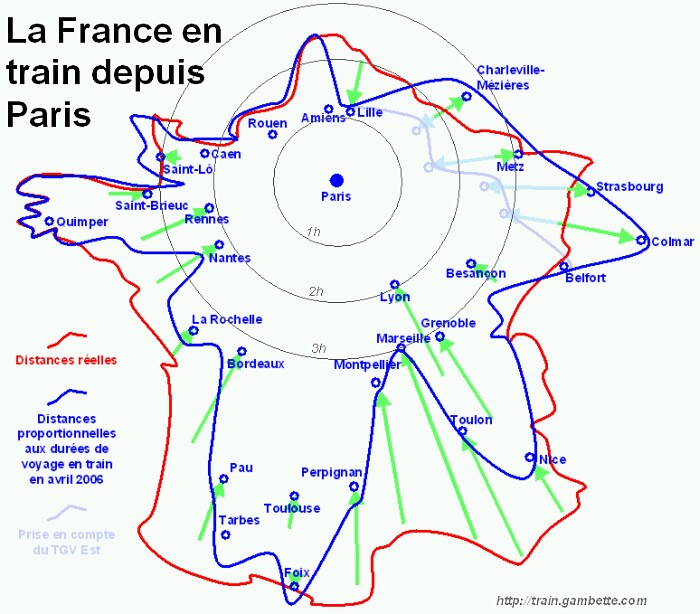
Well that would be nice, but unfortunately not true. Our public transport is tolerable, but Covid accelerated drastic cuts in the bus lines out in the country that (used to) go where trains don't. This has lead to the creation of 'on call' buses which you can reserve in advance if you want to go to one of the villages affected, but which mean that the projected itinerary can only be achieved in ideal conditions. Normally, if one link in your public transport journey is delayed, you just take the next train or bus, but with these on-call buses you are now missing the last leg of the journey, and have to wait at least on hour for the next opportunity (minimum time between reservation and minibus appearing). These maps don't account for this, because it is focused on train travel and the time-distance to stations.
This time-maps are fun, but typical Amsterdam-centric thinking. And don't even bother trying to visit any bucolic place without train stations on a Sunday.
On the whole, public transport in the Netherlands, trains included, are not in a very good position¹. Partly due to the after effects of corona, partly due to a car-focused government.
1: Relative to neighbouring countries and pre-Covid conditions of course. This is still paradise compared to some countries.
I agree that service to real small towns has gotten worse, and I agree that that’s stupid. But a large share of NL’s 400 train stations are in small towns too. Bus service to Tynaarlo going to shit does not mean that “public transportation time distance” is a useless, or “Amsterdam-centric” measure.
But that, indeed, does not mean that public transport is bad. It's still very good. Just less good for a minority.
My situation is that I always need (2x) extra 25 minutes on bike before I can hop on a train. A car hardly increases that speed. A taxi might be faster (due not having to park), but they are (always have been market-driven) unpredictable: they don't like driving to/from a small village.
I often need "last-leg" journeys in remote areas too. Dutch public transport has excellent bike-services. I'll just grab a bike (OV-fiets) at the train-station and cycle to where I have to be. Sure, over 30-minutes makes the entire journey longer than car. But 25 mins bike + train@150km/h + 30 mins bike is most often still faster than a car. And I can drink a beer, code some stuff or watch a netflix on the train. And have 1:50m of light workout under the belt.
Point being: maybe it's getting less-good. And it's good that people complain about that (if only they voted like this too). But most often this complaint is really little more than repeated hearsay; a pretext to keep driving in a car.
That being said, I've been living in other countries and the quality of service is INSANE compared to many other countries. We quickly forget how easy we have it.
People take the train in NL like they take the bus in major cities in France. I hope it'll stay as good in the future, and the shortage stops at some point.
Could you please elaborate? (I am not sure I understood your comment)
In France we do take trains on a regular basis, especially in major cities (the NL population is 17M, the paris region is 12M and largely crossed with trains)
Another friend had one bus a day.
Nowadays I live in the city and would complain if I had to wait for 5 minutes. How we reason about public transport quality is very relative to our expectations.
Try Lollum, Burdaard, or Earnewâld by bus! Similar in population to Stavoren, no train, no dedicated bus line (anymore).
That said, I think it’s more a function of the Netherlands being a small, flat and dense country than having great public transit. You could probably bike between most major cities in less than 90 minutes.
Is there some kind of global index that measures how good public transportation is in major cities of the world? It'd be interesting to which cities rank at the top.
Can I request the well-traveled to share on this thread which cities they found to have the most excellent public transportation?
What is "good public transport"? A tiny village with 24 souls and one busline will probably have more "public transport opportunities per capita" than Tokyo. A very dense city has lower travel times than a spread out (or mountainous) city even if their "amount of PT" is exactly the same.
As such, "good public transportation" either needs an entire bookwork to describe the metrics (and is therefore rather unusable), or is just a highly subjective metric.
Same concept but using an actual map with time mapped to different modes of transportation from any address.
https://i0.wp.com/www.isoul.org/wp-content/uploads/2016/12/s...
Curious about that URL, why does it proxy the content at https://www.isoul.org/wp-content/uploads/2016/12/scnf-time-d... ?
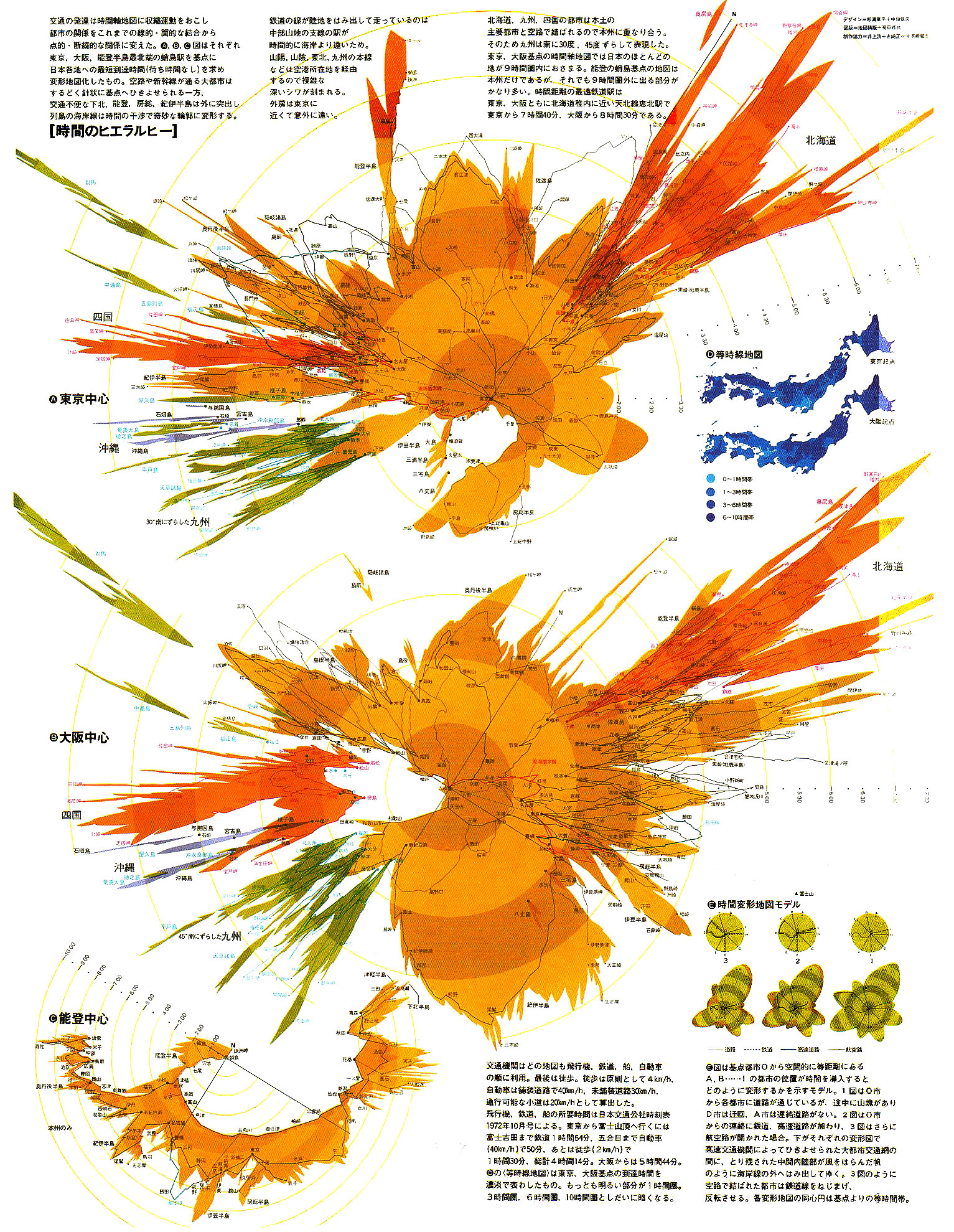
http://kousin242.sakura.ne.jp/maruhei/fff/wp-content/uploads...
It emphasized that travel to a foreign country, let alone emigrating, was massively more complex than today.
Me and friends are in [Location] and are willing to travel no longer then [Time] to [some activity] - show all recommended places for [some activity] within radius [Time]
Isochrone map and cartogram are interesting terms to lookup if desired.