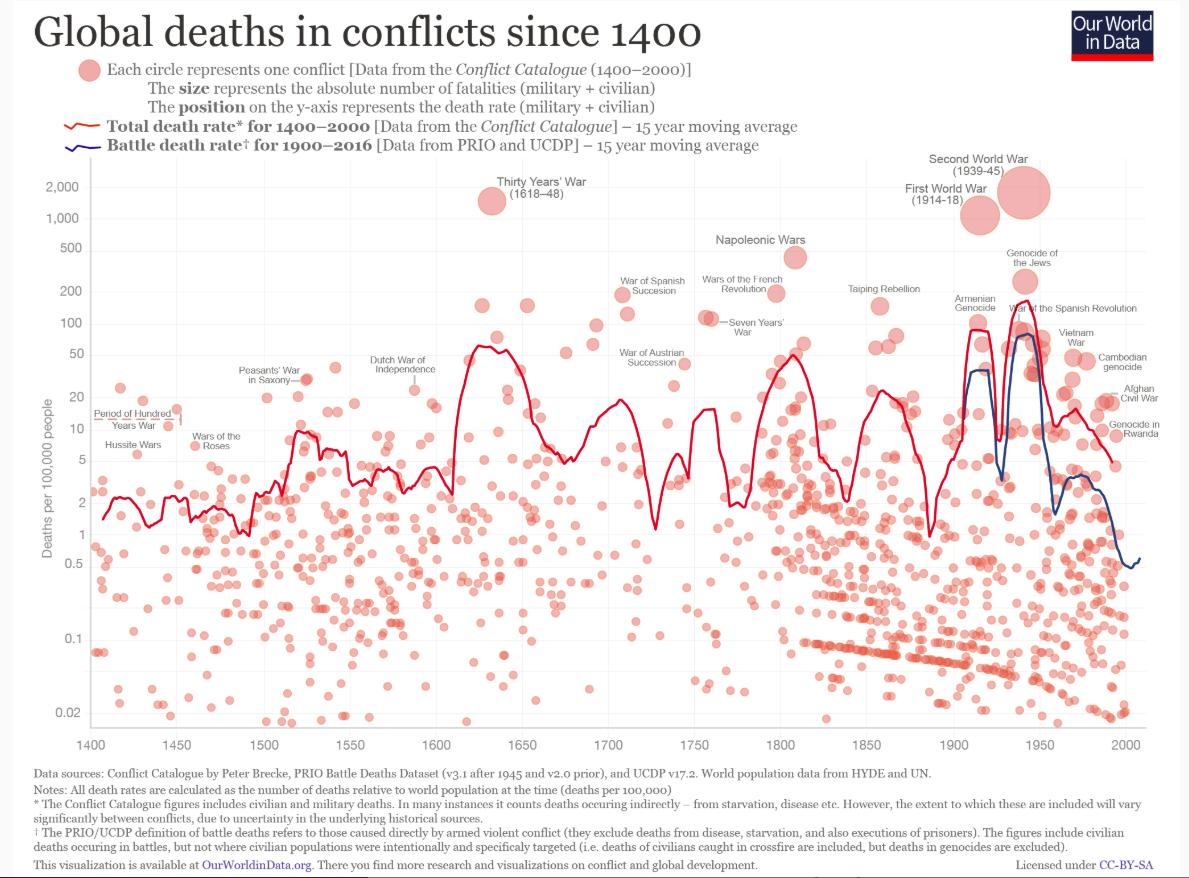
And just to be clear, we're contrasting this time of unprecedented peace with entities that have killed in spasms of violence with no apparent public casus belli than "my book is better than your book and it told me to do so?"
Spasms that, in one set of instances, led to the deaths of a significant fraction of the global population?
“Estimates of the number of people killed in the Crusades begin at 1 million (Wertham…) and go as high as 9 million (Robertson…) passing through 3 million (Garrison…) and 5 million (Elson…) along the way. I took the low middle (Garrison’s estimate) as my estimate. The geometric means of the extremes is 3 million.” Matthew White, The Great Big Book of Horrible Things: The Definitive Chronicle of History’s 100 Worst Atrocities (2012), p. 576 (see f.n. 1 under The Crusades).
NAZI 'DIVINE RIGHT' TO RULE ASSERTED; Dr. Ley Says Reich's 'Mission' to Dominate Other Nations Is Among War Aims WOULD WIPE OUT BRITAIN 'Annihilation' of Obstacle to German Destiny Demanded by Labor Front Head
Or, doctrines like "Manifest Destiny" that were religious in origin and preached in church?
http://nationalhumanitiescenter.org/tserve/nineteen/nkeyinfo...
The only way to end the cycle of violence is by embracing the scientific method, rationality, and empathy. Anything else is a step to madness. Voltaire said it best,
There have been people who once said, you believe incomprehensible, contradictory, impossible things, because we have ordered you to do so; therefore do unjust things because we order you to do so. These people reasoned wonderfully. Certainly, whoever has the right to make you absurd has the right to make you unjust.
Ah, my child, as long as people continue to believe absurdities they will continue to commit atrocities!
I would say we live in the most widespread Uneasy Peace in human history. And unlike religious peace which had occasional conflicts, a break in the peace now would mean annihilation. Is general peace, risk of annihilation better than occasional petty wars without annihilation?
> And just to be clear, we're contrasting this time of unprecedented peace with entities that have killed in spasms of violence with no apparent public casus belli than "my book is better than your book and it told me to do so?"
I quoted The Washington Post's opinion, which is hardly the number most favorable to religious causes. Plus, older books had higher numbers than newer scholarship.
https://apholt.com/2019/02/19/modern-scholars-on-the-casualt...
https://apholt.com/2019/01/30/death-estimates-for-the-crusad...
> NAZI 'DIVINE RIGHT' TO RULE ASSERTED; Dr. Ley Says Reich's 'Mission' to Dominate Other Nations Is Among War Aims WOULD WIPE OUT BRITAIN 'Annihilation' of Obstacle to German Destiny Demanded by Labor Front Head
Well, considering that they murdered priests and pastors in their camps, were they really friendly to religion? Particularly Catholic Priests, who represented 94% of the clergy they executed.
> Or, doctrines like "Manifest Destiny" that were religious in origin and preached in church?
Let's not confuse Protestant fundamentalism motivated by political ends with religion in general.
> The only way to end the cycle of violence is by embracing the scientific method, rationality, and empathy. Anything else is a step to madness.
So said the French Revolution. They did everything they could to break away from religion - they even invented a new calendar starting at year 0 because... anyway. Didn't go so well, there were a few smaller revolutions afterward to get to modern France.
This is the rule, not the exception. Throughout history, instances where religious war was waged or religious atrocities occurred, there was often an underlying political logic to them. Religion has less to do with the underlying morality of the scripture and more to do with what religious leaders of the time say it is, and their interpretation can be...flexible.
> So said the French Revolution.
What followed the French Revolution and Napoleonic Wars was one of the most peaceful 99 years on the European continent since Pax Romana.
The reason why I wrote the above language, quite explicitly, is because religions, in the long-term, do not agree with such co-existence. Eventually, there's a reversion to the mean, or a splintering that spreads fundamentalism and decries other groups.
> I would say we live in the most widespread Uneasy Peace in human history. And unlike religious peace which had occasional conflicts, a break in the peace now would mean annihilation. Is general peace, risk of annihilation better than occasional petty wars without annihilation?
As far as I can tell, this peace we experience is truly un-precedented in the original sense of the word, i.e. there is no prior precedent.
> Well, considering that they murdered priests and pastors in their camps, were they really friendly to religion? Particularly Catholic Priests, who represented 94% of the clergy they executed.
Expanding on this, with the following statement,
> Let's not confuse Protestant fundamentalism motivated by political ends with religion in general.
You can't just say, "these events wouldn't occur under my doctrine. My religion is the only religion and the others aren't."
When you create rules by fiat, "X is Y because I/holy book/prophet said so." Then is it surprising that others will make rules by fiat as well? What makes their rules more valid than yours? You believe that you have god's mandate. Well, so do they. They're both equally absurd claims with equal validity to an outside observer.
The point of the enlightenment is to look towards something more concrete; ideals that have been honed via debate and examination of history. Ideals that are subject to change as we learn more. Ideals that are more real, because they become real in their execution.
You may say, well, that's religion as well, but I am not aware of any religion where things are subject to true debate (can you even question the existence of the deity?), or religious groups that are open to changes in their fundamental philosophies.
This does not mean that religion is innocent. That is a fallacy. They are not mutually exclusive. People can do terrible things when guided by religious faith, or when guided by a secular "faith." Both are bad and should be called out.