As I see it, it's possible to frame all technologies as being fundamentally based on one of the following mechanisms, interactions, or focus points:
- Materials: stuff, its properties, abundance, and sourcing and disposal issues. Wood, stone, ceramics, metals, fluids, chemicals, nuclear materials.
- Fuels: energy potential stored in material arrangements. Biomass, fossil fuels, nuclear fuels. This excludes energy flows such as solar, wind, tidal, and geothermal. Subject to limits in stores and creation rates. Result in waste products and phenomena.
- Power transmission and transformation: from simple machines to complex mechanisms and grid distribution. Levers, screws, pulleys, electromagnetism, beamed energy. This would include energy flows described above.
- Process knowledge: "technology" writ large. As J.S. Mill put it, the study of means, how to achieve some goal through some process or technique.
- Causal knowledge: "science" writ large. As J.S. Mill put it, the study of causes, or why the world is and acts as it does, based on empirical study.
- Networks: nodes and links. These may be physical or logical. Transportation, distribution, social, economic, commercial, political, and conceptual collections of loci and the connections and interactions between them. Famously give rise to network effects, also subject to hygiene factors (below).
- Systems: management of process with feedback and models. From basic polity to vast technological, economic, and ecological systems. "The Art of ship handling involves the effective use of forces under control to overcome the effect of forces not under control" -- Charles H. Cotter.
- Information: input, processing, storage, and output. From basic anatomical senses (sight, sound, smell, taste, touch) to language, maths, logic, abstract representation, manipulation, detection, transmission, reception, and retention. Capable of immense scaling itself, but often with profound limits on direct application.
- Hygiene: management of unintended and/or unanticipated consequences. All technologies achieve both desired and undesired effects, those may be manifest or latent, and may occur immediately or lagged. We tend to best cope with immediate and manifest effects, it is the lagged and latent ones that tend to cause the greatest trouble.
The technologies which seem to best fit your "credit card" model are those involving fossil fuels especially, materials resources formed very slowly or at singular points in time in Earth's history, and of hygiene impacts whose immediate and long-term consequences diverge strongly. Steve Keen (amongst others) shows that economic productivity scales near-linearly with energy consumption, yet we are using fossil fuels at rates millions of times greater than they accumulated. Virtually any mining activity represents extraction at rates greater than accumulation (the reverse is "farming", though even that can be problematic). Current industry has a strong reliance on a large number of elements and minerals, many of which are scarce or sparse. An example of the latter being "rare earths", which are not actually rare so much as they do not form ore bodies, and must be separated with high energy and waste-material costs from exceedingly low concentrations in the Earth's crust. Similarly, various emissions are often presumed or advertised as being low-consequence ... until they are not. Heavy metals, inert compounds (most notably hydrofluourocarbons), synthetic materials (e.g., plastics with bioactive and endocrinologic effects), and carbon dioxide resulting from combustion are all now major environmental concerns, initially dismissed, overlooked, or actively obscured by those with a short-term benefit from their use.
It seems that there are possibilities within process and causal knowledge, power transmission and transformation, networks, systems, and hygiene mechanisms for technologies which are far less prone to risk or debt-shifting. Though critics such as Tainter would suggest that complexity is its own inherent risk, with substantial justificiation.
> Steve Keen (amongst others) shows that economic productivity scales near-linearly with energy consumption, yet we are using fossil fuels at rates millions of times greater than they accumulated.
The only way I can see (without spending more than just a few minutes thinking about this comment) this being true is with 100% efficiency and I wonder if that's the underlying assumption here. I'd hazard a guess that we're using fossil fuels at low single digit percentage efficiency if that and perhaps even putting more in than we're getting out. To your point though, since we're using fossil fuels way faster than they accumulated there's just no way to escape "running out" [1]. Just a matter of when.
[1] I don't think we'll ever run out of course, it'll just be more and more expensive. When I think about running out I think about not having society able to adapt to the cost because of how we've built and designed our infrastructure. The US is particularly screwed here since we rely on them so much.
Energy plays no role in the standard Cobb-Douglas Production Function (CDPF), and a trivial role in a three-factor CDPF where it is treated as a third input, independent of labour and capital. Starting from an epistemological perspective, we treat energy as an input to both labour and capital, without which production is impossible. We then derive an energy-based CPDF (EBCDPF) in which energy plays a critical role. We argue for the redefinition and measurement of real GDP in terms of exergy. We conclude that the “Solow Residual” measures the contribution of exergy to growth, and that the exponents in the EBCDPF should be based on cross-country comparative data as suggested by Mankiw (1995) rather than the “cost-share theorem”.
<https://www.sciencedirect.com/science/article/abs/pii/S09218...>
For an excellent discussion of efficiency of energy use over time, see Vaclav Smil's Energy and Civilization (2017), which shows the actual attained efficiencies of various fuels usage.
<https://en.wikipedia.org/wiki/Energy_and_Civilization:_A_His...>
<https://mitpress.mit.edu/9780262536165/energy-and-civilizati...>
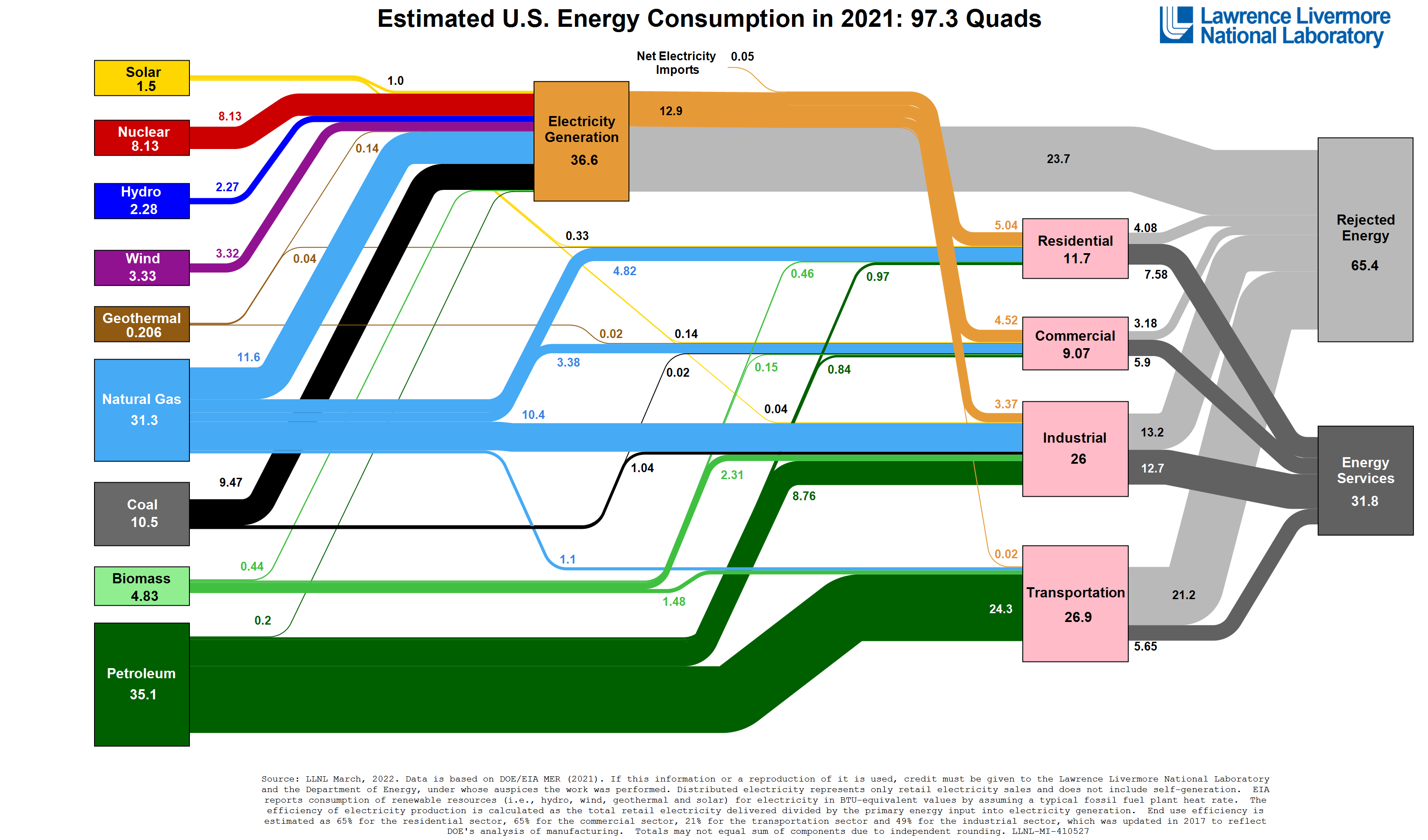
Note that due to conversion efficiency limits, most generally those of Carnot engines, achieved efficiency in converting thermal to mechanical energy trends around 30%. That can go higher in some applications (e.g., dual-cycle steam turbines combined with usage of residual thermal heat in cogeneration plants). But for the most part large-scale modeling relies on the 30% figure. See for example the Lawrence Livermore Labs energy-flow Sankey charts, in which ~30% efficiency simply assumed for the model, rather than explicitly measured, based on modeling:
End-use efficiency is estimated at 65% for the residential sector, 65% for the commercial sector, 21% for the transportation sector, and 49% for the industrial sector, which was updated in 2017 to reflect DOE's analysis of manufacturing.
<https://flowcharts.llnl.gov/sites/flowcharts/files/styles/or...>
<https://gs.llnl.gov/energy-homeland-security/energy-security...>
TL;DR: results are based on overall inputs and outputs, don't get caught up in considering minutiae of conversion efficiencies.