That game was hyped so much, given it was designed by none other than Will Wright it previewed like it would be the most amazing game ever made.
Despite it being reviewed every well upon release, gamers expected even more.
It's a good example of how it is important to temper your customer's expectations regardless if you believe you have a solid product, as you may inadvertently set expectations higher than you can possibly achieve.
I didn't quite understand what you were carrying with you from one stage to the next, and why it mattered.
I ended up not playing it much after buying it, such was the disappointment.
More modern examples would be both Pathfinder games with mediocre kingdom management minigame in first, and bad HoMM clone in the second. Thankfully the main game was still good.
On other side there are games that successfully pulled it but usually it's a some simple-but-satisfying minigame, not some big element of the game.
I mean it's a good game but...
We launched the survey on a Friday to pick up responses over the weekend. When I got to work on Monday I logged on to my computer and noticed that everything was running really slowly. Wasn't just me, my coworkers were experiencing the same network issue.
We got out IT team to investigate...turns out our server (on-prem) was busily handling a lot of network traffic, serving up video links to folks. Someone answering the survey had copied the links to the videos from the survey and posted them on to Kotaku. Since the game was so hyped the post got a lot of interest and our server got a lot of traffic.
As you can imagine, the next 24 hours was spent eating *@#t and apologizing to the client....
There just wasn't any good gameplay loop in there.
The creature stage is interesting and fun, partially because it lasts long and there's an exploration element. Then you get to the tribal stage and the second tribal stage but with cars and honestly I kind of just rush through that. Then you get to the end game which is the most interesting (but least customisable) part.
The building blocks for two RTSes are there, but they've been dumbed down so far that there's no fun to be had. With a tech tree and bigger tribes, I think a minor Age of Empires stage could be great. The city stage would have the same benefits, but I can imagine a civ style game portraying the technological and cultural progress from the bronze age to the space age would be a nice intermediate. Instead of your evolutionary tree picking one or two arbitrary flags in each stage, you could keep the tech tree going for much longer. Show me how I got that teraforming equipment, don't just teleport it into the store because I traveled a thousand spots!
The end game could do more. Perhaps a Stellaris style unit distant unit control mechanic would allow for a more realistic galactic simulator, with different ships of your empire whizzing around while you go on your space adventure.
I have a feeling that if the game were developed by a Paradox or a Firaxis, the later stages would be a lot better.
It would be fun if Paradox were to set up a system where you can automatically launch the next game, all the way from Rome Total War through Hearts of Iron, and maybe jump to Stellaris from there. I know converters exist but it's not a perfectly clean process with fan projects needed for some steps.
Personally, that isn't the decision I would have made, because I think the game is more shallow because of it. Maybe it would have made the game less enjoyable for people who just want to make whatever they want with no consequences, but that could have been solved with a difficulty option.
Opinions differ, to me it was a fun arcade game, with some evolution theme. No more, no less. But I also did not read anything about it before and had no expectations.
On that note, I wonder why there hasn't been anything like it from the indie developer space.
That's not really enough. If you watch The Fountain, it's pretty much the same as the trailer. But while it's a great trailer, it's a terrible movie. There's an expectation that a demo shows parts of a game, and the finished product will be more and cohesive. Spore really wasn't cohesive, but imagining the parts demoed as a cohesive game was super compelling.
One of a couple lessons from that time that have me pretty much sworn off pre-ordering things. Or at least pre-ordering things without predicting my feelings if the product isn't great and being ok with that (hello Looking Glass Portrait)
Gamers expected what was presented in the initial demo. A really dynamic world that changed depending on your creature's abilities, a sandbox game where you could affect things by designing different types of creatures.
All this was scrapped, and what was developed was very different than what was shown in the early prototype demo:
https://www.youtube.com/watch?v=T8dvMDFOFnA
No wonder gamers wanted the thing they got excited about in the first place.
I don’t think that’s true - this review seems representative:
https://arstechnica.com/gaming/2008/09/spore-review/
> Perhaps the whole concept of Spore is just too high, when all is said and done. I honestly had more fun with the rather middlebrow The Sims series. But one also gets the uncomfortable feeling that each phase is now just a shell to be filled in with upcoming expansions and for-pay content packs. Imagine an expansion pack release for each phase, adding in the depth that's sorely missing. It's not a fun thought.
There was also a problem with the DRM system being buggy (the iMac I installed it on had to be wiped to return to normal system performance) and the whole game crashing too often.
Like others, I think it goes back to massively over-promising: the amoeba game on the iPhone was the most fun because it was a complete game. The full game was like they tried to make 4 separate games and made each one progressively less fun because they just didn’t have the resources to do any of them well. I spent many hours playing Civ, SimCity, SimAnt, Railroad Tycoon, Master of Orion, Master of Magic, etc. so I was expecting a game with similar rewards for spending time on it but never even completed Spore because my completionist drive couldn’t make up for the boredom.
It doesn't happen to every game just like not every video goes viral, but if the community picks your game to be next life changing event in their lives you will 100% disappoint them. It's been getting worse over the years and I basically don't pay attention to negative reviews anymore.
It feels like an over-centre mechanism, games can't be "good", they have to be the best ever or total trash, no in between.
If they wanted to change this it’d be easy to fun smaller games (or ones with less expensive assets), release them only when they’re completed, and pitch them realistically to the press … but then they’d be targeting modest profits and their executives wouldn’t be getting yachts. It seems similar to how the VC model encourages failures trying to turn every concept into a unicorn.
Video of the hour long talk:
https://www.youtube.com/watch?v=N4ScRG_reIw
One of the essential problems with designing a Massively Multi Player Online Game like Spore is that players at different levels of the simulation run at different time scales.
Maintaining time synchronization between players is also the reason The Sims Online doesn't have a "Pause" button or speed controls, or automatically pause in build and buy mode, like The Sims.
So instead, Spore is a Massively Single Player Online Game. Users don't interact with each other in real time, but instead users can create their own content, and it exchanges that content between users asynchronously.
That's also how The Sims Exchange lets players asynchronously upload and download their Sims save files along with web pages describing their house, sims, and photo album.
https://donhopkins.medium.com/the-future-of-content-will-wri...
>The Future of Content — Will Wright’s Spore Demo at GDC 3/11/2005
>What I learned about content from the Sims.
>…and why it’s driven me to procedural methods.
>…And what I now plan to do with them.
>Talk by Will Wright, Game Developers Conference, 3/11/2005.
>Based on notes taken by Don Hopkins at the talk, and other discussions and review by Will Wright. The title of the talk “The Future of Content” was purposefully vague, because Will wanted to show Spore in public for the first time, but he had to flat out lie about the title and send a fake set of slides for the EA executives to review, so they didn’t know what he was about to do. A more accurate title for the talk would be “What I Learned About Content from The Sims, and Why it’s Driven Me to Procedural Methods, and What I Now Plan to Do With Them”.
>Introduction
>Will Wright started his talk by saying that he wanted to show this to the game developer community first, before a commercial show like E3.
[...]
Here's my favorite feature that never made it into the final game, which is still a hardcore AI problem ;) :
>Procedural Mating
>Mating calls. Listen for answers. Approach a compatible mate (same type of body you just created) in a nest. Get a good response.
>Procedural mating: Animals squawk and crawl over each other in allkinds of ways, then find something that works, and start humping.
>Rewarded for mating by laying an egg.
>Player rewarded for reproducing: the currency of the game. Go into edit mode to spend currency to buy features and edit the next generation. You have to start saving up for brains, which are expensive. Think of it as a college education fund.
And I love his vignette through the lands of Pokemon, Neopets, dinosaurs, and deep into the star-speckled, rainbow-trimmed, cotton candy, cloud world called “Care a Lot”:
>Make the editor a toy.
>Make portability of content transparent to the player. Game downloads content automatically, without requiring user to visit a web site or download it themselves.
>Most other evolution games don’t make you feel like you own the creature.
>Pokemon, Neopets, Care Bears. Give kids a sense of ownership and mastery over the facts and details of the characters.
>Loved dinosaurs as a kid. Knew the rock-scissors-paper of different species of dinosaurs, which was something his mom didn’t know. Mastery of facts.
>Which Care Bear are you?
>Care bears. Started as greeting cards. Found a web app that categorizes your personality: Which Care Bear are you? Each care bear has special abilities. Care bear have cousins, that aren’t even bears. Care bears live in a star-speckled, rainbow-trimmed, cotton candy, cloud world called “Care a Lot”. If they fall out of the clouds, they land in the “Forest of Feelings” (Kingdom of Caring). Forest of Feelings is over the earth. So the Earth must be the “Kingdom of people who don’t give a shit”.
Spore is an homage to many other games:
>There’s a rule that you don’t mix genres. Always wanted to break that rule.
>Homage to many different games at different levels:
>Tidepool: Pacman.
>Evolution: Diablo.
>Tribal: Populous.
>City: SimCity.
>Civ: Risk/Civ.
>20% of the best of those games. 40% of the game experience is really just aesthetic, appreciating the content.
>A different editor associated with each level.
Also:
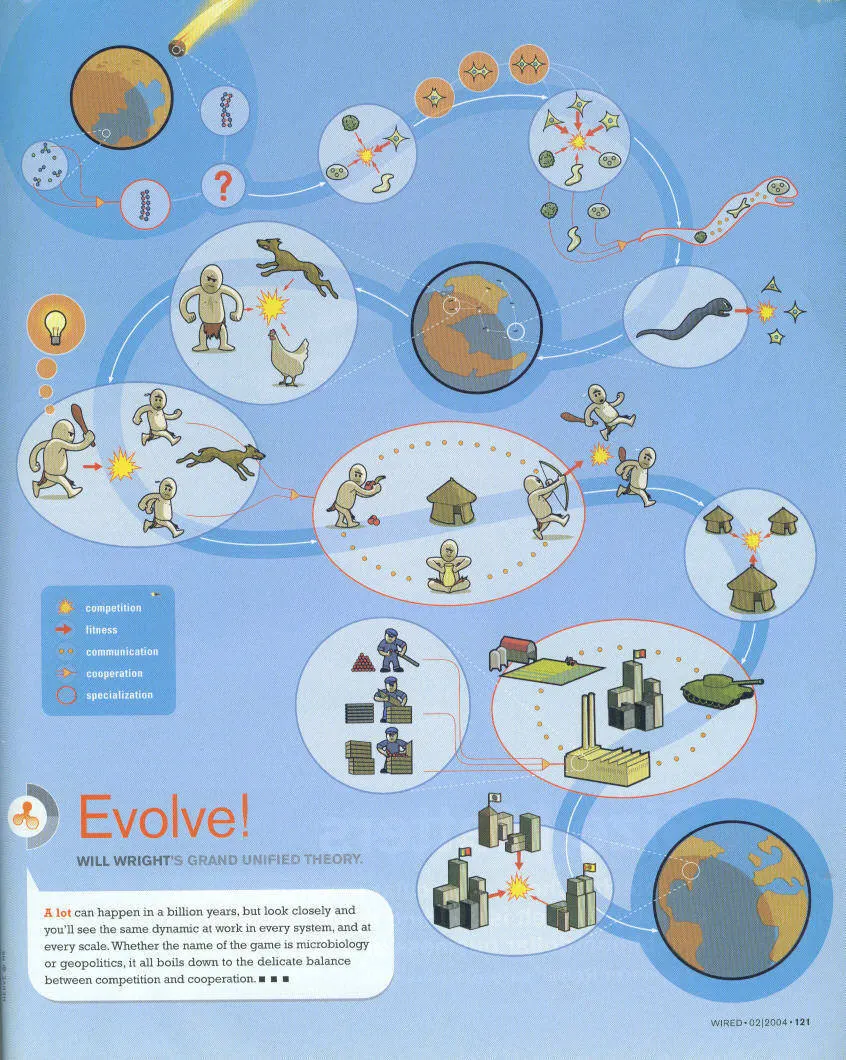
>Wired asked for an illustration to print in the magazine, anything he wanted. So he made a diagram of Spore that Wired published, but he didn’t tell them what it was. The design docs for Spore have been out in Wired Magazine for a year now. (It’s in the Feb 2004 issue of Wired.)
Will’s Secret Diagram of Spore published in February 2004 Wired:
https://miro.medium.com/v2/resize:fit:4800/format:webp/1*6s2...
And of course the 1977 film "Powers of 10" was a big influence:
https://www.youtube.com/watch?v=0fKBhvDjuy0
Will's advice for game designers and creative humans in general:
>Advice: If you have a weird idea that’s so outside of the box, don’t forget it. You should go back and revisit your weird ideas later, because you can never know where they might lead to.
>Epilogue:
>For more about how Spore was designed and developed, check out A Brief History of Spore by Chaim Gingold:
>A Brief History of Spore
http://www.levitylab.com/blog/2011/02/brief-history-of-spore...
>This essay was written part way through Spore’s development, and summarizes one of the biggest transitions the project made — unknown to many — from what could have been a SimEarth like game/science toy to a capital-G computer Game. It tells how Spore made some of its early, and most crucial, navigational decisions down the branches of design possibility, to use Will’s own language. I feel like a discussion of how Spore turned out versus audience and developer expectations is a whole other story that should be distilled and told, but this is not the place for that.
>There’s also the Joystiq interviews Spore’s Chaim Gingold and Chris Hecker:
https://www.engadget.com/2006-11-13-joystiq-interviews-spore...
>On the first day of the Montreal International Game Summit, Chaim Gingold and Chris Hecker presented a keynote on the topic of “advanced prototyping,” specifically as to how it pertains to Spore, the game that currently occupies their time over at EA/Maxis. The same talk, given at the 2006 Game Developers Conference, was rated higher than any other presentation, including Will Wright’s, their boss’s. Before the keynote, Joystiq had a chance to chat with both Chaim and Chris, and discuss their impetus for joining Maxis, the evolution of Spore, and the relationship between Maxis and EA.
>And don’t miss Chaim Gingold’s talk about Spore’s Magic Crayons:
Just be sure to reward the winners with something, like a lifetime subscription.
Spore tried to make everyone a creator, and “everyone” are terrible people. In the YouTube Era he may have had more options, like taking creations from popular streamers, or highly upvoted contributions.
The expectations were mostly from the GDC video, I believe?
Gameplay starts around 12:30:
Success = Outcomes / Expectations
It's worth noting that these two games bookend the career of John Riccitiello as the CEO of EA, and basically ever since then he has been the CEO at Unity.
I for one see this simplicity as a feature. Recent simulation games are waaaaaay too complicated, and although fun, they start to overload my head after a few 10s of hours played. Spore on the other hand, is part of the classic game era where the control nobs are simple, but the fun you take out of rotating each nob is immeasurable.
If they do remake it, I hope they keep it simple.
The powerful but easy to use direct manipulation editor tools, the automatic content sharing system, and the online community around user created content, were together the most innovative and successful things about Spore. (As contrasted with the not as well realized gameplay and storytelling design goals.)
Direct Manipulation Interface:
https://en.wikipedia.org/wiki/Direct_manipulation_interface
Chaim Gingold, A Brief History of Spore:
http://www.levitylab.com/blog/2011/02/brief-history-of-spore...
>Creativity
>Of course, these aren’t any old aliens we ask players to invest in — they’re your creation, your aliens. Once you start customizing, and design your creature, emotional investment is generated. It’s magic. Even the ugly ones are loved by their parents. Many games thrive on the interest generated by players’ creative investment. Console role playing games, for example, get this effect when players invest time in equipping and naming characters. I’ve always felt more attached to my characters as I fuss over their outfits and equipment. Creative interaction seems to always generate emotional involvement and attachment. Psychologically, it would seem that part of this stems from the sunk cost fallacy — we become attached to things we’ve invested time and energy into. Of course, it’s not just the hundreds of hours invested in a World of Warcraft character, their relationships, and possessions that generate attachment, it’s the sense that our fabrications are extensions of ourselves. As recipients of our attention and creative energy, our handiworks are reflections of who we are, tangible manifestations of our personalities. It’s no wonder we become attached to what we make, and take the success or failure of our own work and ideas very personally.
>Spore neatly solves the alien attachment problem by asking the player to design them. If a player makes a creature, and it’s appealing, they’ll be quite invested in it. Reflecting on the success of The Sims Exchange, where players shared stories, characters, houses, and objects for The Sims, Will realized that shared creativity would give Spore a broader appeal. Why not build creative exchange into the game, rather than as a website that orbits it? Player created assets are constantly being uploaded and downloaded by Spore, enough material to fill a galaxy. There’s nothing like taking home your latest finger painting, and having mom hang it on the fridge for everyone to see. Sharing not only fills up the galaxy with cool stuff, but allows the entire world to see your fridge, motivating you to continue creating.
>Of course, a lot of deep magic must work properly for something like Spore’s creature creator to function properly. It must be natural to use, easily producing satisfying results for anyone, from beginners to advanced users. And these aliens, lumps of polygons that no animator has ever seen before, must be brought to life. These are rather complicated endeavors, from a design, aesthetic, and technical point of view, but the player should never notice any of it. The game design implications are also challenging — the game must be playable and interesting, regardless of the creatures dropped into it.
The top bar of the "T" is is a horizontal intergalactic storytelling game spanning all the other levels, that lets you swoop back down to the lower levels.
But the swooping down part didn't really work, because it was hard to come up with scenarios, missions, and stories about unicellular organisms that were relevant to intergalactic civilizations (or players).
So the layers tended to be isolated from each other, and not have direct or interesting effects on each other, because of their different physical and temporal and technological scales.
The fact that each layer was developed by a different team also caused dependency problems that limited the possibility space, the way each layer had to made its own assumptions that would constrain the adjacent layers (a problem you wouldn't have if they were all independent games).
And the storytelling aspect didn't work as well as it did with The Sims, which let you simply take screen snapshots and write captions and publish them on The Sims Exchange. That was because people know more about the interpersonal dynamics of families (or even cities) than unicellular organisms or intergalactic civilizations, so players have their own stories to tell and don't need much support from the game simulation itself.
For example, there is no need to actually simulate or model the motivations or feelings of Sims characters when you're writing or acting out a story about them: That's all up to the player to use their imagination to fill in.
But there just aren't as many interesting topics to write stories about in the higher and lower levels of Spore, that aren't focused on individual people or communities.
https://donhopkins.medium.com/the-future-of-content-will-wri...
>T shaped game.
>The base of the T is a goal oriented gaming.
>The player first goes through a tutorial and sandbox to learn editing tools and game play at each level.
>Player can eventually surf down to the lower levels.
>Goal oriented game trains you to use all the editors and teaches you the simulation dynamics at every level, from bottom to top.
>Once you get to the top you can surf vertically down into the other games, that you’ve learned to use on the way up.
>At the top of the T is a collection of science fiction story genres, that take place on top of all of the lower levels.
>Once you make your way all the way up from unicellular life to intergalactic civilization, the storytelling begins.
>Pull out to galactics level, 10’s of thousands of worlds.
>Like the movie Powers to Ten.
>Always wanted to roll this into a game.
>SETI: Drake’s equation: N = R fs fp ne fl fi fc L.
>Each term of the equation correspond to different power of scale.
>“Wright linked Drake’s equation, which computes the probability of life occurring in the universe, with the long zoom of Eames’ Powers of Ten film.” -Chaim Gingold, A Brief History of Spore
Chaim Gingold, A Brief History of Spore:
http://www.levitylab.com/blog/2011/02/brief-history-of-spore...
>Story
>Spore’s early concept had no structured sense of time or sequence. Would players begin by forming a stable galaxy, stars, planets, and then set to creating life? Or perhaps they would evolve life on a planet, hit it with some asteroids, and try to get panspermia to happen? Like a universe before a creation myth, Spore had no obvious beginning, middle, or end. Deciding the game would move through a handful of stages, from cells to creatures, up through civilization, and then into space exploration, was crucial to getting the game concept to gel, at a high level.
>Structured narratives are unusual for Maxis games, but Spore’s vast scope required a skeletal structure to hang the game off of. Besides, what story could be more appropriate than the evolution of life, and development of civilization? The story allowed both the developers and players to locate themselves in a narrative about the growth and expansion of life. It became possible to inhabit one phase of the game, and think about where you were coming from, and where you were off to. As developers, we could divide our efforts, and think about how the design grew out of the previous level, through this one, and into the next phase of the game. Even with this high level linear structure, Spore was still a monster project, in terms of scope. And, of course, by dividing our production effort into level based teams we set up any kind of inter-level design tradeoff and coordination to be an organizational hassle.
I remember looking forward to the game for quite a while-- then after release, when the reviews were so mixed, I lost interest. It didn't sound close enough to what I'd been reading about.
This part seems key to me:
> the layers tended to be isolated from each other, and not have direct or interesting effects on each other
If that could be looked at more closely, reworked & resolved better, another attempt at executing the original vision might turn out to be worthwhile. I would love to see a team with enough expertise (and budget) give it a try.
After seeing how No Man's Sky has evolved, it seems to me like Hello Games might be one possible strong contender. Or at least someone who was heavily involved with working on that title.
I guess it's not exactly the same thing, but I always look forward to the shitty RNG-based plants and animals it cooks up. It feels right out of a Will Wright game.
Sim City was too brainy, my 10 yr old self didn’t want to do homework about power/water resources. The Sims was a complete sandbox.
Spore wasn’t brainy, but I expected it to be more free form. The 4 stage concept kills any reply value because there’s not much left to be curious about. The creature creation was fun, but I don’t remember my models having any unique behavior. At least nowhere near like The Sims where I could make them pee and cry >:)
Aw, I always thought those were the best parts (my 4 year old self fucking loved the SimEarth manual - the one that went into detail about things like prokaryotes vs. eukaryotes - and there was a giant SC2K strategy book that was The Best) and didn't like Spore because it wasn't Will Wright enough.
Which was probably the problem: It didn't know which audience it was going for. The Sims was great because you could go as deep as you wanted. Like in the Sims 2 I had about 200 unique genetic markers all arranged in a very complex inheritance system, but you didn't need to do that. Whereas with a lot of the Maxis games you did have to and that's what you've identified here that I never really thought about.
Did you ever play any of the 90s Maxis Kids games? I'd be curious what you thought of them - especially something like Sim Town.
I briefly played just about all of them, but not enough to form an opinion.
I found Streets of Sims to be my favorite because I always loved Twisted Metal and the extension to Sim city maps was really cool. Sim copter felt like well…a Sim and I really didn’t know what that was when I was little, so they all just felt like boring intellectual games.
I also touched Sim Towne, Sim Ant, and other weird stuff like that. Again, same feelings.
It wasn’t until I touched Roller Coaster Tycoon and Red Alert 2 that I REALLY got into rts games more.
The interesting part is had they went ahead with the “scientific” and realistic route, I’d bet the game would have sold so much more.
The Galactic Adventures DLC had an "adventure creator" where you could create simple scenarios with your other creations. I didn't realize it at the time, but this was my first exposure to programming. It really lit my imagination on fire and got me interested in game development, and is ultimately how I ended up as a programmer.
Such was my love for this game, I ended up getting involved in the Spore forum ("The Sporum", ha). Strangely enough, one of the official boards was "Creationism vs. Evolution", or CvE as it was known by the forum's denizens. I grew up in a deeply rural and fundamentalist area, so CvE was my first real exposure to the beliefs of the other side, rather than the strawmen the church presented. I argued sincerely on the side of Creationism and got handily defeated by facts and logic many times. It didn't fully change my mind at the time, but it planted the seeds of deprogramming.
So in a way, this game that was so disappointing for many has a lot of personal significance to me. It had a big influence on my personal beliefs and my career. Thanks I guess, Will Wright.
From what I recall (this was some time ago), my disappointment was that the marketing materials presented Spore as a relatively "mature" game (that is, not shying away from the cruelty of the natural world in the early stages, war being a bit more serious in the later stages). Whereas the product that actually launched was overly cutesy and felt more like a child's edutainment game. E.g. I recall some of the early marketing materials had blood effects which were missing from the retail game.
while I do regret buying Spore and feel it was not worth the retail price, I have to agree the creation tools were quite interesting. More importantly, Spore was (IIRC) my first experience with pre-ordering games, and my ongoing refusal to do so again [1] has served me well over the years.
[1] With some very limited exceptions for studios with a proven track record of quality and excellence of craftsmanship, such as Zachtronics.
I wish we got this game, or at least they would release that build one day…
I wouldn't touch that game after the DRM in that garbage screwed with my GPU (9800GTX+ suddenly no longer to utilize 16:9 resolutions) and my DVD drive writing capability was wiped out, both immediately after installing the Spore Creature Creator.
EA got smacked really hard in that courtroom. They settled immediately.
However i must say, that i really did not like the DLCs, those were just weird. It seemed like Spore thought the community is going to create the content for the DLCs, which never happened.
Also still need to invent fun game to do with your created monstrosities.
The API seems to be documented here: https://www.spore.com/comm/samples
Conspiracy theory: the documentation I just linked uses "MaxisDangerousYams" as an example user. The user who submitted this on HN is "DangerousYams". I guess we have a Spore dev here?
https://www.youtube.com/watch?v=V5TXEUiR1Xk
(although it makes me a bit sad to post it)
I didn't bother trying to kill all the Borg but I did manage to ally myself with them, which makes the rest of the galaxy your enemy.