also FWIW Clickhouse's cloud offering also decouples storage and compute using an object store, but they found a good middleground where they keep local caches of hot data.
Which brings me to the next point: I’m convinced the delineation between “data warehouse” and “olap” is largely a marketing move designed to segment the market along made up boundaries.
Snowflake is focused on enterprise customers. It has a lot of features focused on that, like very granular security and governance and data marketplace. There's also some non-enterprise features that ClickHouse lacks, like the ability to execute Python in database (so you can bring ML in).
But the biggest difference is that Snowflake is storage segregated architecture. Scaling Snowflake is done by running "alter warehouse resize" or something. You can also dedicate specific compute slices to specific users and scale them up and down as needed. And this is all managed for you.
If you want to run ClickHouse at scale, you have to run your own k8s, figure out how to manage persistent storage, figure out how to replicate your data, manage cluster replicated tables, etc. Once you outgrow single instance, things get exponentially more difficult - both for the admins and for the users.
Also, while ClickHouse can do joins and is getting better and better optimizer as we speak, and is probably faster than Snowflake for the same money on "single big table analytics" kind of workload, I would expect it to perform much worse in traditional analytics queries, like you would find in TPC-DS.
In reality, you can probably scale something like vitess pretty far, and then by adding your own summary tables on top, you're probably good for most usecases.
I'm not an expert on this level of the stack though, so I'm probably missing a whole bunch of context.
but ch supports large distributed joins?..
In terms of measuring popularity, I love
https://db-engines.com/en/ranking
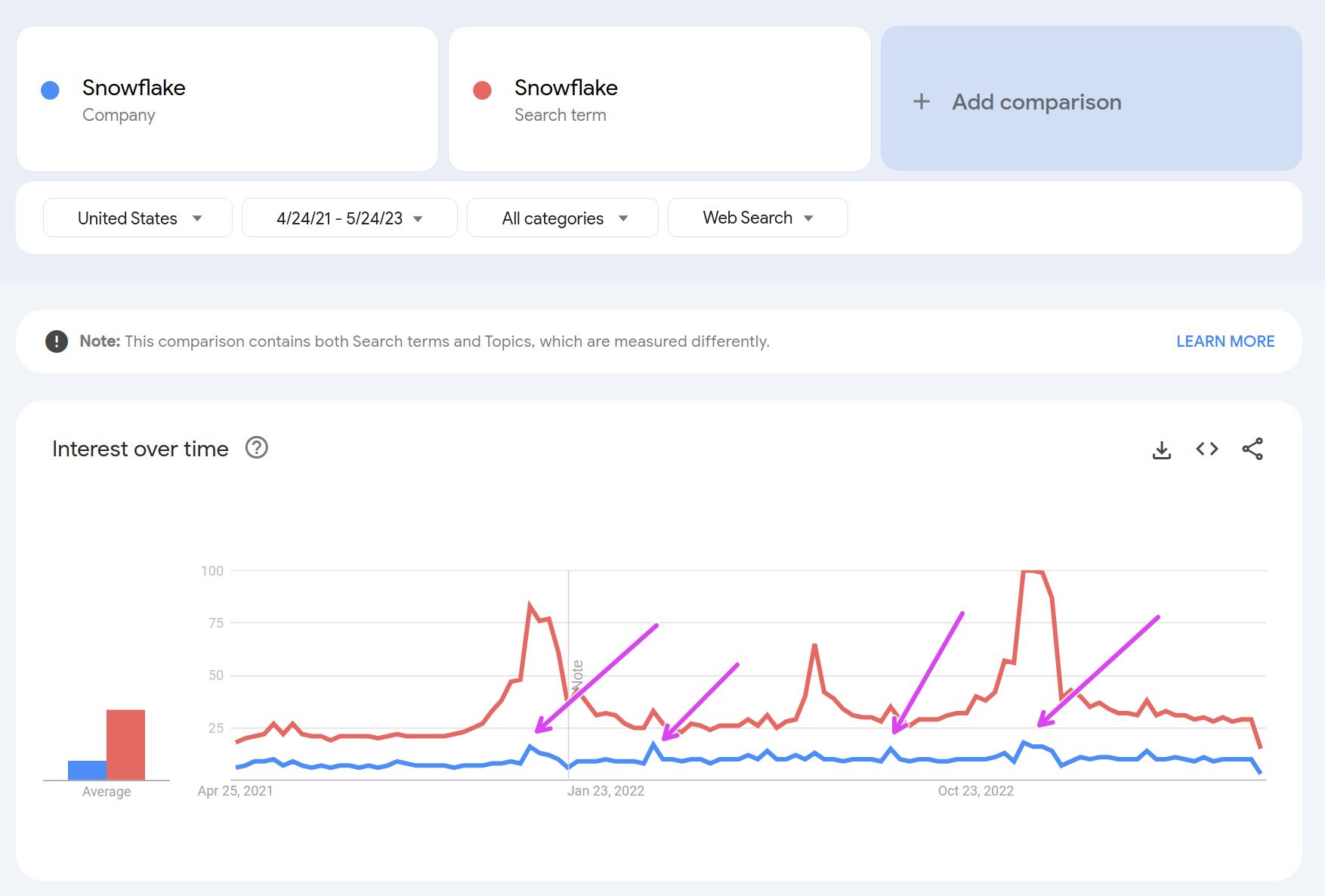
Google Trends is interesting too
https://trends.google.com/trends/explore?date=2021-04-24%202...
Disclosure: I work for Snowflake
See this chart from Gartner DBMS Market Share stack ranks - Oracle was #1 for a long time:
- https://www.linkedin.com/posts/aronthal_dbms-gartnerda-cloud...
Snowflake is now #9 on this chart.
(high res: https://media.licdn.com/dms/image/D4D2CAQGZqgH3ta2R0A/commen...)
I've also observed that Oracle stack people generally don't have experience with other platforms, so push it in whatever org they're working for.
Don't mean to sound dismissive but that what your post reads like, jut because I've never encountered a brown rat does not mean it's not the most populous animal species on earth
In a world of limitless VC money, one might choose the more familiar and battle-tested Snowflake dynamics every time... but the world is shifting quite rapidly, and the degree to which investment in a Clickhouse stack is much less likely to "trap" you in rapidly expanding spend on a more closed ecosystem is becoming notable.
Was Neeva providing useful tooling for this kind of search? I am unfamiliar with Neeva, never used it before. Is this a really useful thing or an acquisition for the investors for a startup to make sure their fund meets a return target?
Is their current technology that good?
I never used it till it shut down, and it looks like about 70% of google to me. That’s great, but you gotta avoid the xoogler trap of rebuilding the 20% of google you want to fix as a startup.
Google has a "collect a lot but don't sell it" approach to data, and Neeva had similar vibes (only giving "basic" search unless you opt in to having your data collected but its ok its private collection)
Big mismatch with its main audience, and that mismatch was raised early, but ignored.
A cushy exit when your ambitious plans fail: gated on your connections.
So the market is technically open but plebs do not have credentials to play at all. Or to quote someone, "The law, in its majestic equality, forbids rich and poor alike to sleep under bridges, to beg in the streets, and to steal their bread."
Not a rap on Neeva team, btw. They did nothing wrong and kudos for tackling a big problem even if they failed at it.
Besides, the "free market" is not a goal on its own. It's a method that is frequently the most beneficial one, but not always.
What if they didn't want Neeva but Sequoia knows Snowflake can absorb the loss for them? What's the procedure then?
Or they have a bunch of people that wanted to work at a startup, now with golden handcuffs who have to keep going through the motions until their stock grants vest.
Maybe they mismanaged their money and/or time or failed to deliver on the tech maybe.
This is contrasted with panic acquisitions like say Adobe & Figma.
How is Snowflake stock dropping 12% "reacting quite positively"?
Use this as a lesson to exercise caution when personally investing in individual stocks in the public markets - even if you are buying tech stocks and feel as though you follow tech trends closely because you work in the industry.
Wall Street already knew and priced it in before you did.
https://en.wikipedia.org/wiki/Gartner_hype_cycle
That's not in any way to dismiss the real usefulness of the technology, it's just that in the short term it will likely be blindly applied to everything. Some of which will stick and become useful.
Edit: The Gartner diagram seems especially not suited for AI. Advanced AI is, in a clear sense, the final technology. The technology with the potential of creating new technology, including better versions of itself. Anything that is technologically achievable at all (consistent with the laws of physics) must be solvable with sufficiently advanced AI. Gartner, at best, applies to some forms of narrow AI.
I have to assume founders are basically wiped out entirely by preferred shares / levered shares given to investors? Staff with equity obviously wiped out as well?
Seems like a situation where early investors enter the FIFO queue to recoup as much of their original investment as possible?
But yea, in general if a company is bought for less than they raised in VC, the returns usually aren’t huge.
Most likely got acquired for less than the valuation the founders desired.
That's probably why the acquisition price is undisclosed.