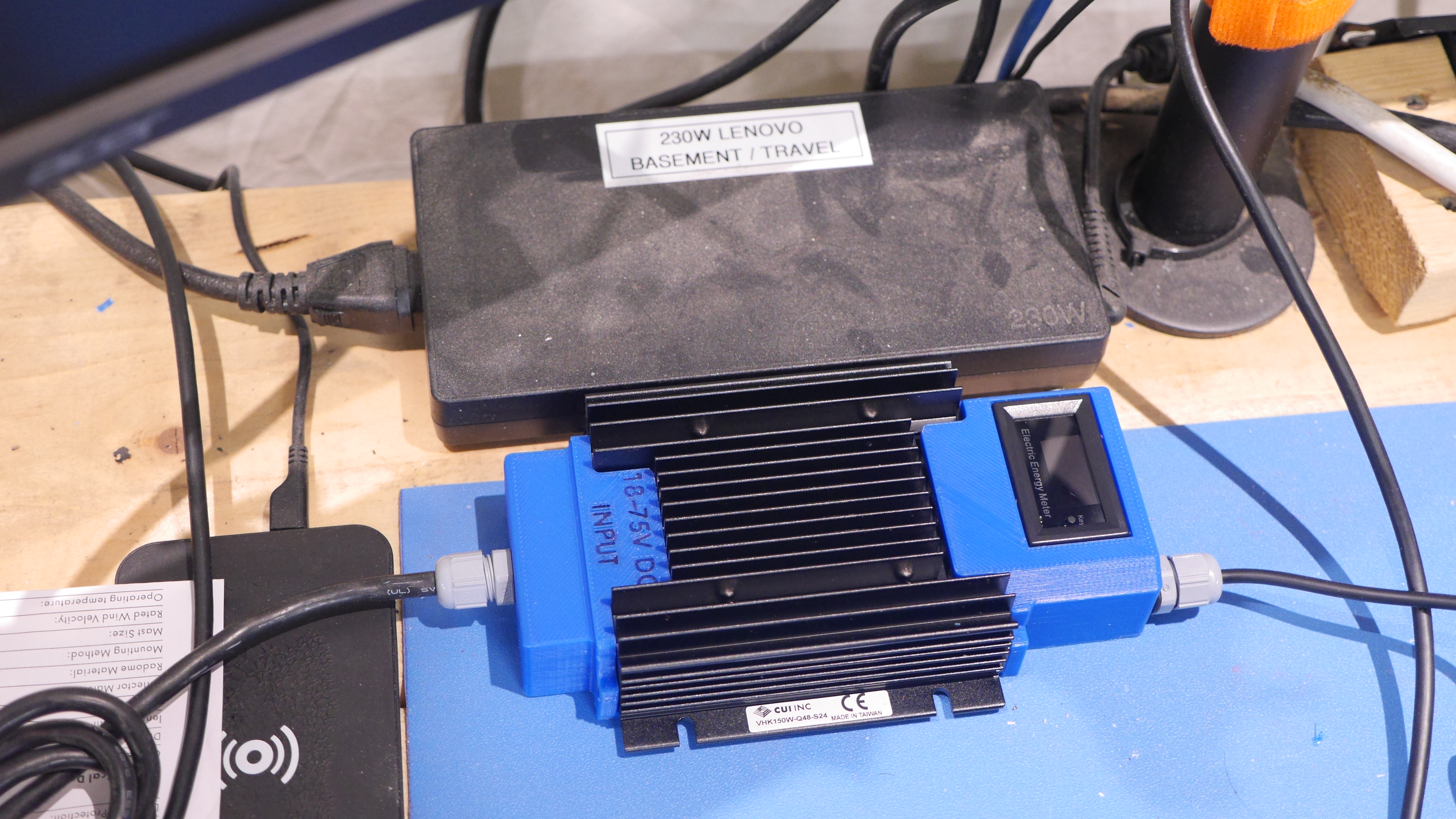
I always wondered if they can accept any voltage over the range. Can I just plug in a solar panel and it will happily charge even as it cuts in and out at low voltages?
If you just try to trick it, there's over- and under-voltage protections built-in, so it should shut off if you just let the voltage float around.
Stick with something in-between to handle the solar.
As far as the Macbook air goes, the official chargers will do 5V, 9V, 15V and 20V output, so yeah, no probably; it supports those.
I think I estimated it was getting around 1.5W (by putting it to sleep for hours and comparing the small amount it had filled by with the drain of a similar period unplugged), though the wall adapter is rated for 11.5W (5V/2.3A), and certainly charges a phone at about that.
I wonder if any laptop power-input circuits are agile enough to perform MPPT and extract a bit more juice out of a panel thus provided...
I then carry this around that got me through a third day (Amazon. Not an affiliate link.)
Anker 747 Power Bank (PowerCore 26K for Laptop), 87W Max Output with 65W USB-C Charger, https://a.co/d/52vd8Ec
This is the largest battery allowed on an Airplane.
https://www.theverge.com/23287770/dewalt-dcb094-usb-c-pd-cha...
The article you linked mentions it at the end, but all of their flex batteries should include this port by default.
I suspect DeWalt won't add the port until a major competitor makes them standard.
I was shopping for some L-series batteries for some photography lighting and knew little about the category.
It took a while to figure out to compare listings on Amazon by the date the product was released to find what the newest product capacities and features were.
Only by comparing products this way was I able to figure out the best ones offered input and output across USB C and micro in addition to their primary purpose of mounting to any device accept L series. (Review count and rating average for out of date products confuses comparisons when looking for detail like this)
I don't use cameras that require this kind of battery so having this additional capability made buying a couple batteries for a single product type a bit easier to stomach.
Stopped reading right there. I fully believe that on evolutionary timescales, the human race will split into 2 races. There will be the leaf blowing species and the others. The “others” will explore the stars, the leaf blowers will have a decreased cranial volume and stay behind and blow leaves.
Nothing interesting can come from the mind of a leaf blower.
(I kid of course, at least he’s blowing them using batteries and not a 2-stroke engine).
Those things worked wonders!
Since then, I've often wondered why people use their spare tear gas dispersers to blow leaves and dirt around, but that's another story.
Note that the absolute voltage limit is likely due to 25V electrolytic capacitors in the input circuitry (find a schematic for a model that uses the "20V nominal" PSU and inspect it to be sure), so 24V should be OK as long as you're aware of how far the tolerance of the output of the PSU you're using can be. I suspect the fact that laptop PSUs seem to come in a wide variety of very-close voltages around 20V (I've seen 18.5, 19, 19.5, 20, 21, even 18.75 or 19.25) is more for vendor-lock-in reasons than anything else --- 19V is only 5% less than 20V, and a PSU rated at 20V may even end up at 19V or less under full load from resistive losses. Due to using DC-DC converters, a slightly higher voltage may even increase efficiency as there's less I^2R losses with the lower current that results.
I did check the stock laptop power supply and it came in at 20.4V, which was somewhat curious.
That's only 2% high, and if it was measured unloaded, I wouldn't be surprised.
I explained the reasons for the ~20V standard for laptops in this comment from almost a decade ago, and not that much has changed since: https://news.ycombinator.com/item?id=7594383
It's only been a few days but nobody's responded yet telling me not to, so I'll get on with the experimentation shortly.
And yeah, as I just showed in another comment, I just take "18v" drill packs, which are 5-series strings of lithium-ion and thus range from about 15 to 20 depending on their charge range, and pipe 'em directly into my thinkpad's input jack. It charges quite happily until they get down to about 17.5v at which point the battery doesn't have a ton of charge left anyway, and the thinkpad neatly stops drawing current and avoids flattening the pack.
https://i.imgur.com/hYRje5h.jpg
I run the exact same arrangement, with a different plug tip, into my Evolve III Maestro. It comes packaged with a 12v brick but it's experimentally happy between 10.4 and 25.1 volts, so 15-20 is right on the money.
https://www.reddit.com/r/linuxhardware/comments/tk6hdp/evolv...
I think one of the major boundary conditions, aside from 25V caps are just thermal. Laptops can't really radiate more than 100W continuously, and 20V at 5A is a fairly happy balance of wire thickness (defined by current rating) and system battery voltage defined by battery chemistry. A 4-cell lithium string tops out at 16v, and a 20v to 16v dc/dc is marginally smaller than a 60v to 16v dc/dc
Note that the 25V maximum rating on the side of the cap is not a design goal: Good designs will de-rate capacitors for longer life. A typical guideline is to apply no more than 70% of an aluminum electrolytic capacitor's maximum rated voltage, 60% of a ceramic chip capacitor's max rating, or less at elevated temperatures and ripple current levels. See [1] for more guidance, or look up the manufacturer datasheet.
It's just not that expensive to install 35V, 50V, or 63V rated capacitors, and it does so much to extend the lifetime and reliability of the products. I always hate taking apart a $2000 servo drive, PLC, or TV, and seeing a blown $0.40 capacitor where a $0.45 capacitor would have been fine, hopefully it didn't take out any more expensive components when it died.
Of course, my experience is primarily in one-off lab PCBs and <100 unit industrial hardware, so perhaps consumer price sensitivity for mass-market electronics makes this guidance different...
[1] https://www.navsea.navy.mil/Portals/103/Documents/NSWC_Crane...
You can also get an "official" adapter for the various battery brands such as this: https://www.milwaukeetool.com/Products/Batteries-and-Charger... (45w over USB C) or https://www.dewalt.com/product/dcb094k/usb-charging-kit (100w over USB C)
Plug adapter is https://www.ebay.com/itm/253555244977
And I just hacked up an old cheap hat charger to become an output connector.
I picked up a very tiny 65W GaNFET usbC brick recently, I’ve been curious to see DIY projects put that technology to use. Marginally higher part cost but significantly better efficiency.
Looking forward to taking a second pass at this and shrinking it down.
at the moment it's somewhat smaller than the stock 'brick':
https://transistor-man.com/PhotoSet/lenovo_dc_supply/P113071...
Would anyone know if I can charge it while the computer is plugged? I usually assume that is a no / no, but if I were to try, could something explode?
Also, I took a look at the user manual for the device and it doesn't mention not to try what you are thinking, so it should be fine.
Mostly have been using it to charge Lipos for RC (cars and drones) on the go.
I gradually moved away from larger and larger battery banks to a more DIY flavor, using lifepo4 batteries and inverters:
https://www.amazon.com/dp/B098QL2VBZ
https://www.amazon.com/dp/B09DQ35JV7
So this is AC -> battery -> AC but your DC setup should work too, skipping charging. The lifepo4 batteries have enormous capacity for not too much money.
You can measure the 13kOhm resistors that you have and see if there is one with a better matching value. 12.7k is ~97-98% of 13k which is well inside the tolerance of your resistors (it says 5% on the bag).
A UPS with LiFePO4 and USB-PD should give you hours of backup power.