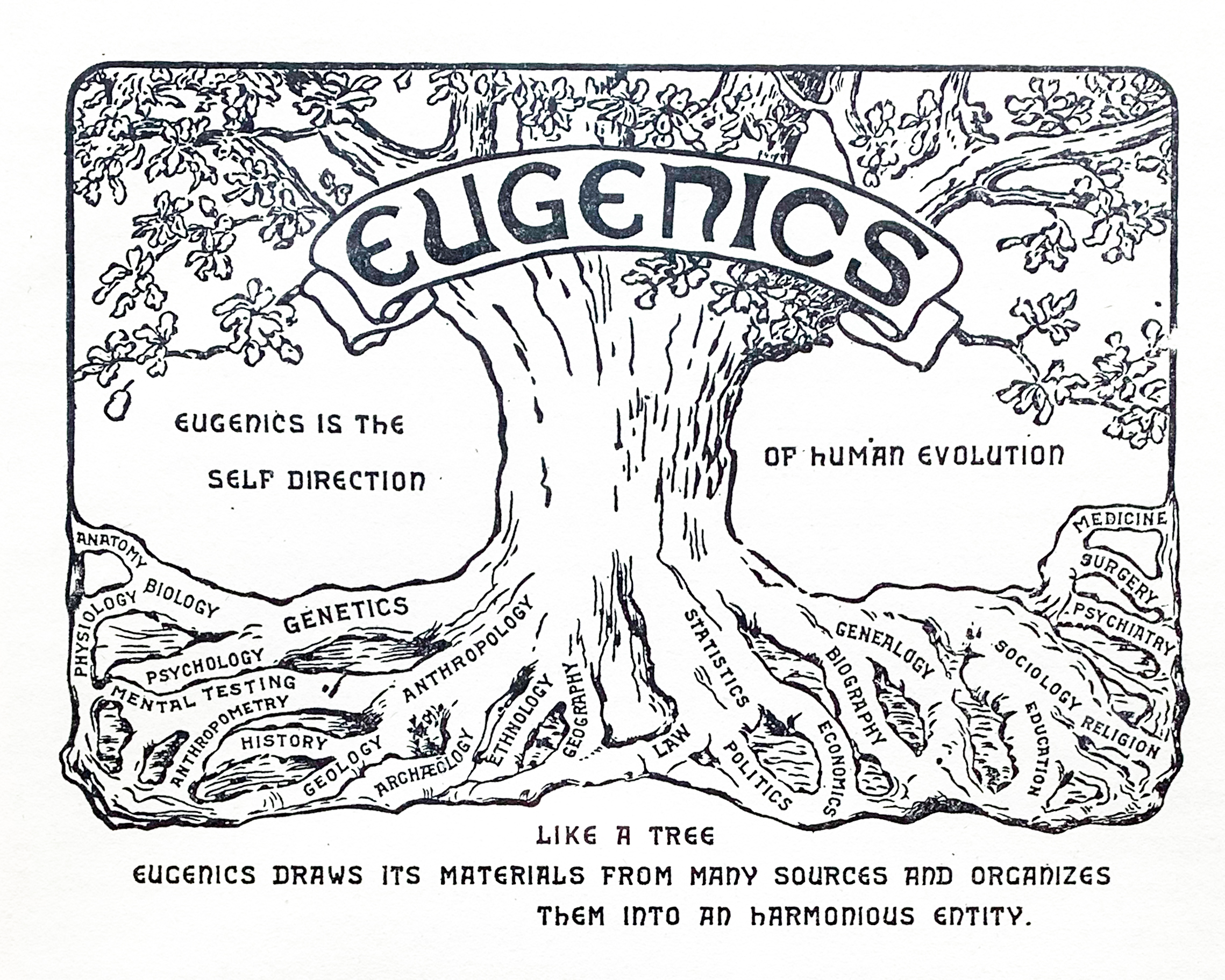
There were multiple points of interest for the Eugenicists. One of them was for the general public and how to get them to have a proscribed conduct and behavior.
Maybe you've seen those diagrams where they have 2 life paths depicted from the Victorian era. That's from Eugenics. Example: https://ia800301.us.archive.org/BookReader/BookReaderImages....
Here's "The Road to Success" for "The Young Man" https://archive.org/details/naturessecretsre00shan/page/244/...
Again, this is part of Eugenics. We focus on the part that was removed (race science) and leave mostly unexamined the parts that were reinvented or repurposed as say, "The Power of Positive Thinking".
Eugenics books, for the general public, were a different beast. Probably the best succinct description for how they thought of themselves can be summarized in this 1921 diagram: https://images.prismic.io/wellcomecollection/efc97918-8073-4...
It is a dangerous psuedoscientific epistemology - a practice with a bunch of faulty logic and ways of knowing that can lead to disasters and it's alive and well - for instance, assuming a social structure in lobsters applies to humans. That these adherents tend to be revealed as secretly racist and thus subscribe to the part which was removed, should be of no shock.
We've mischaracterized Eugenics[1] and allowed it to fester by other names or as Maurice Bardèche, the french neo-fascist observed about fascism in the 60s, "With another name, another face, and with nothing which betrays the projection from the past, with the form of a child we do not recognize and the head of a young Medusa, the Order of Sparta will be reborn"
The point is that if you don't draw the perimeter right around an idea, you can't reign it in. It'll just escape from your hands and re-emerge as something else. So, for instance, the slave plantation becomes the prison farm (https://en.wikipedia.org/wiki/Prison_farm).
We tend to, for good reason, ignore societal trainwrecks and blights on our past. But trainwrecks are the most important thing to study if we strive to build safer trains and seek to avoid similar disasters in the future.
Things have to be accurately tackled with in order to defeat them.
---
[1] it's worth noting it's a big topic and some "real" science has also come out of it, such as biosocial theory and biostatistics studies. Peer reviewed journals such as https://en.wikipedia.org/wiki/Journal_of_Heredity used to be eugenics journals. This is, however, a very small minority.
There is little accuracy in your description of events. Peterson said we share serotonin with lobsters and it fuels a victory/defeat set of behaviours. If you drop the serotonin from his idea, it's no longer what he was talking about.
Your description falls to my mind as a velvet blanket to hide underneath from scary racist and nazi ideas that have nothing to do with Victorian era manners and metaphors about behaviour, expanded out of natural science.
You can't draw a 'perimeter' around the wind.
This type of literature has been a hobby of mine for years and recently I've noticed that I've given myself some expertise.
Hopefully I'll be motivated to write a more complete volume in the future. It takes many pages to build proper context here.
Thanks. I've read your reply but I'm trying to be judicious with my time these days.
When i was younger the things Jordan Peterson said actually helped me. This whole "Reverse Midas Touch" thing is getting really out of hand. Just because a person has had bad ideas, doesn't make the person bad or require destruction of every idea they've ever held or spoken. Just because a group of racist and ignorant people held bad beliefs, doesn't mean every possible belief they held was bad and must be destroyed. This whole argument is just, "but the bad people thought that so it must be bad too", without ever establishing what's actually bad about it. Tell me what's wrong with the ideas without mentioning a group of bad people, tell me about why the ideas are bad. Tell me about the people who "manners and proper behavior" has hurt, and then explain to me why it can't possibly be different. Speak about the ideas, not the people. Everyone knows why those people were bad. Now tell me about the ideas
This type of literature has been a hobby of mine for years and recently I've noticed that I've given myself some expertise.
Hopefully I'll be motivated to write a more complete volume in the future. It takes many pages to build proper context here.
Thanks. I've read your reply but I'm trying to be judicious with my time these days.