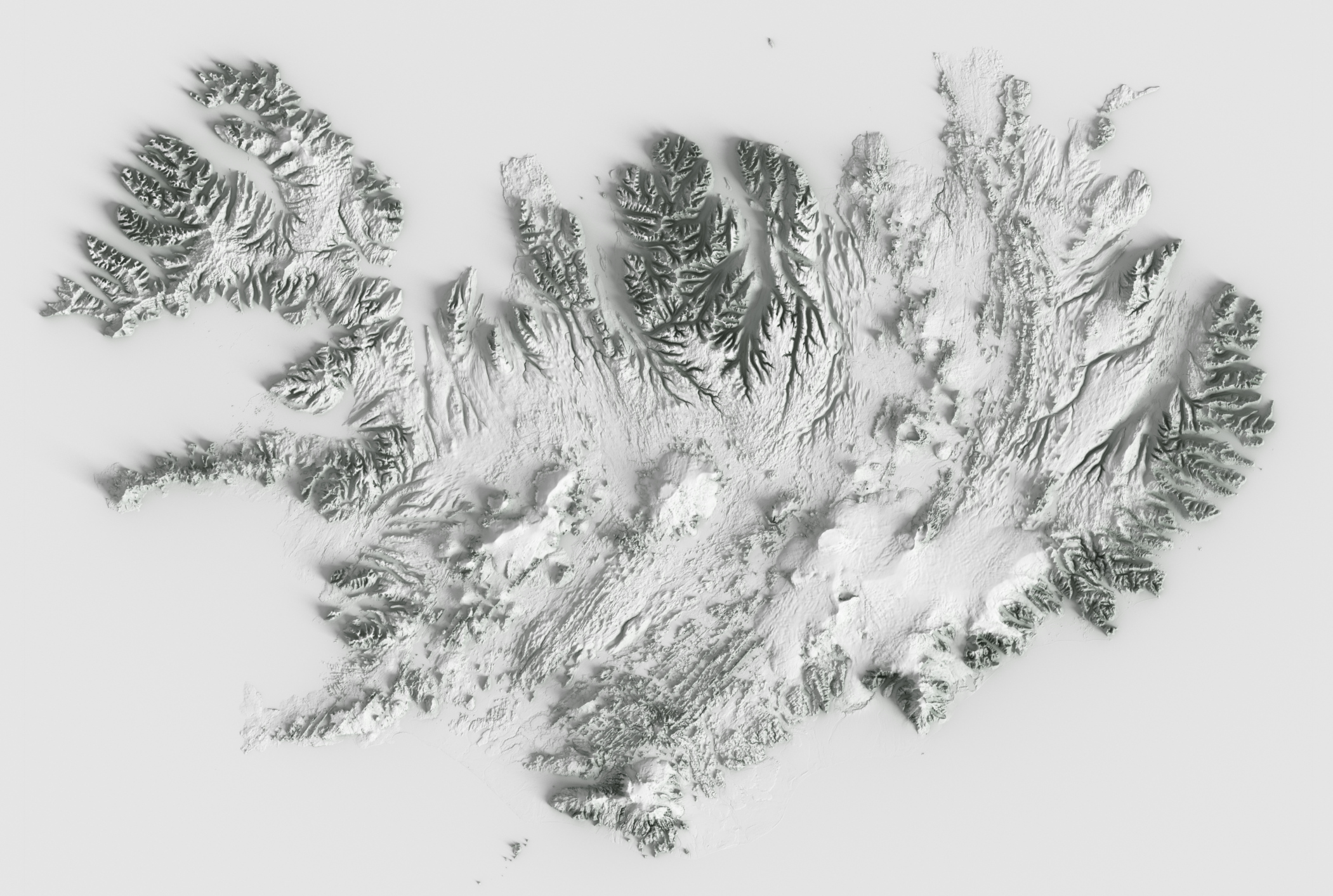
Legend says that this was an intentional design decision, because right handed people usually have their desk lighting on the top left of their desk, giving the map a 3D like appearance.
Here's an article on the topic (german only), it seems to have caused quite the debate back in the day: https://www.swisstopo.admin.ch/de/home.detail.news.html/swis...
that is technically not correct, in the summer for sufficiently high latitudes, the sun sets in the northwest.
The point in the linked article is that the grandseigneurs of Swiss topography didn't like that the usually sunny and warm south slopes show up dark and shaded in the map (and the other way around). They felt this to be unnatural and an error to be corrected. That was back in the 1920s and obviously has not been changed.
i.e. I think this type of thing: https://cartographart.com/minimalist/iceland_2_5k_orth_occlu...
works well, but that's not really a detailed map with normal cartographic details like roads and towns on overlaid with relief shading, so difficult to say.
However even if you do try and do it accurately, places on the equator are likely troublesome: i.e. the whole of Africa or something: you're unlikely to want to do the fully-accurate thing there of above the equator (or where the sun is) being shadowed from the south and below the equator being shadowed from the north, it'll likely be confusing in the middle.
I would rather say it comes from the top-left. If you orient your map with the south upwards, it will look ok, as if the relief was shaded in the morning.
Or, you can throw a (relatively standard for that kind of task) neural network at the problem, have a prototype at the end of the week and something solid by the end of the month.
In those conditions it makes sense to go with the neural network based solution (however, I do hope that having this result will push people to work on a more traditional approach that is competitive with the neural network based one).
See the sections about 'hillshade' at the OpenTopoMap "from scratch" instructions, at https://github.com/der-stefan/OpenTopoMap/blob/master/mapnik...
Check Stefan "der-stefan" Erhardt's instructions to create your own OpenTopoMap service and map tiles from iron: you download elevation data and process them into shaded elevations - https://github.com/der-stefan/OpenTopoMap
edit: and if you're feeling fancy, you can render the relief shading in blender: https://somethingaboutmaps.wordpress.com/2017/11/16/creating...
Which is why the linked Daniel Huffman's technique employed the convincing results of Blender.
I've decided to go directly the 3D route using Babylon.js, see here for an example: https://cubetrek.com/view/6338
Within Switzerland, it also uses Swiss-style maps as texture, outside of Switzerland a visually similar map style.
I'm looking for Beta testers, so feel free to sign up: https://cubetrek.com/
Seems to be some problem in redirecting to the "success page", your email should be verified in any case. I need to look into that.
Edit: seems to be some issue with my Nginx setup.
Great work anyhow!
Let me know if you have any other suggestions: contact@cubetrek.com
[1]: https://www.swisstopo.admin.ch/en/geodata/height/alti3d.html
[2]: https://www.swisstopo.admin.ch/en/geodata/height/surface3d.h...
So the change here is .. instead of pre-written rules to determine outcomes.. use a lot of data, read and build a model from that data, to predict with statistics what the new result should look like given similar inputs.
Machine Learning is data-driven to predict, while algorithms use math and loops to derive answers.
On mobile I see about 5% of the left part of the images after the discussion, along with the color boundary. Brave, Android. Not sure if it just me, Javascript blocking, or what.