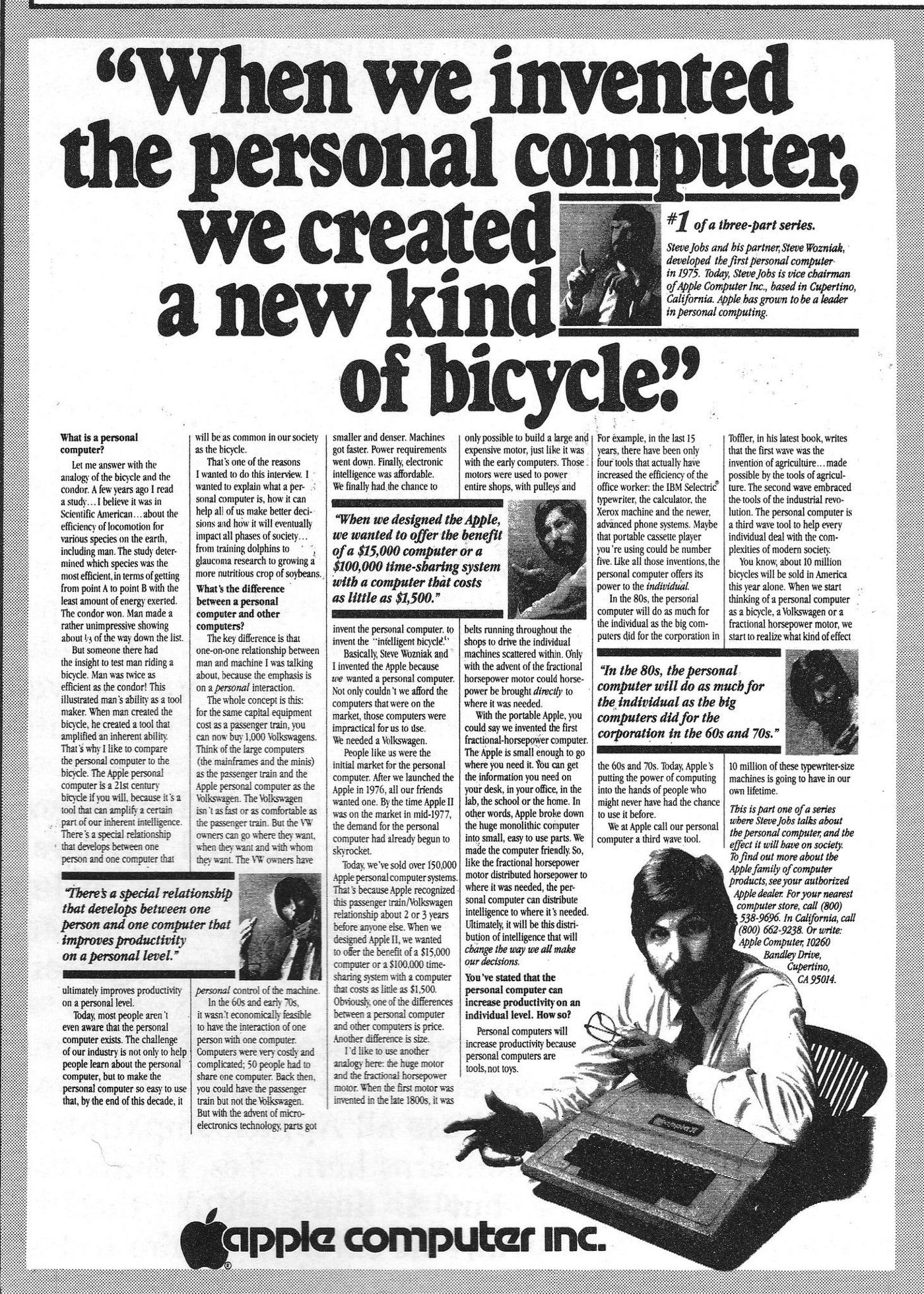
story
http://raganwald.com/assets/images/bicycle-jobs.jpeg
But as a metaphor, I don't think of a bicycle as an appliance. Mainstream bicycles are brutalist: The chain and gears are usually on display and user-serviceable. Parts like wheels, saddles, and handlebars are standardized in a way that allows users to mix and match components freely. In the days of steel frames you could make art bikes and trikes and all kinds of things from a bicycle.
The metaphor works well to describe a lever for the mind's own motive ability.
[1]: I bought a mid-price mountain bike, nothing fancy, in the era before rear suspension was common. It got stolen within a year. I was part of my parents' grandfathered insurance plan that had unbelievably good coverage for bicycle theft. Insurance replaced the bike with one that had all the same features. Not price matching, matching checklist features. Number of gears, etc. It ended up having some extra features, too, because that was what was in the inventory. After that bike was also stolen within a year, they replaced that with one that had all the features that were in the second one. Plus disc brakes, plus many others, because nothing else fulfilled the checklist. The price of my bike more than doubled in two years. No, you can't get that insurance anymore.
Nothing turns more people away from riding bikes than entry-level bikes. Which is unfortunate. Yes, they're constantly needing work and adjustment and never quite shift or brake well.
It doesn't have to be that way though. Mid to top tier components are very reliable and work so much better, even when old. It makes a night and day difference in how pleasant it is to ride.
And I know it's not exactly fair but I can't stop comparing bikes to cars. The amount and preciousness of the materials, the level of stress, the complexity of construction, how long it can go before service, and so on, and damnit, I can't shake the feeling that 1% of the cost of a car should get a really reliable and near-zero-maintenance bike. But no, $200 won't do it. $300 probably won't, even. Not for a new bike, anyway.
These days more like 5K to 10K+ unfortunately.
The trick is buying used. But for someone new to cycling, it's easy to get scammed into a bad deal when buying used, so that's not a great solution either.
If you're familiar enough with the components to evaluate them on a used bike, great deals can be had. My first mountain bike (which I still have) was a very expensive model when new (S-Works, which is the Specialized top of the line) that I got for cheap when it was 5-6 years old. It's almost 20 years old now and still everything works perfectly, buttery smooth shifting, etc.
Hub gear, Marathon Plus tyres, don't store it outside, and just drop it into your local bike shop every ~2000 miles or so as the brake pads get worn out.
That's a matter of perspective. If I create a simple bike drawing in crayon, it has none of those things, but everyone knows what the drawing represents if they had it. Maintenance and extensibility concerns are incidental. Framing things to be attractive, was one of SJ's talents.
Programming on an iPad? Forget it. Have you thought about doom scrolling instead?
Current 13" iPad Pro beats original Macbook Airs for dev, plenty people used them.
I'd argue toolchains readily available on iPad Pro with real keyboard and trackpad today is better than any laptop any devs did work on two decades ago.
Stage Manager, in particular, lets you have main + 4 more windows open to swap with a thumb tap, not even counting you can have multiple overlapping panes and drive an external 4K screen with multi-tasking windowing.
Of course if you use Blink (mosh) you can ssh to anything, you can run VSCode or GitHub Codespaces or Cloud9 or any web IDE, you can use any VDI ... even if you don't like the Git file sync and local native Code Editor tools that are compatible-ish with Codea / Textmate / Sublime flavors of editor.
1- While VDIs can be useful options for remote development, I have found that the user experience can be negatively affected by lag or other performance issues.
2- I would not consider Cloud9 to be a recommended solution, as it might be considered outdated compared to newer solutions.
3- While Codespaces could be an alternative solution, it does not offer the same level of security as other options like VDIs.
One alternative that I would suggest exploring is the use of secure containerized environments (CDEs), such as those offered by Strong Network (https://strong.network/). I work there myself, so I may be biased. But from my experience, these environments offer a more secure and stable environment for development work, without the potential lag and other issues that can come up with VDIs or other web-based IDEs.
Of course, the choice of tool ultimately depends on your specific needs and preferences. If you're looking for personal use, GitPod handles things very well. And if you prefer to stay within the GitHub ecosystem, then Codespaces may be the way to go.
Hope that helps!