> This site is used by all major Linux distributions to provide metadata for clients such as fwupdmgr and GNOME Software.
Based upon that statement and the fact fwupdmgr does not come with Slackware, maybe major equates to GNOME Based ?
But with some extra work, looks like this could be useful for non-GNOME distros.
Slackware is niche, sorry.
And yes, fwupdmgr works fine on Arch too.
Also I feel that openSUSE qualifies as a major distro despite not appearing on that list!
Is there an alternative organization that gathers firmware that ends up on Slackware? If so, then sure there is an argument to be made that companies need to pay attention to both and one shouldn't be claiming to be fully authoritative. But if not, then progress would be Slack getting firmware updates from here, if the distro is interested in such things.
Also Slackware does have fwupd, at least in its "SlackBuilds" system where a lot of optional packages end up AFAICT.
Does anyone know why this is running 24/7? I don't expect my firmware to be changing minute to minute. I need to get OpenSnitch running to keep an eye on these things, heard it was making it into Debian and hopefully derivatives soon.
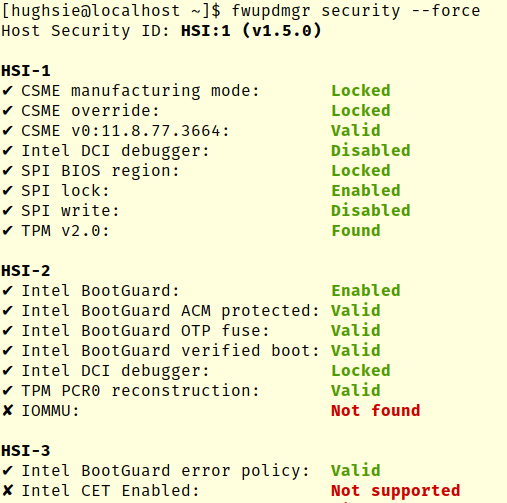
It's really not. The fwupd process doesn't have any internet access at all -- all communication is done through a socket over DBus. All the telemetry is done with the user explicitly opting in -- we even show the JSON in the terminal that is going to be sent.
> Does anyone know why this is running 24/7
We auto-quit on idle or for low memory conditions -- unless you have hardware that's expensive (either in terms of power, or time) like thunderbolt and synaptics MST. The resident RSS is tiny as we mmap all the data files which can be paged out by the kernel -- we can even run fwupd on the tiny BMC processor as well. I'd be interested in what OpenSnitch says, but the D-Bus interface is the only way in and out. Interesting, the daemon doesn't actually do any policy actions itself; all actions have to be initiated by the front end -- which includes downloading new firmware metadata.
I think what yesterday's SSD discussion revealed is that an open database of "leaked" SMART data would be of immense value to users and should have happened years ago. It sucks that privacy derangement vetoes the development of things of real value.
Are you using this to refer to the attitude of companies that want to collect as much data as possible whether or not they have a clear and good use for it, or the attitude of users who are no longer willing to trust large-scale data collection efforts?
I can imagine your future assault robbery trial. "But your honor, stealing his wallet was good for him! Couldn't get into the bar that night and gave his liver a well-needed break." :-D
Still waiting for that to arrive in next Debian…
I’m sure it’s useful to Dell users, but not much to anyone with DIY setups.
This is the second comment I've noticed "waiting for it to hit Debian" and I don't understand.
  hbarta@olive:~$ apt-cache policy fwupd
  fwupd:
    Installed: 1.5.7-4
    Candidate: 1.5.7-4
    Version table:
   \*\* 1.5.7-4 500
          500 http://deb.debian.org/debian bullseye/main amd64
  Packages
          100 /var/lib/dpkg/status
  hbarta@olive:~$
I got a Dell laptop from work with Windows on it. Installed Ubuntu and it immediately prompted me to update the firmware. What an amazing experience!
I always recommend Dell to people looking for a Linux laptop. Although I hear Lenovo started to get their shit together too in the last few years.
Not sure this applies also to non Latitude/Thinkpad consumer models though but I tend to never recommend them anyway.
However, I will say that their Linux laptops I've used have been fine executions of their concepts, and the Linux support, including for firmware updates, has been problem-free even though I don't run the stock OS.
They're a good choice for Linux laptops if thin and light ultraportables are your style.
We bought a 10gbit enabled PowerConnect switch only to learn that the “10gbit” part didn’t actually work until they released a new firmware.
It's really nice to read the author's blogposts describing how he forces hardware vendors to get their shit together and either use a standardized update mechanism or create a thoroughly tested open source plugin.
I remember the first time I got a Dell laptop and put Ubuntu on it, GNOME Software immediately prompted me to install a firmware update. I was so amazed by this. It really felt like Ubuntu was finally a first-class citizen. I'm still completely sold on Dell because of this experience. Sadly they still don't upload all the firmware for all machines. I have no idea why though..
Hence things like Linux firmware updaters that just download the windows firmware file (which they have rights to) and extracting the firmware blob (which they know exactly where it is) so they can avoid the question if they can distribute the blob directly.
Mandatory: I use arch btw :D
https://fedoraproject.org/wiki/Changes/SystemFirmwareUpdates
NixOS doesn't curate a default desktop experience like Fedora does, but it's also a great place to enjoy some of this tech early, and in a very risk-free way thanks to declarative configuration and rollbacks. PipeWire has been effortless to set up (and impressively compatible, performance, and unobtrusive in its own right!) on NixOS for some time now.
A rolling release or a cutting edge kind of distro, even with regular releases, can be really nice if you're into exploring this stuff, like you say.
Unfortunately it doesn't seem like Samsung is uploading that much firmware. "Is uploading firmware on behalf of other vendors" according to the site.
With most things I just complain a bit and then go on with my life, but this actually feels like it could work. Samsung does already release some sort of broken Linux livecd for fw updates, seems like LVFS would be easier for everyone.
What does that mean? We've got a very comprehensive privacy policy... https://lvfs.readthedocs.io/en/latest/privacy.html
The other thing that is great is the testing and validation groups allows you to setup target groups so you can fully validate your updates internally before staging rollouts.
Also @hughsient is really responsive at fixing issues.
We use fwupd at Framework Computer.
It’s like a package-manager for system firmware. For the devices supported, it feels infinitely better than downloading random files from the various vendor-sites on the internet and running setup wizards and all kinds of bloated inconsistent nonsense.
I’d argue fwupdmgr actually represents something objectively done better on Linux than Windows, and my only complaint overall is that not enough vendors are supporting it.
https://wiki.debian.org/Firmware/Updates https://help.ubuntu.com/community/BIOSUpdate https://wiki.gentoo.org/wiki/BIOS_Update https://en.opensuse.org/SDB:How_update_your_bios https://wiki.archlinux.org/index.php/Flashing_BIOS_from_Linu...