That said, have their ever been less satisfying keys in all computing history than those mushy function keys?
Silly little things like the bee are now permanently etched in my mind.
https://www.dwitter.net/d/19166
I even embedded it as a cursor for some of my internal pages at work :P
cursor: url(data:image/png;base64,iVBORw0KGgoAAAANSUhEUgAAABAAAAAQCAYAAAAf8/9hAAAAvElEQVQ4T32TURLEIAhD9Rx6/5PpOdqNM3FeEZcvpiUhEKwF0Vp7xhil917mnNW/9J11zlWzi/QxIzBYxAw1URwEZCepcoOUW2mlPEmyCgPcmeAPwfOLjJ0EN/AagQpit6y7pe8RuGkCYi4VEfxx4aaE2+cotnm5kFmVdYwjLQUR7C7R93hIPrbDNhZy5uiU6zbBzapssQYLkxK4sw/m31EdBNEqXl02UrpEvshoL93Zjyl7rnzOtJpLVs0LZPjTMbC4RZoAAAAASUVORK5CYII=);The IBM XT it sat next to looked depressing in comparison.
And there has never been a game like
Revenge of the Mutant Camels since.
Or a tweener that was as simple and powerful as the one I used then.
And.. I think I’m off to go look for an emulator.
If you want to run well written GEM applications then I recommend ARAnyM [2], which is a lot faster, due to not attempting to do a cycle-accurate emulation of all the original hardware.
And if you have any issues with the above, there are still lots of people hanging out in Atari-Forum that might be able to help [3].
[0] https://hatari.tuxfamily.org/
Have you tried the Sinclair offerings?
A couple years later we bought an extension board for it with a NEC V20 that allowed it to function as a CGA-equipped MSDOS PC, and that's how we got started developing for the PC.
It's odd that two game developers and demosceners from late 80s to mid-90s never owned an Amiga. :)
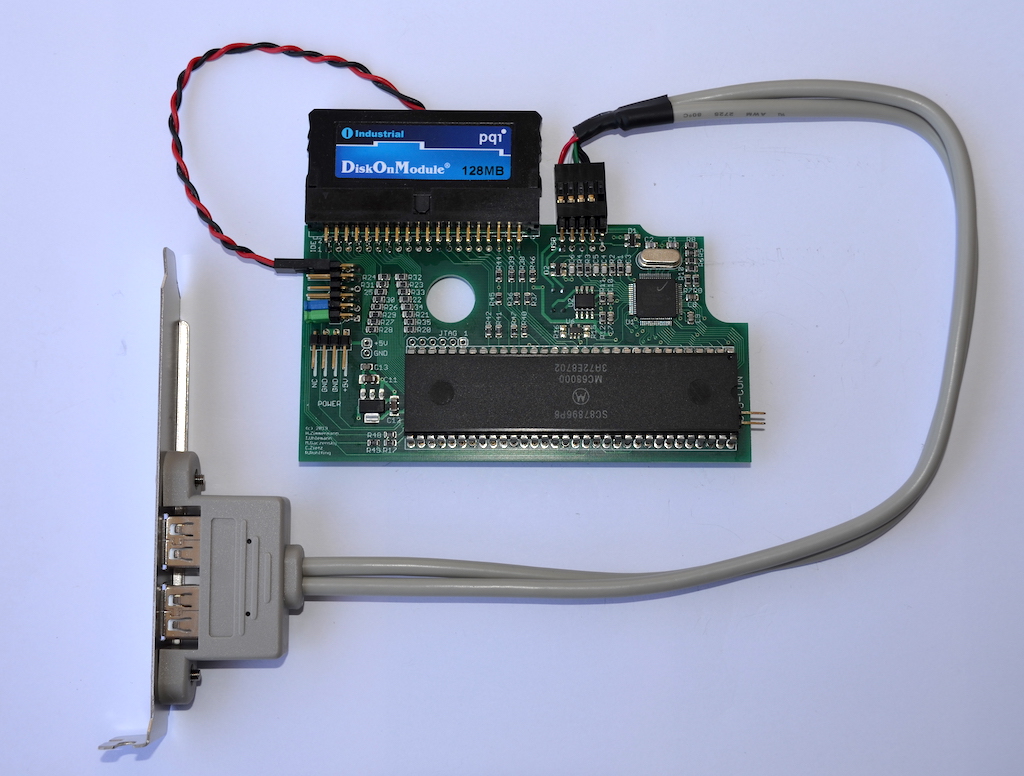
https://retro-hardware.com/2019/05/29/programmers-developmen...
On paper, this should have been perfect: it was a maximally cost-reduced 68k board with capabilities that met or exceeded everything on the market. It was faster than a Mac Plus or PC/AT and 3x cheaper than either, it had an EGA level framebuffer (though the color monitor was still a TV tube). I had one of these and loved it, and was sure it was the best computer in the world.
But it tanked, and it tanked because it didn't run Lotus 1-2-3, or Excel, or Netware, and you couldn't buy a VGA or ethernet card for it out of the back of Byte magazine.
Computers in 1984 were still small enough that you could just throw a good/cheap computer (c.f. the C64) with junk software (c.f. the C64) at the market and have the software vendors figure out everything by writing to the bare metal.
Computers in 1986 needed frameworks and commonality and ecosystems (above this level, note that diskless Sun 3's with 4.2BSD and NFS were reaching market at this moment too). And that meant just shipping something cheaper wasn't enough any more.
Operating system at both Atari and Commodore was treated as an afterthought and didn't get ongoing development. At Atari they put very little investment into the operating system after the original launch, and not much into the hardware either.
Not until his sons took over. Under them, Atari did finally make moves in the early 90s to try to build a large growable ecosystem on what was started and to diversify but it was too late.
My 520ST was upgraded with 2.5MB of RAM and an added blitter chip, so it did happen. I still have the computer and it was still working the last time I powered it up a few years ago.
I’d lent him a Mac Plus with a copy of Excel on it. He was using it as a reference when writing his own spreadsheet.
He’d previously written one for the Spectrum called “TasCalc” and had done some GEM programming, a product he sold as “Proshare ST”.
It downloaded stock prices from Teletext via an adapter.
Smart lad.
In retrospect I suspect that they knew exactly what was going on and left me to it- which was probably the most valuable experience I could have had. If you’re out there, thanks:)
When the 2 week stint was up I transferred to work in goods out for a holiday job and bought a 1040 ST with the proceeds. They were awesome machines at the time.
Nope. If you filled one of these and sent it to the IRS, they would not be happy.
I had my heart set on a Commodore 128. 80 columns! Z-80 mode! 128kB of RAM. I fantasized about an Amiga. But... didn't fit in the budget. I came from a working class family without a tonne of discretionary spending to toss around on stuff like that.
Then I read about the Atari ST, and I was like.. what? I can get 512kB of RAM, an 8mhz 32-bit 68000, internal 3.5" floppy, built-in GUI, and a beautiful flicker free monochrome monitor for the same price as a C128+Monitor+floppy? Was half the price of the equivalent Amiga setup at the time, too.
Great machines. I had a second-hand 520STfm, but upgraded the RAM to 1MB and the floppy to 720k so it was basically a 1040ST. Imagine coming from a 1mhz 5kB VIC-20 to that. What a dream it was to turn it on the first time!
The ST was an incredible value. People who try to compare it unfavourably to the Amiga aren't going back and looking at price sheets from the mid-80s. Spec for spec, there was no competition to the "rock bottom price" of the ST and it remained an absolutely superb productivity machine (but just a meh gaming machine really). The monochrome monitor Atari provided was stellar for its time.
Commodore evened it up a bit when they launched the A500 at a more reasonable price. But still had the problem with the interlaced monitor situation. Fixable, but cost $$.
I beat the crap out of my ST and used it right through til late 92, when I was able to get a 486 50mhz and run early Linux on.
Basically, grounding a pin of the external floppy drive connector (if memory serves) would make the ST read the OTHER side of the single-sided floppy disk of the INTERNAL drive.
This is because some floppies were formatted in single-side mode, and as a result using half of the maximum possible space. Think B-side of vinyl disks, literally.
The switch let you use the other side, provided you formatted it (and beware of the switch position to not mess up at formatting time…)
Many commercial softwares (incl. games) were using that single-side mode for backward compatibility reasons: I believe an early version of the ST serie was using an internal floppy drive only capable of single-sided usage. Hence the legacy.
My switch was really a simple switch I had around, combined with an hairpin directly plugged into the connector.
First hardware hack!
I wish I still had it though.
Atari wanted quite a lot of money for their external 3.5" floppy drive (so that you'd have two - one for your compiler and one for the source/target files). There was a magazine article about how to create a cable (the ST used a DIN connector for the 2nd floppy) so that a Radio Shack 3.5" drive could be used, and it worked fine.
The really annoying part was their hard drive expansion port was proprietary (19 pin D-Sub connector), and wasn't SCSI. That really limited the available choices for mass storage.
Atari was very smart building a VT52 mode into the ST, and the mono hi-res monitor was great.
As for why Atari redesigned the board so many times: no idea.
That and it ran at 640x400, so more screen real estate.
So people would use the Macintosh emulators on them (piece of hardware that plugged in the Mac ROMs and some floppy adapter stuff) and get a machine far cheaper than (and superior to) a standard Mac of the time. Biggest problem was getting the ROMs.
If I recall the products were SpectreGCR & Magic Sac.
https://en.wikipedia.org/wiki/Spectre_GCR
I never did it, but knew people who did, and they were very happy with it.
Other than that, this was my first computer that could actually run compilers on, mostly the Megamax C compiler, or try alternate operating systems.
One thing that would have been cool would be the "Magic Sac" cartridge, that with Mac ROMs added would give you a 'Mac' with 1MB ram, 8MHz cpu, and 640 instead of 512 pixels across which is huge improvement in text layout for a letter sized page. At the same time, I liked having a less "liked by general folks" computer writing many fun but useless programs for GEM.
TBH I think bigger impacts would have come from a few tweaks to the ST hardware: Autocad started life on the ST with the Cyber series of products - including a full expansion port as the cartridge port would allow for high-colour videocards, which the lack of forced them to migrate to other platforms. Similarly for DTP which was huge on the ST at launch.
The AMY chip was pulled at the last minute, but having an 8 channel stereo synth capable of mp3-style playback, alongside a DMA channel (1bit PWM on the DMA chip) would have changed the face of computer audio for 15 years. Even putting stereo output for the YM, and the 1bit PWM on the DMA chip would have been enough to raise the sound bar at the time (vs c64).
Unifying the system clocks like the STE would have allowed the ST to genlock, which together with the expansion port, stereo and midi ports, might have tempted Newtek to do an AV workstation ie. Move professional video production to the platform.
Moving TOS to accommodate large rom sizes could also have changed things, in that MINT (and multitos) were available before linux, and being POSIX compatible (bash, rpm, multiuser etc), it would be similar to having OSX in rom in 1991.
Writing network drivers for the midi ports into TOS would have been beneficial for small businesses, with support for 16 networked machines, and fostered much more collaborative software like lotus notes.
The ST can actually support 7 button joy pads through use of impossible combinations eg. Left+right simultaneously as a fire button. Had Atari sold joypads from launch, that would have benefitted the Amiga as well (it can support even more stuff).
Including the blitter socket as standard in every ST would have allowed Atari to use the T212 transputer instead of the blitter chip in 1987 (the blitter was only available then). In terms of raw power that is roughly equivalent to having a SuperFX2 chip in 1987, but it would potentially change GPU architecture completely as the next generation (T414 in a 32bit) machine would be able to cluster the coprocessors similar to Intel's Xeon Phi, but better.
The ST can do 4pix hardware scrolling and overscan by abusing the shifter (https://youtu.be/hpUbWZWTOiw), there wasn't enough documentation to discover that quickly though. The main thing lacking throughout the ST's and Amiga's life was support of the platform- ship the hardware, make as much money as you can and move on to the next platform, hence lack of development of TOS, no SDK, OCS lasting Commodore until 92. PCs had a much easier time taking over the space thanks to this.
I think, of all the computer companies, the amount of engineering talent that went through Atari Corp was unmatched (ST, EST, ATW, Portfolio, Atari book, CDAR604, TT, Falcon, Lynx, Jaguar, JagVR). I can never understand how it all came to nothing.
It does seem to me that Atari did very well with the use of COTS hardware and software to get a usable machine out at such a low price. It was more usable than the Amiga at base spec (512kB RAM, 1 floppy) because the OS in ROM meant much less disk swapping.
But it did need both a lot more upgrades and expansions as time went on, as you point out, correctly IMHO. Secondly, I think Atari should have adopted PC standards as they appeared and settled: PS/2 ports, VGA and SVGA monitors and display modes, Baby AT motherboards, SIMM slots, IDE connectors, ISA slots and so on. Apple successfully adopted a lot of this stuff, so classic Macs had standard RAM slots, and the lower-end ones had IDE drives, and so on.
Things like PCI (1992), ATX motherboards and USB (1995) came along too late.
Amiga also has the OS in the ROM. Much more of it even (256KB ROM).
You've missed out!
And a 68000 processor (at 8mhz IIRC) AND AN ENTIRE MEGABYTE OF RAM!!!!!