You can get a complete set of snow tires, mounted and balanced on rims, delivered to your door by Tire Rack (no relationship, just a happy customer). If you don't want to change the tires yourself, there are shops that will change them out and store them for you.
A less understood aspect of snow tires is their flexibility in cold. A summer tire will stiffen up below -30. Park it overnight and it will have a flat spot the next morning. It will bounce the car until enough heat builds up in the tire for it to soften. The higher silicon content of proper winter tires prevents this.
This type of driving, except whitehorse is much warmer than where i am (our rivers/lakes remain frozen): https://youtu.be/a_hmPxBUZvc
All wheel drive helps zero with winter conditions, except for going uphill or some other acceleration-equivalent action. Quite the opposite really - many people have experienced how with 4x4 you don't get a warning before you just lose your grip and off the road you go. For the record I'm driving a 4x4, but using summer tires in the winter, with or without engaging 4x4, the car will simply be like Bambi on the ice. Going downhill would mean that I wouldn't stop before hitting something or ending up in the sea. 4x4 doesn't matter for that.
The first thing I do when getting a new car (I always by second hand cars - not that I buy them often, but I'm old enough to have gone through a few) is to buy the best possible summer and winter tires I can get, particularly the latter. That goes before any other investment in the car. I had enough of bad tires when I was very young and without any money.
EditAdd: Many people comment about ice and studded tires. Yes, studded tires are better, not just on ice, but on many kinds of packed snow conditions as well. For some conditions they are the only good option (interestingly enough, this does not always mean that they're better than studless tires on all kinds of ice - it depends on the ice). However, if there's a lot of bare asphalt around, as is often the case when there's a lot of traffic, then studs aren't particularly popular (road wear etc), and in some countries in Europe with lots of bare roads in the winter they're illegal (e.g. Germany IIRC).
As for winter tires without studs, on ice, be aware that there are great differences between brands and types. My father's car had stud-less winter tires while my car had studded tires, and I drove both cars on the same roads and his car behaved well, even on ice or "glassy" snow. But then the tires got old and he replaced with brand new tires, but a different type - much newer, so should be better, right? Not so. Very different to drive. Dangerous I would say, and in fact he got into an accident because of that. I checked that place with my own car afterwards, and no doubt his old tires would have held up just fine.
If you are driving with summer tyres on ice, then of course you are going to be skittering all over the place.
When going downhill on ice, again your tyres are going to make ALL the difference. You shouldnt be trying to stop going downhill on ice anyway. You should be descending at a constant and controlled speed.
What are you on about? Living in Montana, AWD is dramatically better than 4WD. And winter tires are great. We never used them on one of our AWDs because the AWD is so dang good. Snow tires were absolutely required on our 4WD and 2WD cars. AWD or snow tires, I am mindful of stopping distance.
I will always choose AWD for the snow. Then add snow tires if needed.
That said, I strongly disagree with you about AWD. It makes a tremendous difference for control in general in all winter conditions. Adding snow tires to AWD and things are just excellent and way more predictable.
https://toptirereview.com/michelin-x-ice-snow-vs-michelin-cr...
In this test, the CrossClimate all seasons were within 10% of the snow performance of the X-Ice snow tires.
Ya. They are the bare minimum to qualify for that label. They are essentially the worse snow tires that can still be called snow tires. It's all marketing hype, which becomes dangerous when stupid people rely upon it to make safety decisions.
> So called "all season" tires are not snow tires.
Fun fact: US "all season" tyres are sold in EU as summer tyres.
You want to look into "all weather" tyres. The good one are rough equivalent to cheap winter tyre and decent summer tyre. It's still not worth it IMO if you're driving a lot but after COVID I drive little enough that I wouldn't get thru 2 sets of tyres before they rot away.
Hope-springs-eternal denial. And quite a few people don't figure that they'll stay with the same car (and/or live in the same climate) long enough for the "interchangeably so they last longer" thing to pay off.
The former is probably the biggest factor, with the latter taking care of the rest. All-season tires might be less-than-optimal tires in either summer or winter (though the higher-end ones have gotten much better), but the perceived convenience factor is a big enough selling point for most. And when their performance isn't sufficient in winter, people probably aren't going to immediately blame their all-season tires for a loss of traction. They'll just blame the weather and assume that "it is what it is," even with AWD.
If you've never driven on proper winter tires when the weather goes to shit, you don't even know what you're missing. But more than that, I think there's a huge segment of the car-buying public that doesn't give their tires any thought beyond "are they still good?"
Hell, my sister bought a Mercedes a couple years ago that happened to come from the factory with high-performance summer tires and no mention of that fact on the build sheet or window sticker (nor was it spec'd with large wheels with low-profile tires, where it'd at least some sense). Had I not looked at the sidewall when I was with her after the tire pressure sensor went off, she'd have been in for one hell of a dangerous surprise when the first winter storms hit a couple weeks later. Even the dealer was surprised by it.
Ever since then, I've always wondered just how many cars drive around in winter weather with the wrong tires and a blissfully unaware driver.
That seems obvious. AWD means you can use the traction of all tyres to move. But without snow tyres you have no traction, so AWD does nothing.
> So called "all season" tires are not snow tires.
Not quite true, there are 3PMSF all-season tyres, and unrated ASTs might behave well on snow, it depends on the compromises the manufacturer decided on, as the point of an ASF is to balance dry, wet, and snow. But where the manufacturer decides to put the balance is very relevant. That a tyre is all-season doesn't mean it's all-of-your-location-seasons.
In fact, you can have ASTs which are excellent in the snow and absolute shit on dry and wet, that's what "tyre reviews" found with the Tomket Allyear 3 (https://www.tyrereviews.com/Tyre/Tomket/Allyear-3.htm) for instance.
Also technically unrated "winter tyres" may not be suitable for snow either, they might be using better winterised compounds and deeper thread patterns but not sufficiently so to behave well on snow.
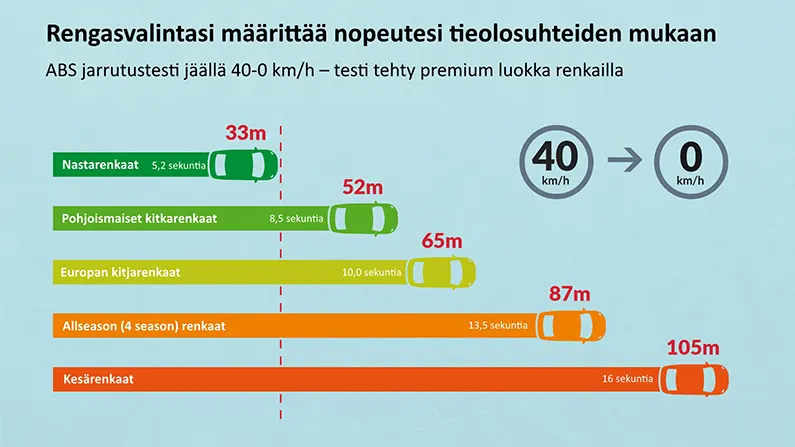
https://www.rengas24.com/images/breaking-distance/breaking-d...
It won’t help with wet ice, but nothing really does. I’ve watched a truck in chains slide on that mess.
I drive pretty well, and getting snow tires made a huge difference in predictability. Braking is more consistent, acceleration is more consistent, and most importantly the point at which I lose traction when cornering is fairly consistent and predictable.
Yes, there's the overhead cost of a second set of wheels and TPMS sensors (because after a few years it's break-even with having the tires themselves swapped, and this way I can swap them myself when winter hits), but overall the cost isn't that significant because it offsets wear on my all-seasons. And it's so, so, so much better when it does snow. Or is icy. Or even is quite cold and just wet, because the tires are still flexible at temps when all seasons get quite hard and plasticky.
AWD + Winter > AWD + All-Season > FWD + Winter > FWD + All-Season
There are plenty of videos[1] showing the above. I guess it should come as no surprise that it comes down to the vehicle, the tires, the conditions, and the driver.
At least for me driving in the PNW (temps usually not too much below freezing), Kumho Crugens (all-season) on my AWD SUV are way superior to Michelin X-Ice (winter) on my FWD minivan. Braking is longer on snow and ice with all-seasons, so I leave 8 car lengths of distance minimum when following other cars. The SUV has superior ESC and traction control that way out perform the minivan.
Several times in my FWD minivan with winter tires, I have been unable to go uphill on icy roads and had to put on chains. Whereas the AWD has no issues at all.
> Braking is longer on snow and ice with all-seasons
I think braking performance is more important. I would choose FWD but on "proper" winter tires. It's better to risk not making up the icy hill, rather than to risk crashing into a front car or even injuring a pedestrian.
By the way, the video doesn't explore braking performance.
(For the unfamiliar with these TLAs: AWD - all-wheel drive, FWD - forward-wheel drive.)
Snow tires are much more effective than all wheel drive, but having both is (obviously) better.
Handy because you don't have to stop/get out/interrupt service - just flip a switch and you've got improved traction!
Seems like a great solution for light snow/mild ice but I would not want to trust my life to these in harsh conditions.
AWD has the characteristic of improving driving traction while doing very little for braking or steering, as demonstrated by the guy who passed us and then rear-ended the mail delivery van.
However, AWD in vehicles without traction control recovery from a slide is more difficult due to there being two different thrust vectors.
On the other hand, chances are it would make cars stay a safe distance away.
Aren't real snow chains more like 300% more traction in the right conditions, since regular tyres offer basically no traction?