https://en.wikipedia.org/wiki/D-VHS
about a decade after that someone asked me for help reading a crate of these tapes that had been flooded then stored in a shed for several years. Couldn't help them at all but it was an amusing diversion figuring out what the hell they had.
https://www.youtube.com/watch?v=papQ8xQxizA
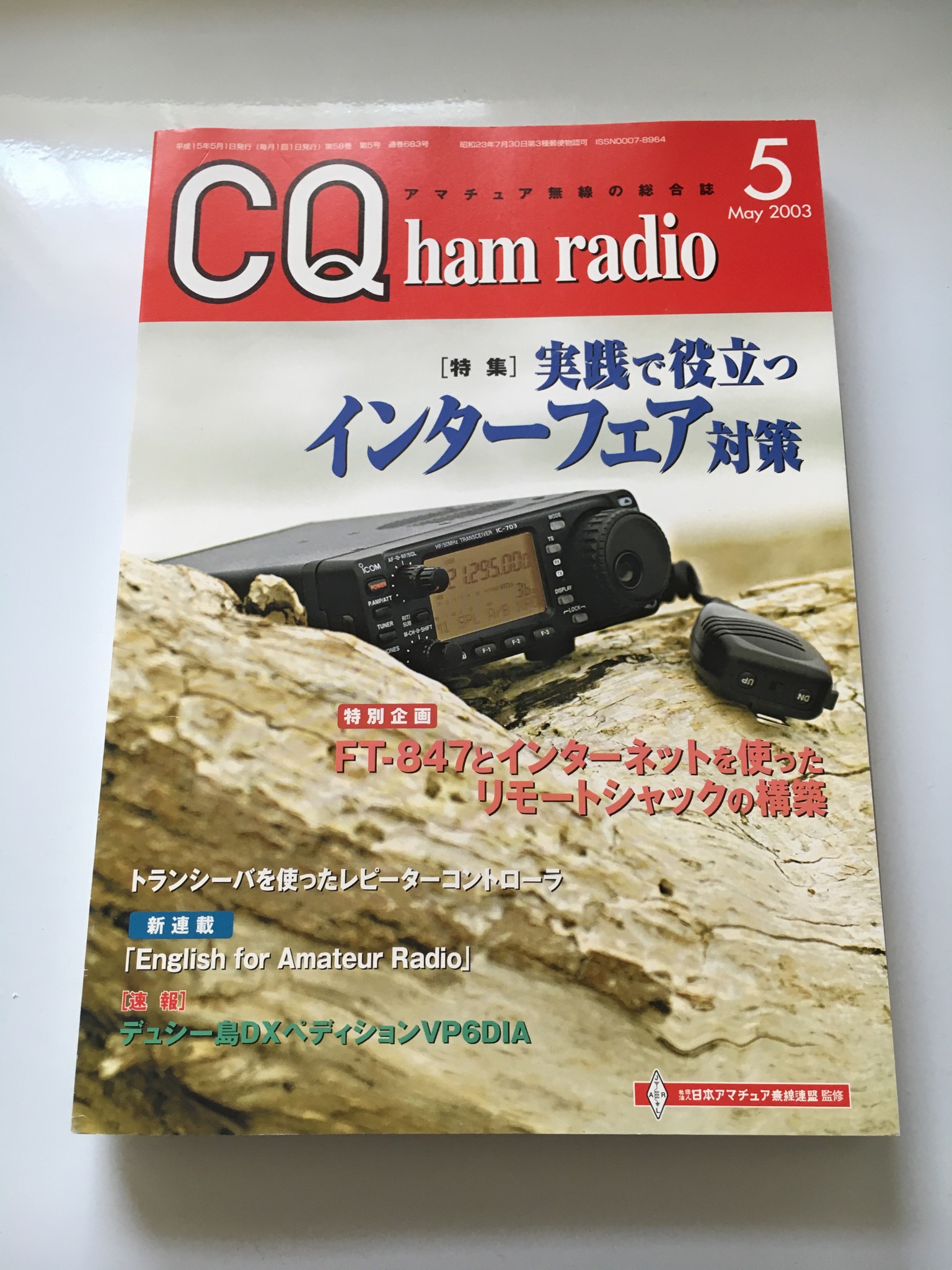
When I was at LSI Logic, I developed the IEEE1394 interface for the second generation JVC D-VHS decks (the HM-DH40000U and HM-DH5U). I worked directly with engineers in Japan and I used to get them to bring me copies of the Japanese ham radio magazine "CQ ham radio" when they would come to visit us in Milpitas. I can't read Japanese, but it's just a wonderful magazine about 300 pages thick (like the old Byte magazine).
When I was hunting information for that client; I found a deck and interface card on ebay for some fairly trivial amount, $200 or so. I was really tempted to grab it just for the "neat weird gear" pile but couldn't justify it. The tapes they wanted read had been submerged for some days and were crusty. The media might have been recoverable but it would have meant pulling it out and putting the tape into new cartridges.
Am I correct in remembering that standard VHS tapes were usable in these drives?
I had no practical use for them as my family didn't have an HDTV for a few more years, nor lived in an country where 1394 was enabled by default on cable boxes. However, the very idea of having a MPEG TS captured on a commodity tape was alluring in being able to have a perfect copy of whatever was on TV.
Alesis also developed an 8-track digital audio recorder based on VHS, ADAT, which used SVHS tapes and could record 20-bit 48khz. ADAT was pretty popular in smaller studios, and was great for the time before multi-gigabyte hard drives. https://en.wikipedia.org/wiki/ADAT
OP's project is cool but it's my understanding the specialized hardware is the big barrier to doing this at home, for most folks, especially if you don't want the tapes routed through a third party for the same reason people invented the polaroid so you don't have to send everything to the Ritz as the mall.
I'm about to start a project for digitalizing a bunch of recordings from a 1990s Sony Handycam for a film project run by a friend of mine. The quality doesn't have to be perfect, but I want to ensure I don't risk degrading the "tapes" themselves. Anyone know of any hardware that is up for the task? Doesn't have to be professional quality, but of course I want good results.
Just about to start the project so haven't had time yet to look into what hardware I need yet, maybe people here have good ideas, you usually do :)
0, https://m.media-amazon.com/images/I/71mbsPXPhzL._AC_SL1500_....
If you can get hold of a Digital8 deck that works (and well) then you can hook that to your PC with a FireWire card, and do a direct digital capture of analogue tapes. The DSP in the D8 deck will do an excellent job of decoding, far better than an analogue deck, and you'll get a really clean output without all the "convert down/convert up/convert back down" thing you get using composite jacks.
You'll need to convert the raw DV files into something suitable for editing and distributing, but I guess - since you're on here - you already know about ffmpeg.
Here's an example of a very old - 2000/2001 or so! - tape that I had lying around in a box in the shed for the past 20 years. I shot it with a hand-held Sony Video 8 camcorder when some power station chimneys were being demolished near where I worked. This would (of course) be the day I forgot to throw a tripod in the car, "Oh I don't need to pack that, I've got one in the workshop, I'll leave mine at home..."
https://www.youtube.com/watch?v=ZPmCygZIjio
It was a pretty grey and drizzly day, as I recall. I could have got the colours up a bit in editing but I didn't feel like it, and this is pretty much how it came off the quite-badly-damaged tape.
Stuck tapes sometimes are stuck because of moisture. In that case, the tapes are "baked" at a certain temperature to get the moisture out. If the tapes are in really bad condition, you get only one chance to capture what's on them, but the flip side is that one run can be of pretty high quality.
Edit: if your tapes are DV or Digital-8, get a camera with firewire out.
If your tapes are Hi8 analog, get a digital-8 camera which can play analog tapes with firewire out. You won't get a better quality without going the VHS-Decode way.
If none of that is an option, get a decent composite to HDMI converter, than capture the HDMI from that into a PC with a HDMI ripper.
Or one of those "HDMI to SD card" rippers floating around.
Just hit record on the box with the usb stick and hit play on the VCR and set a timer to come back in an hour or two.
if the camera is working and has RCA plugs
It's like they've been knee-deep in it so long, surrounded by fellow geeks they just assume everyone should know what they're talking about.
Also, how is it not clear what the project is? First thing I see from the submission link:
> Software defined VHS decoder
> A fork of LD-Decode, the decoding software powering the Domesday86 Project
Which links to https://github.com/happycube/ld-decode and https://www.domesday86.com/
> Software defined LaserDisc decoder
and
> Domesday86 is a project that aims to recreate the experience of the original BBC Domesday project using modern hardware and software
Which leads me to searching what BBC Domesday is, as I didn't know:
> The BBC Domesday Project was a partnership between Acorn Computers, Philips, Logica, and the BBC to mark the 900th anniversary of the original Domesday Book, an 11th-century census of England. It has been cited as an example of digital obsolescence on account of the physical medium used for data storage.
Not sure why everything has to be made for/explained as it's made for literally everyone. Some software is for a niche section of programmers/developers/$niche-group, that's perfectly fine. If you're curious, use a search engine like the rest of us.
Another good idea (that no one is obligated to do) for project descriptions/overviews is to give a brief mention of why. For instance, it would have been nice if the readme for this project mentioned the purpose being "To bypass all non-essential hardware, and process it all in software directly for an affordable and simple way to create a true 1:1 archival copy of analogue tape mediums." It wasn't too hard for me to dig a bit into the project wiki to find that out and piece it together, but I'm used to doing so, specifically because so many readmes tend to not do it themselves.
Finally, you've said "they owe you nothing" and I've also noted the lack of obligation, but while technically/legally true, there are still some expectations and unofficial obligations to varying degrees when releasing open source software. Generally, the more useful/interesting the software is, the more expectations and unofficial obligations there are. Take for instance any software that has a benevolent dictator for life (BDFL) scenario. That term on its own has expectations of benevolence built-in. There are expectations that they'll guide the project in good directions, that they'll ensure bugs get fixed, and to some degree that the community will have some input on things even though the BDFL makes the final call. More generally on most projects, there are expectations that bugs will get fixed, pull requests considered/merged when appropriate, documentation will be provided, and so on. It's hard (perhaps impossible) to have a successful open source project that does not do these kinds of things, so in a real-world practical sense, there _are_ obligations in open source projects, if you want any kind of success for the project.
Of course that's true, but most OSS devs would prefer broader usage to narrower usage.
So, to understand it, I should know what CVBS is and click on links to other projects. Which I did:
Apparently LD-Decode is a Software defined LaserDisc decoder. Great. It also buries its basic purpose in further links.
As for Domesday86 Project, its About page is about project members, privacy policy and general disclaimers. And it's just weird that you think "The BBC Domesday Project was a partnership between Acorn Computers, Philips, Logica, and the BBC to mark the 900th anniversary of the original Domesday Book, an 11th-century census of England. It has been cited as an example of digital obsolescence on account of the physical medium used for data storage." is a good description of whatever it is.
I have an electronics degree and I struggled to get this basic info, so imagine how bewildering this would be to a less technical audience. It doesn't need to be this way. OSS can do so much for people, if only the slightest effort can be made to let them in and indulge their curiosity.
Also, before you respond with an explanation of why jargon is good, consider the reason you didn't boot up your computer with a careful sequence of toggle switch positions, is because someone before you was kind enough to make the technology accessible, even to snarky YC commenters.
The usage of a DC blocking capacitor implies it's not baseband.
wait waht? tyop? if not please tell me where i may ask Santa for this item cuz i wants it.
edit: this link was useful: https://github.com/happycube/cxadc-linux3#where-to-find-curr...
I see this project still uses an actual VHS head. I wonder if, in the future, folks will try to capture magnetic tape signal by using something like a hard drive head scanning over the top of the tape but not touching it? This could potentially retrieve signal badly damaged, unplayable tapes-- lay out a segment of tape on flat surface, scan it, repeat, until entire tape has been scanned.
You can also get laser turntables - https://en.wikipedia.org/wiki/Laser_turntable which look intriguing
I'm rather curious about these microscopes - https://matesy.de/en/products/magnetic-field-visualization/m... which can visualise magnetic fields, they're very expensive though.
By the way, great Japanese docudrama about the making of VHS with Toshiyuki Nishida and Ken Watanabe: https://rarefilmm.com/2020/05/hi-wa-mata-noboru-2002/
It seems like this is an order of magnitude more complex and expensive.
Is the quality really that much better?
For ex. my situation: cheap upscaler bought before covid had really high saturation and turned small areas of similar colours into one color squares no matter the bitrate chosen in OBS(this type of artefact is very obvious in 140p youtube video). After getting into it again in present day the upscaler stopped working and bought another one of the same kind. Guess what, it ships with a different chip and different settings, this time it has almost no colors and presents weird glowing around dark regions when the camera moves around fast. Now I'm in a pickle and I'm really considering going the above route.
Anything exists like this available ONLINE?