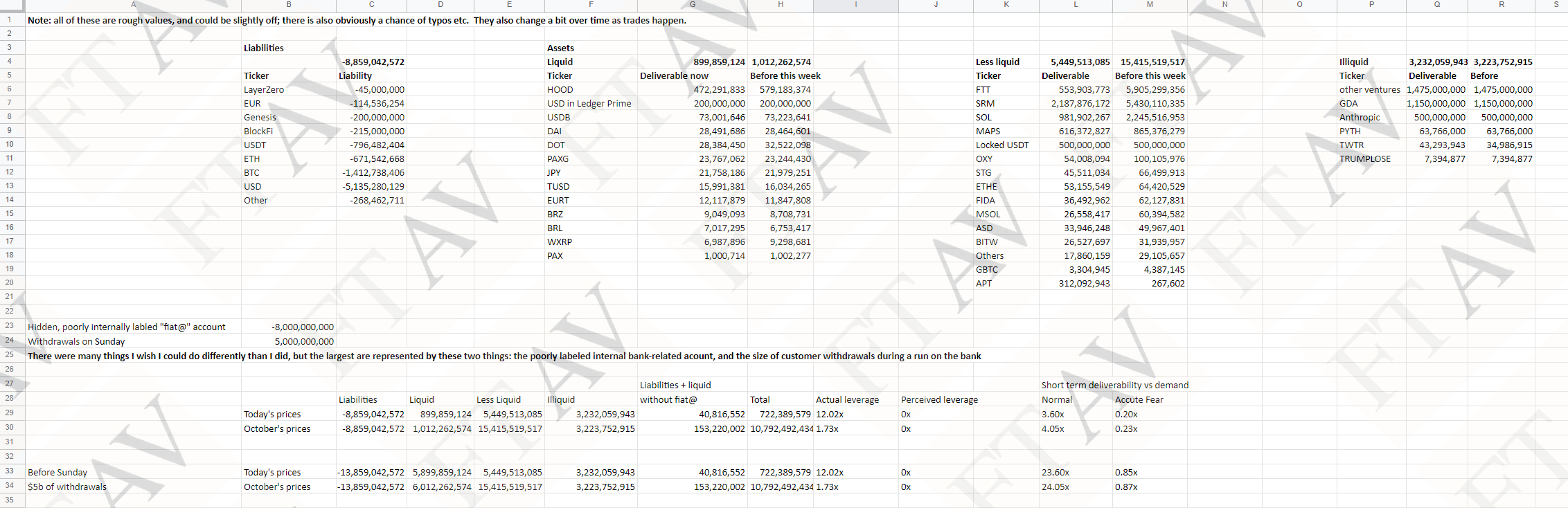
I can't believe they seriously held that much of their total value in their own issued token. That's just preposterous. Imagine if JP Morgan Chase's entire value was in JP Morgan Chase stock, and they just reported that as their value in cash. It's like recursive valuation.
He's still behaving as if having billions of liabilities in real money backed by funny money "assets" is somehow acceptable and everything would have been fine if it wasn't for the "last week".
I’m a complete crypto skeptic who would never touch anything like FTT, but it’s not an obvious Ponzi scheme. I think one of the troubles with crypto is that it’s very easy to operate what is effective a Ponzi scheme, without fully realizing it yourself.
While I think real world finance is on much more stable ground than crypto, I thought it'll be funny to point out that many of the world's central banks back their liabilities (the currency they issue) with own government's bonds. Luckily, the bonds are denominated in the same currency. There is no chance of the central bank going broke, as long as they hold the bonds to maturity.
---
This is not "luckily", it's by design, and there's a couple of other key differences as well.
1.Modern central banking implements an artificial separation between government and CB (an imperfect one), that attempts to make this less recursive...
2. ...but the key difference here is that the value of the dollar ultimately derives from the fact you need to pay US taxes with it. If you want to do business in the US, you need to get some USD to pay taxes in which are then used to keep the US a place to do business in. It is exactly the same model as FTT except that instead of paying "taxes" to trade on one of many market places, the US is a giant nonfungible place, with lots of difficult to move assets and people, serving a fucknormous circular economy with a staggering amount of real world consumption - i.e., a place you want to or have to do business in even if there's shock...
3. ...and has a monopoly on the violence (in the form of laws, courts, police and military) that actually enables the notions private property that enables this all. If the US government collapses your dollars are worthless whether they are backed by a bond or not.
4. Finally, neither the CB nor the government are up for sale or needs to generate profits or shareholder value. All they need to care about is continuing the system in a way that its constituents want (I'm not specifying the aggregation method, oligarchs are still constituents)
So overall, and with the fact that this is a system which has been iterated on for hundreds of years(thousands if you count legal code), yeah, it's a lot more stable
Governments thus, control both the demand for, and the supply of money.
This is the crypto equivalent.
Exactly correct. Most of these crypto companies hold assets that are nothing but tokens they or an affiliated entity print on demand. Just like how most of Tether's assets are commercial paper yet they refuse to name whose commercial paper and no one who makes a market in that space has ever dealt with them - it's obvious the commercial paper was issued by other crypto companies and likely secured only by crypto. And how exactly do people think all of those staking/farming operations are generating those ridiculous levels of "yield"?
It's way worse. JPM stock pays dividends in dollars. The yield on FTT is more FTT.
The value of JP Morgan Case is the total value of their stock, almost by definition.
Buy backs are also basically a transfer of a company's cash to company stock and are regularly done by US corporates.
The difference here is that they secured debt against their own company assets so that when the value of the company went down, they went into more debt relative to their asset value.
They were also leveraging an asset which was highly volatile and which could be easily targeted by bad actors. Anyone with any experience in risk management understands that your leverage should be proportional to the volatility of the asset you're leveraging. This is why you get large loans backed assets like real estate, but not stocks. Stocks drop 20-30% every few years where as real estate is far more stable.
If they were leveraging dogecoin instead of their own token the result would have been the same.
Also, where does Alameda fit into the picture?
What's not clear to me is what they gambled on that lost money.
Business model ought to be simple, the exchange earns loads of fees, and Alameda makes markets on it, earning spreads.
Just putting a lid on the risk there should be enough to keep people occupied, no need to print your own money for extra leverage.
My guess would be other crypto ventures. All these crypto companies pumped each other with no products/assets (Stadium names and soccer team sponsorships with no products to sell!) and invested in each other. The economy had so much excess money and they got pumped and they thought this is what "investing" is. Economy's bubble burst and suddenly their valuations goes to 0.
When economy goes bad everyone is hurt but these companies had nothing but vaporware and are vaporizing as a result.
Just a guess though.
Also, having listened to the FTX podcast a few times just to get some idea of what their magic was, there was one episode where Caroline came on, and the gist of it seemed to be that the host Tristan and a lot of the heavy blockchain cool-aid drinkers managed to convince Caroline to toss out good old risk management principles and Yolo it on defi and nft projects. They referred it in Their podcast as "the summer of defi". I guess that might have been a reason as well
Alameda has a strong incentive to knowingly do bad trades on ftx, i.e. stale quotes + spreads too small, since it increases legitimate volume numbers and generates ftx fees (gains in ftx fees offset trade loss). It's unknown if this happened or to what extent, but it can be very costly to do this in large size.
For that, they can't use FTX. They need USD or a stable coin like USDC.
They can't convert hundreds of millions of dollars of FTT to USDC since demand for FTT is relatively small. And a transaction like that might cause a huge decline in the price of FTT.
So they must have used ETH, BTC etc deposited by customers for swapping to USD or USDC.
I guess their theory must have been the surbowl ads, celebrity endorsemens and all would result in demand of FTT going up after some time. And they can later swap them back to customer funds when required.
But then crypto crashed.
Now customers want to withdraw the funds and they don't have it to give back. And nobody wants FTT.
1- Gamble with them
2- pay themselves
3- lobby the government
4- bailout other failing crypto companies.
Everything here could have been done with any non-crypto exchange.
They were greedy and counted on a bull market. Basically used money that's not theirs to speculate on shitty coins. Shitty coins went down in value along with their customer's deposit. Think about borrowing money at the bank to buy BTC at 60K. You'd be on the same spot.
Margin has the effect of magnifying the effect of volatility in the value of a product on profit and loss. And of course crypto is extremely volatile to begin with (by comparison to other assets).
Since they were acting as a dealer they could lose a lot if their book of business was imbalanced (ie on net a lot of their customers have the same position) and the market moved against them.
Secondly they seem to have had very little equity as a reserve against losses and what equity they had seems to have been in this FTT token which was only backed by the exchange itself. So if the FTT token lost value they would lose all their equity and have no reserves to protect against losses. This happened when Binance tweeted that they were selling their (very substantial) FTT holdings. In normal finance your equity reserves are there for if you have a bad day and lose some money - you can dust yourself off and try again the next day. If you have no equity then your business is insolvent. Trading when insolvent is no bueno and if there are rumours that you are insolvent of course people pull funds, won't trade with you so you have effectively a "run on the bank" and all the problems you had before get worse because now you can't find anyone to trade with as you try to wind down positions to refund customers etc.
Thirdly there seems to have been shenanigans afoot regarding Alameda (the affiliated hedge fund) which seems also to have primarily been long FTT and a bunch of other similar tokens backed by not very much. It may be exchange funds were being used by Alameda for trading - certainly they don't seem to have been kept at arm's length as they should have.
Fourthly there have been allegations that customer funds from the exchange were somehow inappropriately used to cover losses either at alameda or at FTX itself. If this is not true, it's hard to understand why refunds are taking any time at all so make of that what you will.
[1] Essentially a leveraged swap on the price of a particular crypto. So one party will pay say 10x the difference between some reference price and the current price of the crypto and the other side will receive it.
[2] Assets with a certain value as security against losses. Generally you will be required to have collateral which is liquid (ie can be easily sold if need be without affecting the value of the collateral) and relatively risk-free (like treasury bonds). For collateral that is risky, the dealer will take a "haircut" off the face value of the collateral to account for the fact that they may not be able to sell the things for the market value. The market itself (and Alameda) had collateral (FTT and similar) that was on the whole neither liquid nor risk-free.
It's incredible that 1) crypto "finance" is full of products whose name screams scam, and 3) a perp(etuity) is like a fixed-term annuity except it's supposed to lay out forever, but no crypto perpetuity has been existence (and most have already failed) for longer than any annuity term.
Be it Sequoia. Or Yc. PG, Chamath, Mark Cuban ,Balaji or the Collision brothers. Tom Brady or SBF or CZ. Never fucking trust people or organisations.
They are all here for their financial upsides.
Only trust the tech. The maths. If you can't do the work you would be fucked by them.
That's all.
I am not saying PG did something shady. I am saying even a well regarded figure like him in this community should not be taken for granted unless they back their claims by sold evidence.
I apply that reasoning to all investments. Sure, I miss out on all the easy money hype trains, but the investment decisions are almost always safe and still better than market average.
The truth is that for something to be truly spectacular in moving humanity along, you need both tech AND people. You named a bunch of celebrities…OF COURSE you shouldn’t trust those people, you don’t even know them.
Not trusting anyone is just a good way to grow old and bitter about the social state of the world.
Trust and identity are fundamental in financial transactions.
Should we not do that because, with one voice they are all saying that you should do that?
Trust me we have the funds backed 1 to 1 in our exchange is not unless proven cryptographically.
Coinbase used to be US-only, and is still very US-centric. Binance and FTX are international. They only opened US exchanges later, but they are separate, and tiny compared to their international footprint.
I'm also curious how FTX got so big. When they started, the market seemed saturated with exchanges already, and they didn't really have differentation.
The only reputable exchanges are KYC/western based Coinbase, Kraken, Gemini, and perhaps some of the smaller US based companies.
Honorable mention to Bitmex, which was truly financially innovative (basically what FTX and other crypto futures exchanges tried to copy) and admitted exactly what it was (a place to trade with irresponsible leverage). Their only mistake was not trying that hard to prevent US nationals from yoloing on their site.
Not to mention Bitcoin and crypto were created out of the failures of the trusted KYC "western" banking standards of 2008.
You are literally repeating blind trust mantra based on region bias that has just failed again this week.
Crypto is about avoiding the need to trust any of these entities, if it still hasn't enabled that maybe it isn't mature yet as an industry. CeFi or not.
It’s likely Binance was so much easier because they were ignoring KYC laws, but I’m not a lawyer.
Low bar of entry, largest marketplace, and a decent API
Fair bit of luck needed as well since there's hundreds of exchanges launched at around that time.
There's no explanation that doesn't require luck, but there's also no explanation that doesn't require having the prerequisites of liquidity and marketing.
To call all those "Less Liquid" tokens not "Illiquid" is a mastery in self-delusion.
$2.1B SRM $981M SOL
and then all the shitcoins built on those "technologies" where the tokens are their "shares" in those investments.
But to call those tokens valuable assumes there's value in MAPS/OXY etc.
But MAPS has a total market cap of $3.9m today - the forced liquidations in these positions will 100% crush these coins. Even SOL and SRC. Hell - other than their Robinhood position and the fiat and fiat-tokens, there's almost nothing of real value once these liquidations happen.
My guess is less than $700m recoverable, so if you get an offer for >$0.10/dollar on your deposits from a vulture bankruptcy fund, I'd take it.
BTC
Binance, Tether, Bitfinex are all basing their purported asset value on holdings of multiple worthless currencies, many of which they mint and price themselves.
CZ alleged that FTX tried to crash Binance's market a few years ago like Binance did you FTX last week, but failed because they actually hold reserves.
Countries, (central) banks, family funds and hedge funds are about to fail (or are already failing) in a very similar way but on a much much grander scale.
So even the less-shit coins SOL are just getting siphoned off.
I'd take $0.05/dollar now.
Wash trading and market manipulation is basically the defining feature of all these markets.
Does that sound moral to you? I think it’s absolutely terrifying. Every candidate that received that money should have their relation to Scam Bankman-Fraud investigated. It gets worse when you realize his mother and business partner are either related to certain political parties and the SEC chairman.
I was disturbed by Robert Mercer’s dastardly part in the 2016 election, both his donations, his people placing, and his technical consulting. The guy is basically a real life Bond villain. When you look into the other top donors of the Republican Party, you start seeing some real Machiavellian characters. The Democratic donors are not far behind in terms of greed and power, but it sure seems like some of the Republican donors just want the world to burn if it means they can keep their wealth.
Of course they don't, taken collectively. Investigative journalists are our slender hope. They and those few politicos who didn't get a share of the loot, and may now see pushing for tighter regulation as a career opportunity.
Why people think that such things are limited to any one political party or that progressive liberals are somehow immune from it is beyond me.
Used to be a time, about a decade ago, where these very same folks would lose their collective minds when Mitt Romney said stuff like "corporations are people my friend" and "money is speech".
I guess if you can't beat them, join them. Heck, SBF even donated to Mitt: https://en.wikipedia.org/wiki/Sam_Bankman-Fried#Political_do...
Instead of fighting to get money out of politics they decided they can just play this game better and their ends justify the means with very predictable results.
The only surprising thing is they got caught. Although it remains to be seen whether anybody actually admits fault, goes to jail, or any actual changes are made.
  A true scandal is opening for the Biden administration. April 25, 2019: Biden announces his presidential campaign. 13 days later, Sam Bankman-Fried, son of Barbara Fried ( Stanford Professor and co-founder of political fundraising organization "Mind-the-Gap), launches #FTX crypto exchange. The exchange is magically an overnight success. SBF becomes biggest donor to Biden. Election day, FTX implodes completely. If you think this scandal is done, it goes even deeper. Gabe Bankman-Fried, brother to Sam (also a former Jane Street trader), is founder of "Guarding Against Pandemics" He was a Legislative Correspondent for the US House of Representatives and an advisor to large political donors in the Democrat party. The family Aunt Linda Fried is a WEF member on the Global Agenda Council on Aging.

  The father, Joseph Bankman is a Stanford professor who has lobbied on behalf of Hedge Fund managers before Congress before (film records exist). FTX' Head of Ventures & Commercial at FTX Ventures Amy Wu, started with the Clinton Foundation years ago.

  Nishad Singh FTX Director of Engineering has spent over 8 million for Dem candidates. And finally Obama's Commodity Futures Trading Commissioner, Mark Wetien was literally the head of FTX Policy & Regulation. Reports were the organization wanted to spend over a billion dollars on the Democratic party for 2024. A massive, massive money laundering operation has just been broken open.
Regardless of who is in charge and their political affiliations, it simply should not work this way.
Edit to add more substance and thought:
I know it's uncomfortable to address but it's true. On top of the money pulled out of "thin air" via electronic means by the central bank (US Treasury asks for a billion, fed manifests it in exchange for bonds, w/ the US fed at a 6% profit rake scheme, not sure about BoE, etc), the normal everyday banks as part of the fractional reserve system pull money out of "thin air" by loaning out more than they have on deposit. Furthermore, the fractional reserve rate which used to be 10% has been busted down to 0 afaik currently. Literally they can loan out money they don't have and the regional fed will bail them out with liquidity if it gets too bad.
I've known this for a while but in 2016 when I was considering running for congress and started digging into the funding sources of the incumbent, I started noticing a lot of NY banks donating to this random congressman, and pivoting out found that vast swaths of politicians have banks themselves donating money.
no. Scam Bankrupt-Fraud
In the Sequoia profile they greatly admire how Bankman-Fried plays League of Legends while pitching to investors, and takes naps in his office when he’s supposed to be in meetings. How surprised can they realistically act that their genius lost 8 billion dollars in a “hidden, poorly internally labeled account”.
The investment industry needs to face their role in this debacle. The Ontario teachers’ pension fund sent tens of millions to FTX with apparently no due diligence. That money ended up in the pockets of crypto insiders and also funded promotion like Super Bowl ads that sucked more retail dollars into FTX. Some of those poor FTX customers who are facing a 100% loss on their crypto “investment” may have been teachers from Ontario.
Pension funds and VCs don’t generally invest in gambling and drugs. Why do they invest in crypto?
We phoned one of these well known investors to tell them what had happened. By that of course I mean the person in charge of the little piece of the massive fund that was allocated to us.
On the call the guy goes "when I tell my boss in 5 minutes, I'm going to get fired for investing in you". He wasn't wrong.
The thing that shocks me is the due diligence. There's a heck of a lot of things you have to do to get Ontario to invest in your fund. All sorts of documents, double signature statements from banks, meetings where you wear a suit. We'd have lost the investments if we were playing video games, there's no doubt about that. Maybe culture changed but it seems really odd, because part of due diligence is qualitative: does this team seem like serious people?
Telling everyone what regulations should be (and buying politicans) to ensure consumer protection while simultaneously sifting away 90% of consumer funds?
How does a person lie that much?
Advising congress and buying formula 1 ads and sponsoring stadium names gave his scheme a certain unearned legitimacy.
This seems to have been a case of XKCD 978, i.e. lazy journalists. https://xkcd.com/978/
Instead of a supremely polished persona, he hard-committed to the sweaty geek.
Confidence, man.
either way the failing is the same - investors failed to preform adequate due diligence and lent their credibility to things they didn't fully understand because they were distracted by the charisma of the founder and were worried that they would miss potentially outsized gains. as long as large amounts of capital keep flowing to private markets (especially VCs) this will continue happening
https://twitter.com/0xhonky/status/1591630071915483136
https://twitter.com/autismcapital/status/1591601671943393280
(From the first tweet, it doesn’t seem like anyone in the conversation has read https://en.wikipedia.org/wiki/Martingale_(probability_theory...)
It was all funny when these people were portrayed in TV shows, not so funny when that mindset is behind billions of dollars of people's money getting defrauded.
What was their plan? Were they blind? Were they hoping to cash out before it crashed?
Major investors usually get full visibility into the company.
I somehow feel firms like Sequoia gave these crypto stuff some credibility and positive exposure. It was like, "don't worry, their business is legit and booming.'
I thought the rationale was already widely known by now: https://en.wikipedia.org/wiki/Greater_fool_theory
Or in more charitable terms: if an investment has a positive expected return according to their model (meaning that they think they can sell their shares / tokens in the case of some VCs), they do it.
Seriously though, a lot of influencers promoting this stuff have been getting paid in cold hard US dollars to promote these scams.
How do I know? I spoke to influencers to talk about my portfolio companies and many of them told me the crazy amount of cash they were getting paid from these scammers. Think 25,000 for a channel with hardly 100k followers.
That's why I feel like Sequoia partners should be investigated thoroughly. If a terrorist organization gets investments, don't we investigate those investors as well?
If you drop morals, like a16z did, by supporting another scammer and gritting on crypto, it's a very lucrative business.
https://twitter.com/philbak1/status/1591409852957732864?s=20...
jfc...
The reserves are there to provide liquidity for people who want to withdraw their funds in normal times.
The assets are mostly loans. The lenders sometimes fail to repay the loan, and the collateral may not be worth as much as initially estimated.
The bank has capital requirements, so that if loans are not replayed, the bank shareholders take the hit.
If the capital is depleted beyond a certain point, the regulators (and the FDIC in the US) take over the bank, wipe out the shareholders, and install new management. Depositors are repayed up to the insured amount and if there are remaining funds they go to the insured depositors, creditors, and shareholders in that order.
That's of course how thing are supposed to be done. In reality, large connected banks are often bailed out.
I see an endless string of branded code servicing similar technologies, but where are the customer inputs putting in the billions needed to support the industry? Is blockchain liquidating crypto valuations into developer salaries with a VC subsidy?
Money creates more money, so if can can create money that creates more money, we're broadening the economy, expanding it all the time.. (https://www.youtube.com/watch?v=M_3T-Af57Pg)
Sort of similar to how Trump said his own net worth fluctuates day to day sometimes based on his feelings since it is tied to perceptions of the Trump name as a brand.
Or how George Costanza said it's not a lie if you believe it.
Or how a gambler who is down is sure he can make it back.
In other words, yeah, as fraudulent as can be. Lets see if anybody actually goes to jail.
The peak market capitalisation of SRM was less than 1.5 billion (according to coinmarketcap.com ) . So how could FTX's holdings every be valued at 2.2 billion?
"this blog endorses double-or-nothing coin flips and high leverage"
https://pbs.twimg.com/media/FhaKXhRXwAEfvKD?format=jpg&name=...
The simplest model we can make is that the market will instantly jump either up or down. Why does the strategy not work in this case? If it jumps up you win. But if it jumps down you lose not just your stake, but you actually go into debt because of slippage. However if you add the possibility of call bankrupcy to discharge the debt, then it actually does work.
On the other hand if you use a more realistic (but not fully, of course) continous model, then it doesn't work. Why? Because there are such a high proportion of paths the price can take where it reaches your stopout before it reaches your payout. It could go down (game over) up up up, or it could go up up down up down down up down down (game over). I believe you can use martingale theory to prove that it doesn't work.
Tuesday 11/08
129 https://news.ycombinator.com/item?id=33518961 FTX Appears to Have Stopped Processing Withdrawals, On-Chain Data Show (theblock.co)
747 https://news.ycombinator.com/item?id=33520585 Binance to acquire FTX (bloomberg.com)
110 https://news.ycombinator.com/item?id=33523274 FTX Token, FTT down by more than 80% in less than 24 hours (ftx.com)
Wednesday 11/09
430 https://news.ycombinator.com/item?id=33535161 FTX’s financial black hole leaves Binance balking at rescue plan (bloomberg.com)
420 https://news.ycombinator.com/item?id=33537821 We will not pursue the potential acquisition of FTX (twitter.com/binance)
Thursday 11/10
189 https://news.ycombinator.com/item?id=33541790 Ftx.com Has Probably Collapsed (effectivealtruism.org)
197 https://news.ycombinator.com/item?id=33547102 The Sam Bankman-Fried empire crumbled. What happened? (mollywhite.net)
516 https://news.ycombinator.com/item?id=33547863 FTX tapped into customer accounts to fund risky bets, setting up its downfall (wsj.com)
Friday 11/11
108 https://news.ycombinator.com/item?id=33558225 FTX Yikes (rekt.news)
1168 https://news.ycombinator.com/item?id=33561234 FTX to file for U.S. bankruptcy, CEO resigns (reuters.com)
Saturday 11/12
800 https://news.ycombinator.com/item?id=33570274 FTX faces potential hack, sees mysterious outflows totaling more than $600M (coindesk.com)
174 https://news.ycombinator.com/item?id=33571734 FTX investor Sequoia removed its glowing profile of Sam Bankman-Fried (businessinsider.com)
174 https://news.ycombinator.com/item?id=33575281 FTX held less than $1B in liquid assets against $9B in liabilities (ft.com)
139 https://news.ycombinator.com/item?id=33577311 FTX hacker identity discovered by Kraken Exchange team? (cryptoslate.com)
>> https://news.ycombinator.com/item?id=33577437 FTX balance sheet, revealed (ft.com)
^^ You are here ^^
Sunday 11/06
1 https://news.ycombinator.com/item?id=33494404 Due to “recent revelation” Binance is liquidating their FTX Token holdings (twitter.com/cz_binance)
> Context:
Friday 11/04
254 https://news.ycombinator.com/item?id=33464494 Crypto trading firm Alameda Research might be insolvent (dirtybubblemedia.substack.com)
--
All in time for:
Tuesday 11/07 -> Monday 11/06 ("yesterday")
https://news.ycombinator.com/item?id=33518961#33520094
> I admit I did panic and tried to withdraw my funds yesterday. They just processed it today. A bit delayed but still processing.
--
"Get Out" vibes for sure.
At that point it was too late.
If a significant number of customers tried to withdraw a few days earlier, FTX would have collapsed a few days earlier.
The mistake was made when giving FTX the money.
FTX literally has no CFO [1]. How is this possible for a billion dollar company and billions in client assets? How did the investors not insist on an adult to manage the their investment?
The CFO, and the credibility they bring to the table based on their track record and reputation, is part of the system that helps prevents situations like this.
[1]: https://www.ledgerinsights.com/ftx-warning-signs-no-cfo/
WSJ nailed it with Theranos, missed it with FTX.
Another thing is, it seems like this spreadsheet was hand-crafted by Sam Bankman-Fried just before their emergency meetings this past week. Why wasn’t this something that already existed for all top executives to see? How was it not just a printable document or report but was instead something he just typed up? Because no, it is not obvious that a balance sheet of a supposedly multi-billion dollar company would contain typos. Typos!? I mean, come on.
Then again, I have worked with people similar to how Sam Bankman-Fried seems to operate. Not the possible sociopathic tendencies he appears to have but the sort of twitchy smarts he does seem to have. People like that can sometimes think so fast with a lot of confidence that they create this wake of stuff behind them as they work. They “solve” (i.e., move through) problems so fast, that everyone gets lost in the wake and can’t catch up to find all the mistakes left behind or tie the loose ends together. They consider a problem solved if it’s essentially solved but doesn’t have details thought out or if there are possible mistakes that can be “easily” solved in ways not apparent to anyone else. If there’s no one around to slow these types of workers down, it can be complete chaos where you have one person spearheading away through the bushes, while everyone else is getting slapped in the face with the branches snapping back and thorns. At some point everyone gives up trying to follow. Then the person is off on their own where they lose sight of whatever actual problem they were solving and lose track of the bigger picture.
It is entirely possible that that is a component of what has happened here, coupled with some sociopathy, megalomania, and billions of dollars of funding in Sam Bankman-Fried’s case.
You just described me about 15 years ago. I've learned my lesson and avoid "unsupportable solutions" these days like the plague, but I still get pulled aside occasionally and get told quietly that nobody understands why I'm talking about solutions to problems that haven't even come up yet.
The current holdings are valued at today / yesterday's spot rate.
Given that many of these holdings are in (comparatively) thinly traded alt-coins, as soon as you try to dispose of these levels of coins / tokens, the price will fall as supply overwhelms demand.
Of course, this is represented by the fact that many of the alt-coins are marked as relatively illiquid -- and SBF has put a lackadaisical disclaimer at the top about the shifting price.
But the reality is that regardless of how long you wait -- or how much you try to spread the disposals -- you will only ever get a percentage of the current spot rate, given the impact that the sales will always have on the price itself.
I can't shake the feeling that SBF might say... "Yes, but once we have reassured the market, etc, etc, these alt-coins might recover in value -- and then we can dispose at this level."
And, of course, the merry-go-round starts again.
https://mobile.twitter.com/LucasNuzzi/status/159159590823988...
  Token   Last wks  Last wks  Estimated   Peak     Peak         Peak
           value     price     holding    price    date         value
  FTT     $5.9bn    $24.00       246m      $77.69  09-Sep-2021  $19bn
  SRM     $5.4bn     $0.75     7,240m      $12.50  13-Sep-2021  $90bn
  SOL     $2.2bn    $32.00        70m     $258.78  07-Nov-2021  $18bn
But FTT/SOL/SRM is not very liquid. So you use your liquid assets (i.e. your customers' USD, USDT, BTC and ETH). People might wonder where you get all this cash. You don't want to admit you are using customer funds and you only have gains on tokens you printed. So pretend you're genius trader and run a highly profitable exchange.
https://mobile.twitter.com/metavestor/status/159120025903564...
The very first book to read before any other on finance and investment.
It would be the like of telling your kid "Beware of the wolf before sending her through the wood to pay a visit to Granny"...
[1] https://twitter.com/AlamedaTrabucco/status/15233819532395233...