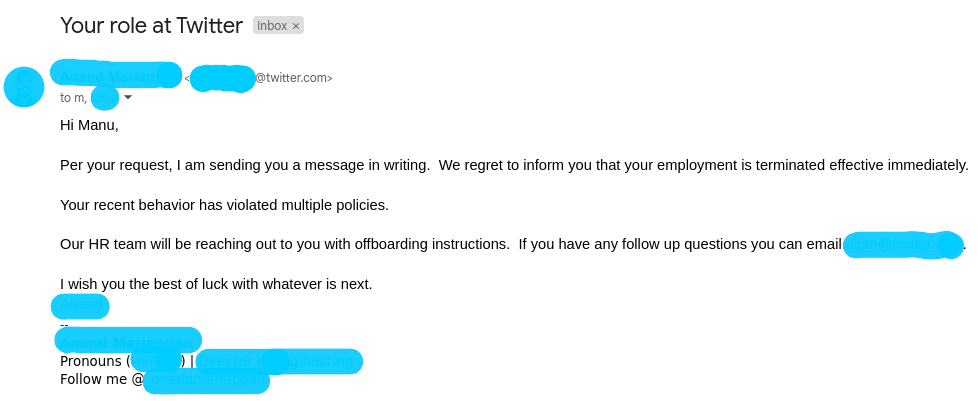
[1] https://ma.nu/blog/img/2022-11-01_bye_twitter/termination_em...
[1] https://www.nytimes.com/2022/10/29/technology/twitter-layoff...
> A: Raw number of lines of code over a certain period (a year I think)
Wow.
Perhaps Musk on top with a gun, shooting everyone on the bottom?
Which is just kind of funny
Sure, they did some coding at some point but I doubt many were ever very proficient and just managed to coast until they become managers and had to drop the farce of knowing how to code.
The amount of junior level mistakes and architectural issues I spot around are incredible.
I wonder if it's a reflection of the increasingly complex tech landscape or a reflection of the increasingly politic and "soft skills first" corporations.
It absolutely makes a difference if the manager knows the domain in which he works. The fact that there is a lot of inept managers that started as programmers does not really discredit that.
Multiple times I’ve had engineers tell me something was impossible, or strictly necessary, or too hard, when it demonstrably wasn’t. If you let too much of that happen, your product suffers.
Some of them are, sure, but one of the skills necessary to effective management is understanding of the work being managed (especially the work at the immediate subordinate level and, if it exists, the next level down.) At the executive level, that probably doesn’t require more than very casual awareness of any of the line work, but at the level of first and second line managers it absolutely does, and its usually a lot easier to find a worker with the right talent to learn the additional skills of management than a “generic manager” who can OJT learn the domain.
I’ve spent most of my adult life in and around tech orgs, and the next even half-competent line- or second-level manager that didn’t start out as an IC I meet will be the first.
1) The top knows what the organization is capable of and can set achievable goals 2) That the bottom is incentivized to do things that achieve the goals of the company
A manager being technical helps #1, information flows upward more accurately.
I think #2 is more nuanced, but when you have a boss, you are directly incentivized to please the boss, not directly incentivized to achieve the goals of the company. Those can be different things and the less technical a manager is, the more different they can be.
This isn't an argument for just promoting individual contributors, though, since lacking management skills also makes both of these problems worse.
It is an argument for flatter organizations. Maybe that's a better way to look at it, every layer of management makes 1) and 2) more difficult. (A fully flat organization wouldn't have either problem at all.) But if a manager has both management and technical skills, it's more of a partial management layer.
They are quite pointed and amusing and he does not discriminate in throwing any of the counter parties in this story under the bus ->
https://twittoons.com/36 - on previous CEO
https://twittoons.com/38 - on the media
https://twittoons.com/3 - on being public
https://twittoons.com/32 - on Elon
You are right, there even are comics poking fun at the moderatorial slant of the site! Oh wait no, there isn't any.
The only note worth mentioning is confusion around the pod system, which I think actually sounds surprisingly effective for creating "culture". The op looks for an engineerimg explanation to justify meeting up with a group of disparate employees working on different projects, at different levels, and in different facets of the company. To me it sounds like a genuinely productive way to create relationships and "water cooler" interactions by letting it not have some ulterior motives related to the product.
That might be bias and optimism on my parent, and I'm sure the reality isn't that pretty either.
So much of what's been mentioned here simply depends on what part of Google you're working in. It's just so massive; different orgs and product areas have vastly different ways of doing things even though there is an attempt to standardize across the whole company.
I guess the author did implicitly mention that this was just their own experience.
OSS just wasn’t as good then
A lot of OSS now is from folks that had experience at google or were aware of what was going on there — or who built things so that they could make things like the best folks (at the time). Some OSS is even from Google of course (eg k8s, chrome dev tools, etc.).
Landscape is of course very different now.
Google is slowly moving towards more OSS and external vendors as stuff gets better
[0]. https://ma.nu/blog/bye-twitter
[1]. https://storage.courtlistener.com/recap/gov.uscourts.cand.40...
[2]. https://www.theverge.com/2022/11/4/23440304/twitter-mass-fir...
A bit later
>21:17 Disconnected from everything mid-meeting, laptop goes blank
Clearly his tool was designed and intended to download emails to explicitly take it off the corporate computer. What point is there in releasing a tool for downloading documents ON the corporate computer ("wanted to save some important documents before potentially losing access") when you entirely lose access to that corporate computer in case of termination. This in combination with the cartoons and other rebellious antics as noted in his blog posts I'm not surprised he got fired.
Still, Phabricator looks like it has terrible, terrible UX. Is that correct to assume?
Yes, why even post this on slack?
You know there is a major shift in management and everyone is under a microscope. Conversations are likely to be monitored and this seems like something that a company can perceive as a threat as now e-mails can be leaked.
> but Twitter “TLMs” (“tech lead managers”) are more managers and less “tech”.
> I feel like engineers at Twitter are less diligent at adding comments and documentation to their code.