The actual issue with Braille, is that letters are often tactically similar. Even tactically, people identify shapes better than absolute positions over a grid; in this sense Braille is flawed by design (why just dots? Why not a mix of dots, curves and straight lines?), and Fakoo's alphabet doesn't solve this.
Regarding Braille, my grandmother became mostly blind at old age. Having maintained an interest in books, while finding herself increasingly restricted with regard to her radius of action, she tried to learn Braille, but eventually gave up. At her age, she couldn't feel the differences anymore. Tactile resolution and significance do matter. (I'd imagine, in her case a similarity to what she had been used to may have also helped.)
Generally – while not knowing much about the viability of the specific implementation –, I think, Fakoo is a great idea.
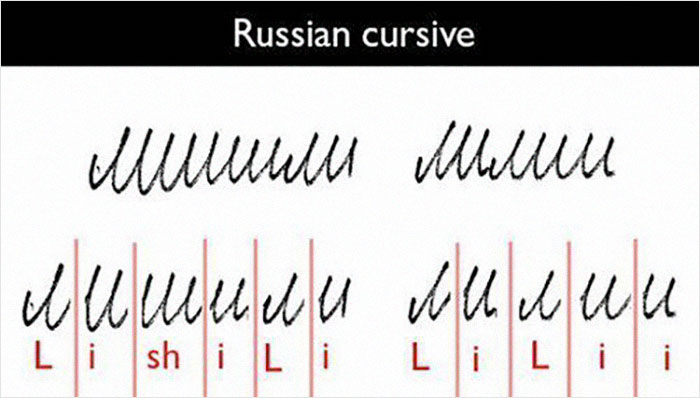
I'm not blind, mind you, although I can read Braille by touch. And sometimes I feel like Braille is the tactile version of this: https://www.boredpanda.com/blog/wp-content/uploads/2020/07/r... - sure, you can decode the letters, but you waste seconds doing so.
Fakoo doesn't address that, and I feel that it's a more pressing concern than making the letters look like Latin letters.
This is a strangely popular myth.
Because it was easier for the technology of the day (invented in 1824) to reliably emboss dots.
Specially when you could easily build a system already using the readers' knowledge of current Braille, something like this: https://i.imgur.com/faOWkxb.png
They're visually more distinctive, but more importantly: I think that they'd be easier to tell apart by touch.
I see that "Z" must take what would naturally be an "I" shape on a 3x3 grid, but why not use just a simple vertical line for "I"?
Perhaps predictable character width (monospace) makes reading easier.
[0]https://www.who.int/news-room/fact-sheets/detail/blindness-a...
[1]https://nfb.org/images/nfb/documents/pdf/braille_literacy_re...
At least with Fakoo, someone who used to be able to see letters before going blind, could probably figure out Fakoo without instruction.
I don’t think that suggestion would go over well.
Also it looks like it would be less informative dense for a given area, which seems like a downside as well.
It’s a neat exercise and could make a cool font for an ultra-low resolution display. But this does not seem like a better solution than just printing normal text above/below/on top of the Braille.
The reason I'm curious is that there's something funny that happens when sighted people create tactile technologies for the blind: they often don't consult with blind people at all. There's something appealing about the idea of theoretically assistive technology that leads to very impractical systems like Boston Line Type [1] or "braille displays" that have only one single character, that's 10x the normal size. It's easy to assume that if you can technically feel something then that's sufficient for blind people, but the history of blind writing systems shows us that's not enough.
This particular idea seems more promising than other efforts (e.g. Moon), because bumps seem to be easier to feel than shaped figures. It can also be written using a regular slate and stylus. However, modern Braille [2] is full of contractions to reduce the number of characters, and even then braille books are massive and heavy compared to their print counterparts. Doubling the width of individual letters and forgoing contractions really limits the utility to very small snippets of text, and learning an entirely new alphabet just for that doesn't seem very practical.
The author's website [3] is full of promises that "anyone" can read the writing system, but it also says "Developer is Alexander Fakoó, who has learned to read the Braille Writing optically". That's great, but sight-reading Braille is a whole different medium from tactile reading. Personally, I used to be able to read grade 1 braille by sight, but could never read by touch.
[1]: https://en.wikipedia.org/wiki/Boston_line_letter
Also, considering that so much is written in Braille, how many people use this?