And guess what? Not using actual money also let's them access "millions of talented freelancers live in countries where it’s hard, if not impossible, to open a local bank account". That's great because those workers also tend to live in countries with lax or non existent labor laws. These new inroads in exploitation is just another great win for innovation! How bright our future gets every day!
I recall Nigerians and Ethiopians mentioning how cryptocurrencies have allowed them to more easily work with western clients or employers.
Kainda sad how all else is either hard to use or skimms too much off the top.
"Privileged" worker? The cult of the robber baron really has spread its wings. Not everyone is willing to talk themself out of a livable wage and benefits, but you do you.
And please let's not even debate if they work or not yet, I am more interested in the reasoning behind preserving the current status quo where billions of people literally cannot access these tools.
Almost every single person on Earth benefits in some way from the current systems over not having them at all. Yes, they tend to let power and resources accumulate with a select few, which is not necessarily the best or most moral outcome. I'd be interested to know why you think this wouldn't be the case with the alternatives - regardless of the intentions of well-meaning ideologues, the powerful tend to get what they want in the end.
> Why not give the rest of the world access to the tools for economical freedom too?
If the issue was as simple as this sentence, then sure. In reality it isn't, though. I could flip it and ask "why abandon regulations that limit how capital can exploit labor and prevent criminals from evading laws"?
> And please let's not even debate if they work or not yet, I am more interested in the reasoning behind preserving the current status quo where billions of people literally cannot access these tools.
What line of thinking is this? Of course the reasoning behind preserving the current status quo, which is a known quantity, over something new, could well be that you don't yet know if or how the alternatives work? That doesn't mean that they can't be better or shouldn't be implemented at some point, but it's totally valid not to want to run head-first into something unknown and potentially detrimental, just because what we have now is imperfect.
Today Braintrust is a democratizing force enabling talent to earn from anywhere, yay! Tomorrow everyone is going to be competing with the absolute cheapest labor globally and NA will be earning avg(NA, Africa) salary while paying NA rents. Uber's trajectory is the same - in every market, it started out with drivers making amazing wages (yay Uber is great!!) and ended with them making less than minimum wage.
Heck, if the future of work is limited freelance gigs, without any workers rights and protection, and being paid in potentially worthless crypto tokens, it is a very ugly future.
But you're absolutely right that this is a mechanism by which they can expand the labor pool for digital work.
US banking regulations don't apply to these dollars? Well, of course, because US banking regulation only apply in the banks in the US. Banks that are located outside of the US are subject to whatever regulation is in place in the location that they're at. Does that mean that Eurodollars are unregulated? No, it doesn't.
Second, currencies don't have interest rates. Only debt instruments do. I have no idea what you're talking about when you say that Eurodollars and US dollars have different interest rates.
Your regulators are thieves and thugs and I don't trust them one bit. I have faith in Bitcoin, or things I can instantly convert to Bitcoin without your regulators interfering. Fiat currencies I need SWIFT or ACH to access are literally worthless to me as I have access to neither, and even if I did it would be a precarious situation that I have to worry about all my money disappearing in a Kafkaesque net of AML investigations from which it will never escape. Your sarcastic tone about "unregulated tokens" is exactly how everyone in my country views your worthless dollar.
I am more worried about excessive tax complexity that getting paid in a foreign currency brings.
Don't forget to mention how employing a person to work 16 hours a day making clothes or a phone helps feed their family.
Given also this announcement is a new capability for how to get paid, not an impairment or obligation, I would hope it wouldn't have detrimental results.
Which is to say that, certainly for now, there's a conflict between technological progress and profit, because cheap labour is so reliable and de-risked compared to eg, creating new machines to automate a process that is currently outsourced. Risks include being undercut by cheap labour, too.
All of which is to say, I don't share your optimism. Maybe there's a case to be made for global full employment being preferable to a highly automated economy, but that begs the question of how to make work itself less hostile to life.
I look forward to the day that Stripe will get investigated for all of the above with this and end up like Paypal, eventually freezing or banning these accounts.
Crypto does not offer anything new at all.
EDIT: It seems Stripe and Crypto apologists have downvoted & flagged my comment since Stripe is somehow a HN / YC darling that is immune from valid criticism even if they venture into crypto scamming, with no usecase that is better than the current financial system.
Crypto is only used for speculating and will eventually collapse under regulation.
@karaterobot
Stripe is no exception here for regulation and will comply by banning accounts if these 'remittances' are fraudulent as the majority of them most likely are.
Even in El Salvador, the country that has adopted bitcoin, merchants aren't using it for payments because they lose money extremely quickly due to volatility, so there isn't a usecase for cryptocurrencies or blockchain at all.
If the biggest player in the crypto space can’t get enough users, I’m doubting any real adoption.
> It is a massive mistake that Stripe is offering anything in the crypto space as everyone and Stripe knows it is full of fraud, money laundering, scams and it is completely unregulated.
The argument is engaging in "everything is X" talk by blanketing an entire space as only engaging in negative impacts.
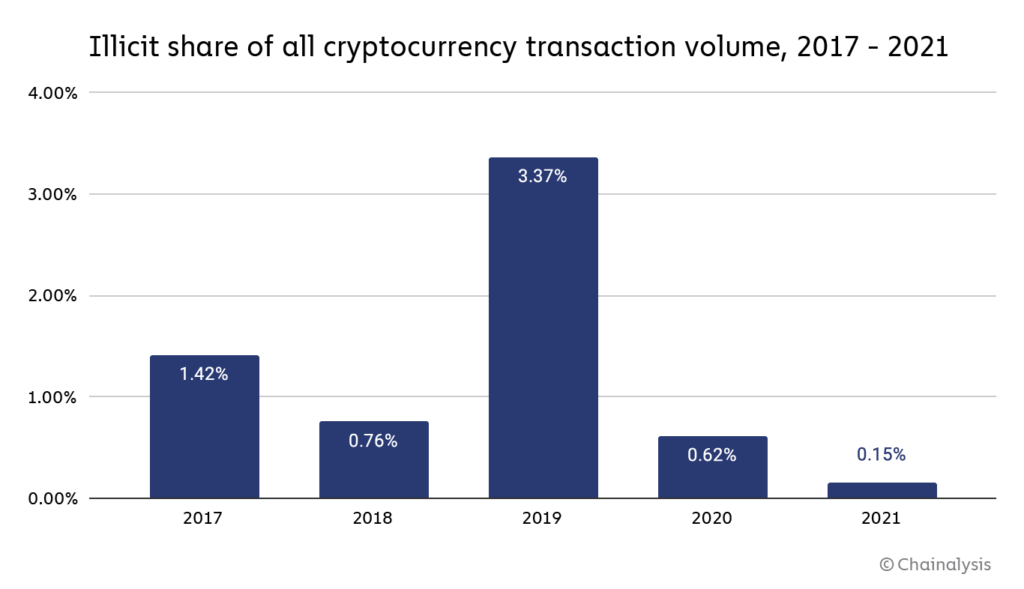
It should be noted that the percentage of crypto used in illicit activity is significantly less than 1%, compared to the estimated 2-5% of global GDP that is involved in money laundering alone within traditional financial ecosystems.
https://blog.chainalysis.com/reports/2022-crypto-crime-repor...
https://blog.chainalysis.com/wp-content/uploads/2022/01/char...
https://crsreports.congress.gov/product/pdf/IF/IF10873/3 (page 1)
Using the same argument, it could be said that cash should be banned because its private & semi-anonymous nature allows for its use in transactions for gambling, drug use, child porngraphy, assasinations, & slave trafficking.
If we somehow magically had come up with a cashless system first, and cash instead was introduced now, I am quite sure that yes there would be calls to ban it for those reasons. It is however an ancient legacy system that's deeply entrenched in our societies, so we're living with it for now, although perhaps not forever.
Sure we have issues in the current financial system, but augmenting (and dare I say) replacing it with an entirely worse unregulated system which loses people money through scams, increases and emboldens ransomware and exposes people to huge volatility is not the way to go.
> The argument is engaging in "everything is X" talk by blanketing an entire space as only engaging in negative impacts.
The negative impacts are FAR greater than the positive impacts of crypto.
i recommend reading the original bitcoin whitepaper to understand what is new: https://bitcoin.org/en/bitcoin-paper
The Bitcoin whitepaper outlines a P2P payments system, today it isn't used as such, rather a store of value, not even Stripe is using Bitcoin for payments at all.
So what use are these cryptocurrencies for, if not for scams and fraud?
Total bitcoinization would be dystopian but as a lifeboat against the inexorable spread of the negative side effects of inflation and the skyrocketing price of assets due to the cantillon effect - it is remarkably effective.
Hate to be a parrot but... "zoom out".
Crypto is hardly inflation-proof, with major cryptos having fallen 80% or more in the last 6 months putting it on pace with the Lira - if you then adjust it for inflation you lose another 10%. It's somehow managed to do all that in the single most inflationary period in 50+ years. I was pretty sure we'd given up on that silly narrative. Crypto is a high-beta speculative play on US dollar liquidity in the global financial system, not a hedge on inflation.
Wanna save money from inflation? Buy some I-bonds.
So uh, zoom back in ;)
[edit] Also, liquidity per (as defined by the size of the Fed's asset book) se isn't really correlated with asset prices, which is why we're doing interest rates. I recommend listening to the Odd Lots podcast with Kashkari in re: inflation.
If you're worried about inflation then I-bonds seem like a less risky way to handle this. (Though the limits are too low for many people, and the website is pretty bad.)
Most of crypto is built on speculation which results in direct losses to consumers. And extensive and endless hacks, which is just another tax on consumers. Very little of bitcoin or any cryptocurrency is used for drugs, terrorism or other serious crimes.
Real world money laundering (trade based etc) is 500x that of bitcoin and real world drug dealing is at least 1000x greater than darknet markets.
This is a fairly low risk move by Stripe, as USDC is more open and trusted than USDT (Tether)
They are also easily and instantly (and perhaps most importantly permissionlessly) exchangeable to hundreds of other tokens thanks to DeFi swap smart contracts.
Take your typical painting/handyman/landscaping/small-scale-construction business as an example. In the US at least: you could call the owner a freelancer, but the majority of the small business is traditionally employed workers.
“Freelance Forward Economist Report” by Dr. Adam Ozimek for Upwork. https://www.upwork.com/research/freelance-forward-2021
Thanks for the source though, don’t mean to sound annoyed at you but rather the post in general.
Users are free to exchange the funds to DAI which cannot be frozen by a centralized issuer.
Stripe is the next Google - with the all the good and bad that this brings.
My concern is that the organization is split into two entities: (1) Freelance Labs, which owns and controls the website.[1][4], and (2) A Panamanian Non-profit that "owns" the token.[2]
Stripe's copy: "And because it’s decentralized, the people that use Braintrust also own and operate the network: Talent keeps 100% of its earnings and clients can make their budgets go further by cutting out unnecessary middle men."
#The Braintrust Foundation has nothing to do with the website:
From the usebraintrust.com TOS[1]: "This Terms of Service (also referred to as the “Agreement”) is a contract between you (“you” or “User”) and Freelance Labs, Inc. (“Freelance Labs,” “we,” or “us”)."
#The website controls the operations of the network:
Also from the usebraintrust.com TOS[1]: "The Site is a marketplace where Clients and Freelancers can identify each other and advertise, buy, and sell Freelancer Services online. Subject to the Terms of Service, Freelance Labs provides the Site Services to Users, including hosting and maintaining the Site, facilitating Projects between Users,, and assisting Users in resolving disputes which may arise in connection with those Projects Users are required invoice and pay any amounts owed for any agreed upon Projects facilitated by the Site and/or Services."
#Users keep all their earnings, except for the 10% fees clients pay:
From the Braintrust whitepaper[3]: "Talent are charged no fees: they are paid their full contracted rate (whether that be per hour or per project). Clients are charged 10% of the total contract value, an amount that is significantly less than in other networks and consulting firms.
Client fees are collected in USD, converted into BTRST, and sent to the Braintrust DAO through the Fee Converter, a smart contract that was proposed, voted on, and implemented by the community in October 2021. This process makes it possible for client fees — in the form of BTRST tokens — to pay for network operations and to fund community programs"
#The token technically doesn't own anything:
Also from Braintrust's whitepaper[3]: "BTRST is not a share of stock, does not represent a claim on profits, dividends, equity, or debt in any company or organization, and is not a financial instrument. BTRST has been adopted by the Braintrust network and users for various activities on the network only, such as for staking, governance, voting, and educational purposes"
#The token has no claim to anything:
From a podcast with Adam Jackson: "We have a token instead of a share of stock. It does not represent any financial claims, any dividends or profit sharing, simply because there is no profit. The network is meant to run sustainably. It's meant to sustain itself. And so, it charges just enough fees to get by on, paying for hosting and maintenance and upgrades and that sort of thing."
Again, I still think it's a potential improvement on the alternatives, and they've built a lot of functionality, but I just worry that the website, seemingly the only way to contract on the network, isn't owned by the foundation.
Is the foundation contractually obligated to heed to any votes from the DAO? It's not very clear that they are.
They've built out a lot[6] that makes me hopeful their network will hold its value, but I just wish they could leave no doubt that their users own the network as well as the resources that power that network.
For example, what if once the network has gained enough value, the owners of Freelance Labs sell the usebraintrust.com website to UpWork? Can they, and if so, what happens then?
[1] https://www.usebraintrust.com/terms [2] https://www.sec.gov/Archives/edgar/data/1756245/000175624518... [3] https://www.usebraintrust.com/whitepaper [4] https://sec.report/CIK/0001759292 [5] https://www.hbs.edu/managing-the-future-of-work/podcast/Page... [6] https://info.app.usebraintrust.com/
I wish the best to the guy, yet i'm wondering does anybody think it is kind of fishy?
Or are they making the assumption that the future of work is freelance gig economy? That sounds awful. And it's not how I've seen the phrase used before.