Hypercard was the BASIC of the Macintosh in that it served the same niche. It certainly was not BASIC, but the idea was the same, a little language and environment that fit into the machine's environment that allowed novices (and then highly practiced novices :-)) to create stuff on the machine for other people to use.
It was killed for the same reason BASIC, in the sense of built-in 8bit micro BASIC, kind of fell to the wayside except as a way to stitch existing apps together. No one is really impressed by a calculator program anymore. Matching the capabilities of modern software is hard nowadays. It's demotivating to create a calculator program... that's it? Hypercard really can't match even JS, et al. in functionality.
I remember when it started to happen in the 16bit era. Software was already starting to get too good and too complex for a simple tool. I got an Amiga. The Amiga had a built-in BASIC -- but no one used it. Why? Because there was no fucking way you were going to recreate even the bouncing ball demo in BASIC. It wasn't going to happen. Essentially, anything you created was going to be a huge disappointment with that tool. This was not necessarily true in the 8bit days -- but from 16bit on, you either learned assembly/C or gave up. People can learn in that environment (and did), but the barrier was much higher.
Lowering that barrier while coming close to the capability of "real" software is a hard problem. Fortunately, it's coming full circle. Now that machines are powerful enough that "real" software is being written in interpreters, JS seems like it actually is the new BASIC.
I'm not totally sold on that -- because the stack is too too baroque (although, again, people do learn in that environment). Processing is perilously close but not quite there because it's so domain specific. Python comes with a lot, but doesn't fit into native environments very well. If I had to chose, I'd say it's going to be something else over the JS/CSS/HTML stack in the same way 8bit BASIC sat over the primitive OS at the time.
Hypercard was mostly useful as a sort of personal wiki or address card book; I used it quite a bit as a notepad with hyperlinks. It didn't die for any real dramatic reasons. It was programmatically stuck in the 9" B&W Mac era and never quite fit onto larger color screens, so once the web came around, Apple dropped it.
Also you history is way off, because BASIC morphed into VisualBasic, which did everything Hypercard could and ten times more, and was the leading programming environment for a generation.
I've never thought of VB being for an ordinary joe in the same way builtin BASICs were -- it was more of a macro language for Office, and a platform specific COBOL, not an entry-level environment. But I don't have enough direct experience -- perhaps I'm wrong about that...
(All of the work that went into it was lost due to an accident, which taught me a hard lesson about the need for backups.)
Tell that to the thousands of otherwise non-programming people who developed real, useful applications (some of them best-selling) in Hypercard.
> it's going to be something else over the JS/CSS/HTML stack
Like building a castle on a swamp. Foundations matter: http://www.loper-os.org/?p=55
The web surpassed HyperCard from day one, simply by locating its resources on the network. And that's why people put up with it, even if we have to dive into a fetid quagmire every time we use it.
HyperCard versus the web is a classic example of Worse is Better.
The whole paranoid 'everybody conspires against it because it's so great' is bullshit. If it's so great, why hasn't anyone make a clone and got rich of it? It's quite obvious why: because everybody who uses it runs into its limitations very quickly, so clones add extensions, and after a few iterations it becomes too difficult for beginners. And then the next clone stands up, lather rinse repeat.
But I'm sure it is one of many in a line of "reasons the software crisis didn't have to happen" - riiight. The "mythical man month"? It's 'cause they didn't do it right in 1960/1970/1980/1990/2001/... If only "they" would learn...
Let's just say that considerably more than "thousands" have written BASIC programs that were real useful applications in their day. I would not argue that people have not done the same in Hypercard.
There's nothing special about hypercard. What's special is having an easy-to-use beginner programming environment that you could create fairly good small programs in -- in comparison to the commercial offerings of the day. BASIC was that, Hypercard was that, but that only partially exists today as the web stack because of it's baroque nature.
"Foundations matter" is really a tautology. I don't think the problem is the foundations. We build on sand all the time. Certainly without a foundation, you're fucked, but you place too much importance on it. Saying something like "Foundations matter" is pretending to be profound without substance. I might just as well say that "Input devices matter" -- and they do -- but how much do they matter? Is everything fucked because we all use mice & keyboards?
JS/CSS/HTML all have flaws -- some more vexing than others -- but they (and the browsers that put them to use) are infinitely superior to HyperCard.
1) It was a concrete implementation of the idea of hypertext that actually worked. The fact that comments in HTML begin with <!-- is a tiny little ode to HyperTalk.
2) It was the first graphical IDE that I know of. (Clunky? At the time -- 1987 -- it was glorious.)
3) It was one of the easiest programming languages to pick up, if not the easiest, and yet it scaled to become quite powerful. (There was eventually a native compiler, itself written in HyperTalk, that could even create INITs.) HyperTalk's ease-of-use led to blind alleys (AppleScript tried to one-up HyperTalk and ended up being "read only").
4) It was extensible via plugins.
It was also an incredibly productive programming tool. In addition to allowing novices to code, it let me -- for example -- implement an RDMS engine in an evening, and build a database application (including reporting functions) in a second evening. It allowed the Millers to create Myst (they used a couple of plugins, one to display color images).
But HyperCard was written by a lone genius (Bill Atkinson) with weird quirks and flaws and it was impossible to maintain or improve. Its notable flaws included:
a) Weird code-base. It never really got a version 2.0. This is probably its single biggest flaw since all the others are things you'd have expected to be fixed in later versions. (Yes I know there was a version 2.0, but aside from a new debugger and plugin interface it wasn't a big improvement and it was slow coming.)
b) No native support for images. Visual Basic would address this by allowing you to treat images as just another kind of variable and manipulate them directly.
c) No native support for color, and 1-bit graphics were built into it in a very hard-to-fix way. Indeed, HyperCard was rewritten from scratch for the Apple IIgs and worked fine in color, but the Mac version never did.
d) No support for native controls. All of HyperCard's controls were faked and looked wrong. (And this flaw was faithfully copied by HyperCard's many imitators -- such as SuperCard, Runtime Revolution (still going!), and Assymmetrix Toolbook.) Again, VB addressed this.
e) No ability to create true standalone applications. Once again, VB addressed this.
HyperCard wasn't killed by Steve Jobs. It withered on the vine and Steve Jobs simply took it off life support. As for the other stuff he killed -- yeah, some of the dead-end Lisp-based projects that hadn't already been killed. No conspiracy -- HyperCard just wasn't fixable and by 1997 it didn't matter any more.
Several HyperCard clones went on to be pretty successful. Macromedia Director came into its own when it copied HyperTalk (which became Lingo). Visual Basic was in essence an improved HyperCard but with a crappy language. (In every head-to-head test I tried between VB3 and HyperCard, HyperCard hugely outperformed VB3, which if you know anything about HyperTalk is pretty sad.) And then of course there's the whole web thing.
But it's definitely a niche product, which we've seen isn't something Apple is interested in. Supercard.us is down right now, so I'm not sure whether it's on the market or not. As Apple has discovered, the vast majority of computer users aren't interested in creating software; they're content consumers. SuperCard probably got as much use for making quick mockups before building a "real" application as it did by amateur developers.
One thing that I'll give HyperCard is that it made it easy for me to play around with programming while I was in elementary school. Today's programming tools are largely not that accessible.
As long as you knew C and could write the Hypercard extensions needed to make Myst actually work, of course.
Edit: With the same amount of effort.
So the question then turns to, why has it never been built? Is it maybe because Hypercard (and other visual systems) become entirely unmaintainable once we get to large-scale systems? And maybe it is because most people don't want a trivialized programming environment? They either want a full system, or just a product?
While I think this is true at the moment, it seems that there is an interesting question behind that, as well. Why don't more people want to create their own software? I do think the author has an implicit point: because, frankly, creating software stinks. Jon Skeet's talk [1] demonstrates this admirably. I spend a shockingly large part of my time working around bugs and leaky abstractions in other software rather than implementing my own ideas.
I don't know if it is possible to design a system with a solid enough abstraction that these problems don't exist. I do know that HyperCard came unusually close, as I know several folks who made HyperCard stacks who wouldn't imagine creating software in any typical fashion.
I hold out hope that such a useful system could be created again, one that gives people enough flexibility to create software solutions of their own (perhaps within a genre of software) and that is able to combat the currently-accurate stigma of programming being "hard".
[1] http://msmvps.com/blogs/jon_skeet/archive/2009/11/02/omg-pon...
Granted, that _may_ be a question of the tools. But I do find it telling that in the long time since the "death" of HyperCard nobody could come up with compelling tools.
And creating software is hard because ultimately, it requires analytical thinking. Which, by itself, is hard. Yes, the choice of tool modulates the hardness of the problem - but the underlying issues are still hard. (Note: I do not claim non-programmers _can't_ reason analytically. I claim the effort/result ratio is not right for them)
It's the same reason most people buy furniture instead of building it. Acquiring the necessary skill set is simply too much effort for the result.
Btw, I'd love spreadsheets-as-apps replaced with something more maintainable but they also have a huge advantage: you can start using a spreadsheet with zero programming. Unless you copy that, you can't compete for that niche.
And my answer to my own question is still the one I previously implied: There is no market for this kind of environment.
Consider, your problem needs to be:
* Repetitive enough to benefit from automation
* Complicated enough that automating it would yield a significant gain in the long run.
* Simple enough to not require going to an actual full-blown programming environment.
* Not numerically solvable, since spreadsheets have that covered.
* Not solvable via macro-recording or workflow solutions, since that market is also well-covered.
I'd say that does leave a fairly small sector. Hence, low demand for Hypercard-like solutions.
I always hope in the back of my mind that someday there will be a way to create a web interface as easily as you could in Hypercard.
I miss it so much.
Jobs understood the division of responsibility between Apple, with its extremely limited resources, and its developer community. What wasn't core to selling computers was cut. We are talking about a company that was 90 days from bankruptcy when he took over. I think he made a good decision.
If somebody has wanted to do a proper visual programming environment in the vein of HyperCard for the Mac, what in the last 13 years has stopped them? It wasn't Jobs.
"Simple" and "pleasant" are different things. Digging a trench deep enough to bury a car is "simple."
> Has this guy played with Interface Builder lately?
Yes, actually I have played with it.
It makes me want to vomit. The whole NextStep stack does, in fact. Because I have used OpenGenera. And HyperCard.
> if somebody has wanted to do a proper visual programming environment in the vein of HyperCard, what in the last 13 years has stopped them?
Here's a example from an unrelated field. The Kalashnikov rifle is more than half a century old. Why has nothing replaced it as the world's most popular weapon of war?
Often, complexity and full-featuredness is precisely what people don't want.
Where is that progress with regards to HyperCard?
This guy writes a lot of well executed but fundamentally vacuous articles; I wrote about a previous one here: http://jseliger.com/2010/09/30/computers-and-network-effects... last year. At this point, PG's essay: http://www.paulgraham.com/trolls.html applies to him. But you wouldn't notice as much from any individual article or submission; it's only through the collection that his tactics become apparent.
And I do not submit my articles to this site, although I do read it when they inevitably end up here. Complain to the person who does.
HyperCard was a big part of my junior high years. It could even be extended, e.g. there was one add-on that allowed color graphics to be displayed and I learned to make some simple games that way.
You're sitting at a device with a numeric keypad, and a 9" screen; Replicating the calculator interface in clickable buttons, with a textbox as simulated LCD is a horrible misuse of the potential of a computing environment.
A screen, a keyboard and a hardware ALU. Being used to run an OS which draws some keys and a screen, interprets mouse movements, parses and interprets Applescript and parses text arithmetic operations, so it can pretend to be some keys and a screen connected to a hardware ALU.
And this is hailed by our "anti-bloat" author as a great example of simplicity which normal people love, and its limits are fine, compared to any other system - e.g. Visual Basic 3 - which is needlessly complex.
It's almost funny, until you read his seven tenets of computing and find that any program which encounters any error should enter a debugger, so you can fix it and carry on. I think that would drive anyone insane.
You prefer inexplicable crashes? Now these are enough to drive someone mad.
And if you do prefer them, wire your debugger to a Blue Screen of Death emulation.
If you're new to programming, "make a calculator" is a great project. It involves simple math -- which you probably already understand -- simple operations, and simple concepts.
It also illustrates some of HyperCard's strengths. I can't think of any other development environment in which "make a calculator" would be a suitable project for the end of the first week of a programming class. And, in the end, the programmer gets something that they can look at and interact with, and which can be easily extended. ("OK, now make it do factorials!")
> It's almost funny, until you read his seven tenets of computing and find that any program which encounters any error should enter a debugger, so you can fix it and carry on. I think that would drive anyone insane.
I wish it worked that way!
Yes, if programs were constantly crashing into debuggers, it would drive people nuts. Absolutely, no argument there. But, I would hope that that alone would motivate programmers to make them crash less.
What we have instead are mysterious black boxes, and I hate that. But, I'm on the end-user support side of things. Here, let me give you some examples of stuff we've dealt with in our little shop in just the last few days:
1. An iMac that hates booting. Sometimes it boots, sometimes it won't. We invoke "verbose" mood, we get some sort of helpful text, and then it all goes away to a black screen. Or, it decides, "OK, all done with verbose mode!", switches to a gray screen, and hangs. Or, we attempt an install from any of our sets of install DVDs, and the most helpful error message we can dig out of any log anywhere is, "i/o error in dvd-rom" (or something similar). It is literally impossible for us to pinpoint the source of the hardware trouble without shotgun replacing every one of the major components in the machine.
2. A FreeBSD system that occasionally does a hard hang. No error log, anywhere. At all. Just halts. Hardware problem? Software problem?
3. An Acer Aspire One with all kinds of really unhelpful error messages in the system logs. Everything seems to be glitching everywhere. Ah, but Windows 7 helpfully generated a mini-dump file of just one of the crashes. Maybe we can track down a bad driver? Let's see, we'll just find and install dumpchk.exe and ... hmm, need to fix debugger symbols for this and ... wait, there's no stack trace? ... uhm ... oh look, it has a "probable cause" at the bottom: "hardware". That's helpful?
I know I'm forgetting some. Anyway, it's like this for us all the time.
I used to know & love MacsBug. Even with the old MacOS programmer's switch, I could occasionally figure out something useful. I would love it if, instead of calls like, "my computer is stuck at a black screen, should I reboot?", we'd get calls like, "my computer just went to this black screen that says null pointer exception at a bunch of numbers in iaStor.sys".
And, even better, if we were so inclined, we could notify software vendors of the specific errors we ran across, so we could do a better job of helping them track down bugs.
He's a better person than I am, because if it were me, I'd already have a script in place that checked the referrer and would post a blank page with "Eat a dick" for anybody coming from HN. If nothing else, it would ensure that the submission wouldn't get as many upvotes (or would get flagged) and I wouldn't feel compelled to put up with the abuse.
Anyway:
So, IIRC, my progression as a young programmer went something like: BASIC on a Commodore 64 / Vic-20, to Logo on I-don't-remember, to HyperCard (and then on to QBasic and Pascal and C and C++ and OOP and on and on).
HyperCard was amazing because its barrier-to-entry was so, so low, and I agree with the author's comments that there still isn't anything quite like it. For one thing, it was on most Macs by default at the time, so you didn't have to find a copy of the software and install it first.
As he shows, it was a piece of cake to get started with. A budding HyperCard programmer could easily learn new tricks by downloading anybody's stack and reading the code. Since it wasn't compiled, you could learn from it. Anything that anybody else did, you could take apart, and learn how to do.
And it grew with you. You could make something as simple or as complex as you wanted. My very first, very naive foray into AI was in HyperTalk; I discovered I could write self-modifying stacks, and decided to see if I could teach a HyperTalk stack to talk to me like a person.
HyperCard also introduced me to online forums for the first time. I still remember, fondly, downloading J5iverson's XFCNs from eWorld. From there, I discovered the world of the early internet -- the alternative to BBSs. Whereas BBSs at the time let me easily chat with someone else in my town (or, more often, play TradeWars or something), eWorld let me chat with people "across the pond" for the first time. For a young kid, this was a life-changing, world-shrinking event.
I disagree with the comments that SuperCard is a reasonable alternative. I don't remember the details now, but while I appreciated the addition of color in SuperCard, it brought with it other complexities that I disliked. I played around with SuperCard but ultimately went back to HyperCard.
So, what I'm getting at is, if it weren't for HyperCard, I don't think I'd be a programmer right now. HyperCard was simple enough for a beginner, and rich enough to keep my interest. It was a huge influence on me. I really can't overstate that.
Almost two decades later, I was approached by an employer who wanted me to teach computer programming to his son. His son was young, not yet in high school, pretty sharp, and, y'know, geeky. Liked video games, liked taking things apart. Not exactly a challenging pupil in terms of motivation.
I spent a ton of time trying to figure out just what in the hell environment to use to teach him. JavaScript? You have to know a lot of other stuff before you can really begin to do anything of value in JavaScript. Before we could do the calculator example in the author's blog post in JavaScript, I'd have to teach basics of HTML, the DOM, and eventually we'd either end up using JQuery or going over the whole "browsers are different in how they handle the same code" discussion, which, honestly, is one of the most stupid problems in the history of computing when you think about it.
Anyway, I went through a bunch of options and finally settled on something called Kids Programming Language (or Phrogram). What a damned mess that was. It wasn't very long before I had to teach the concept of objects to the kid. And scope. And then half the time the entire environment would just up and crash with no helpful explanation. There's a fun problem for a newbie programmer: write some code, your environment crashes, no explanation.
If the field has improved much since then, I'm unaware of it. Not having something like HyperCard available to young programmers really is a tragedy, because it means that future programmers are going to be introduced to programming in college (which, often, is a joke, and IMO also too late in an individual's mental development), or they're going to have to tough it out through JavaScript or Ruby or Python or whatever the inscrutable popular language-of-the-month is, and that's going to really narrow down the field of people interested in getting into programming.
Some free market adherents might respond with, "Well, if there was demand, someone would build it, so obviously there's no demand". Honestly, I find that entire argument completely boring. It's clear that there was a lot of demand for it; did nobody want it before it was invented, and has nobody wanted it since it became no longer supported? I don't think so. I think there is a market for such a thing, and it just hasn't been built yet.
I really hope it will be. It's already on my list of near-future projects if nobody else does it first.
Apple has not, in recent years, on the Mac, been against trying to provide simpler programming environments - look at Automator, (the now also defunct?) AppleScript Studio, or Dashcode.
Let's say we have a type of perforated balsa wood that you can just snap into pieces and glue in place. Making a dog house just went from hours to minutes! Hurrah! So you start telling everyone that this is the new way to construct buildings, but then as you get bigger structures, it starts to fall apart.
Simple programming environments fool you into thinking you into thinking your projects can scale, and the result is a mess. Hypercard was fun, but it wasn't a deep paradigm, it wasn't good syntax, and in the end, I have to say that it was good that it died.
Doesn't seem to have stopped Excel in particular, and spreadsheets in general, from being wildly succesful.
It's good that it died because it doesn't "scale" to the elephantine size of software you're accustomed to?
My guess was that HyperCard was killed because the WWW was coming. I used SuperCard pretty heavily back in '92ish at the second college in Minnesota to get the internet (MCAD - U of M was first). I remember the rows of NeXT boxes they had, the only machines connected and I remember fumbling around with building Gopher sites as well as some basic HTML hacking, as basic as it was back then. I lost interest in HyperCard/SuperCard shortly thereafter.
But it's spirit certainly lived on in Visual Basic, Borland Delphi, Macromedia Director and a bunch of other things. I don't know that this guy had exposure to any of this hence the short sightedness and, in my opinion, miscalculation of Job's motives.
In 1998?
> it's spirit certainly lived on in Visual Basic, Borland Delphi, Macromedia Director and a bunch of other things.
I have used all of these, and beg to differ. The spirit of HyperCard was that of radical simplicity, and it does not live in these systems.
> In 1998?
I built my first HTML page in '93. NCSA Mosaic was the rage in the lab.
> > it's spirit certainly lived on in Visual Basic, Borland Delphi,
> > Macromedia Director and a bunch of other things.
>
> I have used all of these, and beg to differ. The spirit of
> HyperCard was that of radical simplicity, and it does not
> live in these systems.
???
Drag and drop, double click to add script, how is that not the spirit of HyperCard? HyperCard was the preeminent RAD development tool. Easier than Visual Basic? Sure, but not by much. The gap between BASIC and HyperTalk is not that great a leap. If you can't see the parallels between Macromedia Director and HyperCard, you're being blinded by your own weird sense of what's what - considering they both used the same basic language back then.
Fortunately my nephew has taken to Python and is even starting to become a language snob "That looks like a stupid way to program".
None of them have the love-at-first-sight appeal. Most seem like an unbearable ordeal once you've used the real thing.
HyperCard ran black and white windows of 512*342 pixels because that is what the original Mac had (there was a version that did some color things, but that was and felt like a serious bolt-on job). Moreover, all graphics where bitmaps.
Bringing that into the 'real world' as it existed at the end of the eighties would have taken a lot of resources, and it was not guaranteed that the end result would still be HyperCard. For example, if one allowed resizable windows, laymen would have to learn about layout algorithms ('is this button 50 pixels wide, or a quarter screen wide? Is it 20 pixels from the bottom, 10% of screen height, or should its bottom border match that of that text field over there?').
Also, at the time, there were attempts to include some Hypercard/Director-like features to QuickTime. HyperCard was considered for that functionality, but did not make the cut.
You are correct in that I don't think it supported resizable windows without the use of some XCMD though.
* All the cards in a given stack must be the same size, even if there are several different backgrounds in the stack.
* Smallest card size: 64 x 64 pixels
* Largest card size: 1280 x 1280 pixels.
For instance, UNIX's treatment of everything as a file is a great tool, but I think there was a time where that simplified a much greater percentage of computing than it would today. Similarly, I suspect HyperCard died because the abstractions it was using had to be reimagined to stay competitive.
Spreadsheets (as mentioned elsewhere) are an example of a product that has managed to stay focused on the simple set of tools, and, when features were tacked on, they often stay out of the way instead of adding complexity to day-to-day operations. However, I'm not sure they've aged well, but I guess they are the best we have at the moment.
Unfortunately the UNIX philosophy is so powerful that you don't understand it until you live and breathe UNIX. And it also doesn't scale for some use-cases, but this philosophy is the reason why UNIX is not only alive, but the dominant platform.
Also, HyperCard is NOT a "small set of interoperable tools". And neither is Excel.
You're right: HyperCard and Excel aren't a small set of interoperable tools like UNIX is. I would argue, though, that they are close: a walled garden of interoperable tools. Rather than guide you through steps to a specific end (the extreme example is a wizard for, say, a mail merge), they present you with tools you can use to get to that end. Obviously, they don't work particularly well outside their garden, and the great advantage of adding tools to your toolset is cumbersome at best.
I do wish I understood the UNIX philosophy better. Perhaps I'll learn more over time.
http://www.loper-os.org/wp-content/hypercard-calc/hc12.jpg
The scripting language had a verbosity and ambiguity that only a lawyer could love. The documentation for that language was similarly impenetrable to anyone with a background in CS, requiring a serious commitment to trial and error to perform operations that were trivial in BASIC.
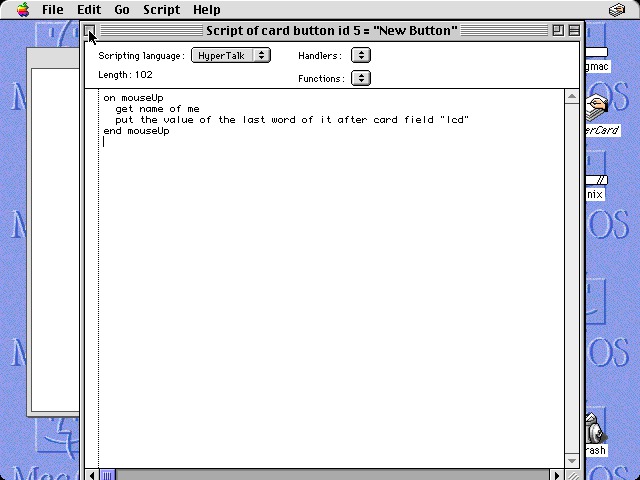
    get name of me
    put the value of the last word of it after card field "lcd"
    it = event.target.name
    currentCard.fields["lcd"].append(it.text.asWords().last())
LiveCode is very verbose and it may take a while for those that are already familiar with C-like languages but it is worth it. Software is easy to maintain and there is little space for confusion, even with few comments.
RunRev company also release a PHP-like engine, so I can create web applications that communicate with native clients on mobile and desktop all from a single language and environment, this is very powerful.
You should always use the best tool for your job. For my job, LiveCode fits perfectly. I also think that xTalk languages are a wonderful introduction to programming and people from non-technical backgrounds can learn it easily and start creating little tools to help their specific domains. Yes, anyone can learn programming in any language, it is just a matter of effort, I believe LiveCode makes this effort fun and productive.
You may read this as advertisement but this is my personal opinion. I am 31 and have been using LiveCode since I was 25 or something like that. In the meantime I got married, got my own place and am living a good life. All my work is LiveCode related. Just telling you that so you guys don't take me for "someone that toys with this cute language every once in a while but is not serious".
Even if you already have your favorite language, it is worth to check out LiveCode, just to learn what else is out there. There are beginner webinars starting next month I think...
With Hypercard you could make something for someone who 1) has an Apple, 2) Has Hypercard installed, and 3) Has the right version of Hypercard installed.
With HTML/CSS/Javascript you can make something to run almost anywhere. It's not 'easy' but it is useful.
With gargantuan effort.
And your creation will still appear distorted in unpredictable ways to many users.
put the short name of me after fld "lcd"
put the value of fld "lcd" into fld "lcd"
Also there is an extra eval (the first one is unnecessary, I think.) But I am too lazy to revise the screenshots.
We hand drew pictures of 3D rooms and then scanned them in and put big invisible buttons over the doors etc.
I personally think the www killed hyper card, suddenly you could do very similar things but have them instantly shared globally.
In my mind hypercards real innovation was creating your own links which would take you to any other card you desired, I think plain old simple HTML came along and killed the poor thing. HyperCard lived in a time of share it on a disc and I imagine Jobs seeing it's days as numbered.
[1] http://www.wired.com/gadgets/mac/commentary/cultofmac/2002/0...
While it is very different from Hypercard, it certainly provides a level of artistic expression and creative freedom that the article alludes is present in Hypercard.
When I booted up QC for the first time a few months ago, I was blown away by its awesomeness.
And then when I further explored the vibrant community out there AND the fact that it can be readily integrated into objective-c / cocoa, it's clear that Apple is very much in tune with what normal people and creative people need to express themselves on a computer. To get started, here are some links: http://en.wikipedia.org/wiki/Quartz_Composer and http://developer.apple.com/technologies/mac/graphics-and-ani... Hint: If you have Xcode installed, simply type "quartz composer" into spotlight and begin your journey.
A final note: I seem to recall but not certain that a) QC was an acquisition by Apple of a french company; and b) the original developer has moved on from Apple
Microsoft also won with a more popular tool for creating visual 'stacks' or presentations: Powerpoint. Most educators were basically using hypercard/supercard/hyperstudio to create presentations - and Powerpoint made it easier to do so.
Hypercard (and hypertalk) isn't dead though. Applescript is still around (despite Apple also trying to kill it). LiveCode and other options are still around and being updated for HTML5 & mobile platforms, as is Visual Basic, too (nsbasic). A java port of the hypertalk language is here: http://code.google.com/p/openxion/
Natural language-like interfaces aren't dead, either. Look at testing tools like Cucumber, the google search engine, Siri, and so forth. Look at all the DSLs out there that try to make Ruby/Javascript/etc. more like natural languages, at least in certain contexts.
I actually approached Steve Jobs about the demise of Hypercard in 1998, when I was 15, at the Seybold SF conference. IIRC he gave a pretty dismissive response about it, basically saying that there wouldn't be a market for it anymore. It was pretty obvious that he didn't care about HyperCard or HyperCard-like products anymore. That, or he didn't want punk teenagers questioning his business strategy.
As a side note, I got my photo taken with him. When the photo was developed I saw that I was wearing a megawatt smile (shit, I met with Steve Jobs!), and Steve was looking distractedly at something in the corner.
The answer is because he'd rather write some link bait trashing Apple and Steve Jobs.
And because he knows perfectly well that making HyperCard is not worth his time.
IMHO his calculator example makes it perfectly obvious why HyperCard not only was killed but deserved to die. Like all of Apple's languages of the time, HyperTalk is awful. Additionally HyperCard is not particularly flexible or elegant, nor does it produce particularly fantastic end results. It's crap.
And in a day like today where we have the web enabling people who have never even heard of a pointer (let alone had to deal with pointer math) to write full fledged, performant, distributed, multi-user applications, why does anyone in their right mind spend 5 minute bemoaning the loss of HyperCard? It's absurdity.
I was sad when Apple decided to only include Hypercard Player with new Macs, which I also think ultimately helped contribute to its death. People liked Hypercard but not enough to pay money for it. By the time Steve killed it, it was a lumbering zombie of its former self.
That sounds crazy, but just look at this article and how he described what he did. He had to take a million screenshots to show it. The same is true for say, the Android app builder, or the Lego logic thing.. the way you sure code is via a screenshot.
And that just doesn't scale very well I don't think. It makes copy/pasting, the most basic way that people learn, really difficult.
HTML5 is pretty awesome, or rather WOULD be pretty awesome if we could erase the last 15 years and all start with CSS3 compliant browsers. But it is such a mess now that I feel bad for anybody starting from scratch.
But the combination of HTML for layout and Javascript for layout is pretty darn powerful, and I think pretty accessible as well. You could certainly build something on the order of the simplicity of Hypercard on that stack.
But I do like the author's comments about the shame that there are far fewer 'programmers' than back in the old days. BASIC on the AppleII is of course the other example (among others).. where it was just so easy and almost natural for ANY user to start getting a feel for things and hacking around. Losing that really IS a shame.
The author makes an interesting point re: computers as bicycle vs train, that nothing like HyperCard exists today and apple now has a clear and hard separation between laying track and riding on it. I agree, but I wonder if HyperCard (or a modern version) makes the same mistake many wysiwyg solutions make: if you do something enough, you'll want more capable tools, and if you're a casual hobbyist, the wysiwyg solution will be too complicated anyway, with a disjointed interaction metaphor to boot. If I were a 5th grader today, I think I'd be better served by starting with python than something like hypercard.
Don't appreciate the crack about the 'aspie software engineer' though. Definitely not needed.
Sure it was limited in what it did, and that was part of its beauty. It was a tool for quickly hacking together a simple application. A tool that nearly anyone could learn to use quickly. And it was fun and spontaneous.
And the Hypertalk language was very interesting to work in. It was like a limited dialect of a spoken language; a pidgin for computers.
FileMaker actually predates Hypercard (depending how you define it), and is similar to the point where you can still find Hypercard->FileMaker conversion tools.
Filemaker is also screens + controls + simple scripting language (albeit not quite as easy to grasp as HyperTalk/Applescript), and is wildly popular for an audience similar to that of Hypercard users.
Fun fact: the best selling game Myst was developed in Hypercard!