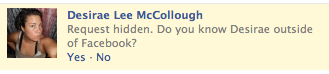
These signals (and a number of other factors) are taken into account when classifying if friend requests are spammy / malicious.
(I work on the anti-spam team at Facebook).
The problem is that Facebook needs to both maintain the fiction that it's a network for only your "real life" friends to seem safe and keeping finding new friends to keep the interest up.
But the average person only has about 150 friends and they're either currently on Facebook or they probably never will be. So to get new friends, people have to friend "friends-of-friends", people sharing common interests, people with attractive photos and so-forth. But if Facebook were to really discourage non-real-friends, everyone's friend numbers would drop and the site's excitement level would start going down.
It is a weird kind of situation... Facebook is become more like "the regular Internet" how that works out will be interesting...
Cure to the present roberry 2.0 - gear up a homomorphic scheme[1] combined with a generative personal cloud[2].
The " personal " in PC was most important when C stood for computer. Next, it will be most important when C stands for cloud.
The other wall this epic bubble is going to run against sooner or later - as people wake up at an intuitive level :
"Well, since Moore's law makes computation really cheap, let's just give away the computation, but keep the data."[3]
All of this nightmare will be compounded by the stunning crap-storm about to emerge in economies world over.
[1] - http://crypto.stanford.edu/craig/
It's not perfect but with a little bit of organisation you can use the same FB account for random people, casual acquaintances and real friends without causing issues.
Hopefully this will only get better.
As long as the profile is a young attractive lady, that option will rarely be chosen.
Moral of the story? There's enough gullible people on Facebook for scammers to make money, regardless what measure Facebook puts in place.
You see you now not only have a list email addresses. You have a list of email addresses of gullible people. Pretty smart if you ask me.
There's also plenty of people who "like" pages because somebody put a transparent like button over them.
"used programming interfaces from ihearthquotes.com" seems to be down/unknown the the googles?
Oh, it's amazing - http://openbook.org/
For the site linked in the parent post, it looks like the site uses the Facebook Graph API search function for public posts and then makes additional queries to show information about the creator of each post. Since you don't need a Facebook account to use it, I suspect they are making the queries via the server. They might be accumulating the profile photo data as they retrieve it, but it doesn't look any different than any other site that uses the server-side Facebook APIs.
Of the 3,517 users who received the second round of requests, 2,079, or about 59 percent, accepted."
It seems to me that either people are really indiscriminate in who they accept as their 'friends', or the 'randomly selected "people"' were actually other socio bots :-D
I delete contacts that don't post anything interesting after my list grows beyond 50.
Edit: more likely, you'd get the data as (id1, id2) pairs with 8 byte longs for each id. That's about 600 GB.
> [...] much of it configured to be available only to people on the user's list of friends.
And it was. People randomly accept friends and then have their data configured to be shared with them. In this case, the problem was not Facebook but was sitting in front of the computer.
Because of this it's not just a problem for the bad user (like my aunt on FB), but also all of their connections (like me and 300 other people).
The real problem with Facebook is that they collect data about you, without you being able to control that data. Everything that people have in their smartphones about you, or that other people add about you on Facebook by other means (uploaded email address books, etc) is agregated into "your" profile, even if you don't actually have a profile on Facebook.
This, and more on News at 11.
You'd be surprised the amount of information that people post publicly.
I wonder what effect allowing assymmetric contacts will have. Will users get used to people "subscribing" to them without reciprocating, or will we all try to achieve the ultimate high score by "friending" everyone we can get ahold of?
Seems both advertising prices and their valuation are linked to this number, I'm curious what kind of due diligence has been done if social bots are as easy as article makes it sound.
Who care?
How long are people going to keep believing that information you share with people who share with other random people is ... "private"?
I've friended spam-bots entirely for shits giggles. Seriously.
I like Facebook a lot. Seriously. I'm there pseudo-nonymously but constantly. But naturally I post nothing I don't want totally public 'cause nothing on Facebook is private to start with.
Define "privacy" in the context of Facebook. You can't and that's the point.