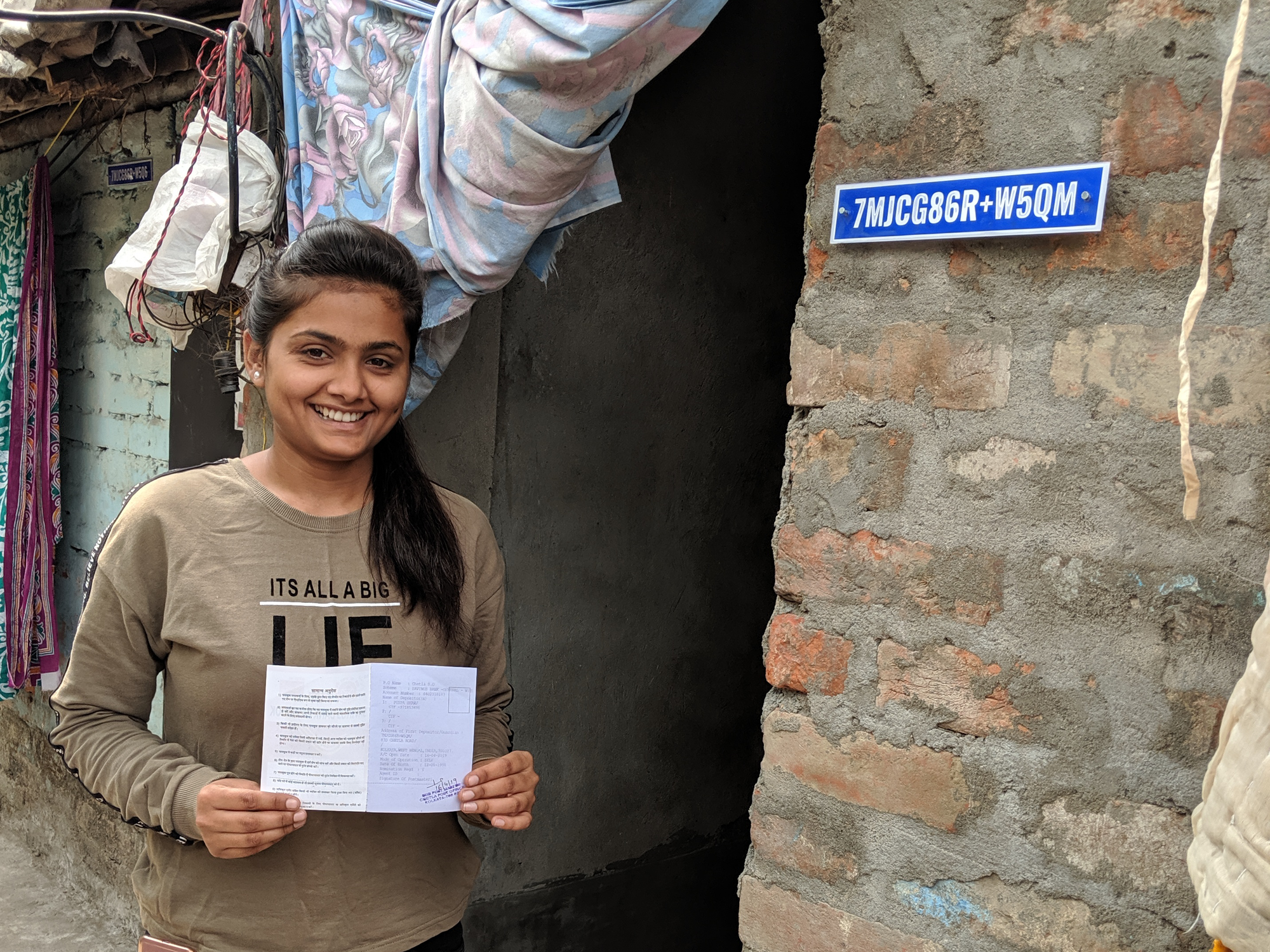
With plus codes you can both have a short, memorable address and gauge relative distance with other nearby addresses. I'm not sure I can think of a reason to ever use fixphrase or w3w as an alternative to this already existing open standard.
The document appears to be a savings account "passbook" from a post office.
Some words may also be difficult to pronounce/hear/spell by non-native speakers. Unlike regular sentences, there's no context to disambiguate.
Did you notice how you can't "decode" the code without looking it up on Google Maps? That's not a location code, that's just using Google Maps.
with w3w if you can't contact the person with the address again, you've no idea where on the planet this place might be.
The biggest issue this type of solution faces is a lack of standardization. There's this, What3Words, other people's hobbyist versions, Google has something like this built into their map product, etc. Every additional implementation is yet another nail in the coffin of the very concept.
The only way it would gain traction is if it were a government-mandated system. But every government already has one, and the benefits of adopting such a system don't outweigh the costs yet.
Non-rhetorical question: who has to remember it and why?
Is this primarily a work-around for the problem of it not being possible for a mobile phone handset to display the location during a voice call? If so, maybe someone should fix that problem because there might be other things that the caller might want to refer to on the screen while calling.
It's slightly hilarious, in a way. I can imagine a conversation with the inventor: How much memory does a typical phone have? And you're telling me that we should use this proprietary system for encoding coordinates so that the user can more easily memorise the coordinates? Tell me, do you use a similar system for memorising your friends' telephone numbers?
Of course in the case of emergency calls it really should not be beyond the wit of man to implement a system so that the owner of a phone can configure it to automatically send its location to the other party when an emergency call is initiated. I'm fairly privacy-conscious but I'd probably enable that one.
The wordlist is surprisingly hard work. The first location I clicked on fixphrase had as one of its words 'french'. That's potentially pretty confusing. It's super hard to get a good wordlist, and it's not just negative words, words that are particularly unusual or words likely to create bad combinations, it's also removing homonyms, words likely to be confused (capital/capitol, carless/careless), geographic words, or words that are combinations of other words in the word list.
> big red plate, small fuzzy ball, wavy green brick
With three disjoint short lists, and two disjoint adjective lists you get permutation robustness.
"A few disjoint lists" are the same thing as one big list if they are used identically in your generation process. There is no difference between "flip a coin, and pick from this 256-word list or that 256-word list according to the result" and "pick from this 512-word list".
If your system is to pick from a 16-word list of adjectives, then another 16-word list of adjectives, and then from one of three 256-word lists of nouns, you are generating codes of 17.6 bits, which is a bit of a downgrade from 48 bits.
I talk a little about my own wordlist choice here http://wherewords.id/+about my word list is here https://github.com/kybernetikos/wherewords/blob/main/lib/wor...
If the system allows it, you can also use fewer words to target a bigger area. For example https://wherewords.id/juniper/detailed/ is an area of Paris, while https://wherewords.id/juniper/detailed/rate/thunder is a specific point in the Gare du Nord. Or if you're standing in Paris, talking to someone else in Paris, you can use context and drop the 'juniper'.
The only real reason I think it can be good to avoid a hierarchy is because having one makes the sensitivity of the word list much more significant. For example, if an entire country has a negative association word like 'stingy' or 'lying' in its first word, that could be a significant problem.
If you really need a checksum, https://wherewords.id/ supports an optional emoji checksum.
With w3w, Gare Du Nord is sunshine.frame.acted while sunshine.frames.acted is Abu Dhabi and sunshine.frame.actor is in Malaysia.
https://what3words.com/sunshine.frame.acted https://what3words.com/sunshine.frames.acted https://what3words.com/sunshine.frames.actor
While in wherewords.id, changing rate to fate or late or gate still produces Paris, but wrong location.
https://wherewords.id/juniper/detailed/rate/thunder https://wherewords.id/juniper/detailed/fate/thunder https://wherewords.id/juniper/detailed/late/thunder
Having an accurate location is important for emergency services. If you’re on a phone call trying to get an ambulance for someone having a seizure, or reporting a fire, shooting, whatever, it’s important to get the accurate location straight away.
If the call centre person misheard your location, but the code is still in Paris, they will think it’s correct and dispatch to the wrong location. It would take too much time after realising the mistake to get the correct location. So with w3w it is far more obvious when these issues happen as suddenly the map is showing as Middle East or Asia, not Paris!
I don’t think an emoji checksum would help here either. Wink. Was that a tongue wink or smirk or etc.
(Full disclaimer: I don’t see the point in w3w either. It assumes people are prepared in advance to have the app on their phone, otherwise if they need to download it/visit its site they have internet so there are better ways of getting the location)
W3W doesn't have a patent on looking up words by array index.
https://patents.justia.com/assignee/what3words-limited
---
I've poked around the website. They claim an "open-source, patent-free algorithm" is used, and therefore the entire concept doesn't infringe on W3W's patents. Yikes. They can expect letters and lawyers.
https://source.netsyms.com/Netsyms/fixphrase.com/wiki/How-It...
GPS coordinates are better.
Some wordlist use words that are uniquely identifiable after some set prefix length (e.g. 4 characters) or use metaphone codes so you can type anything that sounds roughly right (e.g. keewee is the same as kiwi).
  0, 0         catatonic magnetism sandworm   swimsuit  "Null Island"
  90, 0        abacus    magnetism sandworm   swimsuit  "South Pole"
  -90, 0                                                "North Pole"
  85.0511, 0   detonator magnetism snowboard  theft     "South Limit"
  -85.0511, 0  activity  magnetism smudge     vicinity  "North Limit"
  0, -90       catatonic gloater   sandworm   swimsuit  "Easter Island"
  0, 90        catatonic pogo      sandworm   swimsuit  "Indian Ocean"
  0, 180       catatonic sandblast sandworm   swimsuit  "East Limit"
  0, -180      catatonic driver    sandworm   swimsuit  "West Limit"
    0,    0    catatonic magnetism sandworm  swimsuit
   90,    0    dimmed    magnetism sandworm  swimsuit
  -90,    0    abacus    magnetism sandworm  swimsuit
    0,  -90    catatonic gloater   sandworm  swimsuit
    0,   90    catatonic pogo      sandworm  swimsuit
    0,  180    catatonic sandblast sandworm  swimsuit
0, -180 catatonic driver sandworm swimsuitCybergibbons: Why What3Words is not suitable for safety critical applications (2021)[1]
HN discussion here[2].
[1] https://cybergibbons.com/security-2/why-what3words-is-not-su...
Makes it a little hard to use :-/