The goal of $3/gallon is pushing Prometheus down the rabbit hole. Waiting for the perfect factory, with the manufacturing methods, to produce the perfect machine that will immediately go into large scale production, and operate on an automated basis. I expect the company aiming at 10-7-5-3 will reach 3 there faster than the company aiming at 3 to start out with.
If it's a turnkey fuel production device, I'm sure there's a market for hook up electricity in remote location and get a tank of fuel over time.
Fences made of double-sided solar panels mounted a bit more than tractor-width apart, running N-S, coexist nicely with row crops, and cut water loss, improve conversion efficiency (via evaporative cooling), and often increase yield besides (via reduced heat stress). Producing fuel locally is better than selling the power and buying fuel.
                HH XX HH
                HH=XX=HH <--tractor
                HH XX HH
       crop        XX
       |           XX    | <-panel/fence
       v           HH    |
  x|x  x  x  x|x  x  x  x|x  x  x  x|x
  x|x  x  x  x|x  x  x  x|x  x  x  x|x
  x|x  x  x  x|x  x  x  x|x  x  x  x|x
  x|x  x  x  x|x  x  x  x|x  x  x  x|x
  x|x  x  x  x|x  x  x  x|x  x  x  x|x
x|x x x x|x x x x|x x x x|xDue to Russian oil drying up volatile high prices globally will be the norm until technology like this comes into play and at least puts a ceiling on the price. So, the real question is how quickly and how cheaply can they reach 4 million barrels per day of production?
If you hit that you're sorted in Europe.
https://www.tolls.eu/fuel-prices
European prices seem to average about ~ EU 1.8 / litre or ~7.2 EU / Gallon or $US 7.6 / gallon.
For C02 neutral fuel it would just work at that price.
> The thing is one cell doesn’t make that much fuel. What it does do is make enough to tell us what to do to iterate to the next cell design, which is exactly what we need to be doing to improve our performance and costs as quickly and inexpensively as possible. If we stopped this process to replicate one of the iterations of the cell to many cells, we could make more fuel, but we wouldn’t learn any more, we’d use up a lot of time and materials, and it wouldn’t prove that we can compete with fossil fuels on cost - the thing that matters.
Then, there doesn't need to be any marketing and limiting of availability by only having one source of product.
Product manufacturers would probably be ecstatic to generate products that have great use and public appeal, where all you need to do is be the first to be able to manufacture it.
There are two challenges to tackle here: First is to make it work at all, and second is to do it cheaper than what the competition can muster.
Both of which are covered in the article.
As you know, Prometheus converts renewable electricity from solar and wind power into zero net carbon gasoline, diesel, and jet e-fuels (short for “electro-fuels”) that compete with fossil fuels on price. What some readers may not know is that the process we use to do this is new, is only recently possible, and is unlike anything that anyone else is doing to make synthetic fuels today. It is because of this new process that we are the only company making e-fuels that can compete with fossil fuels without new laws or subsidies — our fuels can compete simply by being better and costing less than the fossil fuels they will replace. This is a truly exciting breakthrough in our ability to solve some of the world’s most intractable problems, like climate change, energy security, and the need for increased energy-driven prosperity. But as often happens with breakthroughs of this magnitude, our process has provoked some dramatic responses - It sounds too good to be true! — and raised a lot of questions: How is it possible that your e-fuels are so much cheaper than everyone else’s? And if you can make these fuels, then where are they? Why aren’t they for sale yet? I’m here to answer these questions.
What’s everybody else doing?
If we ignore biofuels and waste-to-fuels and just focus on fuels made partially or fully from electricity from renewable sources, then everyone else who’s making e-fuels is using high temperature, high pressure synthesis. It’s been possible for almost a hundred years to make synthetic fuels from H2 and CO2 by using the Fischer Tropsch process, (invented in 1925), or similar processes that use high temperature and pressure with a catalyst to combine carbon and hydrogen into fuels. Currently, there are many companies using Fischer Tropsch or related processes that call their products e-fuels, which technically can be true if they only use electricity for CO2 capture and desorption, hydrogen generation, CO2 to CO conversion, synthesis reactions, and downstream cracking and distillation. In practice, it’s common to use fossil methane for the heat needed in these processes and to try to justify the additional CO2 this emits by promising to capture it also. Regardless of how closely they keep to the electricity-only ideal, however, none of these approaches can compete with fossil fuels on price.
What’s new about our process and why do our e-fuels cost so much less that they can compete with fossil fuels?
- Electricity is really cheap now
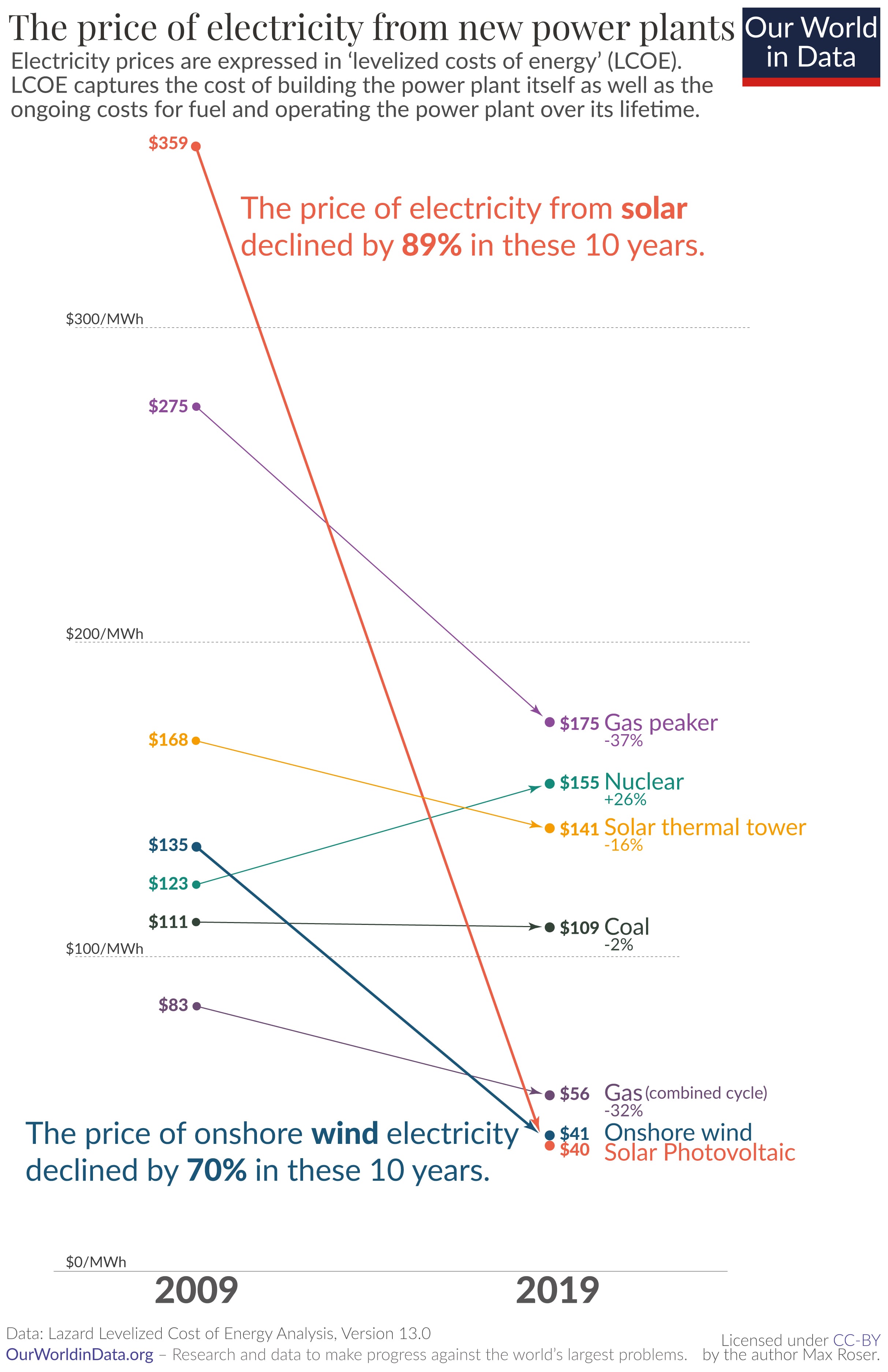
The first reason our fuels have such a low cost is not specific to us — it’s the recent abundance of really cheap renewable power. E-fuels are stored renewable energy. The day has long been anticipated when the cost of renewable electricity would become low enough to enable e-fuels, and that day has come. Specifically, it arrived in 2018, when the cost of utility scale solar power dropped to $0.02/kWh for the first time in a purchase by the city of Los Angeles. This marks a drop of over 90% in just ten years. The most recent record for the lowest utility scale solar bid was achieved last year at $0.01/kWh. The dramatic drop in costs is due to massive investment in solar panel manufacturing and in learning-by-doing cost reductions from making lots of solar panels. Low cost electrons mean low cost e-fuels.
[chart: https://storage.googleapis.com/prometheus-fuels.appspot.com/...]
- We don’t need pure CO2
The second reason our fuels are low cost, and one that is specific to us, is that we don’t need pure CO2. In order to make hydrocarbon e-fuels at scale one needs to capture CO2 from the air by direct air capture (DAC). For everyone else making e-fuels, this is a large cost. This is because their processes all require pure, pressurized CO2 gas. One obtains CO2 from the air by adsorbing the CO2 into or onto something, typically an amine liquid or amine functionalized bead, or in a hydroxide solution in water, or something more exotic, like an ionic liquid. This part isn’t so hard, and doesn’t require much energy, just a fan to blow air. In some cases, passive wind is used, but in either case, it’s not the main energy consumer.
The main energy cost is in getting the CO2 to release from the absorbent — to desorb. And that’s when things get really expensive, because this requires a lot of energy, almost always in the form of heat from burning fossil methane or a portion of the fuel produced. This is why most DAC CO2 processes cost $500-$600/ton of CO2 with a far distant and hopeful target of $100/ton at scale. But even at $100/ton CO2, any fuel one goes on to make is already too expensive to compete with fossil fuel.
At Prometheus, we don’t make or need pure CO2 gas, so we don’t need to desorb it. Therefore, we avoid the vast majority of this cost. Instead, we capture CO2 in water and then use it in water to make fuel. ARPA-E refers to this as “reactive CO2 capture” and identifies it as a significantly lower-cost DAC approach. Because our DAC tech is fundamentally different, our cost to capture CO2 is only $36/ton, the lowest in the world, and the only one low enough to enable fuel that competes on price with fossil. (More on this below.)
- We use electrocatalysts, not catalysts that need high pressure and temperature
The third reason our fuels are low cost, and another reason that is specific to us, is that we use electrocatalysts to do what only pressure and temperature could do before. The first widely read paper on this showed that CO2 in water could be turned into ethanol at a faradic efficiency of 63%. This means that 63% of the electrons that went into products in the process went into ethanol. We licensed a second-generation of this catalyst that has even better performance, making much larger and more complex carbon-based fuels with electricity alone.
Using electrocatalysts instead of the high pressure and temperature catalysts everyone else uses gives us a big reduction in cost because we can do the same job at room temperature and pressure while using much less expensive materials. It’s also great for our system performance because we can turn our process on and off quickly, matching intermittent solar and wind power. High pressure and temperature systems can’t operate like that.
- We’re the only ones who don’t need distillation
The fourth reason our fuels are low cost is that we’re the only company in the world that can replace distillation with nanotechnology to separate fuels from the water in which they’re made. In my previous startup, Mattershift, I commercialized a carbon nanotube (CNT) membrane, and published on it in 2018. Numerous academic publications have shown that membranes like this could separate alcohols from water, but until Mattershift produced them, no commercial CNT membranes were available. Previously, the only way to separate alcohols from water was to use distillation, another highly inefficient and expensive heat-based separation process. The CNT membranes solve this problem, using over 90% less energy than distillation and dramatically lowering the cost of extracting our fuel. This is a big deal because it reduces what is a major cost for other e-fuel makers to a minor cost for us.
Ok, that sounds good, but how does all this compete with fossil oil and gas?
The math on the cost of our e-fuel is pretty simple. The only inputs are air (CO2 and water) and electricity, and the only outputs are oxygen and fuel. The cost of the inputs plus the cost of the equipment and its maintenance make up nearly all of the cost. There are some other operating costs, like the vacuum pump and coolers on the CNT membranes or the power for pumps and controls, but these are less than 1% of total operating costs. I won’t include taxes or delivery fees since these vary a lot from place to place.
The main cost is electricity. The energy density of liquid e-fuels is very high, the main reason that they have long been desired as a solution for decarbonizing long-haul shipping and aviation. For gasoline, the energy density is approx. 33 kWh/gallon. In a TEA study we did last year with a third-party engineering firm, the estimate for the overall efficiency of our process (chemical energy in the fuel / electrical energy used to make it) is approx. 43%. This is a really great efficiency, because it includes everything involved from start to finish, including DAC of CO2, synthesis of the fuel, and separating the fuel so it’s ready to use. At this efficiency, our gasoline will need approx. 77 kWh of electricity per gallon. If the cost of power is $0.02/kWh, then the electricity cost of our e-gasoline is $1.54/gallon.
The next cost is CO2. The third-party TEA put our DAC cost at $36/ton of CO2 at $0.02/kWh, making it the lowest cost DAC in the world, and this cost drops further with lower costs of electricity. A gallon of gasoline contains approx. 8.9 kg of CO2 per gallon, so at a cost of $36/ton, this results in a CO2 cost for us of $0.32/gallon.
The most important cost after electricity is equipment cost, typically called capital cost. Adding up the electricity and CO2 costs, we get $1.86/gallon. If we want to stay below $3.00/gallon (for example), then we need to keep the capital and maintenance costs less than $1.14/gallon. Our cost models tell us that we can have capital and maintenance costs that are significantly lower than that, due to the advantages listed above, including not needing CO2 desorption or fuel distillation equipment, using low cost materials due to low temperatures and pressures, and deploying mass manufacturing methods like those used to make cars.
Ok, that’s cheap fuel, I’m into it. But where are the demos? If you can do this, why can’t I buy the fuel yet? . . . Dude, where’s my fuel?
In short, the fuel is coming. We’re about to do more and bigger demos. And we can replace fossil fuels a lot faster than most people think. Here’s where we’re at now.
First, we make fuel from the air all the time at Prometheus. We’ve been doing it since we started with the Fuel Forge Demo 1 system I built in the Y-Combinator batch in 2019. We just don’t make that much at any given time, and there’s a really good reason for this. We’re optimizing the most expensive part of the system, the electrochemical stack (which we call the Faraday Reactor), and the fastest and best way to do that is one commercial-scale cell (a cathode, anode, and separator) at a time. The thing is one cell doesn’t make that much fuel. What it does do is make enough to tell us what to do to iterate to the next cell design, which is exactly what we need to be doing to improve our performance and costs as quickly and inexpensively as possible. If we stopped this process to replicate one of the iterations of the cell to many cells, we could make more fuel, but we wouldn’t learn any more, we’d use up a lot of time and materials, and it wouldn’t prove that we can compete with fossil fuels on cost - the thing that matters.
It’s worth pointing out that companies that do demos to show they can make e-fuel aren’t showing that much. After all, it’s been possible to make fuel that way for over 100 years. What matters is showing that you can make it at low cost, and that is something you do with chemical analysis, bills of materials, and cost models. Kind of boring as demos go, but it’s what matters most. We’ve been killing these demos, which is why we are the first unicorn in the e-fuels space.
So let’s talk about capital cost, the one we need to keep below $1.14/gallon to stay below $3.00/gallon fuel.
For this it helps to compare our Titan Fuel Forges to a more familiar system, a hydrogen electrolyzer. Our Fuel Forges are similar in many ways to hydrogen electrolyzers, in that they consist of many layers of cells, each consisting of a cathode, an anode, and a separator. In an H2 Electrolyzer, the anode is where electrons are stripped from water, producing oxygen, and the cathode is where electrons are added to protons, producing hydrogen gas. In our system, the anode works the same way, but our cathode, in addition to making H2, also makes liquid fuels. Both systems have capital costs dominated by the costs of the electrochemical stacks.
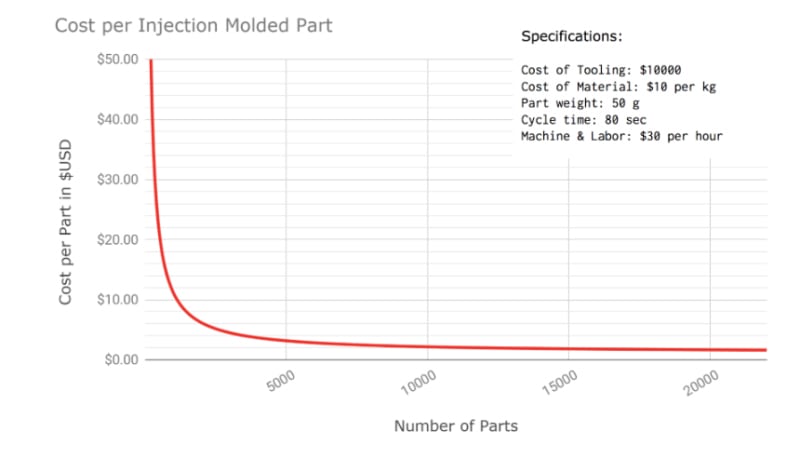
This brings us to the issue of economies of scale. For high temperature / high pressure systems like Fischer Tropsch or e-methanol to gasoline (MTG), economies of scale mean large refinery installations that cost billions of dollars and years to build (and still don’t get to cost-competitive fuels). For modular, mobile systems like our Titan Fuel Forges, however, economies of scale mean mass manufacturing. Building a Fuel Forge isn’t like building a refinery, it’s like building a car. When you mass manufacture a product, the cost of the product asymptotically approaches the cost of the materials. Since our process uses only inexpensive metals like copper and steel, inexpensive gasket materials and other low pressure, low temperature components, our cost of materials is low. This is a very powerful approach for low fuel cost.
One thing that’s especially advantageous about the stack dominating the cost of the system is that bringing economies of scale to stack manufacturing by making many cells is very nearly as powerful as making many Fuel Forges overall. For manufacturing methods like injection molding, for example, one can get to very low costs very quickly, delivering impressive economies of scale. A Faraday Reactor, like an H2 electrolyzer stack, is made of many layers, so making even a few Fuel Forges can quickly lead to low stack costs.
[chart: https://storage.googleapis.com/prometheus-fuels.appspot.com/...]
https://inspirationfeed.com/how-to-correctly-calculate-the-c...
For this reason, driving down the cost of the Faraday Reactor is the single most effective way to drive down the cost of a Titan Fuel Forge, and therefore the capital cost component of the fuel.
In the stage we’re at now, we’re close to locking down the design of our commercial-scale cell and stack design and are about to start automating their assembly into many-cell stacks. Even with the slow global supply chain we’ve all been dealing with lately, this can happen pretty quickly, because it’s a fairly simple assembly process — just slow when it’s being done by hand. This means we’ll be making larger quantities of fuel and we’ll get to do the demos with motorcycles, race cars and classic cars, and jetpacks and planes that we know you want to see. Up to this point, I haven’t been willing to do these larger-scale demos because of the significant slow-down they would involve, delaying our progress towards launching commercial fuel - the thing we care about most. But the right time to do them is coming soon. Personally, I’m really looking forward to doing those demos, because I like putting on a good show.
Our not-so-secret plan is to get the Faraday Reactors into automated assembly and take all the data we’ve gathered to design and build the first Titan Fuel Forge 1.0 commercial system. I think we can start the build this year, but I’ve learned that schedules are hard to predict right now. If everything goes our way, we’ll be shipping fuel very soon.
After that, we’ll be making more Forges with automated Faraday Reactor assembly and most of the rest by hand as fast as we can, but to really scale quickly, we’ll need to build a factory to make many fuel forges. We call this factory the MetaForge.
The rate at which we can build Fuel Forges in the first MetaForge will be set by the rate at which new solar and wind power can be built. If we assume for the moment that each Titan Fuel Forge will have a rating of 1 MW each, then 1,000 Fuel Forges will require 1 GW of new renewable power to operate. If 250 GW of new renewable power for “power to X” projects are built each year, then the MetaForge could make 250,000 fuel forges per year. (Compare this rate of production to that of car factories that can make more than 500,000 cars per year). At this rate, these forges could decarbonize approx. 30 million cars per year. This is a very rapid decarbonization rate compared to any other options currently under consideration. Alongside the growth of battery electric vehicles, it’s feasible using this approach to decarbonize the global vehicle fleet entirely by 2040. Using e-fuels to replace all energy products made from oil and gas across sectors could eliminate over 20 GT of CO2 emissions per year.
For the love of god, throw your web site away and start again with some simple, static HTML pages.
Please please, for goodness sake, put a quick loading static page front and center quick! This stuff is too important and too cool to be lost to same hokey web design.
https://www.prometheusfuels.com/news/prometheus-site-of-the-...
The first page view shouldn't be loading all that crap that isn't being used.
It may seem like a small thing, but it is an important detail, and it makes me question if the company is snake oil or not. It doesn't appear very professional to take this approach. Maybe it was ok in 1998, but not today.
It wasn't.
Not sure if the screwed up scroll behavior was possible in 1998 but it wouldn't have been ok then either.
Even more "interesting" is that in their news section was this article: https://www.prometheusfuels.com/news/prometheus-site-of-the-... - so I don't think they're going to be listening to HN about their design anytime soon, which is a shame as that site is awful.
The site itself weighs 375MB, ~150MB after compression, and pins my CPU for about 3 seconds on load, using 1.70GB of real memory.
... and then looked and worked like 50kB static website from 10 years ago.
“Our tech works in the lab. Simple math shows it can be competitive in the market. Now, we’re focusing on scaling the tech.” Those words make sense when coming from a genuine effort that could succeed. Those words are therefore copied by charlatans as well.
I have no reason to think Prometheus is in the latter camp, but the presence of that camp makes life harder for them I think.
Seems much more scientifically plausible however. I'm just a natural skeptic.
I think here they would really have to get a working prototype / pilot plant up and running, with a transparent demonstration. That's how the Haber process got support from Bosch c. 1909.
https://en.wikipedia.org/wiki/History_of_the_Haber_process
Generally speaking however, industrial processes run with pure streams of ingredients are more efficient. The rate-limiting step in the process as they describe it looks like the first one, because they're just using 400 ppm CO2 air as the input, with no pre-concentration. You'd need some kind of energy return on energy investment, i.e. how much electricity input per liter of produced fuel, plus lifetime of the catalyst etc. to make sense of how plausible it is.
https://twitter.com/ramez/status/1516199169911713794?s=21&t=...
> There are no shortcuts around the physics required to assemble a molecule.
So the process is viable, but the cost is prohibitive?
https://www.technologyreview.com/2022/04/25/1050899/promethe...
BUT... when I lived on the grid I paid $.13/kwh. At 77kwh per gallon that puts us at $10.01/gallon. It is unknown if this is just syn gas or ethanol, or what the BTU of that gallon is. And this definitely isn't diesel, which would have the biggest impact. I know when my friend did bitcoin mining he was able to get $.03kwh so... let's use that 77 * .03 = $2.31. So between $10 and $3 a gallon is actually possible.
With gas over $5 or $6 (the company is in Santa Cruz? Their gas is probably $7 or $8 at this moment, I bet) ... this will work
The other issues are... United States uses 30TW of oil a day (convert barrels of oil to BTU and convert BTU to watt hours... to convert oil used per day in watts to speak of)... and 10TW of electricity a day.
To replace 'fossil' fuels we'd need ...70TW of electricity after inefficiency conversion.
There isn't enough copper, nickle, and silver to make all those solar panels. There isn't enough public support or political capital to build nuclear reactors either. This is another flaw.
Another commentor suggested, just replacing Russian's oil at 4 million barrels a day. That's possible. And it makes it exciting.
The price of electricity is variable, sometimes negative. You would not need to produce at levelized cost, but only when the sun is shining.
If they used power only at production peaks and colocated with generation (saving ~10% line losses), $0.02/kWh seems in the realm of the possible.
As to lack of resources to build enough solar capacity, concentrator plants make that a non-issue.
It's important to ask these questions of what the tradeoffs really are when thinking about Energy Returned on Energy Invested, whether e-fuels would actually decrease new car production (i.e. older cars get used longer if e-fuels really make sense), the political economy ramifications if these things really worked, etc.
In prior waves of interest of things like algae-based fuels (see https://www.greentechmedia.com/articles/read/lessons-from-th... ), my rough understanding is that they could be done but the numbers just didn't work out.
Finally, it's really worth pointing out the concern of any of these things falling under solutionism when also thinking about the state of our planet from a more integrated framework such as the planetary boundaries: https://www.stockholmresilience.org/research/planetary-bound...
They're not talking about carbon offsets for the linked article, they're literally talking about using captured carbon to make fuel.
Remember "Don't Let the Perfect Be the Enemy of the Good"
They just pass the air through water. A part of the CO2 from air will dissolve in water, up to its solubility limit.
The water with dissolved CO2 is then used in their electrolytic cells, which produce ethanol (dissolved in water). Presumably the water depleted in CO2 is reused to dissolve again CO2 from the air. (Some of the initial water is also converted into ethanol, so some fresh water must be added to the recirculated water.)
So they claim that they achieve in a sufficiently cheap way both the capture of CO2 from air and its conversion to fuel.
The OP explains that the main reason why they aren't delivering fuel is because they can't perform the carbon-dioxide separation cheaply enough. So, they have a plan to deliver cheap captured-carbon fuels, once they solve the issue that has consistently eluded companies seeking to produce captured carbon fuels. If they manage to solve it, great that's an awesome invention. But until that actually gets solved, they're one of many synthetic fuel companies that are blocked on the problem of carbon capture.
A GW-scale ammonia plant is under construction in Norway. We will need thousands of them in short order. They need to be made cheaper.
Another concern competing with this is called Terrapower Industries. They are maybe less far along, but their web site is actually readable: https://terraformindustries.com/
If they could sequester, say, half their captured carbon, that would be a good look.
edit: By using excess ammonia, you reduce nitrogen oxides with a mechanism similar to AdBlue in diesel engines.
Fuel cells using ammonia seem much safer, but they are farther from being a commercially available solution.
Natural gas burners inject ammonia to cut their NOx output. Maybe they know something.
They're going to really need to knock people over the head with the part that what goes out is only what goes in, and also why that's better than extracting oil from the ground.
[1] https://en.wikipedia.org/wiki/Prometheus_Fuels#:~:text=The%2....
Maybe this doesn't reflect on the company, but I feel if you can't even create a simple web page, then what the hell else are you going to struggle with along the journey?
Does anyone else get the smoke and mirrors vibe from this or am I just being overly skeptical and not reading thoroughly enough into the literature provided?
If this tech is true, I can see the HUGE potential it has.
I'm also skeptical that petrol / diesel / long chain hydrocarbons are even the right fuel to make. If the average length of the carbon chain for something like diesel is around eight, you can make roughly eight times the number of methanol molecules for the same carbon input. Hydrogen requirements are also lower, so the cost limitation there is reduced as well. It just seems like an inherently cheaper $/kWh pathway for storing energy, especially when you consider that there are already amateurs doing methanol conversions for cars for a few thousand dollars.
Obviously this doesn't work for aviation, but the calculus there is a bit different. LH2 has a number of advantages for aircraft, and depending on how much cheaper it is than synthetic kerosene, it may prove to be the better option.
On the subject of direct air capture -- have any studies been done on its efficacy relative to fast growing plants? Some seaweeds can grow at a rate of a meter a day, which obviously requires pulling carbon from the water (i.e. indirectly from the atmosphere). Similarly, it seems like there are pre-existing (and potentially cost effective) pathways for shorting the carbon cycle by, for example, using sewerage as a source, since all of that carbon was at one time pulled from the atmosphere by a vegetable.
Anyplace where LH2 aircraft operate, kerosene-powered airframes will be simply unable to compete. It is not clear that existing airframes can be retrofitted, and build-out of LH2 craft may take a long time. By 2040, if civilization has not collapsed yet, probably the majority will be LH2, and old kerosene airframes will be on marginal routes.
Synthetic hydrocarbon fuel will have strong demand for at least a decade or two, maybe longer depending on many factors including various costs, taxes, and regulations.
EDIT: I will pay one-time fee of 4*30 = $120 to get those first 4 cans.
EDIT-2: $12/gal if 93-octane equivalent
A quick DDG search suggests BEV has an efficiency of 80%, so the same 77kWh would end up doing 61.6 kWh of actual work when charged directly.
IMHO long-term this is no solution for general transportation, but ICE cars are still sold and as such will stay around for a few decades. Plus applications which require a higher energy density (mainly aviation & space; probably trucking & shipping; maybe long-range personal transportation) could make good use of these.
> The main energy cost is in getting the CO2 to release from the absorbent — to desorb. And that’s when things get really expensive, because this requires a lot of energy...we don’t make or need pure CO2 gas, so we don’t need to desorb it. Therefore, we avoid the vast majority of this cost. Instead, we capture CO2 in water and then use it in water to make fuel. ARPA-E refers to this as “reactive CO2 capture” and identifies it as a significantly lower-cost DAC approach.
Messing with scrolling semantics just makes people hate you.
What I mean by that is all the chemistry / electrolysis / carbon nanotube stuff, they do mention that this is where the main cost is, but what happens when that equipment needs to be replaced?
What is the environmental impact of the equipment itself?
(I'm ... if not a huge fan, desperately interested in seeing whether or not Fischer-Tropsch fuel synthesis is viable. Stumbling straight out of the gate with an impossible-to-read website is ... a very disappointing self-pwon.)
Seriously, that page took 10s to load, pegged my laptop CPU and got the fans spinning. WTF?
Because that scrolling is so bad I’m almost impressed.
Low temperature processes run at a low rate so you have a huge machine and large quantities of catalysts tied up to make just a trickle of fuel.
Nice to see the F-T process bypassed because the high capital cost makes it the last refuge of the desperate.
> “It’s laughable,” says Eric McFarland, a professor of chemical engineering at the University of California, Santa Barbara. “It’s the tech bubble again,” he added later. “People are putting money into lots of things that ultimately won’t ever work, and this is one of them.”
And it points out that the CEO (and submitter here) has a history of making predictions that have not come true, such as saying in 2018 that they would be able to undercut gasoline on price in 2019.
I really hope they are able to do what they say they can do but I won't be at all surprised if they fail.
https://www.technologyreview.com/2022/04/25/1050899/promethe...
Since it supposedly doesn't require large capital cost, can be done in small scale and doesn't require exotic materials (except for cheaper separation of fuel from water) it would be perfect technology for small time experimenters and small entrepreneurs in all corners of the world.
See it, then believe it.