A small cup of black coffee with oatmilk for $3.50. Please.
The fact that it's more ecological to produce doesn't translate to lower prices for many reasons.
Here we buy litres or half, and we adore milk, mostly 3.5%. The non-diary alternatives are not even allowed to be called milk (they are now drinks).
Sure we're burning down the planet and allocating massive amounts of water to feed and maintain livestock during drought conditions.
BUT! The ranchers need their 5th house and the proles need their artificially cheap meat that is blocking their arteries.
( not a vegan just annoyed by mis-allocation of resources )
The amount of oat you have to feed a cow to get a single litre is not even close to the literal handful you need for an oat-based milk - let alone the time and how of work that went into caring for the cows, handling the mess, etc.
It should not even be close. We simply industrialized the whole diary thing, and consider it essential.
And I say this as someone who cannot live without cheese. It should just be way more expensive and reflect the cost it has on the environment/society.
https://www.nature.com/articles/s41598-020-63647-8 see the references
height difference found:
https://academic.oup.com/ajcn/article/106/2/597/4557638
may be related to IGF-1:
So replacing it will not change anything in that regard, we just must be aware that (any) milk is (liquid) food and not a drink. Same problem as with softdrinks or fruit juices.
Anecdata: I regularly drank (cow) milk as a child and now I'm over 2 meters in height. But of course correlation with n=1 is not causation, and I'm sure many people here are equally large without a drop of milk. :D
(1) https://www.albertahealthservices.ca/assets/info/nutrition/i...
1. What percentage of land use for dairy cows is arable?
2. What percentage of water consumed by dairy cows is recycled (eg from rain water), how does that compare to something like almonds?
3. What percentage of greenhouse gas emissions are added to the environment over already existing in the environment and just being moved?
Pretty much all of it. It's either being used directly for grass, or indirectly to grow grains which are fed to the cows.
> What percentage of greenhouse gas emissions are added to the environment over already existing in the environment and just being moved?
I think the number itself is the amount over what already existed.
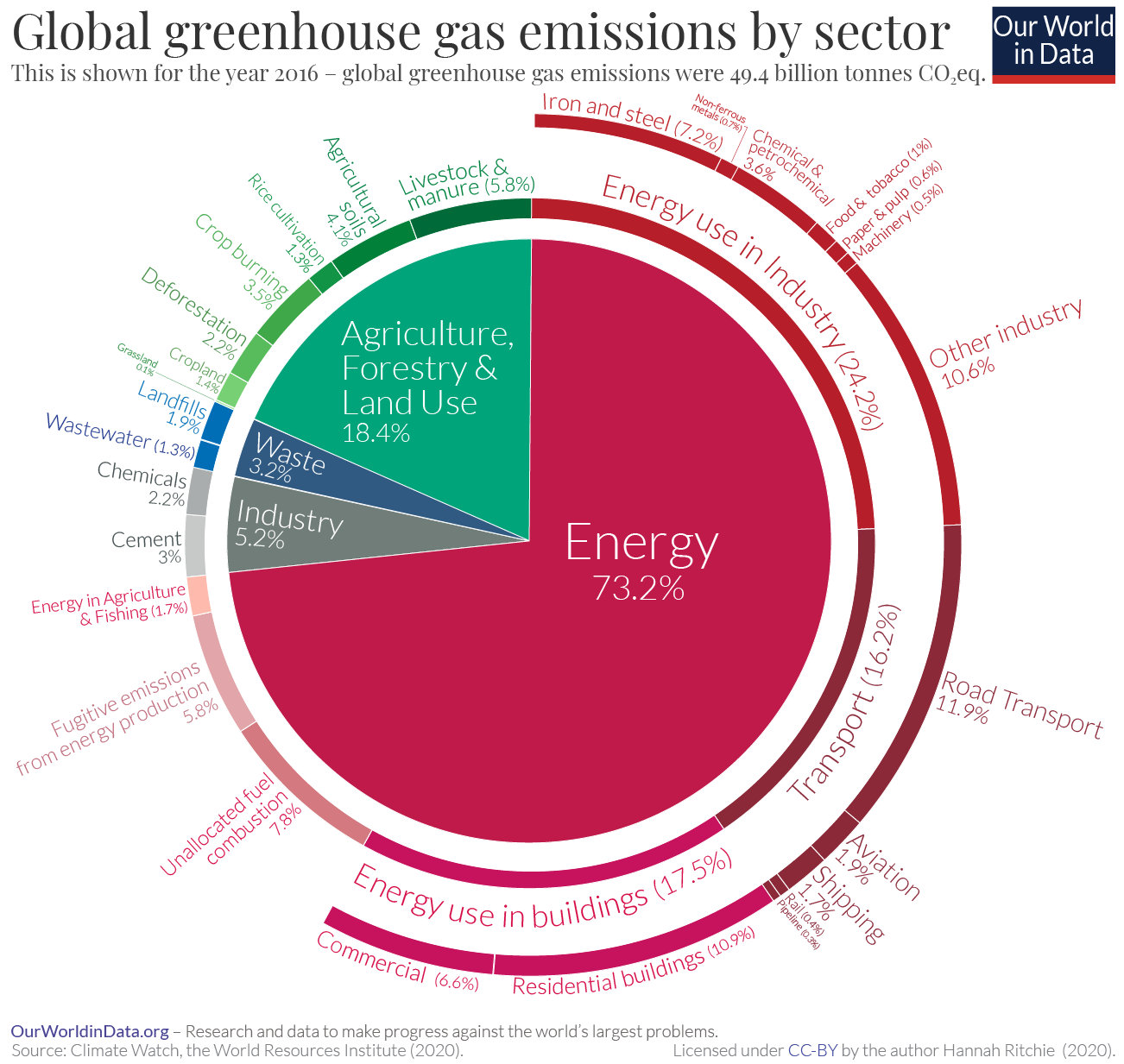
- Methane leaks from Oil and gas drill sites and abandoned wells alone account for 5.8% of global emissions. [0]
Ethically I am aligned with animal welfare but rationally it is a lot more realistically that we force Oil&Gas to clean up their act than to expect everyone worldwide to switch to oat milk.
[0] https://ourworldindata.org/uploads/2020/09/Emissions-by-sect...
https://www.washingtonpost.com/world/interactive/2022/amazon...
This is more about beef than milk, but the situation is likely very similar.
I guess it was a combination of us being on HN right now and the fact that I apparently downregulate how much signal I expect to get from English grammar rules when reading text written by strangers on the Internet. I certainly don't see any problems with your grammar upon re-reading.
I wonder if I would have correctly parsed "...published a big story on how American beef consumption is actively destroying the Amazon"?
Oatly adds enzymes to break down the starches to sugar.
*The nutrition profile is a bit more complicated as I think they add enzymes to break down starches in the oats, so you end up with more sugar even though it's not technically "added".
Absolutely, but that's also true of cows milk. The sugars in oat milk are a bit simpler (primarily maltose rather than lactose), which gives a lower glycemic index, but the total sugar content isn't much different.
Either way, if you compare them to something like fruit juice or full-sugar soft drinks, the sugar content is still pretty low.
There's more variation in alternative milks, even within one type, than cow milk. We're mostly soymilk (bean milk, the kids call it), but it took a little while to find one that didn't feel chalky or weird. Happily it's the store brand that's $2 a half gallon. Settled on soy creamer, which is not as thick as dairy creamer but next best thing among non-dairy that tastes good.
With you on cheese! It's what makes plant burgers taste good.
Also, I really dislike how these studies are conducted. They often don't account for the fact _something_ will be produced on land and _something_ will be consuming it. There used to be millions of American Buffalo roaming the plains. I'm not sure relatively normal behavior is something to be concerned about.
The pollution IMO we should be concerned about are the chemicals in production of industry and food which are not natural. For instance, giant mono-crops of soy, which then go to factories where they are heavily processed, might be in-effect worse for the ecosystem as a whole. Another example is almond production. It takes far too much water to produce almonds and to make milk is insane.
I personally wouldn't be surprised if the soy, oat, almond industry are pushing these studies.
    While most infants can digest lactose, many people begin to develop lactose malabsorption—a reduced ability to digest lactose—after infancy. Experts estimate that about 68 percent of the world’s population has lactose malabsorption.1
    Lactose malabsorption is more common in some parts of the world than in others. In Africa and Asia, most people have lactose malabsorption. In some regions, such as northern Europe, many people carry a gene that allows them to digest lactose after infancy, and lactose malabsorption is less common.1,2 In the United States, about 36 percent of people have lactose malabsorption.1
    While lactose malabsorption causes lactose intolerance, not all people with lactose malabsorption have lactose intolerance.
Consumption of large amounts of soy milk every day is surely not hundreds of years old.
Almond milk contains almost no almonds (and tastes horrible IMO, but YMMV, may also just be the brand I tried), I would assume that it's not that big of a chunk of the global almond production.
But in any case, oat milk should be safe, right? It's just a very watery porridge, isn't it? :D
https://www.thelancet.com/journals/langas/article/PIIS2468-1...
Yes, I said "developing" for a reason. It's mostly northern Europeans with the ability.
I'm not being unreasonable here, some people just won't give up real meat or milk, ever.
It’s not literally milk, but these are clearly milk substitutes, where people use them when they would otherwise use milk.
Would that matter for collectors?
PS. I don't care about watches at all, btw.
https://www.theguardian.com/food/2020/jan/06/us-dairy-indust...
I’m not lactose intolerant but I do buy lactofree milk I find it to last a bit longer and I see no reason to temp fate as you can become more and more intolerant as you grow older and I do like my cheeses.
And we are talking of fossil fuels, carbon that wasn't in the ecosystem for maybe many millions of years, compared with the relatively short lived and recycled methane that emits living things. There is a big elephant in the room that nobody dare to talk about.
1. "Work with nature" - what does that even mean?
2. "Stick with cows which graze on open grass land" - the amount of such cows is a tiny fraction of all cows. How will I know how to get to those cows?
I'm not even a vegan, but also hold no delusions about milk products.
My only concern is if some studies will come out in a few years showing oat milk health effects similar to what is being discovered about soy. I don’t have all knowledge on this, but apparently soy can mess with hormones. It’s not going to kill nearly anyone, but it’s worth being aware of.
What gets left out is the fact that phytoestrogens are ubiquitous, found in many plant foods. [0]
The argument from the less concerned was something along: Better safe then sorry, no one can say what larger amounts of estrogen will do to a boy well below 1.
In some countries cow milk is even subsidized.
Edit: cow milk is actually less healthy than alternatives and there is no reason to encourage it.
Most children would do just fine with soy milk as an alternative.
Because poor people consume it. Dairy products are also a replacement for meat if you're poor enough.
the price they get paid for their milk does not depend on what the consumers would be willing to pay, but on the large milk production companies who buy all their milk and dictate what they are willing to pay, and without subsidies they would simply buy their milk elsewhere.
This is an issue being pushed with the intention of distracting from the real issue: fossil fuel use.
This part is still horribly true though.
Emmisions related to livestock are 5.8% of _all_ global CO2 and other GHG emissions [0]
In comparison Transport emissions are 16.2%. [0]
The steel industry as a single industry accounts for 7.2% of emissions.[0]
Methane leaks from Oil and gas drill sites and abandoned wells alone account for 5.8% of global emissions. [0]
Sure we need to look into all fronts but before we guilt people into oat milk shouldn't we, via policy, enforce leak cleanup of abandoned Oil&Gas drill sites?
[0] https://ourworldindata.org/uploads/2020/09/Emissions-by-sect...
I'd love to see how animal-free protein products stack up against these other alternatives. I think including it in the comparison may do something to assuage the "but it's not milk, so..." objections.
Also if you read this Perfect Day, I don't eat much icecream but I'd buy vegan whey protein powder from y'all in a heartbeat.
Sorry for the grump take. It feels very silly to be “what about” ish about this. Couldn’t we just tax plane fuel a bit more first or something?
I also don't think anyone is trying to (realistically) take away your milk. It is useful though to inform people about the impacts of their choice, and let them make an informed decision.
Bio diversity, while not quite the same risk as climate change, is another hazard well worth focusing on. What’s the point of tackling greenhouse emissions if we live in a Speaker for the Dead biological dead-end with only a handful of ubiquitous species?
The bulk of dairy production isn't for "milk" at all, it goes into derived products (mostly cheeses). And while there are a few plant based alternatives in that space, they aren't "oat milk" or whatever.
Per this link, "fluid milk" is only 24% of dairy usage: https://www.progressivedairy.com/news/industry-news/how-is-t...
Basically, this article is doing the "paper straws" thing and addressing the wrong part of the problem. If you want to talk about dairy cow impact you need to get people off of ice cream and yogurt, not milk.
Even though it doesn't represent the majority of milk usage, maybe we shouldn't dismiss fluid milk entirely, since it's an easy first step.
I heard a convincing argument (tho citation needed, I guess) that veal meat is usually sourced from dairy cows' male offspring. And the idea of keeping dairy cows in a state of perpetual pregnancy is kind of off-putting too.
YMMV, but for my family, the health benefits, and animal welfare / humane farming concerns, and viable (tasty!) alternatives, were enough to make the switch an easy decision. Adding climate change impact and I feel even better about it.
I've always been a huge ice-cream fan so the fact that it's been retooled in a more addictive form is very concerning.
How about start heavily invest in clean, or at least cleaner, energy production instead of getting this crap on HN front page. Flagged this crap.
"The extraction and processing of natural resources has accelerated over the last two decades, and accounts for more than 90 per cent of our biodiversity loss and water stress and approximately half of our climate change impacts."
This includes farming, as well as extraction of fossil fuels, minerals etc. In fact, the climate change impact of farming (biomass extraction) is about the same as fossil fuel extraction, according to that study.
Here's a guardian article about the report (but the official summary is also very readable): https://www.theguardian.com/environment/2019/mar/12/resource...
I don't have a source at hand right now but you can look it up.
same thing for artificial meat or even soy protein--easily more expensive than regular pork/hamburger/chicken...
no surprise, seeing as how most of eco-leftism is really just propaganda aimed to increasing profits...and this propaganda is always aimed to young people who are willing to spend more money to send a signal to others about their conscientiousness...and also easily manipulated by propaganda
Maybe, or maybe the incumbent products are massively subsidized.
I really enjoy the new ultrafiltered cow milk that have come out recently. Half the sugar, no lactose but all of the protein.
The average dairy cow produces 2320 gallons of milk per year. Dairy cows drink 40 gallons of water per day, which is about 14600 gallons per year. A grown dairy cow eats about 30 pounds of food per day - 50% grain and 50% grass, so about 5475 pounds of grain per year. It takes 127 gallons of water to produce 1 pound of maize. Not counting the water requirements for grass, and assuming that our cow only eats maize, we'll need 695325 gallons to of water to feed the cow.
It takes 22000 gallons of water to irrigate an acre of land. Each acre produces 2 tons of hay, so we'll need 11000 gallons per ton of hay or 11 gallons per pound, which is 60225 gallons of water for grass.
Total water consumption of 1 cow per year for grass + grain + drinking water = 770150 gallons.
That brings us to needing 770150 gallons of water to produce 2320 gallons of cow milk. So, about 331 gallons of water to make 1 gallon of cow milk.
They say that each almond requires 1.1 gallons of water. 1 pound of shelled almonds = 3.63 cups of almonds. There are 416 almonds in a pound. So, about 26 per ounce, and 208 per cup. There are 16 cups in a gallon. To make almond milk, we mix 6 cups of water for each cup of almonds, which will yield us about 6.5 cups of almond milk. It'll take 2.46 cups of almonds to make 1 gallon of almond milk, so 512 almonds, so 563 gallons of water.
Things we're not accounting for in the above comparison:
The water cost of producing pesticides, fertilizers.
The water cost of producing health treatments for cows.
The water cost of producing diesel to transport grains to the cows.
The water cost of producing electricity and packaging.
I'm sure I'm missing a lot.
Sources:
- https://albertamilk.com/ask-dairy-farmer/what-do-dairy-cows-...
- https://dairy-cattle.extension.org/how-much-milk-does-the-av...
- https://thelivestockexpert.com/how-much-water-does-a-cow-dri...
- https://informedfarmers.com/how-much-grass-does-a-cow-eat/
- https://www.derthickscornmaze.com/interesting-about-corn/how...
- https://www.answers.com/Q/How_many_almonds_are_in_a_pound
- http://anniekateshomeschoolreviews.com/2011/10/shelled-vs-un...
- https://www.openfit.com/how-many-nuts-are-in-an-ounce
- https://www.answers.com/Q/How_much_water_does_it_take_to_mak...
- https://www.freightwaves.com/news/how-much-weight-can-a-big-...
- https://www.motorbiscuit.com/how-many-miles-per-gallon-do-se...
- https://askinglot.com/how-much-water-does-a-farm-use-per-acr...
https://en.m.wikipedia.org/wiki/Atmospheric_methane#/media/F...
Dairy is only a fraction of the overall cattle industry, and an even smaller part of supplying the protein needs of people necessary to live healthy lives.
Not only that, as per article:
> A liter of dairy milk is not comparable to a liter of plant-based milk in terms of its nutritional profile.
I'm sure the "but my brand" crowd will disagree based on the subjectivity of their lack of taste but they'll be wrong.
In the end if we believe that milk is a driving force I'm climate change we might as well just start hoping for a giant asteroid to end it all now.
I appreciate the sentiment, but getting people to switch seems as futile as converting a steak lover to strict veganism.