Great. I didn't need an existential crisis today :)
I really wonder about the quality of life as I age though. There is such a wide spread in my family. One of my grandfathers died of COVID early in the pandemic - he made it to 83.
I had always considered him too stubborn to die. He survived two congestive heart failures, two bouts with cancer, and a heart attack. He had never taken care of himself (obese all of his life, heavy smoker from teenager to age 50, emphysema (from smoking), etc.). He caught COVID while recovering in a physical rehab from his heart attack and that's what ended up doing him in.
His body was pretty much trashed by age 50 though. His ability to do things was pretty restricted from that point forward. As a child, he couldn't go on roller coasters with us, he had to be really careful with his diet, etc. He spent the last 3 years of his life in bed or wherever he could get on a walker.
Meanwhile, my other three grandparents are enjoying their late 70's and early 80's - they travel, go hiking, play golf, play with the grand children and great-grandchildren, etc.
I wonder how old I'll be when I get to the point where dying doesn't sound any worse than living.
It's okay to slow down, but don't stop moving.
Don't check what are the odds of you dying this year. You won't like them either.
I'm not really a brave guy, I fear change, but you got to take your chances while you're still alive.
However, I understand the job market might not always be appreciative of gaps in employment.
I have always wondered what the income volatilities as you age are for the purposes of calculating how much I should be saving. My current strategy is to assume I will be unable to earn income and/or need to spend a lot on healthcare with increasing material odds starting at age 50 (since I might not have access to subsidized health insurance that comes with a job).
It looks like at around age 18 - 30ish, the numbers start catching up, with a sharper reduction in expectancy differences happening around age 35.
From the PRB:
"Men are three times as likely as women to die from injuries (unintentional injuries, suicide, or homicide), and progress against those causes of death has been much slower than against other causes in the last 50 years. There is also evidence that men at all ages are less likely to seek medical care and less likely to comply with medical instructions than are women."
# awk '{print $7-$4}' chart | gnuplot -p -e 'plot "/dev/stdin"'
Where `chart` is just what I copy and pasted from the site :)
Especially on the 0-1 year old group. Toxic masculinity starts in utero.
https://www.ncbi.nlm.nih.gov/pmc/articles/PMC1121551/
Also, I think you are trolling, but I'll bite. The expectancy in the 0-1 age group takes into account all life events that will affect the child over time, including what I had quoted. If you look at the probabilities in early life for both sexes, they have similar death probabilities.
I was going to reply but then decided, no, nevermind.
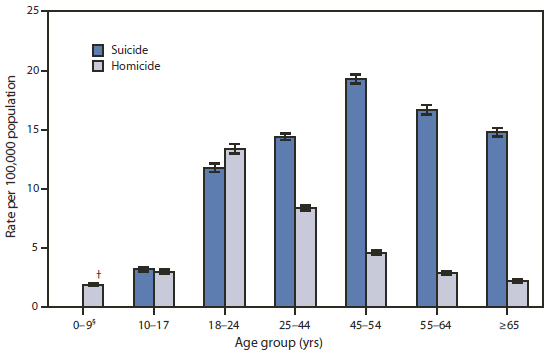
https://www.cdc.gov/mmwr/preview/mmwrhtml/figures/m6128qsf.g...
https://stateofchildhealth.rcpch.ac.uk/evidence/mortality/ad...
What I find interesting is the divergence at age 10 by gender. By the late teens, boys are about 2.5 times more likely to die, in spite of the probability being the same at age 10.
[1] https://www.statista.com/statistics/241488/population-of-the...
I know a guy back in college who majored in actuarial science but he's also doing computer science. These 2 subjects have good synergy.
"Health behaviors (rates of current smoking, obesity [defined as body mass index {calculated as weight in kilograms divided by height in meters squared} ≥30], and exercise during the past month)"
It looks at what ages people died in the year 2019. If you die at age 80 in 2019, that means you were born in 1939. But if people born in the year 1939 are living to age 80... how do I put this... wouldn't you expect people born in, say, 1989 to live longer? Wouldn't people born 50 years later have longer life expectancies? Especially if you believe the stuff about accelerating rates of technogical growth.
If you add the current age to the remaining years of life, the total lifespan is monotonically increasing. This is reflecting the fact you are only looking at the expected age of an increasingly dwindling group of lucky survivors.
Both were female, though.
In particular, I'm curious to see what years the population of particular generations peaked.
Edit: Actually what I'm really looking to do is to correlate certain marketing demographics with generations. For example, "in what years did Generation X comprise the majority of living people in the 18-34 demographic?" (where Generation X is defined as people born 1961-1981).
It's also a great study case for understanding some basic principles of linear algebra: The dominant eigenvalue is the stable population growth rate, and the corresponding eigenvector is the stable age distribution.
Roughly 20% make it to 90.
And around 1% make it to 100.
The road curves steeply at the end!