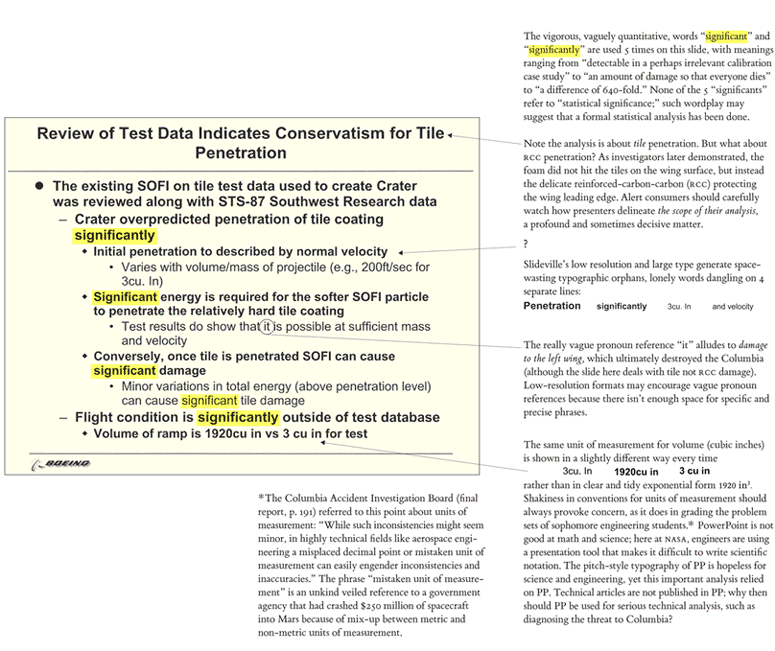
The title is not reassuring. Conservatism in engineering is essentially about creating safety margins through conservative estimation. The title is saying we need to be careful because a tile was likely penetrated. Hell, if I remember correctly they were reporting that there was known tile damage on the news before reentry, but that they didn't know the extent.
"NASA felt the engineers didn’t know what would happen but that all data pointed to there not being enough damage to put the lives of the crew in danger."
If you thought they didn't know, then ask them what they do know! It's right on the slide that flight conditions are outside of test parameters and that the mass of the projectile was much higher. How the F do you work at NASA and not understand the basic principles of mass, velocity, and energy well enough for that to stand out enough to ask questions or run your own calculations...
The reason the slide is laid out the way it is, is because it's describing the thought process and creates a deductive argument for how they got to their concern. This is a presentation for a briefing for other engineers, not a conference or sales pitch. It's supposed to be formal and contain the synopsis of technical points. Using projectors for technical briefings predates the use of PowerPoint. I see nothing wrong with the layout in that context.
Edit: why downvote without a reply? NASA has a history of blaming vendors when they screw up. This looks like another example to me. The presentation format does not have any issues given the setting and target audience.
To say that "the slide doesn't have any issues" is laughable on the face of it. But it's immaterial; your claim is that "NASA just ignored the engineers from Boeing" rather than "NASA didn't understand the engineers from Boeing". Communication is a two party process, and believe it or not, NASA isn't actually incentivized to take risks that lead to loss of life and damages public perception of them; it's far more likely they didn't understand the stakes, and looking at the slide from that perspective, it's very easy to see why they would not have understood the stakes even if the Boeing engineers did.
As you said, it is a 2 way street. Slides are accessories. Do you have the conversation that unfolded during this slide and presentation? Did the audience ask questions about things they didn't understand?
Is there even any evidence that NASA didn't know about the damage or had a rescue plan?
You claim they wouldn't have taken the risk, yet if I remember correctly they had no rescue plan and gave a relatively low (70%ish maybe) survival rate. Low level employees did raise concerns about severity of the damage. This seems to support the idea rather the communication between the vendor and NASA was sufficient since some NASA employees shared the same view.
https://www.dailymail.co.uk/news/article-2271525/It-better-d...
It is a godawfull title. I believe that is how it reads to you but it totally reads the opposite to me. I read the title and it translates in my head as “we reviewed the test results and they suggest that the tiles are built sturdy enough to not get penetrated”. Exactly because what you say the word “conservatism” means to me that a system is designed to meet the loads plus reasonable safety margin. So if the review of test data indicates conservatism that means to me that the test found the test object roboust even with a reasonable safety margin. Otherwise i wouldn’t say that it “indicates conservatism” but that it “indicates lack of safety margin”.
> The reason the slide is laid out the way it is, is because it's describing the thought process
I agree, but that is not a good thing. People think in all kind of haphazard ways, before you communicate to others it is on you to look at your ramblings and make it orderly. The penultimate sentence is the most important one that should go first “flight conditions is significantly outside of test database”. That doesn’t mean that the tile is broken, nor does it mean that it is not broken. It means that we can’t tell from our tests.
Though in fairness they then have sub points that kind of contradict this conclusion rather than support it.
But honestly this slide would make more sense if several of the sub points where top level independent statements instead.
That point read to me as if they completely overestimated the damage.
And, for context, Edward Tufte, whose review of the slides is being referenced in this article, is the same one who misunderstood and misrepresented what the actual issue was during the briefing the night before the Challenger launch, in his paper reviewing the presentation the engineers made then.
Edit: previous HN discussions of Tufte's Challenger review here:
But their recommendation was challenged by the NASA SRB managers. And after an offline discussion the SRB vendor came back and had changed their opinion that it was safe. And the NASA SRB manager never brought up the o-ring temperature concern to the rest of the management team.
[0] https://history.nasa.gov/rogersrep/v1p90.jpg
[1] https://en.wikipedia.org/wiki/Space_Shuttle_Challenger_disas...
Yes, because the Thiokol managers overrode their engineers and said it was OK to launch.
> And the NASA SRB manager never brought up the o-ring temperature concern to the rest of the management team.
That was probably because NASA had already classified the O-ring issue as a Criticality 1 flight risk, which is supposed to mean that a failure could result in loss of vehicle and loss of life and that the Shuttle can't fly until the issue is resolved--and then waived it. So it wasn't as if the O-ring issue was a new one or that NASA wasn't already aware of its seriousness.
It looks like the bad "before" example in a presentation skills workshop. This was created by engineers working on life and death issues involving billions of dollars of hardware.
The slide from the post that you're referring to (which is 16:9) is a fabricated, probably created for this post, and is not a faithful copy of the actual deck that was presented in 2003. The actual slide—complete with a Boeing watermark, sans some of the errors and presentation issues we can see in the blog post, and in 4:3, of course—can be seen in Tufte's book.
Who knows why the slide in this post was fabricated (and why the author failed to indicate this fact anywhere).
The other issue is, some people really, really, don't want to speculate.
In this case it seems that the person who made the slide probably assumed that the tile could be broken with a high enough probility. But because it was outside all available data, the slide says that we don't really know.
Of course, anybody in a position to make such a go-no-go decision should have enough experience talking to engineers, and seeing this effect in action to recognize the slide for what it is. It is really weird to conclude that based on absence of data, it is probably safe.
A quick and dirty re-writing of the title (and slide):
_______________
Review of Test data indicates incident is well outside of safety margins.
- Volume of ramp is 1920 cu in vs 3 cu in for test
- Once tile is penetrated SOFI can cause significant damage.
- Flight condition significantly outside of test database
_______________
Now that should get a reader's attention.
My main point is that the title claims thus slide is what killed 7 people and basically blames the creator, but leaves out all the other failures. Slide formatting and wording (which ignores the actual discussion that should have gone with it) is really inconsequential compared to the rest of the process in a briefing.
Granted this is pure speculation on my part and should be treated accordingly.
"Given this, we strongly recommend against launch"
To the point of the article, I think this is the wrong takeaway, meaning the slides were not communicating effectively.
The second point illustrates this. It says the models were overpredicting the penetration. Meaning the models were conservative and the the actual penetration was likely less than what models show. They were setting the table for an optimistic outlook.
The real issue, IMO, is highlighted later in the article where there isn't sufficient fidelity in the tests to back up those claims. Tests after the incident showed the foam acted very differently at the delta-v that actually occurred.
And regarding your point about blaming contractors, the vast majority of work done by NASA is done by contractors. NASA is, to some extent, a pass-through organization that funds other organizations like Boeing, Lockheed, Honeywell, Jacobs, etc.
>If you thought they didn't know, then ask them what they do know!
This gets to the same cognitive biases that led to Challenger, EVA 23 and a host of smaller incidents nobody hears about. Data is not objectively weighed in these situations because of schedule pressure, optimism bias, etc. In this case, most launches were showing foam shedding with no issue, so it lead to a false belief that it wasn't dangerous even though it was out-of-spec. Add to that a slide that says the models are too conservative and you can see where cognitive biases may influence the decision. Lastly, most people like to think they're self-aware enough to identify these biases in real-time, but they aren't. It's also why the incident lead to a separate organization within NASA focused on safety, quality, and risk that has a segregated chain of command.
> This, however, is the story of a PowerPoint slide that actually _helped_ kill seven people.
I'm not so sure how many people are familiar with the term "conservatism" as used here. I'm not. Some might be aware, those who are not aware will just skip over
I read this slide a couple of times. There's no thought order, no connection between the topics (even if we assume people are familiar with the subject) and several typos.
It is not a Powerpoint fault it is a fault of whoever wrote this.
This is an issue with information hierarchy. If this is a risk (and I can't imagine what might have been a bigger risk at that mission) it needs to be brought into attention. Not added to line 4 of slide 7 and be done with it.
I don't expect "foam strike more than 600 times bigger than test data" would go over well politically. You'd be telling the audience that these people will die while everybody watches. No manager want to be the messenger for that kind of messages.
This has been a recurring theme throughout my career, the struggle between being seen as "alarmist" and accurately conveying urgency.
We get this in the medical field all of the time. "Outcomes delivered via mechanism seen as potentially contraindicated" or some other spaghetti. I've been in these meetings many times, where we (the individual contributors) have to tell the bosses or peers or partner group about something that might be bad. As in Y2K-style of bad, where it will be bad if we don't address it but if we do address it with the urgency needed, no one will be able to recognize the success for what it is.
As you said, no one's manager wants to be seen as crying wolf all of the time, but post-hoc there's the expectation that a couple of engineers way out at the end of the limb of the tree didn't just wait for the limb to be sawed off behind them, they took out the saw and did it themselves. That they stood up in the presentation and yelled "you're all idiots! This is going to kill the entire crew! Everyone will die, don't you see?! And I'm not standing for it!" just before they rip the badge off of their lanyard or belt hook and then righteously storm out.
And other communication, for that matter. Instructional videos from that era make "pro" YouTube look like amateur hour, let alone modern material produced by industry and government, which is even worse.
Have you ever worked for a business with “management”?
(not the one that downvoted your comment btw)
> Attempting to have slides serve both as projected visuals and as stand-alone handouts makes for bad visuals and bad documentation. Yet, this is a typical, acceptable approach. PowerPoint (or Keynote) is a tool for displaying visual information, information that helps you tell your story, make your case, or prove your point. PowerPoint is a terrible tool for making written documents, that's what word processors are for.
I think that’s on point for many companies. A lot of the terrible slides you see in meetings are actually intended as documentation after the fact, and few people recognize (or care) that this makes for a terrible presentation.
Ironically, I think Powerpoint isn’t such a bad tool for creating handouts. If the intended reader reads the document on their screen instead of printing it, a nice PDF with screen-shaped pages might actually be close to optimal.
You just have to be 100% clear whether you’re creating a document or a presentation.
[1] http://mamamusings.net/archives/2005/11/19/the_culture_of_th...
My experience outside of academia is that people use PowerPoint exactly for persuasion. Even to the degree that when I wanted to prepare a presentation internally, one of my bosses got angry because he thought I was going to bullshit him. (PowerPoint is something you do to a customer or to the board, not to your colleagues.)
PPTs are great, when they have been written by someone who knows what to communicate and how to do it, which involves knowing your audience. For boffins, slides that are denser than average but lighter than what they would otherwise have to read, are just fine. For the layman, one better err on the side of simplicity and direct impact.
> PowerPoint is something you do to a customer or to the board, not to your colleagues
That is bullshit borne of insecurity. If one can be persuaded so radically by a presentation, one's convictions are pretty weak to begin with.
Personally I am a big fan of powerpoint for making "boxes and lines" diagrams about how a product works, what process we're using, things like that. I love making stuff like
https://www.slideshare.net/paulahoule/making-the-semantic-we...
It happens in my corner of academia too, and I'm all for it. When I give a talk, I'm trying to persuade people to read my paper and ask me interesting questions about the work. The paper has all the gory details. The point of my talk isn't to duplcate the written text, but to make it accessible enough that people want to learn more.
1. presentation - should be sparse, key, anchoring data that enables people to ground themselves while they listen and pay attention to YOU
or
2. Reference - dashboard and background and details and density
If a deck may be used for both purposes, intentionally or not (e.g. we expect it to be shared and referred to by people not attending), resist the urge to do a hybrid slide, and if at all possible make presentation slides at front, reference/supplementary slides at back.
Worst situation is when somebody uses what are effectively reference slides for a live presentation. People's attention is split between reading and making sense of dense information on screen, and the key important points you are trying to verbalize.
This has been my SOP for years, but its amazing how resistant some folks are to it (like $NUMBER_OF_SLIDES is the sole measure of quality...with "more slides are bad, mmmkay" being the default). I fought with my last boss on this endlessly, as I would rather have many slides with small digestible chunks of info that I could scaffold my presentations through at a brisk clip, and they preferred as few slides as possible, with dense text and charts, that they would elaborate on in long exposition.
I always got better positive feedback, to no avail. My decks would be 'edited' into a compacted slop-fest. Drove me batty.
High-level stats during the actual presentation, meaty details available upon request.
As a presenter I have to worry about whether my slides will be seen w/ or without video of my presentation. Therefore I try to make my slide decks able to stand alone, though I admit this is not great.
The common pattern now instead is to make colorful and near-content-free slide decks where the presenter simply speaks with colorful backgrounds. I am terrible at crafting such slide decks -- well, I've not tried. This pattern works while presenting though, and I should probably adopt it. Or perhaps I should adopt the Jeff Bezos approach.
What presenters and audiences need is a commitment to publish video of presentations, including Q&A segments. And video has to be playable at 2x speed.
(Yes, almost every video I watch I watch at 2x speed. Where platforms allow faster playback speeds I've even gone faster. Speech is extremely low-bandwidth. This does mean I've to backtrack more often than I'd like, but it's still better this way. I pay attention more when speech is faster -- up to the point where I can't follow, of course, and which I shy away from.)
I use presenter notes precisely for what you're describing. My actual slides are sparse, but I distribute slides with full presenter notes so all the main points get across in a written form after the fact, without distracting from the talk.
In Powerpoint, I use the "print to PDF" function and tell it to generate pages containing slides with notes.
I'd add a tip: start writing your notes in the speaker notes and leave the slides blank, instead of the other way around (which is kind of what PowerPoint's UI pushes you towards). Only create the actual slide content after refining your speaker notes once or twice.
For me, at least, I find it's much easier to add content to the blank slide than it is to refine (aka: erase words from) the sentences I initially type out. I tend to like slide content that is graphics (photos, screenshots, graphs, diagrams), titles, or lists of short headline-style text (1~3 words).
Since seeing that, I double-down on making my speaker notes tell the story for those that couldn’t be in the room.
What you want are the talk notes, something you can read to understand what the shape of the talk was, what context each image came out in. The video of the actual talk substitutes quite nicely for these notes.
It would be preferable if more presentation media had a “front of card/back of card” approach where the card itself specifies how long it thinks it should be on the screen (evaluable over “timing runs”), bullet points for the speaker and readers of the printed form, as well as the image that will be shown.
I've seen Powerpoint since medical school evolve from trying to squeeze as much information as possible on slides to utter nonsense and hundreds of words per displayed page. Heck, just stay home and automate your presentation to display the slides and mail them to your students instead, don't do this.
I've also been guilty when having to turbo half ass wing a teaching session of stuffing a lot of text in my slides. But I was aware this was not appropriate and I always tried to not be "that person". However, when you have 30 million presentations per day around the world, this is almost impossible to do.
He answered: „Awesome. I had 8 slides this morning. Now I have three.“
That day, something fundamentally clicked in me.
I learned that day that condensing and sharpening information towards a punchline is real, hard and meaningful work.
Or, as Mark Twain once said, “I didn’t have time to write you a short letter, so I wrote you a long one.”
I am partial to Woodrow Wilsons' variation on the theme; something resonates when I'm asked to for a development/programming estimate.
I wish pdf would die. It's a left over vestage of a paper world. It's also left over from a non-connected, non-international world A4 vs US Letter.
PDF really has no place in this smartphone first world
When your screen is bigger than a page, reflowing the text is almost never what you want because long lines are hard to read. Thus even though computer screens aren’t limited to the size of a sheet of paper, you want to wrap your lines at paper-width (or better, book width) anyway.
Note that programmers typically define an effective page width for source code by enforcing an 80-100 column limit.
:shivers:
Makes me think of being forced to dig a hole with tweezers.
Right, but you can create such a thing with a word processor. Just change the page size or orientation.
Sure, the page breaks might not default to where you want them, but you can add page breaks wherever you want, and don't need to create a text box for each paragraph.
If you start doing fancy CSS tricks you can break that too, of course.
That's not how I remember it being presented to the public. The official word at the time was that there were no feasible rescue options. Yes, they could have done a spacewalk to inspect the damage but if it had been bad there still wasn't anything that could have been done. I think the main problem with launching a rescue mission was the time it took NASA to get a shuttle ready for launch.
Atlantis was already scheduled for launch 41 days after Columbia. Columbia had ~30 days of air. NASA believed that Atlantis prep could have been accelerated and launched in time to attempt a rescue.
https://arstechnica.com/science/2016/02/the-audacious-rescue...
Basically yeah, it could have been done, but only by pulling out one of the other shuttles out of active maintanance, skipping a whole bunch of repairs and necessary checks, launching in record time, and actually managing a situation where there are two shuttles in orbit, something NASA wasn't exactly prepared for at the time.
And the biggest question of all - what if the second shuttle becomes damaged in the exact same way on the way up?
That's not to say that NASA shouldn't have at least attempted a rescue. Knowing anything about the way US approaches situations like this, it would have been a "no expenses spared" effort and they would at least try. But unfortunately it's extremely likely that the second shuttle would have also been lost on the way, with crucial maintenance and checks skipped just to make it space worthy in time.
https://arstechnica.com/science/2016/02/the-audacious-rescue...
That there was "no other feasible plan" than re-entry was presumably because the risk of re-entry was assumed to be low. If the risk was correctly estimated to be higher, then it seems likely the rescue plan would become feasible (since, what other choice would NASA have?)
Everyone here is dogging the Slide. Sure it sucks - but I DISTINCTLY remember analysis of resuce. Do a space walk and repair it; send a second shuttle (they existing crew would run out); something else.
Also, the crew had a chance to call their loved ones and "sat good bye", and the pilot was anticipating the wing melting off.
NASA knew the risk, they tried to prevent it - but the shuttle still crashed
Reading word for word off a text-heavy deck in a monotone with no images or diagrams is a recipe for disaster. I tend to have my decks (back when I was doing presentations) be relatively text-lite and involve images/diagrams that back up my talking points. And I've seen image-heavy decks that really don't convey anything either.
[EDIT] There's also a kind of horrendous, illegible house style some places, that's expected to be how these documents look. The US military and any big businesses that work heavily with them are infamous for this. They routinely produce some comically terrible decks and graphics. I wouldn't be surprised if that weird, seemingly-intentionally-hard-to-read style is also present in at least some parts of NASA, especially up at the administration level.
  1. Title slide with company logo
  2. Content slide with 2 or 3 bullet points
3. Closing/thank you slide with contact infoUnfortunately I direct experience and it's definitely present in some parts of NASA. We have increasingly been doing away with presentations when reporting updates up the chain. Just shoehorn your work into a single poorly designed slide and lob it over the fence. Your project manager rolls up your slide with everyone else's and lobs that deck over the fence to the program management. Hey, at least it's one fewer meeting.
Nothing gets the creative juices flowing like sitting through an 8 hour presentation of a deck with 200 slides, which are really just 10 different slide decks from 10 different departments stitched together, mostly containing quotes copied from actual design documents and pasted into bullet lists
That's true, but it's also how much time the presenter had to put the presentation together. Was he already 6 weeks behind on a dozen (meaningless) deadlines when he found out he had to give a presentation tomorrow morning at 8 AM?
Most time when I see a wrong and overful slide deck, people don't actually have any idea what they want to say. They just dumped some information in the slides that might be handy.
That is part of the reason Powerpoint is everywhere. You cannot assume that people have read anything before the meeting, you cannot assume they will read during the meeting, so you need to read it out loud to have a decent chance of it being received.
I am also not thrilled accepting the use of titles and formatting as a excuse to skim 100 words. It is just the refusal to read/comprehend on a smaller scale.
I've been told—very seriously—by multiple management consultants that public and private sector executives alike won't read a damn thing unless it shows up in powerpoint format, and even then you have to walk them through point by point or they'll miss most of it. This, when the documents are coming from people they're paying tons of money specifically to tell them stuff.
The company in question (you've heard of them, if you've heard of any management consulting companies at all) quite literally had an off-shored office dedicated to producing PowerPoints decks from notes overnight, while everyone on an actual engagement was sleeping. The primary tangible output of an engagement, as I understand it, is, overwhelmingly, PowerPoint decks. It's the Final Draft of the upper-end management world—apparently, you'll be dismissed and lose face if you show up with anything else, or even send something else in an email.
I wouldn’t want to give up engineering, but I think that sounds like something I could put up with if someone forced me to be an executive.
If this was a presentation done in high school they would have gotten a failing grade. And I think we can expect more from university educated people.
If someone wrote "I approved the landing as the title of the slide did not seem alarming", that person would be resoundingly rebuked. That would be an outrageous official rationale and the person would be regarded as lazy and negligent.
But that is practically what happened and what we excuse.
I agree, we can expect more from the presenters here.
Experts are humans, experts get bored, experts can't necessarily follow your bad presentation.
Underneath it all we're smart monkeys, not robots. You can't force yourself to pay attention indefinitely. It's not in our biology.
No matter how smart you are if you hear hours of presentations in a day, you will only take home a certain maximum amount of the stuff that seemed important.
If you're a presenter, and you have something life-and-death important to say, you should repeat it, you should put it into simple words, you should use appropriate language, voice and maybe even pictures to make it clear.
I mean, NASA is the one who called in the vendor engineers to answer questions they had. If you didn't get answers to those questions, or if the answers weren't clear enough for you, then NASA needs communicate that. You can't get the information you want if you don't ask the questions. Everyone here is blaming a slide deck (that had the information on it!) instead of asking how NASA could have ignored that information. Slide formatting is a pitiful excuse for lack of due diligence by the recipients of that briefing - the people responsible for the safety of the at-risk personnel.
This led to a certain realistic fatalism:
"Then [Linda Ham] delivered the sentence that would define the rest of the tragedy; a sentence that was repeated as common wisdom by almost every senior manager that I talked to over the next two weeks: ‘You know, if there was any real damage done to the wing, there is nothing we can do about it.’ As unsettling as that was, I had to agree; going back to the first shuttle flight it had been well known that there was no way to repair the heat shield in flight. Nobody, not even me, thought about a rescue mission. Why would we?" - Wayne Hale, https://waynehale.wordpress.com/2013/01/07/after-ten-years-d...
Once it became clear, during the investigation, that the foam impact had created a hole in the reinforced carbon-carbon leading edge of the wing, the board's chairman, Admiral Hal Gehman, insisted that a test should be performed to demonstrate that this was likely. As this meant destroying one of the few spare parts, and it had not been decided at this point to retire the shuttles, he was unsure whether this was worth doing, but what convinced him to go ahead was the number of engineers and managers who still doubted this could have happened, despite all the evidence.
It is never just one thing.
The whole of Wayne Hale's retrospective starts here: https://waynehale.wordpress.com/2012/08/14/after-ten-years-w...
Especially when Boeing is involved
The people making the decisions, whether they listened to the presentation or not, perhaps gave too much credence to what was on the slide. The audio portion is temporal, even if recorded. You're there in the moment listening, but it doesn't necessarily last.
But the slide is "eternal". Always there to be referenced, or passed along. The slide was going to be viewed repeatedly over a longer time frame. Biasing the memory of those who may have been at the presentation, and serving as a "single" source of truth for those who did not.
As much as PP is meant to be a visual AID, most folks are actually pretty lousy at using it that way, and PP has morphed, even if unintentionally, as an artifact of record.
I'm as guilty as the next guy wanting to skim the PP deck rather than listening to the presentation. I can skim a deck in 5m, vs sitting for 60m listening.
Similarly for technical papers. Read the intro, the summary, skip to the end, read the conclusion. Only if any of what I read is actually interesting will I dig deeper in to the paper.
This isn't an appropriate comparison. The purpose of the conclusion is to present the findings of the paper, whereas the purpose of presentation slides is not (or at least, should not be) to summarize the content of the presentation.
It’s a wall of text. It should have had a single sentence in bold giant font:
WE HAVE NEVER TESTED AN INSULATION COLLISION AT ANYTHING CLOSE TO THIS LEVEL
"SOFI and ramp mean the same thing, whats the reader to dooooo"
"Significant is used 5 times... without explanation!"
"There are 100 words!"
Yes, we need to know how the presentation went, and we also. need to know what NASA would have alternatively done and if it was honestly considered at all or even feasible
On a side note, its crazy that a couple tiles compromise the entire vessel, but I understand that the heat would travel across the inner metal. Its still crazy to think there isn't some other kind of dissipation measure possible.
Wouldn’t the foam initially be travelling as fast as the spacecraft? So it’s just the time between it’s release and hitting the wing to accelerate.
Which technically is the speed of a bullet, but just barely. Nowhere near nine times.
http://s3.amazonaws.com/akamai.netstorage/anon.nasa-global/C...
These managers were REALLY that braindead? These are NASA managers in charge of life-or-death decisions, and their dull eyes glaze over as spittle puddles underneath them because they're too stupid to read one whole entire paragraph worth of text without ignoring subheadings because they "don't look important"? I hope they're happy with the result of their childish intellectual laziness.
If you're in charge of 10000 life-or-death decisions, and are on a tight schedule, you are unlikely to give each of them its proper attention.
It doesn't look too bad on my desktop, but on my Android which is set to 130% it's almost unreadable. I had to use reader mode.
And it doesn't resize on mobile, probably because they're using px in their CSS instead of em or something scalable.
When the shuttle design was finalized in the late 1970s they knew it had a 2-3% chance of a hull loss per launch. They were still planning to launch it 50 times a year so that would have meant losing a shuttle and crew every year!
The shuttle had hundreds of critical flaws and that 'normalization of deviance' meeting at which slides like this were shown at was a routine part of each shuttle launch. For each of these unacceptable situations they had to convince themselves that, with some mitigation (or not), they could accept it. It was inevitable that something like this was going to happen and then there would be recriminations about the details of that meeting.
Every other crewed space vehicle had an escape system to get the crew away from a failed rocket. The Challenger crew survived the explosion but were killed when the reinforced crew section hit the ocean. Similarly the Colombia astronauts were killed by a thermal protection system that was "unsafe at any speed". When the first few shuttles were launched there was a huge amount of concern about tiles breaking and coming off. Once they'd dodged the bullet a few times they assumed it was alright but it wasn't...
In the literature "normalization of deviance" has turned from a formal process used in managing dangerous technology to incidents such as: surgeon takes a crap and goes to work without washing his hands, forklift operator smokes pot and operates, etc.
At the Flight Readiness Review for the solid rocket boosters before launch the engineers of Morton Thiokol (the solid rocket booster manufacturer) objected to launch because of the detrimental effect of the cold temperatures on the o-rings in the solid rocket boosters. They had never launched in that cold of temperatures before and previous test data had shown erosion of the seals on previous flights. These concerns were not communicated by the Morton Thiokol management or NASA present at that flight readiness review to any of the higher level managers that got final approval on launch.
For Challenger it was a known issue and people specifically said "don't do this".
Charles Perron, in the book Normal Accidents warns of the tendency of people to subtract from the safety margin of a successful system in the pursuit of speed, performance, profits, etc.
It does boggle the mind however that with so much documentation for the Shuttle they never thought to specify a minimum launch temperature!
One huge issue, beyond whether a rescue mission would've been possible, is whether it would've be ethical. If NASA knew that Columbia was stranded in orbit, then it would be knowingly sending a second crew up on a vehicle with the exact same potential problem, with no time to mitigate it. I'm sure a rescue crew would've volunteered despite the risks, but anyway the point is that "the slide that killed seven people" is erasing all of these questions.
This article is not attempting to answer that question, there is volume of literature on that.
The primary thrust of the article is to highlight a common tool we use and how using it ineffectively can be dangerous, it does a good job of communicating that point effectively albeit with click baity title.
I and most people here wouldn't understand tile design or shuttle engineering or ethics of space risks and not something we can learn from, it is rocket science after all,
However crappy PowerPoint presentations we all use and consume and we could potentially improve communicating in our day to day professional lives even if though we don't do cool NASA kind of projects.
Then they would have been fired unceremoniously and replaced with engineers that knew better than to make their bosses look bad. (who themselves would then, of course, been held responsible for apparently preventable deaths).
Stop blaming the engineers for this stuff. This is the fault of the timeline chasers.
More engineers need to risk this and raise red flags, publicly, about potential lethal faults. Yes, you will suffer if you get fired; but our education as engineers (if I may include myself among those ranks despite being a software guy...) must be such that we would find _not_ raising the red flag shameful and despicable. So much so that it would seem far worse than losing one's job.
This is not just a normal, routine presentation. This is an all hands on deck emergency and discussion. And NASA isn't just a bunch of MBA's, but rather people who have spent their entire careers immersed in this kind of stuff.
No matter what is one the slide, I expect that the audience asks detailed questions. Even if the slide has just a big thumbs up emoji, I suspect you would still get a lot of really hard questions.
Think about presentations on programming, where someone in the audience points out that the example code on the slide is incorrect/won't compile/undefined behavior
I would expect a bunch of geeks (which I think would be there at NASA) to scrutinize the slide and try to find any flaw in the logic. Especially when the lives of people they deeply care about are on the line.
If they are so cavalier about human life that they just skip the details of the slide while making literal life and death decisions, it speaks of a very deep culture rot that goes far beyond PowerPoint.
IDK. I too like to think the discourse and Q&A would have signaled differently than the slide. But, this is also 2003 and people generally had not gotten great at communicating via powerpoint yet. It's still bad now, it was horrible then. A unformatted list of bullet points was obviously still an acceptable slide format which tells me a good deal of how much slide skillz these folks utilized.
So, I do believe the slide title. I feel like it could have just as easily been discussed prior to the slide, it was agreed the test was acceptable or risk was low, and so the title was just trying to indicate that "it's been pre-agreed there is no problem here" then outlines some of the concerns which were considered.
Alternatives like Prezi exist, but are not really going to be accepted in formal presentations https://infovisu.com/assets/pubs/linder2015beyond.pdf .
If you really bring me a physical piece of paper today, I doubt I would be able to keep track of it.
I remember reading each of the astronaut's bios after the Columbia disaster, and the same thought kept echoing in my head: what a tragedy, what a waste. Seven remarkably talented people. I had no idea until I read this article how easily their deaths could have been avoided.
In reality, there was likely nothing that could have been done once the damage occurred. Example source (form the 3 months after the disaster) here [1].
At the time no space shuttle was kept ready to launch for rescue (though this changed after this disaster) and their options here were limited. A common thought is 'just dock at the ISS' but the shuttle didn't have the fuel to reach it (future flights would ensure they were in the same plane to be able to dock there).
A more in depth review years later(with a summary here [2]) did find that it may have actually been possible to launch another shuttle in time, but it would have had to have skipped safety checks, and importantly, launch with a known issue on board (the foam strike possibility). And even then, the rescue mission would have had to gone off without a hitch, because even in the absolutely bare minimum amount of time required, the Columbia crew would have been dangerously low on oxygen.
[1] https://www.spaceflightnow.com/shuttle/sts107/030430save/#:~....
[2] https://arstechnica.com/science/2016/02/the-audacious-rescue...
Yes, you can de-emphasize information in a powerpoint presentation, just like you could with a chalkboard, overhead slides, or any other way of presenting information to a group. So what?
https://www.edwardtufte.com/bboard/images/0001yB-2239.gif
I think it's why I think teaching engineers how to draw and do good design is important. How big is a cubic inch? How big is the crater in the heat shield that we're talking about?
It would have been better to draw comparisons and explore things. Here's a simple sentence that could have done better;
"Sir, our test database was for objects the size of an average icecube. The thing that hit the wing was the size of seven and a half footballs. It's 640x larger!
[chart that shows just how much kinetic energy we're talking about]
We're looking at somewhere between 640x to 1000x more energy than we've ever seen. We have a problem."
A friend and I did an interview with Don Eyles a while ago and he said something that haunts me, "if you see something, say something" https://twitter.com/_areoform/status/1501589762599112704
I'd like to go a bit further. If you see something, design and explain something. Challenger is a great example of this; Dr Tufte covers it extremely well, just laying out the boosters and the blowthrough they experienced from left to right on a chart that has temperature as the X axis, you can see clearly that it gets worse as the temperature drops. But no one at NASA or Thiokol thought about doing that.
No one thought about humanizing the data. They knew how important it was. They tried to say something. But they couldn't express it.
It's not enough to just show people the data. We need to get people to understand it. And that's often social suicide.
It's easy for people to want to remain stuck in their status quo, no one likes the "negative person", but that's what ends up getting people killed in safety critical environments. And that's how we get messes like the ones we're in today.
One particular one that comes to mind is climate change, I am unsure if most people are aware of this, but it's very similar to the failure expressed here. Most of the scientists whose work is consumed by the IPCC and the models that are published by the IPCC know that the "consensus" is wrong. Except, it's wrong in the opposite direction to what certain people want it to be.
The reality is far worse than what the models suggest. The models still don't include the loss of permafrost - what's worse is that they don't model the non-linearity of permafrost loss, methane emission, that then sparks more warming and more permafrost loss etc, https://www.woodwellclimate.org/review-of-permafrost-science... nor do they include effects of how the climate would change of ocean conveyor currents shut down (AMOC in particular is of significant interest, https://www.aljazeera.com/news/2021/11/12/concern-grows-over... ). They also don't model the melting and release of clathrates from the ocean, or the effects of ocean acidification, and several other non-linear processes.
I had a very polite, but heated argument with one of the scientists involved and he told me that they aren't going to include that, because if they do, the numbers will look much worse and they'll be dismissed as apocalyptic loons.
Which brings us, elegantly, back to the point that Dr Feynman made in his remarks about the Challenger disaster,
"For a successful technology, reality must take precedence over public relations, for nature cannot be fooled."
That's an understatement. A close reading reveals that it misrepresents the position of Tufte's writing, the conclusions of the investigation board, and the report of the subsequent return-to-flight group.
And it uses "sweetened" (fabricated) figures, to boot. <https://news.ycombinator.com/item?id=30622688>
Slides make sense as a way to introduce the outline of concept to a broad audience in a way that requires much less effort than 1-on-1 discussions. They are not a means for coming to decisions. If you need to make a critical, life- and business-shaping decision off the back of a side deck, you should instead delegate the decision to someone who knows more than you.
https://www.edwardtufte.com/bboard/q-and-a-fetch-msg?msg_id=...
One slide and bad culture killed seven people.
There is a simple low-effort high-information solution to this problem - have everyone vote (or bet) on the decision. This, more than anything else, will reveal whether or not you've reached understanding/consensus/alignment.
(This is not to say that the final decision should be made by voting, rather it's to gauge the level of consensus)
Alternative title: death by ears, how failing to listen and communicate killed seven people.
My own personal experience is that it's easier to be concerned with the small things (we have to have naming conventions), than with big things (are we building the right thing). I think there is a tendency to think "it'll probably work out".
I agree: it's an awful slide. But the information was there. And I can imagine that the engineers were asked to assemble that presentation in a couple days, so I'd be surprised if they could do anything better.
I agree: an outsider would not understand a word of that slide. So what? What was the audience of that presentation? Why did the audience not read the slide / documentation beforehand? Why was it not understandable by them?
Again: the point here is the stakes. Would I read such a presentation for my day-to-day work? Probably not. Would I read it until I understand every single word if there were 7 lifes at stake? OF COURSE! Would I try to understand the engineers that had to assemble a comprehensive and credible document in a matter of days, and do my part of the work? If it was my day-to-day job, probably not. If there were 7 lifes at stake? OF COURSE.
So yeah, terrible slide. Don't try to justify people not reading it, though.
https://www.amazon.com/gp/product/0596522347/ref=ppx_yo_dt_b... https://www.amazon.com/gp/product/0470632011/ref=ppx_yo_dt_b... https://www.amazon.com/gp/product/1101980168/ref=ppx_yo_dt_b...
If you only have time to go through 1 book, I would recommend Slide:ology.
I mean obviously Boeing engineers need to communicate to NASA their assessment of the situation, but they don't want to be blamed for any technical difficulties (e.g. if second shuttle would have to be launched to save the crew). So they think Columbia will probably be fine, but let's communicate our worries to NASA, but let's do that in deliberately vague and conspicuous language, in hope that NASA managers won't see the fine print.
But this '...has grown exponentially...' is just such BS. sigh I just cannot get used to this expression entering lay language.
We don't need Tufte and his subtle points to see this was an abominable piece of communication. More important, would be the question "is it safe to call out a bull shit slide in a corporate meeting". We hear of how Bezos or Jobs would be rude and obnoxious to their employees when something was not laid out clearly. This, on the other hand is where politeness takes us.
Death by PowerPoint: The slide that killed seven people - https://news.ycombinator.com/item?id=19668161 - April 2019 (127 comments)
Death by PowerPoint: the slide that killed seven people - https://news.ycombinator.com/item?id=24115837 - Aug 2020 (1 comment)
Yes. This proves PowerPoint isn't to blame per se, but how it was used.
The shuttle is inherently dangerous. An endless # of things can go wrong. The Shuttle program should have been grounded anyway on the basis of cost and danger. Too bad it took a tragedy for that to happen.
hindsight bias
done properly, one could read the heading and subtitle of each slide and never need to look at the contents, unless some specific detail is desired/needed.