Personally in winter I heat my house to 14c as a minimum, 20c in the living room and office. Reason being I only need warmth if I'm sat down and not moving, so any higher and I start to get too hot.
My temperature is now approaching absolute zero.
Needless to say that thermal insulation is awful in IT.
It's the other way around. Indoor temperature varying with the outdoor temperature is one of those weird things you experience when going abroad from your colder climate, at least in Europe.
I don’t know if I live in a cold climate but people will start to complain if the temperature goes below 21C indoors.
So I wear 3-4 layers, including fingerless gloves and a hat. It looks ridiculous, but nobody sees me. And in summer, well... I don't wear much or anything. I at least put on a shirt for video calls :P.
Frankly, it sucks; and this is my last year here before I go nomad full-time.
Back in 2012 to 2015 I worked most of the time I think in the radio lab at the company I worked for at the time. Temperature was often above 30 degrees in the summer. I didn't think much of it back then, went into office, started working and forgot everything but after a while I realized I was drinking 1.5l water during the work day without needing to visit the restroom and I would be exhausted when I came home.
It was noisy and warm but almost no interruptions and still very nice compared to insulating an attic in in the summer (I've done that too so I know.)
(This winter I tried working from the garage in December but at below 0C it gets impractical even with really warm clothing.)
I live in a '30s UK semi detached. It had an air brick , a blocked up fire place and blown double glazing in each room. (barring two that were replaced)
We had to re-render the place, as it was starting to fall off at the front, and the back was scarred from unfinished renovations.
We replaced the double glazing with triple (it was cheaper than double glazing at the time, so a no brainer. has a u-value of about 1.0)
We also put 90mm of external wall insulation round the outside as part of the re-render. This cost an extra £4k compared to just a normal re-render.
before the insulation, in summer the front room would reach 37 degrees C with the blinds down, and in winter with a 5kw wood burner and central heating on full we'd reach about 18 degrees c when outside was either windy or -3c
Now in summer the hottest we've had it is about 29, with the blinds open. In winter we reach 20 within 30 minutes of the heating coming on. ( no need for the wood burner)
My parents also have a door to the attic for storage and heat leaks up through the un-insulated edge of the pull-down stairs door.
On YouTube Matt Risinger is a great resource for home repair and information. He tends to like expensive products but overall he explains main concepts well.
Early on, Risinger did a bunch "building science" explainer videos. Challenging then conventional building practices. Like advanced framing (using 2x6 studs at 24" spacing). Like properly insulate attics to prevent condensation and heat loss (keep HVAC vents within the thermal envelope).
Those early explainers are the foundation (harhar) of subsequent product and project highlights. Alas, now they're hard to find (via YouTube's lame UX). Risinger should probably pin primers to the top of his playlist, linking into his archive.
Having insulation on the outside of your structure, and especially outside of your air/vapour barrier, is ideally where you want it (behind whatever cladding you're using):
* https://www.buildingscience.com/documents/insights/bsi-001-t...
For us it stopped our moisture problem. We had mold growing on the walls, because all the moist air would hit the wall and dump out water (proper drops).
Now the walls are 10 degrees warmer, none of that condensation is built up.
there is also thermal mass and junk, but not having to wipe down the walls every night is a big big win
He does not go into much detail on roofs, but in his wall examples, the outer cladding and the drained cavity behind it appear to be a de-facto rain control barrier outside of the insulation layer (which could be, he says, rock wool or glass fiber, which are surely a big problem if they get wet, right?) If this is so, then what does it mean to say the insulation is outside of the rain control barrier? Furthermore, if we combine these diagrams with the one showing a roof-wall junction, there does not seem to be any barrier against rainwater reaching the wall insulation that way, and I cannot see how this is not a problem.
the exterior wall features brick/stone cladding as a primary rain/UV barrier and thermal buffer, and a channel to wick away air, heat, and moisture on its interior, before hitting the "control layer".
the interior wall can be concrete block, steel frame, or wood frame, with only the latter insulated, and with a semi-permeable interior skin (gypsum board + latex paint).
both walls are designed to wick moisture away from the control layer to reduce mold and other problems.
the big downside to these perfect walls are that they're actually two walls, and as such, (roughly) twice the cost of regular stick-built walls, and they're twice as thick, which, given a fixed lot size, reduces interior square footage.
I keep hearing (to my naive/inexperienced/non-builder mind) contradictory advice about how insulated houses should be, and I've been trying to figure out how to square decreasing heating/cooling costs with keeping a house from feeling stuffy.
I guess for stuff like the triple glazing that's not really affecting air exchange in the first place, it's just preventing energy loss, since you're already not doing air exchange through your wall. And maybe getting better insulation in walls means you can crack open a window without it being as much of a problem?
Our old house, built in the 1920s had been basically sealed. Since it was only 1600 sqft and had no air ducts, the rooms were small and got terribly icky. Id crack the window open in the winter to get rid of the humidity (in PA, so hardly mild winter).
You have to realize that a lot of moisture from those those 8 tall glasses of water you’re supposed to drink leave your body as vapor. I think I’ve read half the water you expel is through your lungs [citation needed]?
If your house is sealed this water has no where to go. If there’s four of you it gets bad very quickly. This moisture eventually will escape through your drywall, into your insulation and finally through the cracks of tour siding; but that means materials that should be kept dry aren’t
Our new house is very drafty and I dont plan to fix that until I instal a heat exchanger. The air in the new house is much better, and despite being at least double in size our bills have only doubled (ie the added draftiness doesn’t seem to have had that big an effect)
The solution is a heat exchanger. This is a device that exhaust stale air and replacing it with fresh air while passing through a heat exchanger. You can have very large air flows with the outside almost free energetically.
I don't have empirical evidence, however I am pretty sure that we have reasonable air exchange. My evidence for this is threefold:
1) when we have used the log fire, it didn't kill us, or pull the door open.
2) there is still a slight draft,
3) we have a missing floorboard in the understairs cupboard
Whilst all of the air bricks in the rooms were covered, the suspended floor still has four bricks exposed. The triple glazing is sealed UPVC, however in the loft conversion we were forced to have trickle vents (I think thats overkill)
It doesn't ever feel stuffy, which is good. I do need to get a real CO2 monitor though.
One last bit of evidence is how quickly particulates from cooking disappear
Found this while searching: https://www.ag.ndsu.edu/publications/energy/air-to-air-heat-...
It drives me up the wall, winters are not long and it doesn't get that cold but there's a few days a year when the weather drops to around 12 degrees celcius within my apartment (so 54 degrees Fahrenheit) and as someone from colder climes that's used to central heating, I'll say that I much prefer a cold winter with a warm home than a mild winter with a super cold home. I've seen the same when I lived in Japan...
Additionally due to the poor insulation, you get to hear the noise outside quite a bit which I personally hate.
However, there is still a significant amount of single-glazed properties in poorer areas or in listed historical buildings.
I think that might change as we go towards energy efficiency, we need to swing the needle back towards more efficiency = good.
If insulated well and air sealed a home would lose very little energy. But also you'd need a good air handling system to move and refresh the air.
And therein is the rub! Ventilation is critical in building design and many older houses cannot easily be retrofitted with a mechanical ventilation system, not to mention the costs.
Also, sealing air gaps is pretty much impossible in a house that wasn't built this way. I have been trying all kinds of things in my (30 year old) house to seal up gaps but there are spaces inside the floors to the outside through small mortar gaps, spaces behind electrical sockets, gaps in various parts of the floor and even around windows between the finishing.
I would personally like to see a more top-level view from governments. In the UK, for instance, they should be targetting the oldest housing stock and simply replacing it. I know this is hard because people own their freeholds but if we are serious and if someone would get a nice warm house in return for their old house then I think most people would be up for it.
I kinda feel sorry for the guy, investing all the hard work and having good intentions, but due to poor workman ship he cannot expect to get the insulating effects he's surely hoping for.
Is this a correct usage of amortization?
But with cold bridges and such it can be a little complicated to get right.
Note: I suggest using underfloor heating, it should be more efficient with a glass roof, because there is less hot air to raise to the top of the house.
Buildings like this in Paris are often so tightly packed together that windows in walls barely provide any light. Replacing the roof with a more standard one would necessitate giving up any daylight and having lights on all the time.
this period is important. otherwise number doesn't mean much to me.
Thats the amount planet's biosphere can process divided by number of peoplle.
To put that stat in perspective, the average carbon emmisions per person [0]:
Qatar is almost 40 tonnes pp
United States, Canada, Australia is about 15 tonnes pp
Switzerland, France, Italy, under 5 tonnes pp
South Sudan is about 0.13 tonnes.
It really puts in perspective how much wasteful carbon reduction and lifestyle changes are needed for us to have any reasonable expectation at curbing this.
Edit: added source
[0] https://ourworldindata.org/grapher/co-emissions-per-capita
Degree days work better in regression as, assuming the correct base temperature is chosen/calculated, heating degree days are directly proportional to heating energy consumption (including being zero when it is warm enough that no heating is needed) and cooling degree days are directly proportional to cooling energy consumption.
More info and data here: https://www.degreedays.net
including an article explaining the process typically used for before/after calculations:
https://www.degreedays.net/calculate-energy-savings
Disclaimer: I work for the company behind that site, and yeah I know it looks a bit dated :D
So buildings have what is known as a heating base temperature, which is the outside temperature above which heating is not needed inside the building. This is not the thermostat temperature inside the building (say 20 C), it is actually lower because of various factors like people and electrical equipment generating "free heat" inside the building, and how well the building is insulated to retain that free heat.
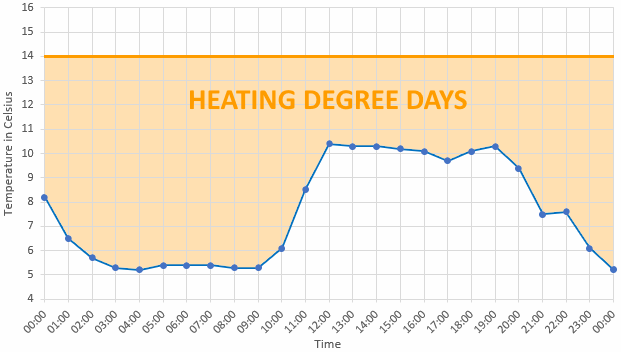
The base temperature varies from building to building, but let's say, for example, a fairly-well-insulated home might have a heating base temperature of 14 C. If the temperature outside is 14 C or above, that building will stay perfectly warm inside on its own, without the heating system needing to come on.
But, if the outside temperature drops below 14 C the building will need some heating to keep it comfortable inside. How much heating it needs will depend on how much the temperature drops below 14 C, and for how long.
And this is what heating degree days quantify. Here is an example diagram that demonstrates quite nicely how they are calculated (using a base temperature of 14 C):
https://www.degreedays.net/images/heating-degree-days-calcul...
The neat thing is that the heating degree days for any period of time represent all the relevant temperature variations across that period of time, and assuming you used an appropriate base temperature, are proportional to the heating energy consumption over that period of time. So for example you can have just one figure that represents the heating degree days across an entire week/month/year, and that will encapsulate all the relevant temperature variations across that week/month/year.
If January had 200 heating degree days, and February had 300, you can expect the heating energy consumption of the building to be 50% greater in February than in January. (Assuming you have chosen the right base temperature for your building that is!)
Compare this with knowing that the average temperature across a week/month/year was 12 C. What does that tell you about how much heating was needed in that week/month/year? Not a lot, cos you have no idea how much it varied within that time. This is the case even within a single day, since the temperature can vary a lot within a day.
Hence why people in the energy-saving business would typically use degree days rather than temperature data :)
(That said, hourly temperature data or similar is good for more sophisticated building simulations. But those are a lot more involved. On the simpler end of the spectrum degree days are a much better choice.)
It would have been nice to add a calculation of the energy required and CO2 produced to manufacture, transport and install that roof.
I feel this is an important metric that is generally ignored in these conversations. And yet, it is crucially important in order to determine the true outcome.
That said, I understand just how complex this input can be to obtain. You can’t reduce it to a number per window. That’s not how it works.
In order for someone to produce those ten (or whatever) windows somewhere in the order of twenty companies must exist and operate constantly. Aluminum mining and processing, steel production, extruders, paint/coatings, chemicals, oil/petroleum, fasteners, cardboard and foam packaging, forklifts, trucks, CNC machines, computers, etc.
The point is: These companies don’t exist just for the 42.5 minutes it took to assemble and pack the windows. In order to be able to buy ten windows, they have to exist whether or not someone is buying that model window or not. The energy required and CO2 produced comes from the combination of all of these factors. And, yes, this is hard to estimate. Yet the numbers are very far from zero.
It’s like saying you are going to go live in a tent on a small island to reduce CO2 emissions while ignoring the car ride, flight and ferry that get you there and the freighter that delivered your possessions.
I'd also like to point out that with switching from gas to heat pump heating/cooling you'd probably save even more on your bills and have 0 on-site carbon emissions and likely 0 off-site emissions as your electricity starts coming from non-carbon sources. Heat pumps are around 3x more efficient than the most efficient gas heating because they're just moving heat around, not creating heat.
As Saul Griffith says[0], "You can't 'efficiency' your way to 0" (meaning 0 emissions, which is what we need).
Efficiency is a great win for our bills and cutting some emissions but even if every building made their current systems more efficient, we'd still be on track for over 1.5C of warming. What we need is transformation, and most of that to electric heating/cooling/transport/cooking. And we need it fast, all across the residential and commercial economies in the next 2 decades with more in the next decade. It's going to be a war-time-like effort. Thanks for getting it started!
> (assuming a 0.3g of CO2e per kWh
It's kg there, not g.
And this number is for the electricity, gas is 0.203 kg per kWh.
If you are indeed heating with electricity, in france the electricity CO2 is almost always below 100g of CO2e per kWh.