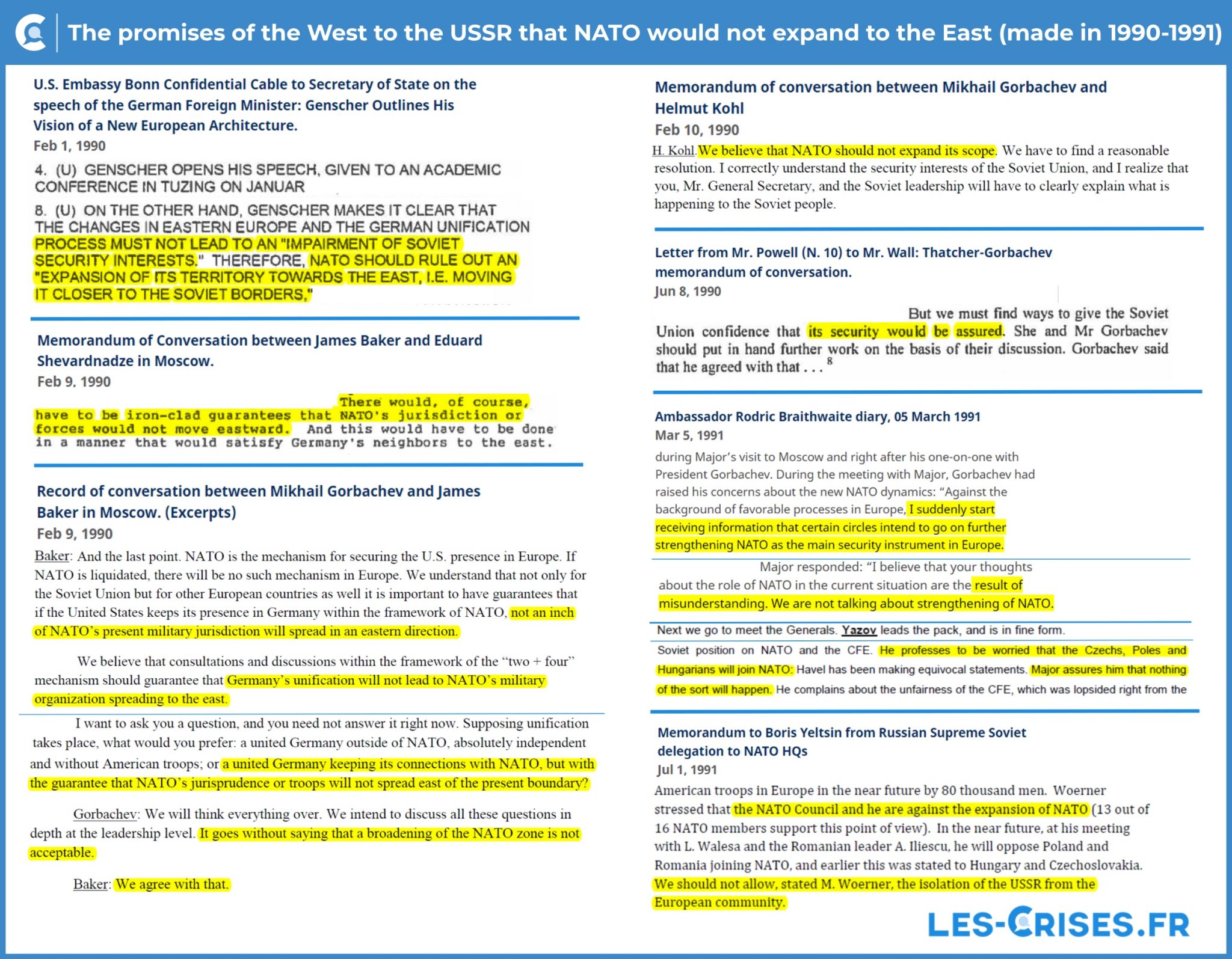
It's a very well known non-agreement.
> James Baker agreeing to Gorbachev that NATO would expand "not another inch" eastward
That's...not how binding international agreements are formed.
EVERYONE: claps
RUSSIA: says one thing and do the other one
EVERYONE: gasps
Thank you, this is exactly the point I arrived at as well. It's an admission that the primary tool of the US State Department is to make friendly, reasonable verbal agreements in front of the press and public, then do the dirty move they really wanted to do when the news cycle has moved past. This maintains the appearance to the US public that their foreign policy is always just, and never cynical or deceitful.
https://www.spiegel.de/international/world/nato-s-eastward-e...
> But the recollections of those involved aren’t always consistent. Roland Dumas, who served as the French foreign minister in 1990, would later say that a pledge was made that NATO troops would not advance closer to the territory of the former Soviet Union. But the U.S. secretary of state at the time, James Baker, has denied that any such promise was ever made – a claim that some of his own diplomats, however, have contradicted. Jack Matlock, who was the U.S. ambassador to Moscow at the time, has said that "categorical assurances" were given to the Soviet Union that NATO would not expand eastward.
Even if you deny that such a promise was made (and broken), you should be able to understand how having a hostile military alliance literally on your border is unacceptable and the US would never accept it were the tables turned. That's the point.
There are no good guys here. Go back to the Cuban Missile Crisis. There's a popular narrative of the US being provoked. But the truth is, the US instigated the Cuban Missile Crisis by deploying strategic nuclear weapons to Turkey (interestingly under the auspices of NATO, a "defensive" pact). Cuba was reciprocity. Those missiles in Turkey were quietly removed.
According the grand strategy of the cold war, those missiles were defensive. Their presence was requested by Turkey and when they were removed there was a diplomatic stink about it because the Turks argued that this was the US no honouring their agreement. There was nothing "quiet" about their removal.
This isn't comparable to Ukraine however. The US isn't trying to put nuclear missiles in Ukraine (and there aren't NATO nukes in any other former SSR either.) And it wouldn't matter if they were, because the range of ICBMs has increased since 1962. Russia isn't invading Ukraine to prevent nuclear weapons from being deployed on its doorstep; it's doing so to reestablish its control over its former empire.
That may have worked for the germans to prevent paying reparations to greece, but the NATO trick lead to the problems we now have with russia.
Remember how the US reacted to some missiles in Cuba?
1. The Russian Federation, the UK and the US reaffirm their commitment to Ukraine, in accordance with the principles of the Final Act of the Conference on Security and Cooperation in Europe, to respect the independence and sovereignty and the existing borders of Ukraine
2. The Russian Federation, the UK and the US reaffirm their obligation to refrain from the threat or use of force against the territorial integrity or political independence of Ukraine, and that none of their weapons will ever be used against Ukraine except in self-defence or otherwise in accordance with the Charter of the United Nations.
3. The Russian Federation, the UK and the US reaffirm their commitment to Ukraine, in accordance with the principles of the Final Act of the Conference on Security and Cooperation in Europe, to refrain from economic coercion designed to subordinate to their own interest the exercise by Ukraine of the rights inherent in its sovereignty and thus to secure advantages of any kind.
https://www.les-crises.fr/wp-content/uploads/2022/02/Promise...
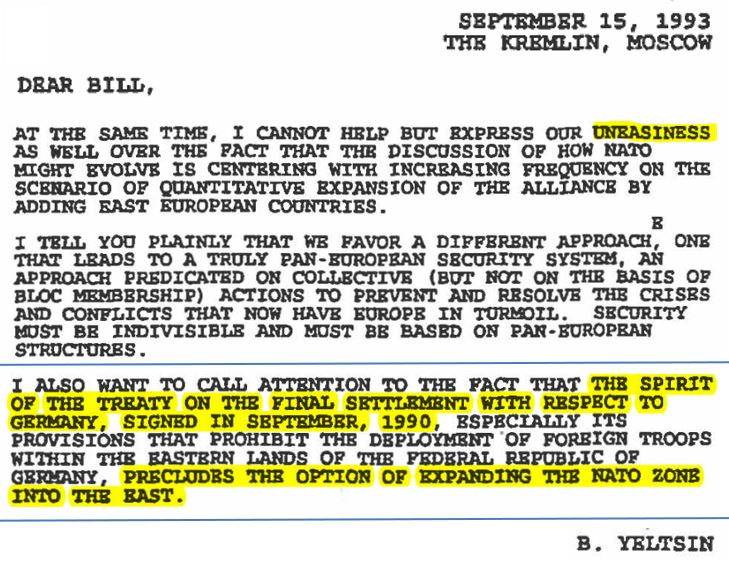
Yeltsin in this telex to Bill Clinton from 1993:
https://www.les-crises.fr/wp-content/uploads/2022/02/otan-ex...
Reported in the NYTimes: https://www.nytimes.com/1993/10/02/world/yeltsin-opposes-exp...
Then came a promise from Secretary of state Christopher on 10/22/93 that there would be no extension:
https://nsarchive.gwu.edu/document/16380-document-08-secreta...
However Richard Holbrooke changed his discourse, and Yeltsin complained in 94:
https://nsarchive.gwu.edu/document/16385-document-13-officia...
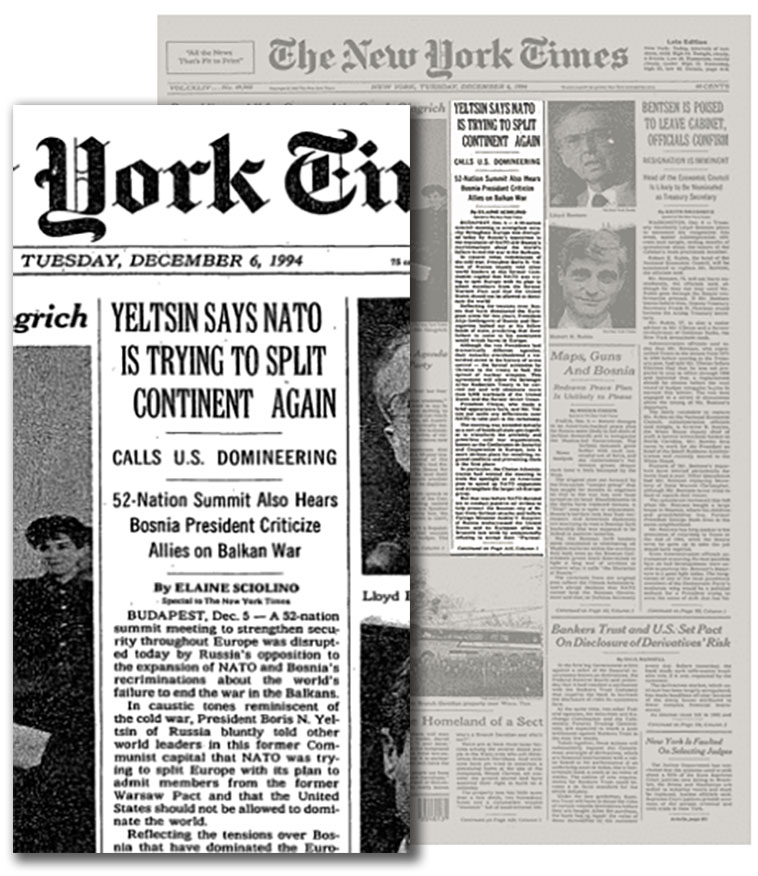
Then again:
https://www.les-crises.fr/wp-content/uploads/2022/02/NT-fron...
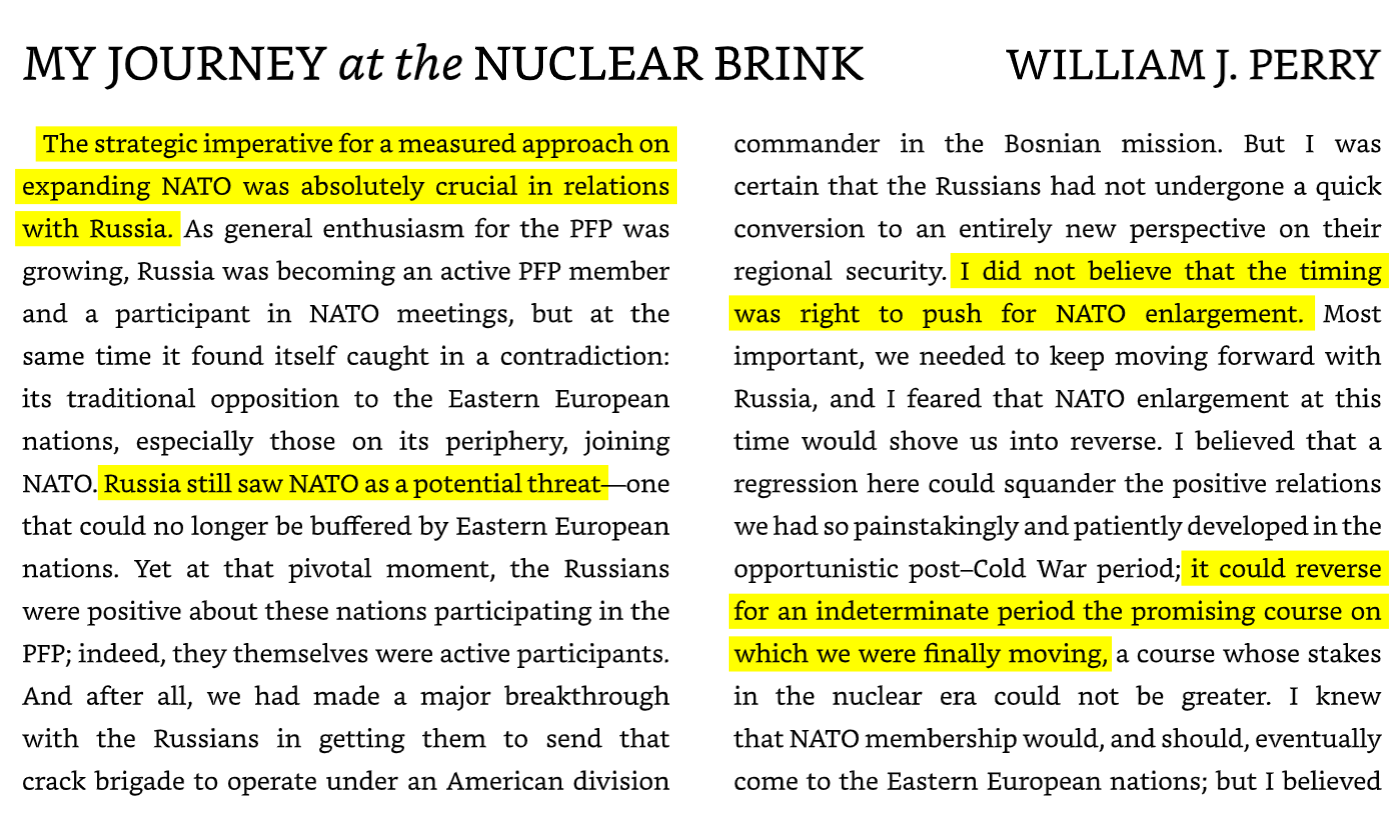
However, Yeltsine nearly died in 96, and his election relied entirely on manipulations at a large scale from the CIA. Therefore, Clinton thought he was free to proceed with NATO extension:
https://www.les-crises.fr/wp-content/uploads/2022/02/Perry-p...
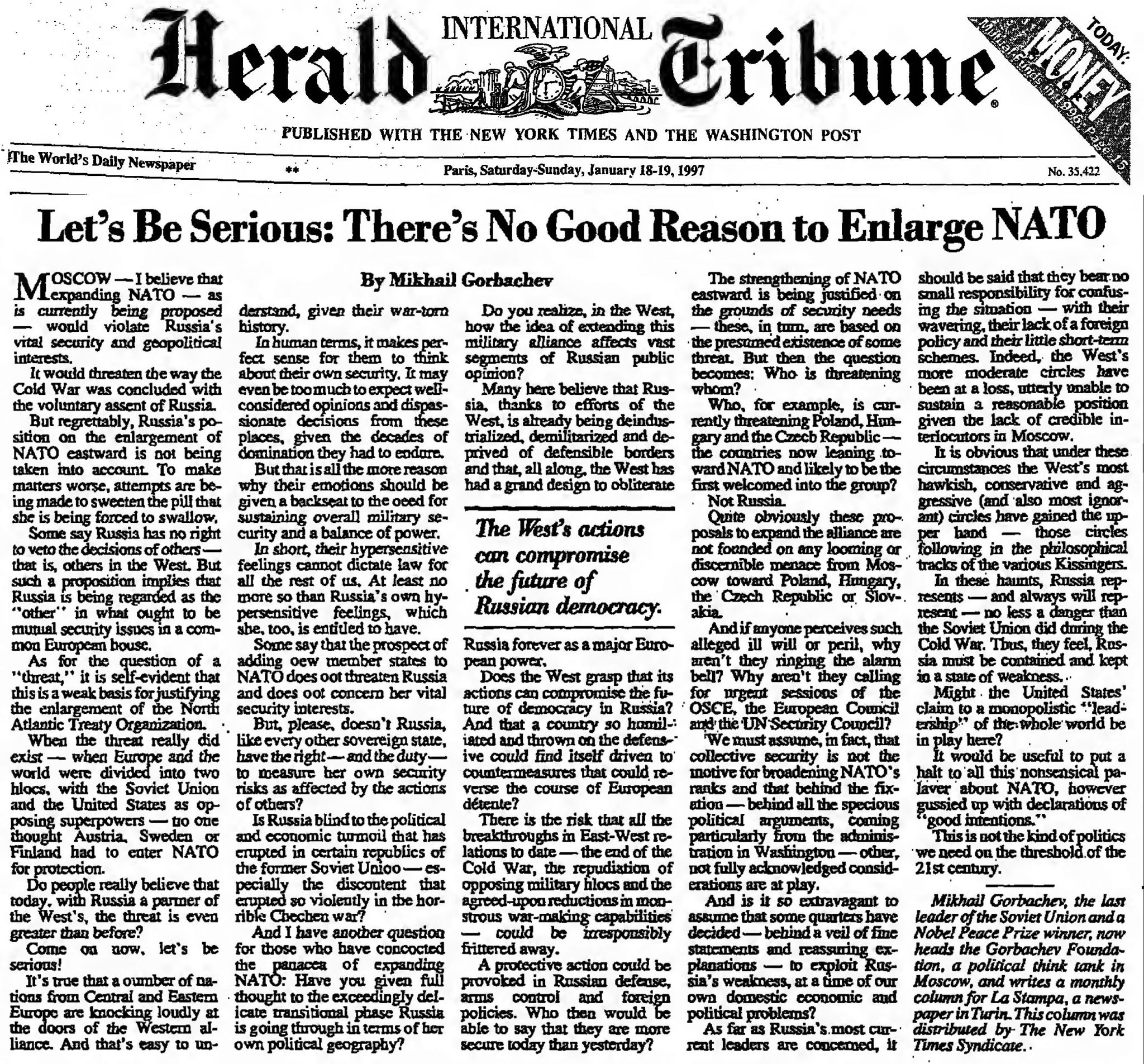
But there was large disapproval from the Russian, like Gorbachev still in this Herald Tribune 1997 guest article:
https://www.les-crises.fr/wp-content/uploads/2022/02/otan-ex...
But in the US too, like George Kennan in the NYTimes, 1997:
https://www.nytimes.com/1997/02/05/opinion/a-fateful-error.h...
and many others, Michael Mandelbaum,Richard T. Davis, John Lewis Gaddis, even Thomas Friedman thought extending NATO was a serious mistake.
> Privately, though, a few more perceptive officials acknowledged that relations with Russia had not been handled well. In his memoir, Duty, Robert M. Gates, who served as secretary of defense in the administrations of both George W. Bush and Barack Obama, made some interesting admissions. “When I reported to the president my take on the Munich conference, I shared my belief that from 1993 onward, the West, and particularly the United States, had badly underestimated the magnitude of the Russian humiliation in losing the Cold War…” Yet even that blunt assessment given to Bush did not fully capture Gates’ views on the issue. “What I didn’t tell the president was that I believed the relationship with Russia had been badly mismanaged after [George H.W.] Bush left office in 1993.” Among other missteps, “U.S. agreements with the Romanian and Bulgarian governments to rotate troops through bases in those countries was a needless provocation.” In an implicit rebuke to the younger Bush, Gates asserted that “trying to bring Georgia and Ukraine into NATO was truly overreaching.” That move, he contended, was a case of “recklessly ignoring what the Russians considered their own vital national interests.”
https://www.cato.org/commentary/did-putins-2007-munich-speec...
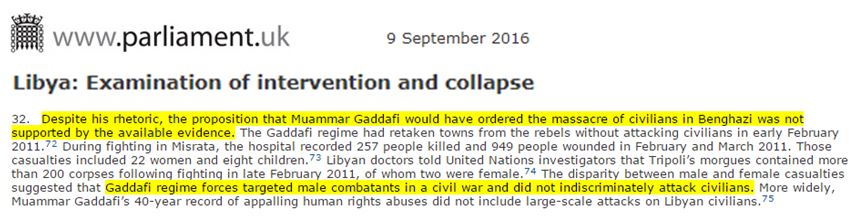
Also, there's the treachery of the 2011 Libya operation :
https://www.les-crises.fr/wp-content/uploads/2018/03/libye-0...