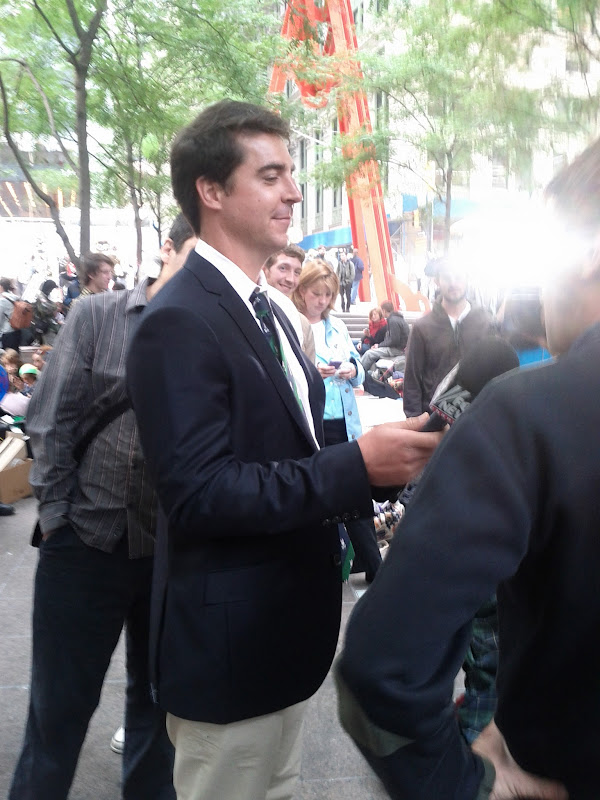
The Tea Party doesn't have much presence in NYC and its leaders weren't involved in this particular protest, and "Occupying" is a sixties lefty word that's not going to turn out the Tea Party rank and file.
We're not loony. We're not the creation of any group. Anyone claiming to be a Tea Party "leader" or "creator" isn't. We're your neighbors and friends who are "mad as hell and not going to take it anymore". We're dismayed that our kids are obligated to pay six digits in government debt before they can talk. We know what happens when anyone spends $2 of every $1 that comes in. We're outraged that the Republicans agreed to allow this administration another $2.4T in spending of money we don't have and our kids won't have. We're tired of having our money taken from us to spend on wasteful cronyism, meddling, and funding idleness, while told we can't be trusted to wisely spend our own money we earned. We're tired of being dismissed as looney by people who vote for confiscating our hard earned income under threat of fines, imprisonment or death.
The Tea Party is middle Americans who, on the whole, just want to be left alone. Yes we'll fund "safety nets", build infrastructure, etc. No, we don't want people to starve and die...we also want the able to take care of themselves, and for people to cope with the obvious consequences of their own actions.
Our protests are, on the whole, spontaneous. On boards like this we express concerns, discuss under-reported news, and decide "hey, let's call Senator X and let him know we exist" or "hey, let's rally at location Y at time T" and spontaneous groups gather and act. Oh, BTW, we clean up our own trash too.
We see $1.5T in deficit spending, and know that despite our objections we're the ones saddled with paying it off. We object to getting shafted, and you dismiss us as "looney".
http://www.nytimes.com/2011/08/17/opinion/crashing-the-tea-p...
http://www.fivethirtyeight.com/2010/04/new-data-on-tea-party...
TARP will still end up losing tens of billions, but TARP was superseded by far larger (and less transparent) bailouts run through the Federal Reserve. The banks that have repaid TARP only did so because they had other forms of government support, from over a trillion in Fed lending guarantees, to bailouts of their counterparties at AIG, to the bailout of worthless bondholdings at Fannie and Freddie.
And, we aren't out of the woods. Today the banking system is more concentrated and perhaps just as fragile as it was in 2008.
http://www.nytimes.com/2008/09/30/business/30bailout.html?pa...
Although the official "Tea Party" didn't have their first protest until Jan 2009, it was the same people pushing their congresscritters to oppose the bailout.
I would really like to know what you would cite from TARP as a solid investment.
Tim O'Reilly is posting to the site of a corporation that funnels money to Bermuda so that it only has to pay a 2.4% tax rate. http://en.wikipedia.org/wiki/Double_Irish_Arrangement http://www.bloomberg.com/news/2010-10-21/google-2-4-rate-sho...
And O'Reilly probably has Eric Schmidt and Larry Page's phone numbers.
There is a big difference between what Tim was talking about ("constructed a set of financial products with intent to defraud") and what you're talking about ("[using the website of / knowing the founders of] a corporation that funnels money to Bermuda [after getting an okay to do so from the IRS] so that it only has to pay a 2.4% tax rate [on overseas income]").
In Ireland the low corporate tax rate is viewed as vital to creating jobs here.
Microsoft: http://maps.google.com/?ll=53.276525,-6.207876&spn=0.004...
Intel: http://maps.google.ie/maps?q=leixlip+intel&hl=en&ll=...
IBM: http://maps.google.ie/maps?ll=53.332712,-6.241581&spn=0....
Oracle (and/or Sun): http://maps.google.ie/maps?hl=en&ll=53.358473,-6.227601&...
The "it's just a game, these are the rules" mentality is actually deeply anti-free-market in the classic sense of intelligent individuals making free choices--- it's the view shady corporate types take, who try to stack the rules and then also promote the view that everyone has to just listen to what the government says the rules are, and not make individual decisions.
https://lh3.googleusercontent.com/-X-DagzpHhDU/TnevQadAJeI/A... https://lh5.googleusercontent.com/-Che5TfKQre8/TnevQT7sqZI/A...
Now that I successfully bashed their reporting, Fox News reaches the public that needs to be educated in these issues the most.
Someone needs to provide productive capital in the form of equity. If that equity wasn't tradable, fewer people would be ready to provide that capital. If there was no financial capital, there wouldn't be any credit either.
So without much equity capital and without loans everything would have to be funded out of cash flow. There would be no large projects, no investment in future demand or longer term infrastructure, it would all be hand to mouth.
Also, in many cases that cash flow would eventually outgrow what a company or individual can productively deploy. Without creating financial capital out of that cash flow, ie lending the money to someone who can productively deploy it, that capital would be stuck even though it could be used productively elsewhere.
Or is the protest somehow in his realm that we're hearing about it?
Either way, there's little doubt that one $100 million CEO outweighs a lot of scruffy students. And in this case, amounts to something sadly futile. Even if he'd just got one friend CEO ... "and this is my friend Liz: she's a $150 million CEO, listen to what she thinks."
But that's not actually in the interests the smart money actually funding the "Occupy Wall Street" types. The last Congress gave us "finance reform" that left us Too Big Too Fail and a bunch more regulatory levers. The pols got more scope for favors and campaign donations, the bankers got more regulatory barriers to competitive entry.
The chief author of that "reform"? Progressive Barney Frank.
The Tea Party is the GOP's reckoning for failing their principles. The Democrats has yet to come.
For this reason, I think #OccupyWallStreet as a movement against unjust investment of financial capital really does have the capacity to unite elements of the left and right.
The viability of those economic arrangements is hard to assess, as he himself couldn't actually specify them. (They would emerge, he claimed, upon destruction of the bourgeois framework that limits our imagination of other possibilities.) But whatever his merits as an economist (he cribbed heavily from Adam Smith) or a social theorist (cribbed from Rousseau), he was a lousy historian and completely missed the inevitable distortion of high-sounding ideals in service of the accumulation of power.
#OccupyWallStreet likely aren't Marxist, if only because they don't strike me as the sort to buckle down to "The German Ideology" never mind "Das Kapital". (And I don't conflate them with "the left", which comprises great variety, some of it considerably more thoughtful.) But phrases like "unjust creation of wealth" show an uncomfortable similarity to the Marxist technique. Such phrases are written to be undeniable -- geez, who is in favor of unjust creation of anything? But the power lies in adopting the vocabulary beneath them, the definitions of justice which turn out to reflect a particular agenda that is considerably more controversial than our common disgust at the unjust. It turns out that these organizational procedures create considerable power for those determining the language by which "just" and "unjust" shall be determined. The organized, having accepted the adoption of language as an organizational tool necessary for the correction of "injustice", lose the use of language for independent analysis -- and perhaps so deeply they don't even notice the loss. At that point, it becomes impossible for the organized to challenge the determinations of justice made by those controlling the organizational language.
The Tea Party types are necessarily unsophisticated. But they've noticed that they've gone along with a lot of fine-sounding language, only to find themselves with the short end of the stick. It's hardly to be wondered that they prefer to keep it simple, or that they find the #OccupyWallStreet types all too recognizable.
http://en.wikipedia.org/wiki/History_of_the_cooperative_move...
Also, Barney Frank is wicked smaht.
Since 1967, real GDP of the USA rose from 4T to 13T, a 320% increase (2005 dollars), or a growth of about 2.8% a year. (http://www.data360.org/dataset.aspx?Data_Set_Id=354)
This would be my sign:
US household income growth: 0.5% a year since the 60s.
US GDP growth: 2.8% a year since the 60s.
Who is stealing our growth?
Typical household sizes have shrunk too, so your median household income might well be feeding 2 people rather than 3. http://www.census.gov/population/socdemo/hh-fam/hh4.csv
Still:
1967 - 59,236k households, GDP 3.9T ~= 65k / household (2005 dollars).
2010 - 117,538k households, GDP 13T ~= 111k / household (2005 dollars).
That's something like 1.2% GDP growth per household, while median household income is going up at 0.5%.
On one hand, there might be less dependents per household, but on the other hand, there's a lot more women working. Despite all the housewives burning their bras, forgoing large families, putting their kids in childcare and getting a job, household income still hasn't risen.
Maybe there's a lot of low-payed single women, dragging the median down. That doesn't convince me that everything is OK though.
Let's look at incomes of income-earning over 15s:
Between 1960 and 2004, the salaries of white males went up 0.068% a year. White women's salaries grew at 2%, probably because they were working much greater hours. Black men did well, and black women did even better. But overall, it was a 0.74% per year increase. http://en.wikipedia.org/wiki/Personal_income_in_the_United_S...
People are better off, but mostly because the women are working longer hours, they don't have kids. Soon, they will also be working more years, as the boomer realize they can't retire. It's a lot better if you're black, but not because of productivity growth trickling down to median workers.
I could track down the numbers, to find how many workers over 15 there are (or maybe how many people there are over 15, or between 15 and 65), but I just don't think productivity growth is <1%, like median income growth. If productivity growth is <1%, then we have another problem altogether.
OK, here we go, real growth by percentile (1960 to 2007):
95th: 1.86% / year. 80th: 1.58% / year. 60th: 1.4% / year. 40th: 1.1% / year. 20th: 1.05% / year.
Arguably (as pg says), this is a good thing, because risk-takers and innovators are being rewarded, driving growth. But it's not as simple as high inequality = high growth, and that doesn't explain why inequality is growing. pg says it's because corporate structures are becoming more efficient, cutting out deadwood managers. Whatever. If this is the case, why isn't GDP growing at a higher rate than the 60s? Has our society simply reached the point where technology no longer drives growth? That's scarier than greedy executives, compliant governments, self-serving boards of directors looting society; but I don't think it's happened yet.
China had huge inequality in the from 1750 to 1950, and stagnent growth, low inequality and moderate growth from 1950 to 1990 (with a few hiccups, notably the Great Leap Forward, and Cultural Revolution, but communism worked a lot better than their previous system of capitalism + corrupt feudalism), then high inequality and high growth from 1990. While inequality might be a requirement for high growth, it's not always a good sign. It can just mean that the rich and powerful are screwing the poor, which makes it harder for a poor innovator to take their idea from rags to riches.
Since 1967, US population increased from 198,712,056 to 310,000,000, a growth of about 1% a year.
Per person income has risen about 1.2%/yr.
Per person GDP has risen about 1.6% over per person income.
BTW: nobody stole your growth. You get what you agree to in exchange for your efforts. If you work the same menial job year after year, don't expect much income growth. If you take risks and innovate and work hard, you can see huge income growth. This, of course, is the purpose of this discussion board: to take opportunities and profit from them. A lot of people are content with not much income growth; they're quite comfortable where they are. Those of us frequenting ycombinator.com are interested in doing a lot better than "comfortable where we are", and the numbers show there is a lot of money to be made by taking the marvelous opportunities this nation affords us.
As I already replied (to another poster), my bad.
>> You get what you agree to in exchange for your efforts. If you work the same menial job year after year, don't expect much income growth.
This just isn't true. A menial worker makes a little more than they would have in 1960, and a lot more than they would have in 1920. Innovation trickles down. Rich bankers riding a bubble on the way up, and bailouts on the way down does not.
"The system" isn't totally broken, but it's a little rigged. It always has been. The more corrupt the system is, the more certain people get paid for not innovating, taking risks, and working hard; which doesn't create a lot of real growth.
I'd say a lot of the corrupt growth is the result of bubbles at the moment - making short term gains at the cost of long-term gains. Tactics include dodgy financialization, creative accounting, ripping off customers at the cost of goodwill, mistreating employees then being screwed when talented staff abandon the company, outsourcing cost centers then getting hit by bait-and-switch prices (Chinese and Indian wages will rise), and so on.
People who are already rich benefit (due to good dividends, higher stock prices, and performance bonuses), but will lose in the long run (unless they get bailed out). Nobody complained when the rich were making money, because they though the benefits would trickle down; but now that a lot of the benefits have proved to be illusionary, people are pissed.
Name one person (not a left-wing nut-job) who bagged the Enron execs when everyone thought they were actually making money ;)
My point is, I don't see any good reason for relative difference between the rich and poor to change over time (past a certain point, say, what it was in the 60s). If it does, it might be because something is broken.
But I wouldn't give up on it yet, a core seems to be prepared for long-term occupation and it could grow.
From the outside it just looks like a bunch of hippies.
However, if you truly want to fix a problem like that, you have to out-strategize back. Which doesn't necessarily mean legal measures. E.g., no need to occupy Wall Street, as long as the lessons are learned and it's replaced by something better.
What you seem to be saying is that somehow this will resolve itself. I honestly doubt that is even remotely possible. Investment banks and hedge funds are making huge amounts of money, why would they change their business model? If the investment bank model stops working smart money will move. Smart money already has moved, look at Goldman Sachs. Goldman has since the crash been playing new tricks and old games that worked to make money. Why would someone stop playing when the game they know is still helping them to win? There is no incentive to change. Devious practices continue in multiple institutions, the market is more volatile than ever and the profits are still increasing.
Change only comes from within because of some internal conflict or contradiction. There is no conflict of ideas in the banking industry, their goal is still making money with money. Their goals and methods are still closely aligned. That means that the change must come from outside. Either reform (legislation and government force), revolution (social force) or depression (economic force through a market collapse). Doing nothing just delays the inevitable.
Not sure what you're trying to say there.
In my only semi informed opinion, it seems that this sort of crime is so distributed and hard to prove that it likely is just too difficult to create a convincing case to a jury of folks who may or may not really grasp what really happened on wall street. I am not even sure that many of the fraudsters even knew the full consequence of their actions. I am by no means defending anyone here, I just think that the "crime" is too difficult to package up neatly.
But at the end of the day, if a financial product is so complicated that it can't be regulated, that's a good sign that it never should have been created in the first place.
In Egypt, half a year before Tahrir Square January-February 2011, they had the "silent stand"[1] -- which consisted of just showing up in public places en masse and saying nothing, in memory of a young man who'd been tortured to death by security services. I'm pretty sure I heard Wael Ghonim say that even he thought it was a slightly daft idea until it actually happened, and then it seemed that they'd found a catalyst for average people to join in a protest.
I too hope for some sort of movement that can bridge the artificial divide between Tea Partiers and scruffy leftist kids. Fundamentally, nobody is asking for particularly radical reforms here; so it should be possible to have widespread support.
[1] http://www.demotix.com/news/394309/khaled-said-silent-stand-...
I have a feeling this movement would be much more effective if it could actually name names and link to evidence. "Read Taibbi" isn't enough. I've read all of Taibbi's pieces, and it's hard to see a real criminal case succeeding out of what he presents. Some of it might seem outrageous, but investors were aware of the risks in CDOs well before the bubble burst and wanted them anyway. Claiming a little marketing spin from Goldman Sachs is a criminal attempt to defraud doesn't pass the laugh test for me.
edit: shame sallie mae loans can't be bankrupted anymore.
http://www.adbusters.org/blogs/adbusters-blog/tahrir-moment-...